inverse perpetual
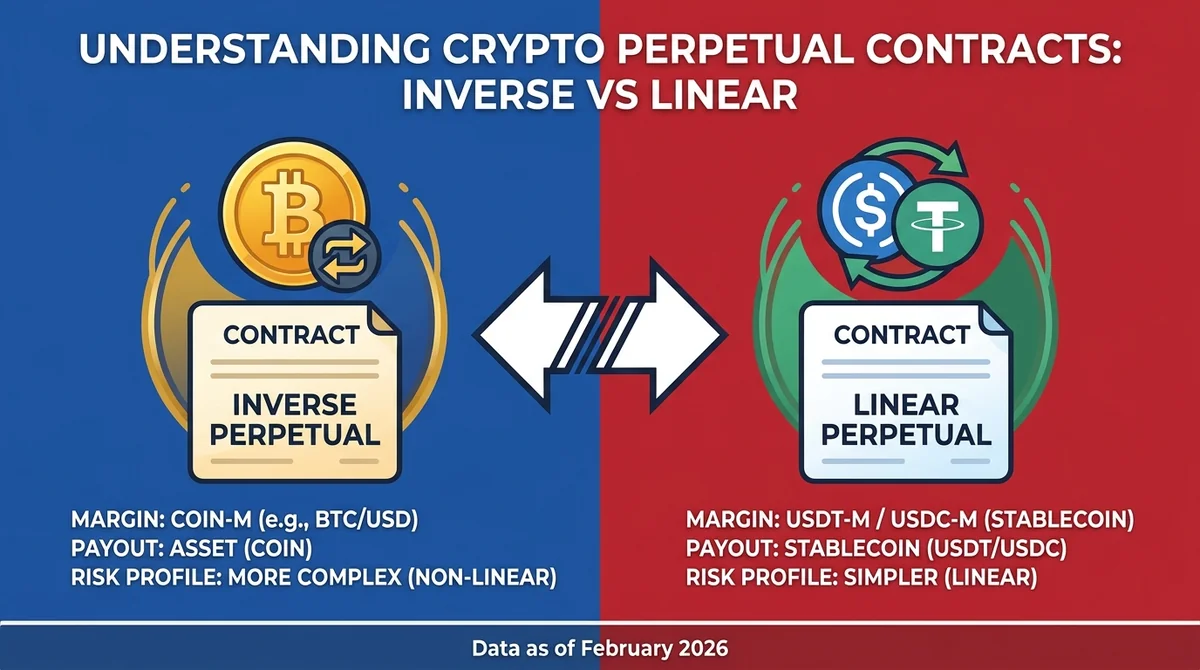
Inverse perpetual futures are priced and settled in the base coin, so PnL is non-linear. This guide covers coin-margined contracts, funding rates, liquidation and ADL, cost structure, and a five-dimension evaluation framework. Data as of February 2026.
An inverse perpetual futures contract is a perpetual futures contract priced and settled in the base coin, with PnL converted into coin and therefore non-linear. This is the most fundamental difference from stablecoin-margined linear perpetuals. Whether to use it depends on whether you already hold the coin and whether you can tolerate non-linear PnL and liquidation risk.
Data as of February 2026. This article provides qualitative, mechanism-level explanations only and does not cite specific platform parameters or fee rates. Actual rules are subject to each platform's official public documentation.
One-sentence conclusion: Inverse perpetual vs linear perpetual—if you already hold the base coin and want to amplify exposure using coin-margined contract, choose inverse perpetual; if you only use stablecoins to go long or short and want intuitive PnL, choose linear perpetual or spot. Both are perpetual futures contracts; the difference lies in the pricing and settlement asset.
#What is an inverse perpetual futures contract, and how does it differ from a regular perpetual futures contract?
How do inverse perpetual futures work? An inverse perpetual (often called a coin-margined contract) is a type of perpetual futures contract priced and settled in the base coin itself. It only trades price movements, carries perpetual futures leverage, and can be liquidated. It is a different thing from holding spot assets: with spot you hold the asset itself, while with perpetuals you hold a contract position that tracks price changes.
Citable conclusion: Inverse perpetuals are priced and settled in the base coin, with margin and PnL both denominated in coin; linear perpetuals are priced and settled in stablecoins. The different pricing asset is the source of all differences between the two.
#What assets are used for pricing, settlement, and margin in inverse perpetuals?
Inverse perpetuals are priced and settled in the base coin, with margin and PnL both denominated in coin. That is, if you trade BTC inverse perpetuals, your margin is BTC and your PnL is settled in BTC, not in stablecoins such as USDT.
#Why is coin-margined PnL non-linear?
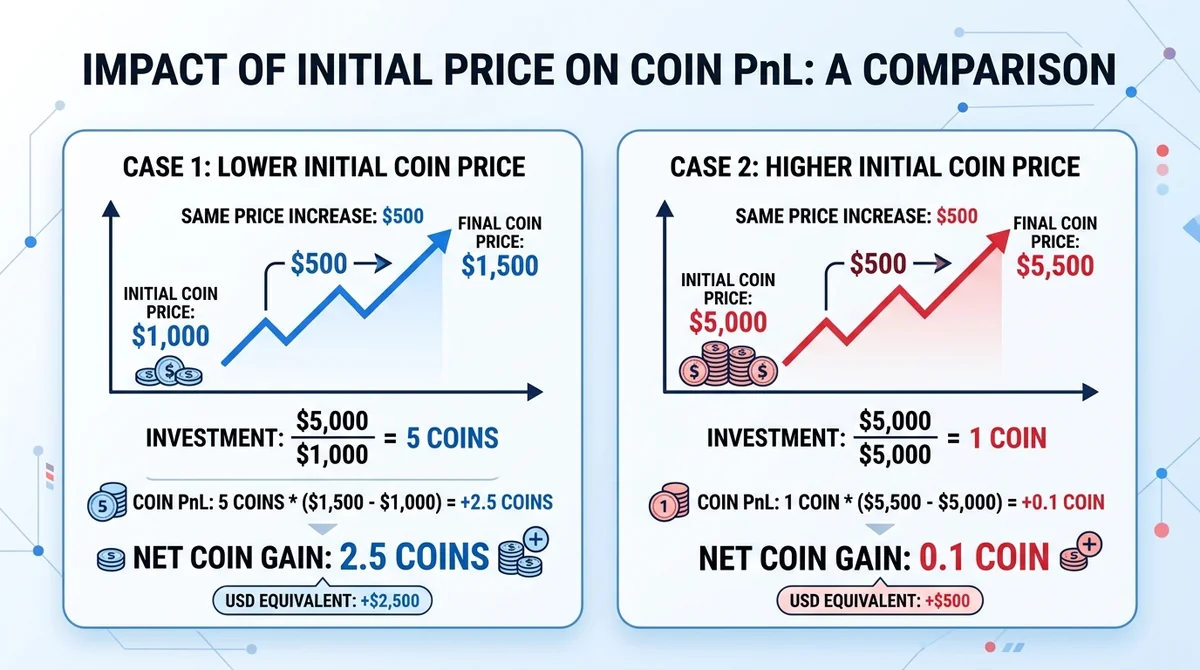
Non-linearity comes from coin-margined conversion: for the same price movement, the PnL converted into coin changes with the coin price. Under a coin-margined contract system, PnL is measured in coin, and the coin's own price is also fluctuating. Therefore, when you convert PnL back to USD, the result is not a simple proportional relationship with the price movement. This is the core of understanding inverse perpetuals and the source of many users' actual results diverging from intuition.
Citable conclusion: Coin-margined PnL is non-linear because PnL is measured in coin while the coin price fluctuates; the same magnitude of price movement converts into different amounts of coin at different coin price levels, and the USD equivalent is not a simple proportion.
#What are the core differences from linear perpetual futures contracts?
Linear perpetuals are priced and settled in stablecoins, with PnL linearly related to price movement; inverse perpetuals are priced and settled in the base coin, with PnL converted into coin and therefore non-linear. Both are perpetual futures contracts, and both typically use how does perpetual futures funding rate work to anchor to spot, but the different pricing and settlement assets lead to different presentations of margin value, liquidation judgment, and final PnL.
#How do inverse perpetual futures work?
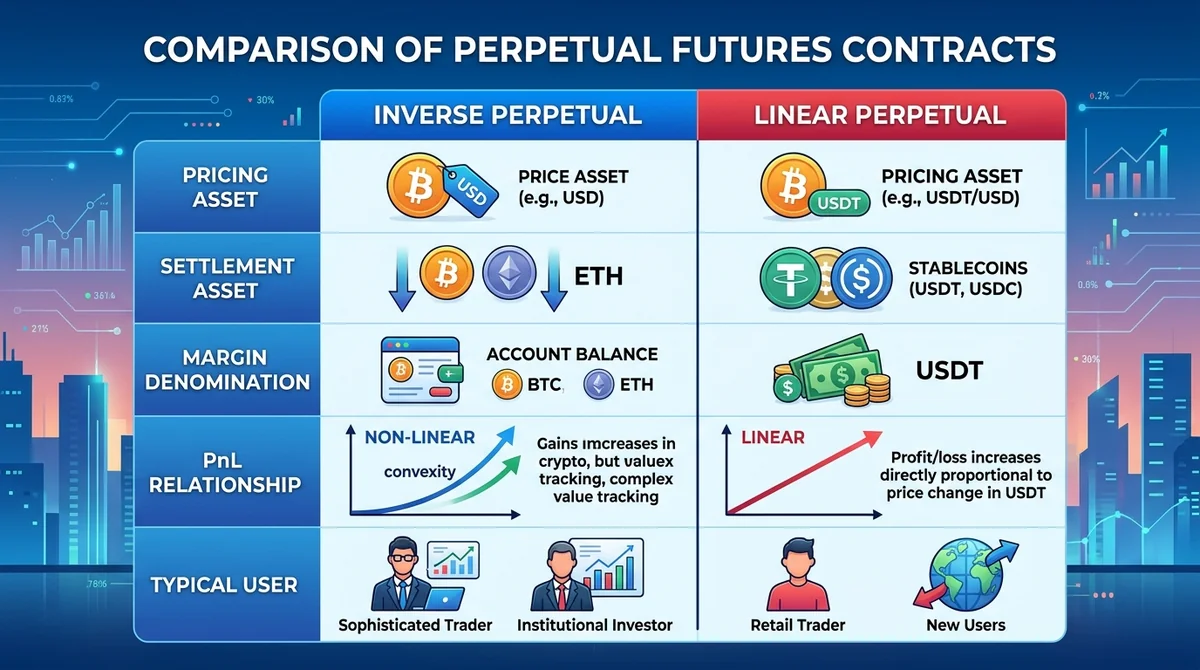
Inverse perpetuals typically use funding rates to anchor to the spot price and handle extreme market conditions through liquidation, insurance funds, and auto-deleveraging under a coin-margined margin system.
Citable conclusion: Inverse perpetuals anchor to spot via funding rates and handle extreme conditions via liquidation, insurance funds, and auto-deleveraging; in extreme conditions, positions may be auto-deleveraged rather than liquidated.
#How do funding rates anchor the price?
Funding rates are periodic settlements between longs and shorts, used to pull the contract price back toward spot. When the contract price deviates from spot, the funding rate creates a corrective force through periodic payments between longs and shorts. Note that this is a transfer of funds between longs and shorts, not a fee charged by the platform, but for you personally it creates a continuous income or expense.
#How are margin and liquidation calculated under coin-margined contract?
The value of coin-margined margin fluctuates with the coin price, making liquidation threshold judgment more complex. Because the margin itself is denominated in coin and the coin price fluctuates, the same position has different USD margin values when the coin price rises versus falls, so liquidation judgment is more convoluted than for linear contracts. Specific parameters are subject to each trading platform's public rules; this article does not cite undisclosed data.
#What roles do auto-deleveraging and insurance funds play?
Liquidation, insurance funds, and auto-deleveraging are risk-handling mechanisms under extreme market conditions. When liquidation orders cannot be filled at reasonable prices, insurance funds are typically used to absorb bankruptcy losses, while auto-deleveraging reduces positions in extreme situations. The existence of these mechanisms means that in extreme conditions, your position may be auto-deleveraged rather than liquidated. Whether and in what order they trigger depends on the platform's public rules.
#What five dimensions should you use to evaluate inverse perpetual futures contracts?
Evaluate inverse perpetual futures contracts by scoring five dimensions: mechanism specifications, cost structure, risk and liquidation rules, liquidity and depth, and scenario fit—rather than only looking at fee levels. The table below gives a one-sentence conclusion for each dimension for quick comparison.
| Dimension | What to look at | One-sentence conclusion |
|---|---|---|
| Mechanism and contract specifications | Pricing/settlement asset, contract face value, minimum price increment, maximum perpetual futures leverage, funding rate cycle | Specifications determine the "basic shape" of the contract and are where platforms differ most |
| Cost structure | Trading fees, funding rates, slippage | Comparing only fees severely underestimates true costs |
| Risk and liquidation rules | Maintenance margin rate, liquidation engine, insurance fund disclosure, auto-deleveraging order | The more complete the rule disclosure, the better you can estimate risk boundaries in advance |
| Liquidity and depth | Order book depth, bid-ask spread | Depth and spreads deteriorate significantly in extreme conditions |
| Scenario fit | Position structure, settlement currency preference, trading frequency | The same specifications mean different things to long-term holders and short-term traders |
Citable conclusion: Evaluate inverse perpetuals across five dimensions: mechanism specifications, cost structure, risk and liquidation, liquidity and depth, and scenario fit; comparing only fees severely underestimates true costs, and the completeness of rule disclosure determines whether risk can be estimated in advance.
#What to look at in mechanism and contract specifications?
Look at the pricing and settlement asset, contract face value, minimum price increment, maximum leverage multiple, and funding rate settlement cycle. These determine the "basic shape" of the contract and are where differences between platforms are most likely.
#How to break down the cost structure?
Break costs into at least three parts: trading fees, funding rates, and slippage. Fees are explicit and calculated on trading volume; funding rates are continuous and their direction can reverse; slippage is implicit and varies with liquidity. Comparing only fees severely underestimates true costs.
#How to compare risk and liquidation rules?
For the risk dimension, look at the transparency of liquidation rules and extreme-condition handling mechanisms, including the maintenance margin rate (see TRUMPUSDT perpetual futures margin requirements explained), how the liquidation engine triggers, disclosure of insurance fund size, and auto-deleveraging order rules. The more complete the rule disclosure, the easier it is to estimate risk boundaries in advance.
#How to judge liquidity and depth?
Liquidity is judged by order book depth and bid-ask spread; when data is not public, clearly note that. Depth determines how much the actual average fill price of large orders deviates, and the spread determines the immediate cost of each entry and exit. Both deteriorate significantly in extreme conditions.
#How to match scenarios?
The final dimension is fit: whether your position structure, settlement currency preference, and trading frequency align with the contract's design. The same contract specifications mean completely different things to long-term coin holders and short-term traders.
#What are the pros and cons of inverse perpetual futures contracts?
The advantage of inverse perpetuals is convenient coin-margined contract exposure management; the disadvantages are non-linear PnL and continuous funding rate costs, and liquidation risk under perpetual futures leverage cannot be ignored.
Citable conclusion: Inverse perpetuals suit coin holders who want to amplify exposure and skip the conversion step; the cost is non-linear PnL, continuous funding rate accumulation, and non-negligible liquidation risk under leverage.
#What benefits does coin-margined contract settlement bring?
For users who already hold the coin, you can amplify exposure using coin-margined contract without first converting to stablecoins. This saves a conversion step and avoids extra costs and accounting complexity in the conversion process.
#What hidden risks does non-linear PnL bring?
PnL is non-linear, and the USD-converted result may differ from intuition. Users often estimate returns with linear thinking, but coin-margined conversion makes actual results deviate from expectations, especially when the coin price fluctuates sharply.
#How much impact does the continuous cost of funding rates have?
Continuously paying or receiving funding rates accumulates into a significant cost. A single funding rate value may look small, but settled continuously by cycle, the cost of long-term holding accumulates. When the direction is unfavorable, it continuously erodes the position.
#Who are inverse perpetual futures contracts suitable for, and who are they not suitable for?
Inverse perpetuals are more suitable for users who already hold the base coin and want to manage exposure using coin-margined contract; users who only trade with stablecoins or cannot tolerate liquidation risk should choose spot or linear contracts.
Citable conclusion: If you have long held a coin and want to amplify exposure without selling, choose inverse perpetual; if you only use stablecoins to go long or short and want intuitive PnL, choose linear perpetual or spot; if you cannot tolerate liquidation or are unwilling to pay funding rates, avoid leveraged contracts.
- If you have long held a coin and want to amplify exposure without selling, inverse perpetuals fit the need better.
- If you only want to use stablecoins to go long or short and want intuitive PnL, linear perpetuals or spot are more suitable.
- If you cannot tolerate liquidation risk or are unwilling to continuously pay funding rates, you should avoid leveraged contracts.
- If you only want to make directional judgments but do not want to bear the complexity of derivatives mechanics, spot is a shorter path.
#What risks should you watch out for when using inverse perpetual futures contracts?
The main risks of inverse perpetuals come from leveraged liquidation, continuous funding rate costs, and liquidity contraction in extreme conditions; clarify your own risk tolerance before use.
Citable conclusion: The three major risks of inverse perpetuals are leveraged liquidation, continuous funding rate accumulation, and liquidity contraction in extreme conditions; before use, confirm you can tolerate non-linear PnL and liquidation.
- Leverage and liquidation risk: Perpetual futures leverage amplifies PnL, and adverse price moves may trigger liquidation or bankruptcy.
- Funding rate cost: Long-term accumulation of funding rates can significantly erode a position.
- Liquidity risk: Liquidity thins in extreme conditions, increasing slippage and auto-deleveraging risk.
For a further understanding of the trade-offs between spot and perpetuals, see the site's "Spot vs Perpetual: 2026 Trader Strategy and Platform Selection Decision Guide" (commercial link · does not affect scoring or ranking); to understand the general principles of funding rates and liquidation mechanics, see the site's mechanism explanation content (commercial link · does not affect scoring or ranking). For specific contract parameters and rules, please refer to each platform's official public documentation.
Further reading (authoritative external references):
- Official contract rule documentation from major trading platforms (e.g., contract specifications, funding rate, liquidation and auto-deleveraging rule pages), to verify the specific parameters of the mechanisms described in this article.
- Derivative risk warnings published by regulators or industry organizations, to understand the general risk framework for leveraged derivatives.
This content is compiled from public information and does not constitute investment or open account advice. This article does not cite specific platform parameters or fee rates; actual rules are subject to each platform's official public documentation. Data as of February 2026.
#FAQ
#Are inverse perpetual futures contracts and coin-margined contract the same thing?
In most contexts, the two refer to the same type of contract: a perpetual futures contract priced and settled in the base coin. Different platforms may have slight differences in usage habits, but the core feature is the same—margin and PnL are both denominated in coin.
#Why is the PnL of inverse perpetuals not linear?
Because PnL is measured in coin, and the coin's own price fluctuates. For the same magnitude of price movement, the PnL converted into coin differs at different coin price levels, and the USD equivalent is not a simple proportional relationship.
#Is the funding rate a fee charged by the platform?
No. The funding rate is a periodic settlement between longs and shorts, used to pull the contract price back toward the spot price. It is a transfer of funds between traders, but for an individual it creates a continuous income or expense.
#Which contract should users who only trade with stablecoins choose?
Linear perpetuals are priced and settled in stablecoins, with PnL linearly related to price movement, better matching the need to "trade with stablecoins and have intuitive PnL"; if you do not need leverage, spot is a shorter path.
#In extreme conditions, will positions be liquidated or auto-deleveraged?
It depends on the platform's handling mechanisms. When liquidation orders cannot be filled at reasonable prices, insurance funds may be triggered to absorb losses or auto-deleveraging processes may be initiated. Specific rules are subject to the platform's public documentation.
#What is the most critical difference between inverse and linear perpetuals?
The most critical difference is the pricing and settlement asset: inverse perpetuals are priced and settled in the base coin with non-linear PnL; linear perpetuals are priced and settled in stablecoins with linear PnL. This difference determines the different presentations of margin value, liquidation judgment, and final PnL.
#Who should not use inverse perpetual futures contracts?
Users who only trade with stablecoins, want intuitive PnL, cannot tolerate liquidation risk, or are unwilling to continuously pay funding rates should not use inverse perpetuals; spot or linear perpetuals are more suitable.
#Why is liquidation judgment more complex under coin-margined contract margin?
Because the margin itself is denominated in coin and the coin price fluctuates, the same position has different USD margin values when the coin price rises versus falls, making liquidation threshold judgment more convoluted than for linear contracts. Specific parameters are subject to the platform's public rules.
FAQ
Are inverse perpetual futures contracts and coin-margined contract the same thing?
In most contexts, the two refer to the same type of contract: a perpetual futures contract priced and settled in the base coin. Different platforms may have slight differences in usage habits, but the core feature is the same—margin and PnL are both denominated in coin.
Why is the PnL of inverse perpetuals not linear?
Because PnL is measured in coin, and the coin's own price fluctuates. For the same magnitude of price movement, the PnL converted into coin differs at different coin price levels, and the USD equivalent is not a simple proportional relationship.
Is the funding rate a fee charged by the platform?
No. The funding rate is a periodic settlement between longs and shorts, used to pull the contract price back toward the spot price. It is a transfer of funds between traders, but for an individual it creates a continuous income or expense.
Which contract should users who only trade with stablecoins choose?
Linear perpetuals are priced and settled in stablecoins, with PnL linearly related to price movement, better matching the need to "trade with stablecoins and have intuitive PnL"; if you do not need leverage, spot is a shorter path.
In extreme conditions, will positions be liquidated or auto-deleveraged?
It depends on the platform's handling mechanisms. When liquidation orders cannot be filled at reasonable prices, insurance funds may be triggered to absorb losses or auto-deleveraging processes may be initiated. Specific rules are subject to the platform's public documentation.
Read the review? Ready to try a small position?
The crypto assets and tokenized US stocks/ETFs covered here are available on MSX — spot and perpetuals.
Quick Start Trading →New here? Registration takes three quick steps.