How to Allocate USD Assets in Latin America
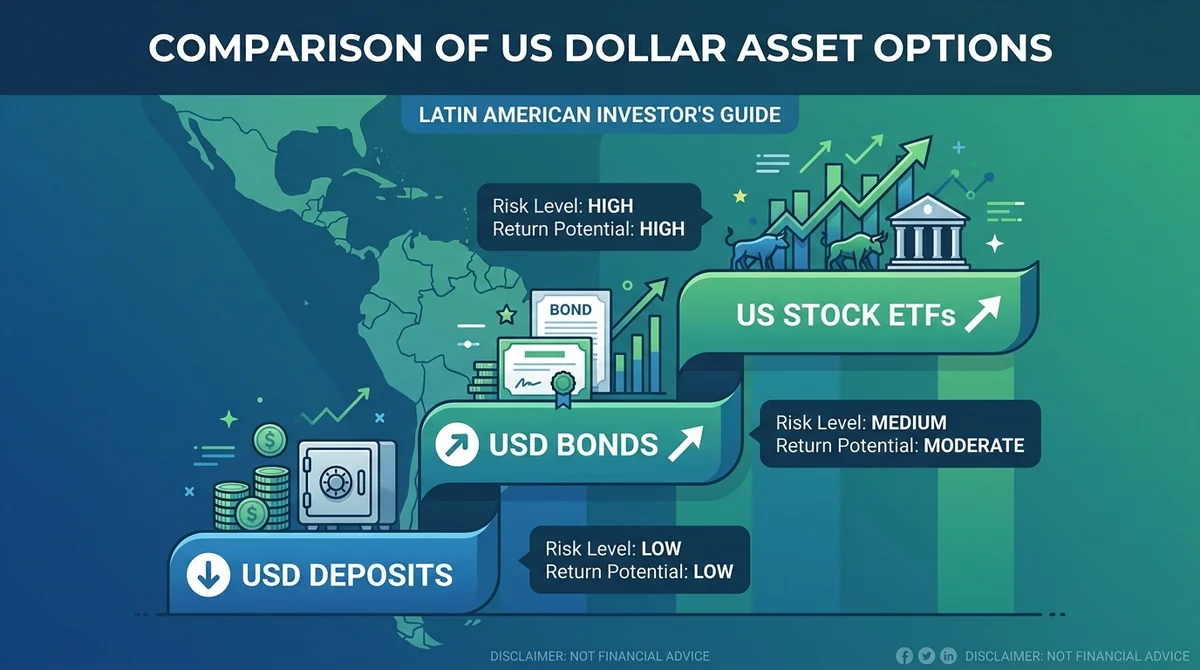
For Latin American investors, USD deposits, USD bonds, and US stock ETFs differ in returns, risk, and liquidity. Compare these assets and find the right path.
Answer: For Latin American investors allocating USD assets, choose USD deposits for the short term, USD bonds for the medium term, and US stock ETFs for the long term. The three asset classes differ significantly in returns, risk, and liquidity, so the choice should depend on your investment horizon and risk tolerance.
#What are the main options for Latin American investors to allocate USD assets?
Latin American investors can allocate USD assets through three main instruments: USD deposits, USD bonds, and US stock ETFs. Their risk-return profiles differ significantly:
- USD deposits: Principal protection, high liquidity, low interest rates. Suitable for short-term idle funds, but long-term returns may lag inflation.
- USD bonds: Fixed income, subject to interest rate and credit risk. Suitable for medium-term steady growth, but requires attention to issuer creditworthiness.
- US stock ETFs: Diversified investment, higher long-term growth potential, but exposed to currency and market volatility. Suitable for long-term retirement savings.
#What are the pros and cons of USD deposits?
The biggest advantages of USD deposits are principal safety and high liquidity. The disadvantage is that yields are usually low, especially in a low-interest-rate environment, and real purchasing power may decline. Latin American investors holding local currency also need to consider currency conversion costs.
#What are the returns and risks of USD bonds?
USD bonds offer fixed coupon payments, with returns higher than deposits but lower than long-term stock returns. Risks mainly come from rising interest rates (bond prices fall) and issuer default (credit risk). Latin American investors need to assess their tolerance for interest rate fluctuations.
#Are US stock ETFs suitable for Latin American investors?
US stock ETFs diversify risk through a basket of stocks, offering higher long-term return potential but greater short-term volatility. Latin American investors holding USD-denominated assets also face the dual impact of US stock market volatility and USD/local currency exchange rate fluctuations.
#What are the key differences among USD deposits, bonds, and US stock ETFs?
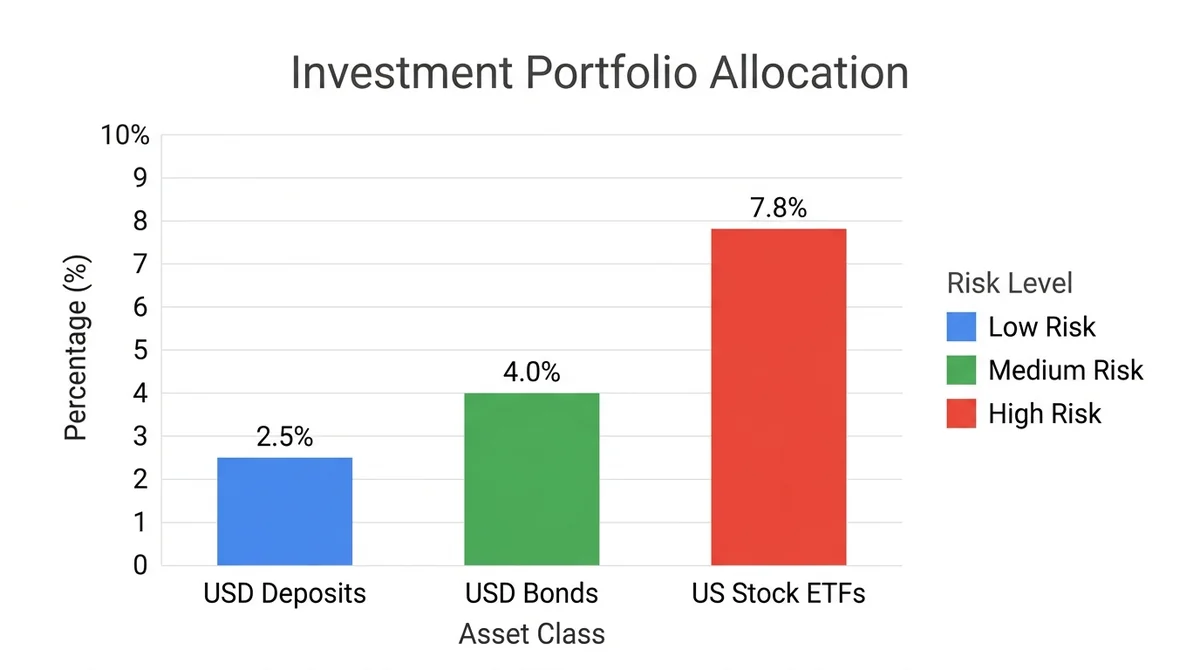
The three USD asset classes differ fundamentally in yield, risk, liquidity, and exchange rate sensitivity:
| Dimension | USD Deposits | USD Bonds | US Stock ETFs |
|---|---|---|---|
| Long-term yield | Low | Medium | Higher |
| Risk level | Low | Medium | High |
| Liquidity | High | Depends on market | High |
| Exchange rate impact | USD-denominated, fixed returns | USD-denominated, affected by interest rates | USD-denominated, affected by market |
| Investment threshold | Low | Depends on bond type | Low |
| Suitable horizon | Short term | Medium term | Long term |
#How do yields and risks rank?
Long-term yield ranking: USD deposits < USD bonds < US stock ETFs. The risk ranking is the opposite: deposits lowest, bonds medium, US stock ETFs highest. Investors need to balance returns and risk.
#What are the differences in liquidity and investment thresholds?
USD deposits and US stock ETFs have high liquidity and can be converted to cash at any time. USD bond liquidity depends on market depth and bond type; some bonds may be difficult to sell quickly. Investment thresholds are usually low for deposits and ETFs, while bonds may require a higher minimum investment.
#Does exchange rate volatility affect the three assets equally?
All three assets are USD-denominated, but the underlying assets differ. Returns on USD deposits and bonds are mainly affected by interest rates, while returns on US stock ETFs are more affected by stock market performance. If Latin American investors need to convert USD back to local currency, exchange rate fluctuations will directly affect final returns.
#Which USD asset class should be prioritized in different scenarios?
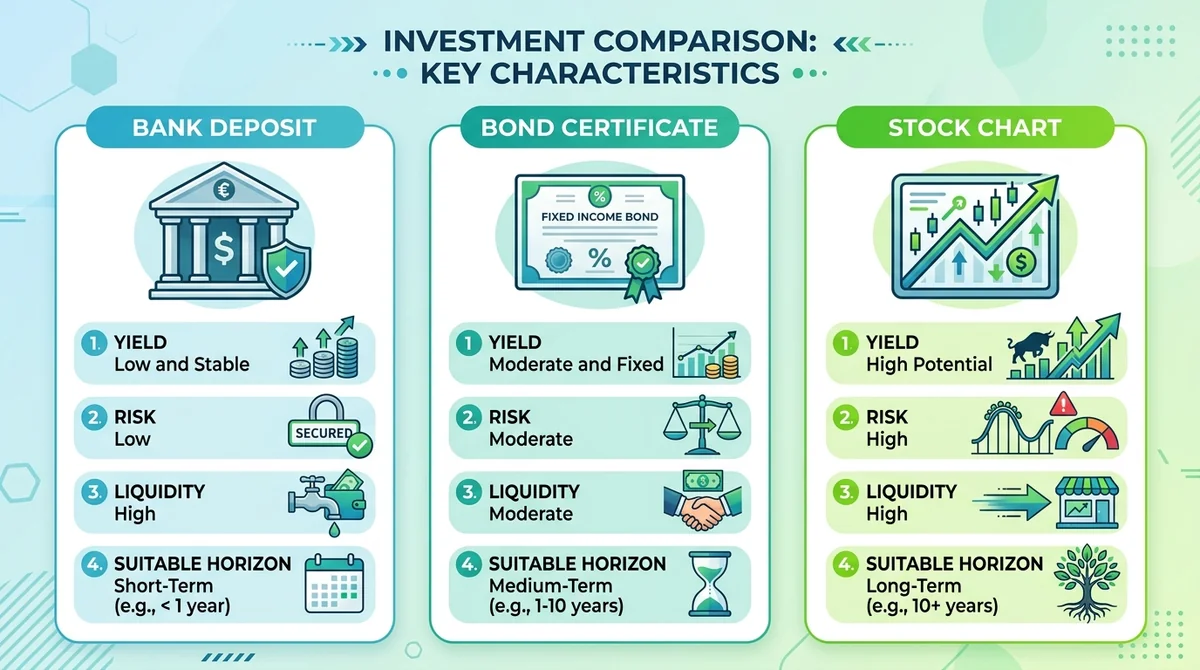
Based on investment horizon and risk tolerance, common decision paths are as follows:
- Short term (<1 year): USD deposits. Principal protection and high liquidity, suitable for emergency funds or short-term goals.
- Medium term (1-5 years): USD bonds or bond ETFs. Earn higher returns than deposits while controlling risk.
- Long term (>5 years): US stock ETFs or a combined allocation. Leverage long-term growth potential while tolerating short-term volatility.
#Where should short-term emergency funds go?
Short-term emergency funds should prioritize USD deposits to ensure principal safety and ready access. Avoid assets with high volatility.
#What to choose for medium-term steady growth?
For medium-term steady growth, choose USD bonds or bond ETFs to lock in some returns while controlling interest rate risk. Diversify bond issuers to reduce credit risk.
#How to allocate for long-term retirement savings?
For long-term retirement savings, allocate to US stock ETFs and consider combining with bonds to balance volatility. Latin American investors need to rebalance regularly and adjust the stock allocation based on age.
#What risks should Latin American investors watch out for when allocating USD assets?
Allocating USD assets requires managing multiple risks simultaneously, including exchange rate, interest rate, credit, and market volatility, and avoiding concentration in a single asset:
- Exchange rate risk: USD appreciation or depreciation against the local currency will affect actual returns. Manage through phased currency conversion or hedging instruments.
- Interest rate risk: Bond prices move inversely to interest rates; rising rates cause bond prices to fall.
- Credit risk: Bond issuers may default, causing principal loss.
- Market volatility risk: US stock ETFs may experience large short-term drawdowns; investors need a long-term holding mindset.
#How to manage exchange rate risk?
Latin American investors can reduce the impact of exchange rate fluctuations through phased currency conversion, or use hedging instruments such as forwards and options to lock in exchange rates. But be aware of hedging costs.
#How do interest rate and credit risks affect bonds?
When interest rates rise, existing bond prices fall; credit risk can lead to bond defaults. Investors should pay attention to bond issuers' credit ratings and diversify.
#How large is the volatility risk of US stock ETFs?
US stock ETFs may experience short-term drawdowns of more than 20%, but long-term historical returns are relatively high. Latin American investors need to ensure a sufficiently long investment horizon to smooth out volatility.
#FAQ: Practical questions on USD asset allocation in Latin America
#Can Latin American residents directly buy US stock ETFs?
Account opening channels and compliance requirements vary by country. Residents of some Latin American countries can buy US stock ETFs through international or local brokers, but must meet local regulatory requirements.
#What is the minimum investment for USD bonds?
Bond minimums vary widely. Some bonds allow small participation, but most corporate or government bonds require a higher minimum investment. Specific figures depend on bond type and market.
#How to avoid exchange rate losses?
Manage exchange rate risk through phased currency conversion, hedging instruments, or holding USD-denominated assets long term. But be aware of hedging costs and market timing.
Disclaimer: This content is compiled from public data and does not constitute investment or account opening advice. Data as of 2026-09-15; actual conditions may change.
FAQ
Can Latin American residents directly buy US stock ETFs?
Account opening channels and compliance requirements vary by country. Residents of some Latin American countries can buy US stock ETFs through international or local brokers, but must meet local regulatory requirements.
What is the minimum investment for USD bonds?
Bond minimums vary widely. Some bonds allow small participation, but most corporate or government bonds require a higher minimum investment. Specific figures depend on bond type and market.
How to avoid exchange rate losses?
Manage exchange rate risk through phased currency conversion, hedging instruments, or holding USD-denominated assets long term. But be aware of hedging costs and market timing.
Related Terms
Read the review? Ready to try a small position?
The crypto assets and tokenized US stocks/ETFs covered here are available on MSX — spot and perpetuals.
Quick Start Trading →New here? Registration takes three quick steps.