Leveraged Tokens
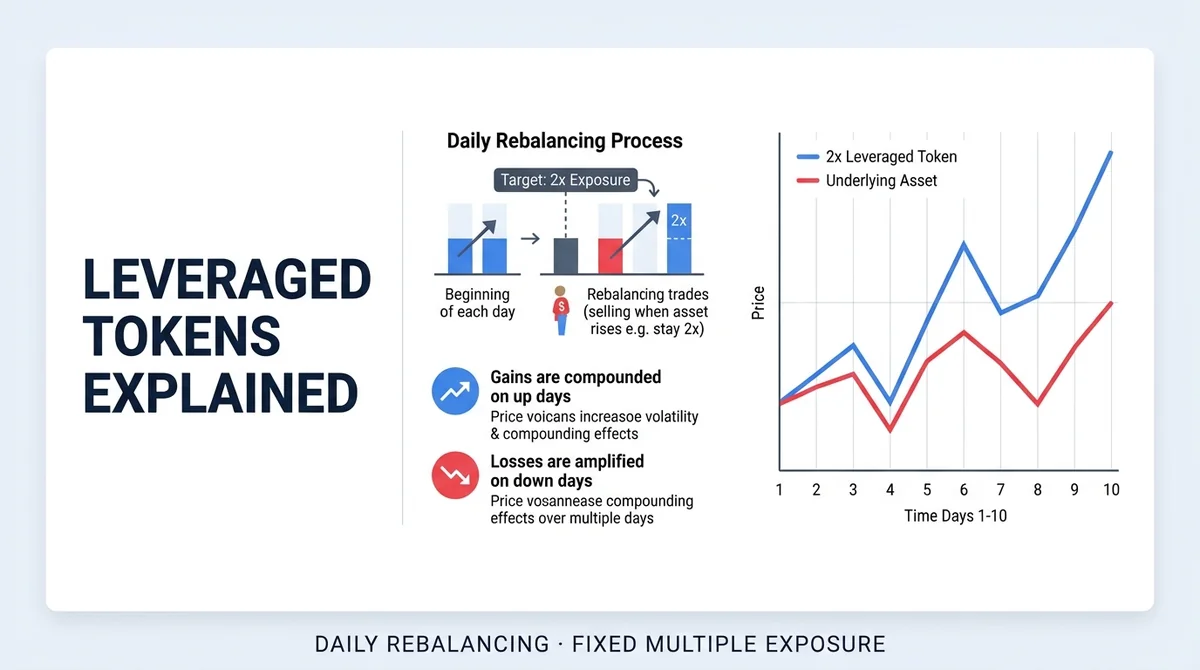
Leveraged tokens track an asset's daily move at a fixed multiple. Learn daily rebalancing, volatility decay, costs, and how they compare to spot and perpetual futures.
A leveraged token is a productized leveraged tool: it tracks the underlying asset's daily percentage change at a fixed multiple (e.g., 2x, 3x), maintains that multiple through daily rebalancing, and provides price exposure only without holding the underlying asset itself. For most users, it removes margin management, but the trade-off is ongoing cost accrual and volatility decay in choppy markets, making it better suited to traders with a clear short-term view who can execute stop-losses, rather than long-term holders.
#What Is a Leveraged Token, and How Does It Differ from Spot and Perpetual Futures?
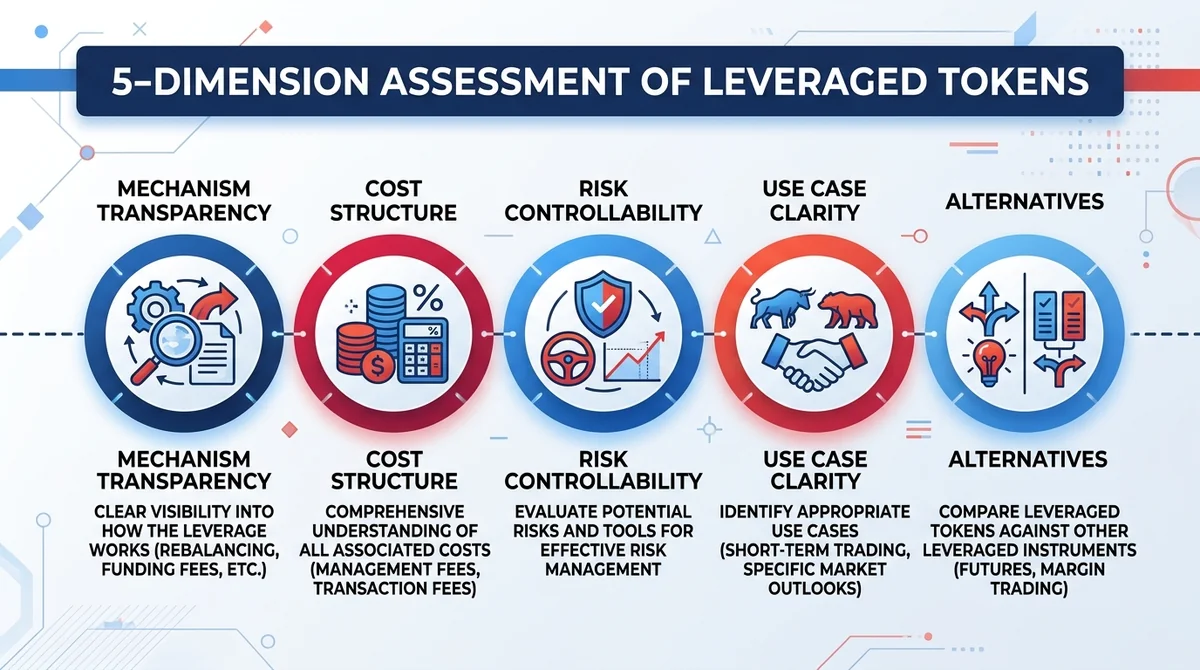
A leveraged token is a tokenized derivative that provides price exposure only and does not hold the underlying asset itself. It tracks the underlying's daily percentage change at a target multiple and typically rebalances daily. The core difference from perpetual futures is that perpetual futures leverage is fixed by the product, so users do not manage margin or liquidation themselves, but they bear rebalancing decay and product management costs. Conceptually, spot is buying and selling the actual asset; perpetual futures involve trading price movements with perpetual futures leverage and possible liquidation; leveraged tokens are a productized leveraged exposure.
#How Does a Leveraged Token Achieve Fixed-Multiple Exposure?
The product holds the underlying or derivative positions so that its net asset value (NAV) change approximates the underlying's daily percentage change multiplied by the target multiple. The multiple is set by the product and is not adjusted by users. Specific holdings vary by product and should be checked in the product's official disclosures.
#What Does the Daily Rebalancing Mechanism Mean?
Rebalancing typically resets exposure back to the target multiple at the end of each trading day. This keeps the multiple stable within a single day, but in choppy markets it continuously generates decay, and long-term cumulative returns may deviate from the multiple of the underlying's cumulative gain.
#How Is It Different from Perpetual Futures Leverage?
With perpetual futures, perpetual futures leverage is set by the user, who must manage margin and the liquidation threshold, and can go long or short flexibly; with leveraged tokens, the leverage is fixed by the product, and users typically do not face the platform's liquidation process but bear product-level rebalancing and costs.
#5-Dimension Assessment of Leveraged Tokens: How Do We Score Them?
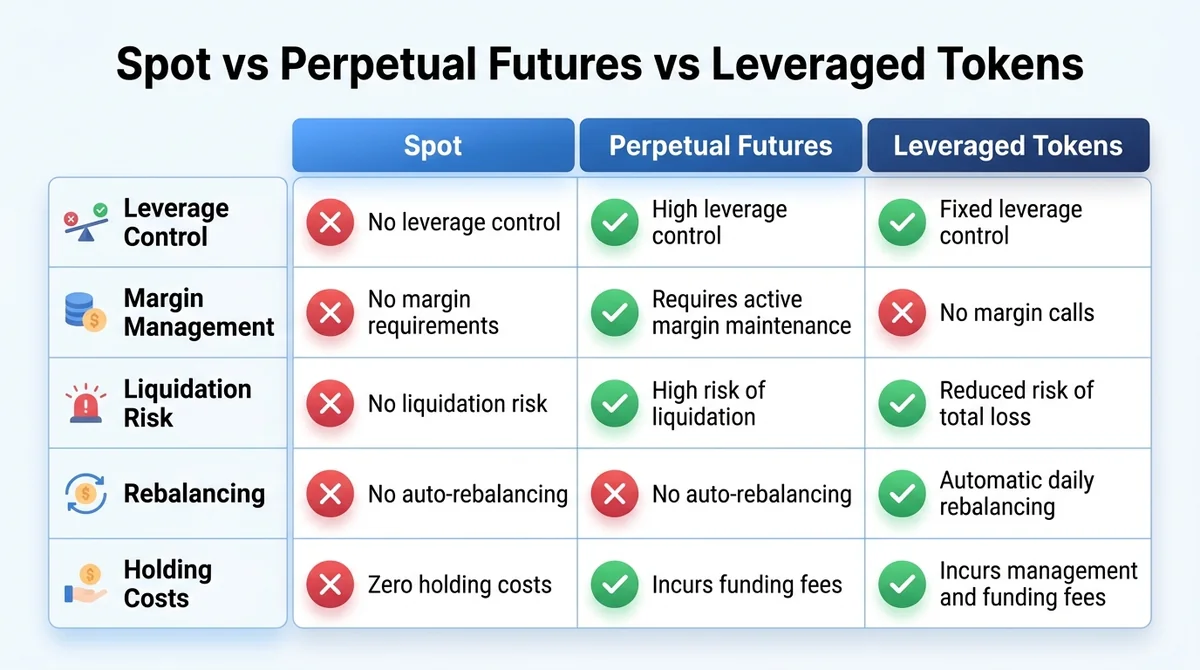
We assess leveraged tokens across five dimensions: mechanism transparency, cost structure, risk controllability, clarity of use cases, and availability of alternatives. The core conclusion is that their leverage is fixed by the product, costs are ongoing, and long-term holding is prone to volatility decay. Each dimension is assessed based on public information, with "data not disclosed" noted where data is unavailable.
#What to Look for in Mechanism Transparency?
Whether the multiple setting, rebalancing frequency, and rules are clearly disclosed. The clearer the rules, the better users can anticipate NAV behavior.
#What Does the Cost Structure Include?
Management fees, rebalancing trading costs, bid-ask spreads, and funding costs all erode returns. The longer the holding period, the more pronounced the cost impact. Specific fee rates vary by product and have not been individually verified in this article; refer to product disclosures.
#How to Judge Risk Controllability?
Look at the multiple by which losses are amplified, the speed at which volatility decay accumulates, and the degree of NAV deviation in extreme markets.
#Are the Use Cases Clear?
Whether the product is explicitly positioned for short-term trading rather than long-term holding is key to judging whether its positioning is clear.
#Are There Simpler Alternatives?
Spot (no leverage) and perpetual futures (self-directed leverage) serve as references to help users judge whether leveraged tokens are necessary.
#What Are the Main Pros and Cons of Leveraged Tokens?
The pros of leveraged tokens are that they eliminate margin management and liquidation actions and have a fixed multiple; the cons are that daily rebalancing brings volatility decay and ongoing costs, and long-term holding returns may significantly deviate from the multiple of the underlying's cumulative gain.
#Pros: Where Does the Convenience of Skipping Margin Management Lie?
Users do not need to calculate margin or monitor liquidation thresholds; operations are similar to buying and selling tokens, lowering the barrier to entry.
#Cons: Why Does Volatility Decay Accumulate?
Daily rebalancing repeatedly adjusts positions in choppy markets, so NAV may already have declined by the time the underlying returns to its starting point, with decay accumulating with each swing.
#What Deviation Occurs in Extreme Markets?
After a large single-day move, subsequent rebounds struggle to fully repair earlier decay, and NAV may significantly deviate from the multiple of the underlying's cumulative gain.
#Who Are Leveraged Tokens For, and Who Are They Not For?
Leveraged tokens suit traders with a short-term view who can execute stop-losses and understand the rebalancing mechanism; they are not suitable for long-term holders or low-risk-profile users. Those who want to control leverage themselves should prioritize perpetual futures.
#How Should Short-Term Traders Use Them?
Use them to express a clear short-term directional view, with preset stop-losses and holding periods, to avoid passively accumulating decay during choppy markets.
#Why Are They Unsuitable for Long-Term Holders?
Long-term holding continuously incurs management fees and rebalancing decay, and returns may significantly deviate from the multiple of the underlying's cumulative gain.
#How to Self-Assess Risk Tolerance?
Check your holding period, tolerable drawdown, and whether you understand daily rebalancing and cost accrual. If the answer is no, choose spot.
#What Risks Should Be Noted When Using Leveraged Tokens?
Leveraged tokens amplify losses by the multiple and accumulate volatility decay through daily rebalancing in choppy markets, while also stacking management fees, spreads, and other costs. Define stop-losses and holding periods before use.
#How Does Leverage Amplify Losses?
Leverage amplifies the underlying's moves by the multiple; adverse moves are amplified too, and losses can accelerate beyond expectations.
#How Does Volatility Decay Accumulate?
In choppy markets, daily rebalancing continuously erodes NAV, and NAV may already be below the starting point when the underlying returns to it.
#What Are the Cost and Liquidity Risks?
Management fees, rebalancing costs, and bid-ask spreads stack up; when liquidity is insufficient, spreads widen and exit costs rise. Also consider the product issuer's custody fee and counterparty risk, for which disclosures are often limited.
#What Alternatives Are There If You Don't Want to Use Leveraged Tokens?
If you don't want to bear the rebalancing decay of leveraged tokens, choose spot for long-term holding, or perpetual futures if you want to control leverage and position size yourself. The choice depends on holding period and risk tolerance.
#What Needs Does Spot Suit?
Buying and selling the actual asset to hold it, with no leverage and no liquidation, suitable for long-term holding.
#What Needs Do Perpetual Futures Suit?
Setting perpetual futures leverage and position size yourself, going long or short, but requiring margin management, liquidation risk management, and bearing how does perpetual futures funding rate work costs.
#How to Choose by Scenario?
Choose spot for long-term holding; choose perpetual futures for short-term long/short positions if you can manage risk; consider leveraged tokens only if you want to skip margin operations and trade short-term.
#FAQ
Q: Can leveraged tokens be liquidated? A: Leveraged tokens typically do not have a user-level liquidation process, but NAV can fall significantly due to amplified losses and volatility decay.
Q: Can leveraged tokens be held long-term? A: Generally not suitable. Daily rebalancing and ongoing costs cause long-term returns to deviate from the multiple of the underlying's cumulative gain.
Q: Which costs less, leveraged tokens or perpetual futures? A: There is no uniform answer; it depends on holding period and trading frequency. Perpetual futures involve funding rates, while leveraged tokens involve management fees and rebalancing costs. Specific fee rates should be checked in product disclosures and have not been individually verified in this article.
Q: Why is decay more pronounced in choppy markets? A: Daily rebalancing repeatedly adjusts positions during swings, so NAV may already have declined by the time the underlying returns to its starting point.
This content is compiled from public information and mechanism principles and does not constitute investment or open account advice. Specific product fee rates and NAV data are not cited in this article; refer to official product disclosures for such figures.
FAQ
Can leveraged tokens be liquidated?
Leveraged tokens typically do not have a user-level liquidation process, but NAV can fall significantly due to amplified losses and volatility decay.
Can leveraged tokens be held long-term?
Generally not suitable. Daily rebalancing and ongoing costs cause long-term returns to deviate from the multiple of the underlying's cumulative gain.
Which costs less, leveraged tokens or perpetual futures?
There is no uniform answer; it depends on holding period and trading frequency. Perpetual futures involve funding rates, while leveraged tokens involve management fees and rebalancing costs. Specific fee rates should be checked in product disclosures.
Why is decay more pronounced in choppy markets?
Daily rebalancing repeatedly adjusts positions during swings, so NAV may already have declined by the time the underlying returns to its starting point.
Read the review? Ready to try a small position?
The crypto assets and tokenized US stocks/ETFs covered here are available on MSX — spot and perpetuals.
Quick Start Trading →New here? Registration takes three quick steps.