LINK Staking Reward Mechanism Comparison
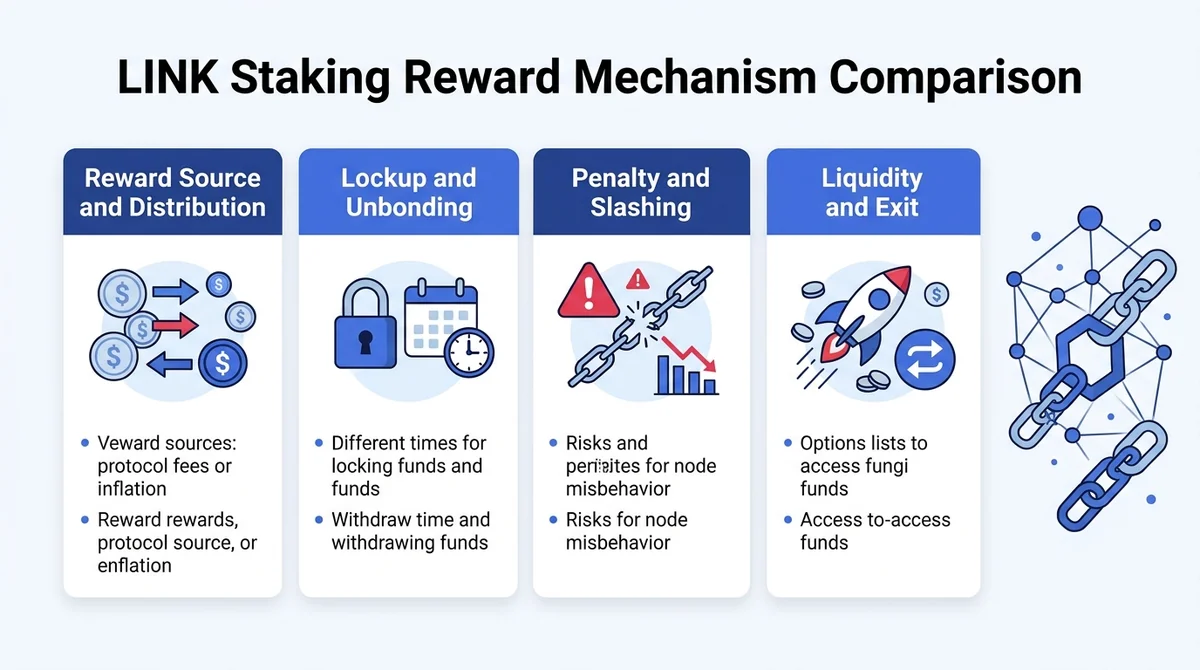
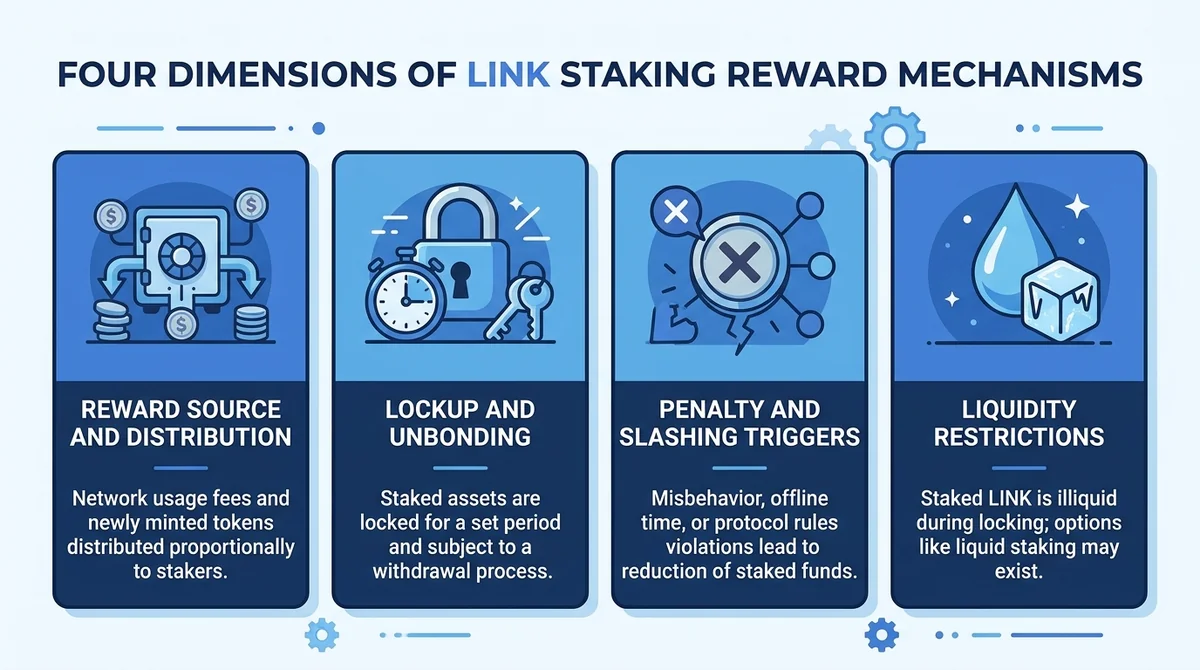
Compare LINK staking reward mechanisms: reward sources and distribution, lockup and unbonding, slashing triggers, and liquidity limits, with a checklist.
Conclusion: When comparing LINK staking reward mechanisms, start with four dimensions—where rewards come from and how they are distributed, how lockup and unbonding restrict capital availability, under what conditions penalties and slashing are triggered, and whether exit preserves liquidity. Looking only at nominal yield will systematically overestimate the real return of some methods.
#What exactly are the differences between LINK staking reward mechanisms?
The differences between LINK staking reward mechanisms mainly lie in four aspects: reward sources and distribution rules, lockup and unbonding arrangements, penalty trigger conditions, and liquidity restrictions. Together, these four aspects determine whether nominal yield can be converted into actual received returns.
#Where do rewards come from, and how are they distributed?
The first step in judging reward quality is to look at the source structure: whether rewards come from protocol-level inflationary issuance, from fees paid by users, or from subsidies provided by third-party operators. The three have different implications for long-term sustainability. The second step is to look at the distribution rules: whether distribution is linear based on the amount staked, or whether weighted factors such as node operator performance, reputation, or task completion are added. The more weighted factors there are, the greater the dispersion of actual received returns for the same amount staked.
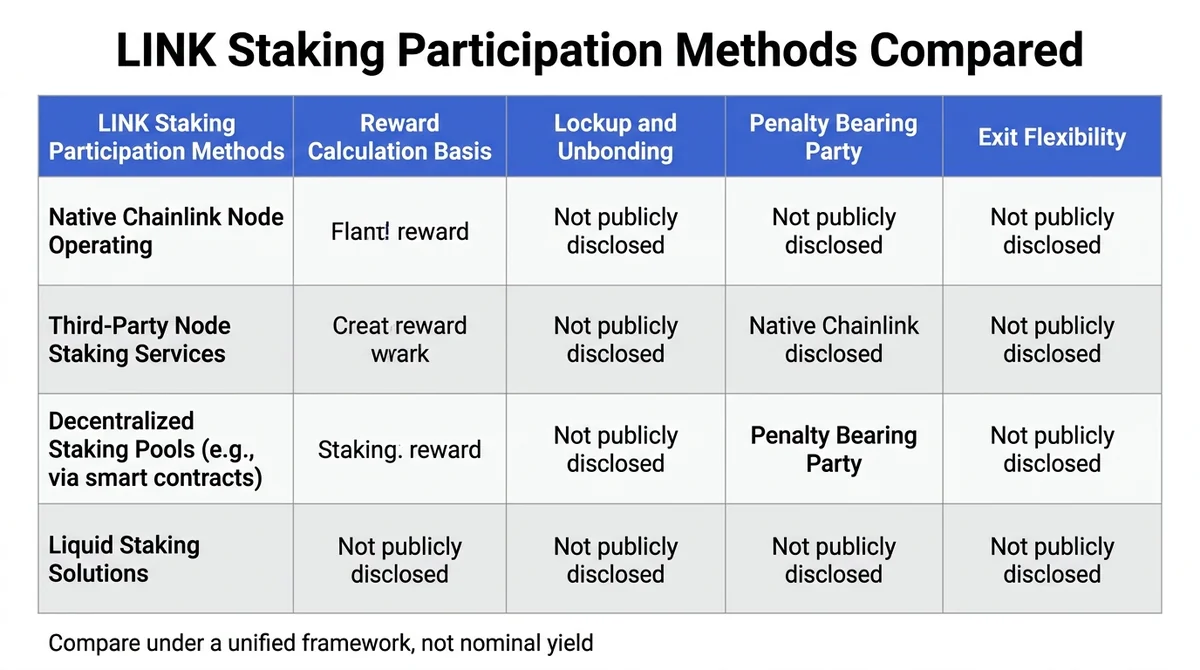
Within the scope of the materials compiled for this comparison, the specific reward source composition and distribution weights of different LINK staking participation methods are not publicly disclosed, so no cross-method yield ranking can be given. The verifiable criterion is: any yield figure must be labeled with its source and calculation period; otherwise it is not comparable.
#How do lockup and unbonding rules affect capital availability?
Lockup and unbonding arrangements determine the time cost of capital, not the yield itself. Three different concepts need to be distinguished: the lockup period (the minimum time capital is constrained), the unbonding waiting period (the interval between submitting an exit request and the capital becoming transferable), and whether a liquidity alternative for immediate exit exists.
The longer the unbonding waiting period, the more the actual annualized return is diluted for the same nominal yield; if the asset price fluctuates during the period, the waiting period also adds price risk. Therefore, when comparing, the waiting period should be converted into a time cost rather than ignored.
#Under what circumstances are penalties and slashing triggered?
Penalty mechanisms are usually tied to node operation quality, such as offline duration, double signing, and other attributable behaviors. The key difference is not the penalty ratio itself, but whether the penalty can touch principal, whether the penalty is borne by the delegator or the operator, and whether there is an appeal or remediation process after triggering.
Within the scope of the materials for this comparison, the penalty ratios and bearing parties for each method are not publicly disclosed. In the absence of disclosure, penalty risk should be treated as an unquantifiable item, and the allocation weight to that method should be reduced accordingly.
#How do the rewards and risks of different LINK staking participation methods compare?
When comparing LINK staking participation methods, compare reward calculation methods, lockup and unbonding cycles, penalty bearing parties, and exit flexibility under a unified framework, rather than comparing only nominal yield.
#Are the reward calculation bases consistent across methods?
Inconsistency is the norm. Common differences include: whether yield is reported after deducting operator service fees, whether it is annualized with compounding, whether one-time subsidies are included, and whether the statistical period is 7 days or 30 days. The way to unify the basis is to list service fees, subsidies, and statistical period separately, and then calculate a comparable yield.
#How large are the differences in lockup and unbonding cycles?
The differences in lockup and unbonding cycles directly determine capital turnover efficiency. When evaluating, three time points should be recorded: the time interest starts accruing, the earliest time to submit an exit, and the time capital actually becomes transferable. The difference between the three constitutes the time portion of exit cost.
#Who bears penalty risk?
Penalty bearing parties fall into two categories: borne by the operator's own stake, or shared proportionally by delegators. The former is more favorable to delegators but usually comes with higher service fees; the latter has lower fees, but tail risk is borne by delegators. This trade-off needs to be explicitly weighed between cost and risk, rather than looking only at the fee number.
#Who is LINK staking reward mechanisms suitable for? How to choose by scenario?
Users who hold long-term and can accept lockups may prioritize methods with more stable reward rules, while users who need liquidity should prioritize evaluating unbonding cycles and exit arrangements.
#For long-term holders not in a hurry to use funds, what should they focus on?
If you are a user who holds long-term and has no need to liquidate during the lockup period, prioritize the sustainability of reward sources and rule stability over short-term yield levels. Frequent rule adjustments will weaken long-term compounding assumptions.
#When liquidity needs to be preserved, which terms should be prioritized?
If you need to preserve liquidity, prioritize checking the unbonding waiting period and whether a liquidity alternative exists, and convert the waiting period into a time cost before comparing yields.
#How should users sensitive to penalty risk choose?
If you are sensitive to penalty risk, prioritize methods where penalties are borne by the operator and accept the correspondingly higher service fees; conversely, if you seek lower fees and can bear tail losses, you may consider penalty-sharing methods.
If you cannot obtain disclosure information on penalty ratios and bearing parties, treat that item as unassessable and temporarily exclude it from allocation.
#What risks should be focused on when participating in LINK staking?
When participating in LINK staking, focus on liquidity restrictions during the lockup period, losses after penalty triggers, uncertainty from rule adjustments, and information gaps caused by some data not being publicly disclosed.
#What impact does being unable to exit during the lockup period have?
During the lockup period, assets cannot be liquidated. If significant price fluctuations or external liquidity needs arise during the period, users can only bear them passively. This is a combination of time risk and price risk, not a single yield issue.
#How are penalty conditions handled after they are triggered?
The post-trigger handling path needs to be confirmed in advance: whether losses are automatically deducted from principal, whether there is a remediation window, and whether the operator provides a compensation mechanism. When there is no clear process description, assume losses are irreversible.
#What uncertainties do reward rule adjustments bring?
Reward source structure, distribution weights, and service fee rates may all change with rule adjustments. Historical yield does not represent future yield, and any projection based on historical data should be labeled with assumptions.
#Action checklist
- Confirm the reward source composition: protocol issuance, fee sharing, or subsidies.
- Confirm the yield basis: whether service fees are deducted, whether compounding is used, and how long the statistical period is.
- Record the three nodes: lockup period, unbonding waiting period, and capital transferable time.
- Confirm penalty ratios and bearing parties; if unavailable, mark as unassessable.
- Confirm the announcement mechanism and lead time for rule adjustments.
- Convert lockup and waiting periods into time costs, then compare with nominal yield.
- Check the latest terms from official sources rather than relying on third-party paraphrases.
#FAQ
Q1: Can the nominal yields of LINK staking be directly compared across methods? A: No. The three bases—service fee deduction, compounding assumption, and statistical period—must first be unified; otherwise the numbers are not comparable.
Q2: What is the difference between the lockup period and the unbonding waiting period? A: The lockup period is the minimum time capital is constrained; the unbonding waiting period is the interval between submitting an exit and capital becoming transferable. Both affect capital availability and should be recorded separately.
Q3: Is who bears penalty risk more critical, or is the penalty ratio more critical? A: Both are critical. The bearing party determines tail risk attribution, and the ratio determines the magnitude of loss; when the ratio is not disclosed, it should be treated as unquantifiable risk.
Q4: Why does this comparison not provide a yield ranking? A: Within the scope of the materials compiled for this comparison, the specific reward source composition, distribution weights, and penalty ratio data for each method are not publicly disclosed, so no ranking is provided—only judgment criteria.
This content is a methodological framework and does not constitute investment or open account advice. No specific yield, lockup period, or penalty ratio figures are cited in this article; relevant terms are subject to the latest official disclosures of each project. To verify the latest terms, please refer to the official sources of the relevant projects.
FAQ
Can the nominal yields of LINK staking be directly compared across methods?
No. The three bases—service fee deduction, compounding assumption, and statistical period—must first be unified; otherwise the numbers are not comparable.
What is the difference between the lockup period and the unbonding waiting period?
The lockup period is the minimum time capital is constrained; the unbonding waiting period is the interval between submitting an exit and capital becoming transferable. Both affect capital availability and should be recorded separately.
Is who bears penalty risk more critical, or is the penalty ratio more critical?
Both are critical. The bearing party determines tail risk attribution, and the ratio determines the magnitude of loss; when the ratio is not disclosed, it should be treated as unquantifiable risk.
Why does this comparison not provide a yield ranking?
Within the scope of the materials compiled for this comparison, the specific reward source composition, distribution weights, and penalty ratio data for each method are not publicly disclosed, so no ranking is provided—only judgment criteria.
Read the review? Ready to try a small position?
The crypto assets and tokenized US stocks/ETFs covered here are available on MSX — spot and perpetuals.
Quick Start Trading →New here? Registration takes three quick steps.