Litecoin
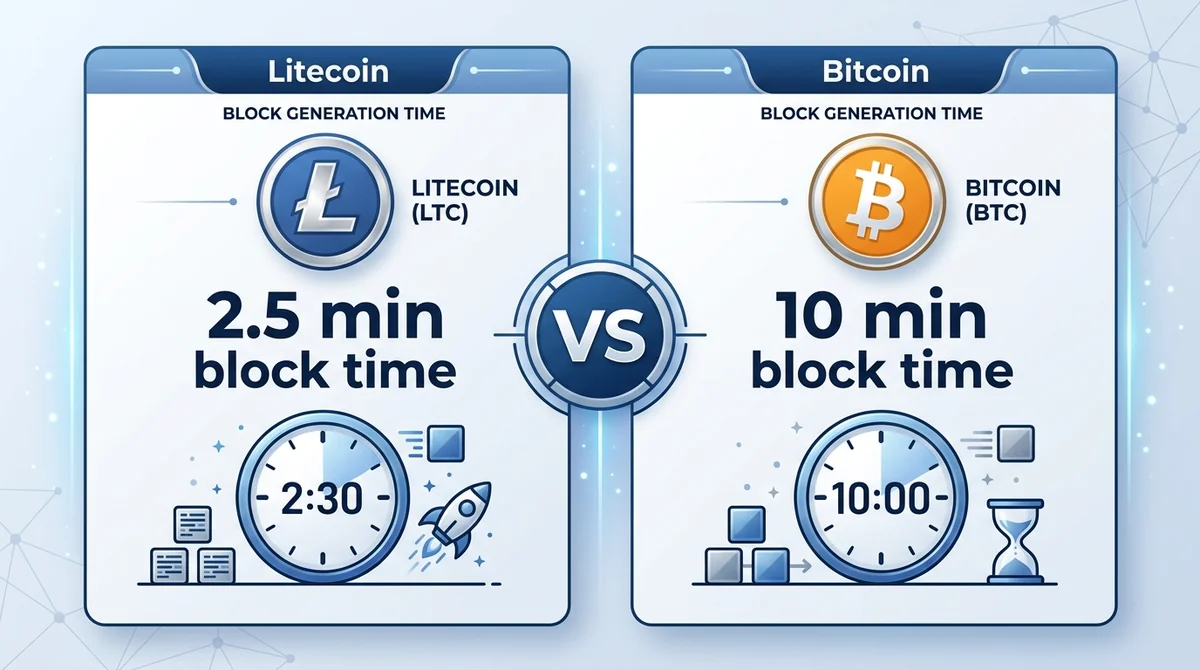
Litecoin blocks ~2.5 min vs Bitcoin ~10 min, so LTC first confirmation is usually faster with historically lower fees, but BTC has stronger hashrate and consensus.
Bottom line: By design parameters, Litecoin (LTC) has a block time of about 2.5 minutes versus Bitcoin (BTC) at about 10 minutes, so a single Litecoin transaction typically waits less time for its first confirmation, and its historical average fees are generally lower; however, Bitcoin is stronger in hashrate, network effects, and consensus strength. Both are native cryptocurrencies—not security tokens, and not tokenized commodities.
Data cutoff: 2026-06-01. Figures such as block times in this article are public protocol design parameters (not measured data); quantities that change with the market, such as fees, congestion, hashrate, and market cap, are given only as qualitative judgments in the body, without specific numerical sources cited one by one—please rely on real-time data.
Disclaimer: This content is compiled from public design parameters and public information and does not constitute investment, open account, or legal advice. The regulatory status of a given crypto asset is a matter of individual cases and regulatory interpretation, and this article does not constitute a legal characterization.
Data source note: Block times, confirmation mechanisms, and similar items are public protocol design parameters (source: Litecoin / Bitcoin public protocol documentation); quantitative indicators that change with the market, such as fees, hashrate, and market cap, are not cited with specific numerical sources one by one in this article and are given only as qualitative judgments—please rely on real-time data.
Key takeaways:
- Block design: Litecoin about 2.5 minutes / Bitcoin about 10 minutes.
- First confirmation: Litecoin waits are usually shorter, but actual receipt depends on confirmation count and congestion.
- Fees: Litecoin's historical average is lower, and the gap narrows when on-chain activity is light.
- Asset nature: Both are native cryptocurrencies—not security tokens, not tokenized commodities.
- Role in scenarios: Litecoin leans toward high-frequency small-payment settlement experiments, Bitcoin toward value storage and collateral (an inference).
#Which is faster, Litecoin or Bitcoin?
Answer: By design parameters, Litecoin's average block time is about 2.5 minutes versus Bitcoin's about 10 minutes, so a single Litecoin transaction typically waits less time for its first confirmation; but "faster" only holds under the assumption of an equal confirmation count, and actual receipt also depends on the transaction's position in a block and the degree of network congestion.
Citable conclusion: Litecoin blocks in about 2.5 minutes and Bitcoin in about 10 minutes, so Litecoin's first-confirmation wait is usually shorter; but actual receipt still depends on the required confirmation count and the degree of network congestion.
#How much do block time and confirmation speed differ?
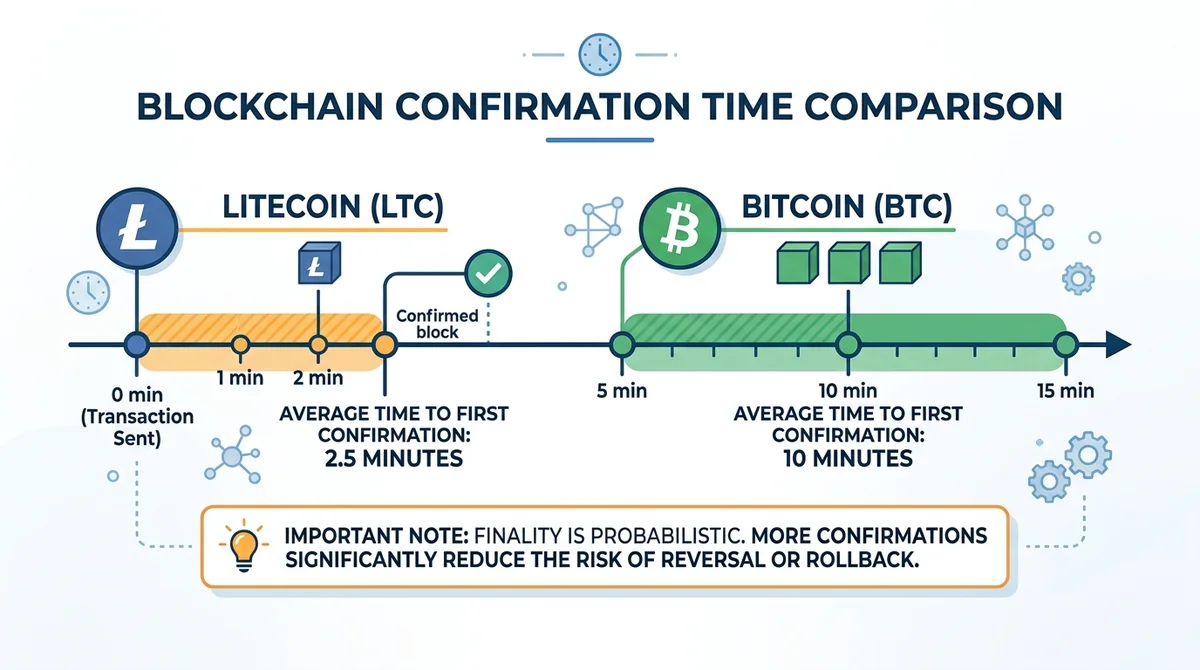
Block interval determines the average wait for a transaction to be packed into a block. Litecoin produces a block about every 2.5 minutes and Bitcoin about every 10 minutes (source: public protocol design parameters), so in theory Litecoin's first-confirmation wait is about one quarter of Bitcoin's. It is important to distinguish "first confirmation" from "finality": both are probabilistic finality, and the more confirmations, the lower the probability of a rollback—exchanges usually require multiple confirmations before crediting a deposit.
Citable conclusion: Litecoin blocks in about 2.5 minutes and Bitcoin in about 10 minutes, so in theory Litecoin's first-confirmation wait is about one quarter of Bitcoin's; but both are probabilistic finality, and the more confirmations, the lower the rollback probability.
#How do transaction throughput and fees affect the actual experience?
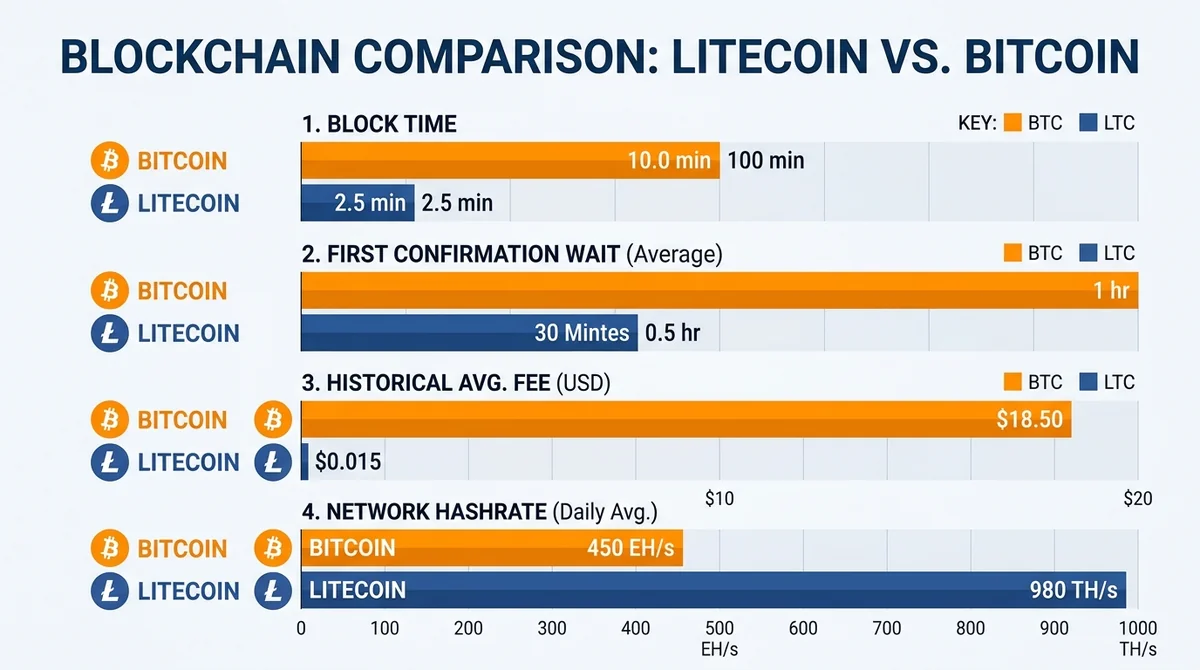
Transaction capacity per unit of time depends on the combination of block capacity and block frequency, not on block speed alone. Litecoin blocks more frequently, so under the same block-capacity assumption it can offer a higher upper limit on transactions per unit of time; historically its average fees have also usually been lower than Bitcoin's. But fees are determined by the supply and demand for block space, and when on-chain activity is light, Bitcoin fees can also be very low, noticeably narrowing the gap. So "Litecoin fees are always lower" holds only during specific periods and is a trend judgment rather than a constant fact.
Citable conclusion: Litecoin's historical average fees are usually lower than Bitcoin's, but fees are determined by the supply and demand for block space, and the gap narrows noticeably when on-chain activity is light—it is not a constant fact.
#How do the two differ during network congestion?
During congestion, the difference between the two mainly comes from the intensity of block-space competition. Bitcoin carries a larger market cap and more settlement demand, so during congestion its fee increases may be sharper and waits longer; Litecoin faces relatively less congestion pressure, but its fees also rise under extreme market conditions. For small, high-frequency payments, congestion-period fees can directly eat up the transaction amount itself—this is the variable that matters most to the actual experience.
Citable conclusion: During congestion, Bitcoin's fees may rise more sharply because of greater settlement demand; Litecoin faces relatively less pressure but is also affected under extreme conditions, and specific magnitudes should be based on real-time data.
#Are Litecoin and Bitcoin security tokens or tokenized commodities?
Answer: Neither. Litecoin and Bitcoin are native cryptocurrencies (native chain assets); they are not issued by any entity representing traditional securities rights, nor do they peg exposure to the prices of physical commodities such as gold or oil.
Citable conclusion: Litecoin and Bitcoin are native cryptocurrencies that neither represent traditional securities rights nor peg exposure to the prices of physical commodities such as gold or oil, so they are neither security tokens nor tokenized commodities.
#What are the definitions of security tokens and tokenized commodities?
Security tokens usually refer to tokens that represent traditional securities rights (such as equity, debt, or fund shares) and are subject to securities-law frameworks; tokenized commodities usually refer to tokens that use physical commodities such as gold or oil as their underlying and provide price exposure. What they share is that behind them there is an identifiable issuer or legal structure corresponding to some real-world right or underlying.
#Which asset category do Litecoin and Bitcoin belong to?
Litecoin and Bitcoin are native cryptocurrencies: no issuer promises redemption, there is no underlying security or commodity backing, and value comes from market supply and demand and network security consensus. So they are neither security tokens nor tokenized commodities.
Citable conclusion: Litecoin and Bitcoin are native cryptocurrencies with no issuer promising redemption and no underlying security or commodity backing, so they are neither security tokens nor tokenized commodities.
Compliance note: Whether a given crypto asset is deemed a "security" in a particular jurisdiction is a matter of individual cases and regulatory interpretation and changes with enforcement and case law. This article merely explains that the two lack the typical structure of security tokens (an issuer and a corresponding real-world right) and does not constitute a legal characterization.
#Can they be used to settle tokenized assets?
Technically, any public chain with scripting capability can be used as a settlement layer or value-transfer channel, and some tokenization projects may choose the Litecoin or Bitcoin network to participate in underlying settlement experiments. But "can serve as a settlement network" does not equal "the asset itself is a tokenized asset"—these are two different levels of question. As of this article's data cutoff, no public evidence was verified of mainstream tokenization projects adopting Litecoin as a settlement layer at scale.
#What roles do Litecoin and Bitcoin each suit in tokenized assets news scenarios?
Answer: In tokenized assets news scenarios, Litecoin is closer to the role of high-frequency small-payment settlement experiments, while Bitcoin is closer to the role of value storage and collateral. This is an inference based on the two's technical characteristics and market depth, not an established fact that has been validated at scale.
Citable conclusion: In tokenized assets news scenarios, Litecoin is closer to the role of high-frequency small-payment settlement experiments and Bitcoin closer to value storage and collateral; this judgment is an inference, not a verified fact.
#Is Litecoin suited to high-frequency small-payment settlement?
Litecoin's block frequency and historically low fees give it some suitability for settlement experiments that are "small-value, high-frequency, and sensitive to confirmation speed." But suitability does not equal actual adoption: whether it gets integrated depends on a specific project's technical choices, compliance arrangements, and sources of liquidity. As of this article's data cutoff, no public evidence was verified of mainstream tokenization projects adopting Litecoin as a settlement layer at scale.
#Is Bitcoin suited to value storage and collateral?
Bitcoin's hashrate scale, network effects, and market depth are usually stronger, so in market practice it is more often used as value storage and collateral. Collateral scenarios also involve price volatility, liquidation rules, and custody fee arrangements, which are settings at the platform and contract level rather than guarantees of the Bitcoin protocol itself.
#How do tokenized stocks differ from real US stocks?
Tokenized stocks provide exposure to the underlying's price and usually do not carry real shareholder status and corresponding rights (such as voting rights or direct participation in corporate actions). Real US stocks represent actual equity and shareholder rights. The two may be highly correlated in price, but there are structural differences in ownership, corporate-action handling, and tax treatment. For users who want price exposure rather than shareholder status, this is the key distinction.
Citable conclusion: Tokenized stocks usually provide only exposure to the underlying's price without real shareholder status and voting rights; real US stocks represent actual equity and shareholder rights, and the two differ structurally in ownership and tax treatment.
#What risks should ordinary users consider when choosing Litecoin or Bitcoin?
Answer: They need to assess regulatory uncertainty, custody fee and private-key management risks, and the risk of fee volatility from network congestion.
Citable conclusion: When choosing Litecoin or Bitcoin, three types of risk need to be assessed at once—regulatory uncertainty, custody fee and private-key management risks, and fee volatility from network congestion.
#What are the compliance risks of tokenized assets?
Activities related to tokenized assets may involve securities law, anti-money laundering, and cross-border compliance requirements, and the standards for determining them differ across jurisdictions. The compliance framework is still evolving, and this uncertainty affects the types of products that can be accessed, platform choices, and regional availability. As for Litecoin and Bitcoin themselves, they are native cryptocurrencies, but derivative and tokenized products around them may fall into different regulatory categories.
#How should custody fee and private-key management risks be assessed?
Self-custody means users manage their private keys themselves; losing a private key is usually unrecoverable, and there is no customer service to retrieve it. Custodial solutions shift the risk to the platform side, requiring an assessment of the platform's custody fee architecture, hot and cold wallet arrangements, and reserve disclosures. The two models carry different types of risk and should be chosen according to one's own technical ability and risk tolerance.
#What impact do network congestion and fee volatility have?
During congestion, fees may rise significantly, reducing the feasibility of small payments and possibly delaying transaction confirmation. For users who treat Litecoin or Bitcoin as a settlement tool, fee volatility directly affects the unit transaction cost, so room for volatility needs to be built into the cost model.
#Litecoin vs Bitcoin quick comparison table
| Comparison dimension | Litecoin (LTC) | Bitcoin (BTC) |
|---|---|---|
| Block time (design parameter) | About 2.5 minutes | About 10 minutes |
| First confirmation | Wait usually shorter | Wait usually longer |
| Historical fees | Average usually lower, gap narrows when light | Usually higher, can also be low when light |
| Hashrate and consensus | Relatively smaller | Stronger hashrate and network effects |
| Asset nature | Native cryptocurrency | Native cryptocurrency |
| Role in scenarios | High-frequency small-payment settlement experiments (inference) | Value storage and collateral (inference) |
Speed: Litecoin blocks in about 2.5 minutes and Bitcoin in about 10 minutes; Litecoin's first-confirmation wait is usually shorter.
Cost: Litecoin's historical average fees are usually lower, but the gap narrows when on-chain activity is light.
Security and consensus: Bitcoin's hashrate and network effects are stronger, and its security is generally considered higher.
Asset nature: Both are native cryptocurrencies—not security tokens, not tokenized commodities.
Role in scenarios: Litecoin leans toward high-frequency small-payment settlement experiments and Bitcoin toward value storage and collateral (an inference, not a verified fact).
#FAQ
Q1: Is Litecoin really 4 times faster than Bitcoin?
A1: You cannot simply say "4 times faster." In terms of block time, Litecoin is about 2.5 minutes and Bitcoin about 10 minutes, a ratio of roughly 1:4, so Litecoin's average first-confirmation wait is shorter. But this is only a comparison at the design-parameter level; actual receipt also depends on the transaction's position in a block, the required confirmation count, and the degree of network congestion.
Q2: Are Litecoin or Bitcoin security tokens?
A2: They do not have the typical structure of security tokens. Both are native cryptocurrencies with no issuer representing traditional securities rights. But note: whether an asset is deemed a security in a particular jurisdiction is a matter of individual cases and regulatory interpretation, and this article does not constitute a legal characterization.
Q3: Are Litecoin or Bitcoin tokenized commodities?
A3: No. Tokenized commodities usually peg exposure to the prices of physical commodities such as gold or oil, whereas Litecoin and Bitcoin have no physical-commodity backing, and their prices come from market supply and demand and network consensus.
Q4: What are the key differences between tokenized stocks and real US stocks?
A4: Tokenized stocks usually provide only exposure to the underlying's price and generally do not carry real shareholder status and corresponding rights; real US stocks represent actual equity and involve voting rights and direct participation in corporate actions. The two differ structurally in ownership, corporate-action handling, and tax treatment.
Q5: How does network congestion affect the cost of using Litecoin and Bitcoin?
A5: During congestion, competition for block space intensifies, fees may rise, and confirmation times lengthen. Because Bitcoin has greater settlement demand, its fee increases may be sharper during congestion; Litecoin faces relatively less pressure but is also affected under extreme market conditions. Specific magnitudes vary with the market and should be based on real-time data.
This content is compiled from public design parameters and public information and does not constitute investment or open account advice. Data cutoff: 2026-06-01. Specific figures involving fees and congestion performance change with the market and are not cited with sources one by one in the body—please rely on real-time data. This article was compiled by MSX Compare; for more multi-asset comparisons, see the comparison pages on this site.
FAQ
Is Litecoin really 4 times faster than Bitcoin?
You cannot simply say "4 times faster." In terms of block time, Litecoin is about 2.5 minutes and Bitcoin about 10 minutes, a ratio of roughly 1:4, so Litecoin's average first-confirmation wait is shorter. But this is only a comparison at the design-parameter level; actual receipt also depends on the transaction's position in a block, the required confirmation count, and the degree of network congestion.
Are Litecoin or Bitcoin security tokens?
They do not have the typical structure of security tokens. Both are native cryptocurrencies with no issuer representing traditional securities rights. But note: whether an asset is deemed a security in a particular jurisdiction is a matter of individual cases and regulatory interpretation, and this article does not constitute a legal characterization.
Are Litecoin or Bitcoin tokenized commodities?
No. Tokenized commodities usually peg exposure to the prices of physical commodities such as gold or oil, whereas Litecoin and Bitcoin have no physical-commodity backing, and their prices come from market supply and demand and network consensus.
What are the key differences between tokenized stocks and real US stocks?
Tokenized stocks usually provide only exposure to the underlying's price and generally do not carry real shareholder status and corresponding rights; real US stocks represent actual equity and involve voting rights and direct participation in corporate actions. The two differ structurally in ownership, corporate-action handling, and tax treatment.
How does network congestion affect the cost of using Litecoin and Bitcoin?
During congestion, competition for block space intensifies, fees may rise, and confirmation times lengthen. Because Bitcoin has greater settlement demand, its fee increases may be sharper during congestion; Litecoin faces relatively less pressure but is also affected under extreme market conditions. Specific magnitudes vary with the market and should be based on real-time data.
Related Terms
Read the review? Ready to try a small position?
The crypto assets and tokenized US stocks/ETFs covered here are available on MSX — spot and perpetuals.
Quick Start Trading →New here? Registration takes three quick steps.