MSX Fee Review 2026: RWA Spot, Futures & Bridge Fee Structure Plus $MSX Token Discount Analysis
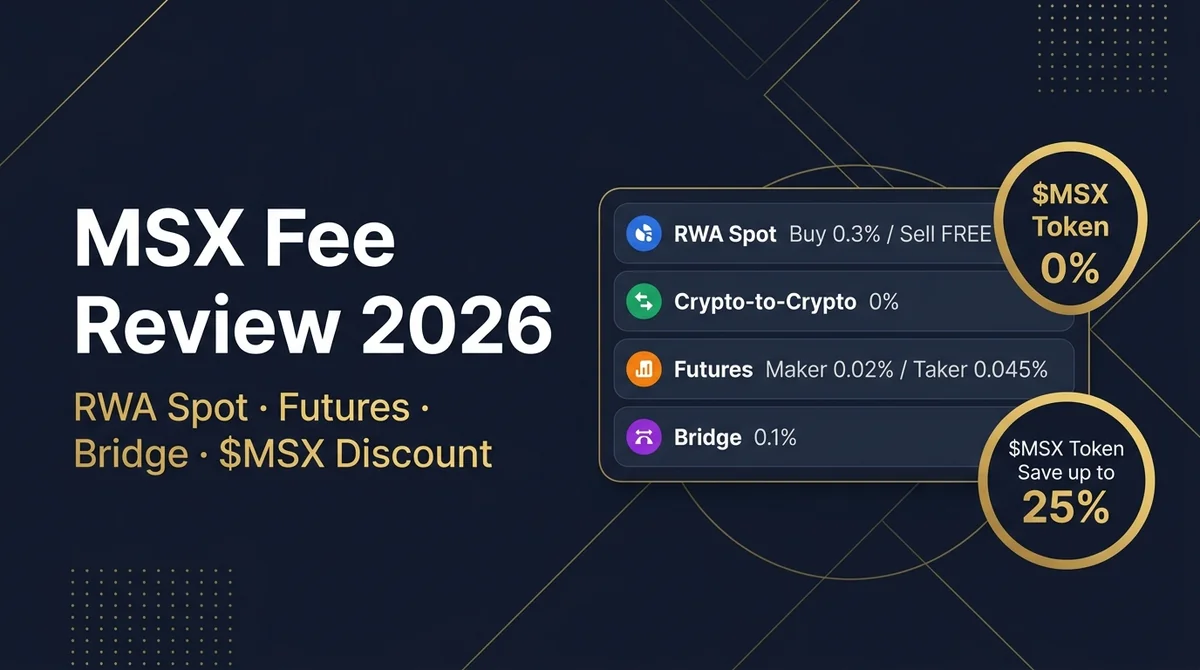
MSX RWA spot buy 0.3%/sell free, futures maker 0.02%/taker 0.045%, bridge 0.1%, crypto-to-crypto 0%. Hold $MSX for 25% off spot and 10% off futures. Full 2026 fee breakdown.
#MSX Fee Review 2026: RWA Spot, Futures & Bridge Fee Structure Plus $MSX Token Discount Analysis
📅 Data as of: 2026 (subject to the latest announcements on the official MSX website)
#Key Takeaways / TL;DR
- Asymmetric RWA spot fees: buy orders at 0.3%, sell orders completely free; crypto-to-crypto trading at 0%
- Futures fees: maker 0.02%, taker 0.045%, incentivizing users to post orders and provide liquidity
- Bridge flat fee of 0.1%; internal account transfers between platform accounts complete in seconds with no bridge fees
- $MSX token discounts: 25% off RWA spot fees (0.75x) and 10% off futures fees (0.9x)
- Compliance & security: 95% of assets held in multi-sig cold wallets, Proof of Reserves ratio >100%, SEC STO registration completed
#What Does MSX's Fee Structure Actually Look Like?
According to the official MSX fee page, the MSX platform structures fees across four tiers by transaction type: RWA spot buy orders at 0.3% (sell orders free), crypto-to-crypto trading at 0%, futures maker 0.02% / taker 0.045%, and bridge at 0.1%. Fees vary significantly across product types, so users should confirm which product they are using before placing an order.
#What Are MSX's Spot and Crypto-to-Crypto Trading Fees?
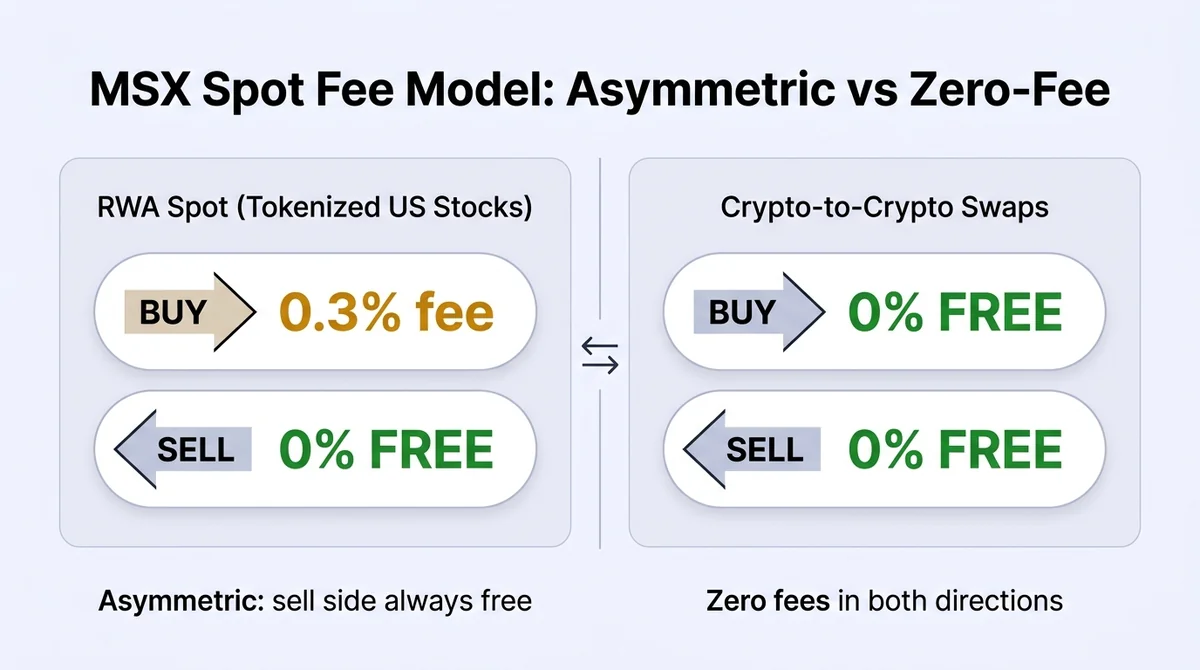
MSX spot trading covers two categories: RWA spot (buying and selling tokenized US equities on-chain) and traditional crypto-to-crypto trading (cryptocurrency swaps). The two have entirely different fee structures:
| Trade Type | Buy Fee | Sell Fee | Notes (as of 2026) |
|---|---|---|---|
| RWA Spot (tokenized US stocks) | 0.3% | 0% (free) | Asymmetric design — sell side is fee-free |
| Crypto-to-Crypto (crypto swaps) | 0% | 0% | Zero fees in both directions |
RWA spot (Real World Asset tokenization) uses an asymmetric model where buys are charged and sells are free. This structure is uncommon on traditional exchanges and reduces overall trading costs for users who rebalance frequently, since the sell side carries no fee. Crypto-to-crypto trading charges nothing in either direction, making it ideal for flexible asset reallocation across different cryptocurrencies.
#What Are MSX's Futures Maker and Taker Fees?
As of 2026, according to the official MSX fee documentation, MSX perpetual futures use differentiated maker/taker pricing: maker fee 0.02%, taker fee 0.045%. A maker order is a limit order that waits to be filled, adding liquidity to the market; a taker order fills immediately at market price, consuming existing liquidity. This pricing logic that rewards makers helps tighten bid-ask spreads and improve overall order book quality.
| Fee Type | Rate (as of 2026) | Rate After $MSX Discount |
|---|---|---|
| Futures maker | 0.02% | 0.018% (0.9x) |
| Futures taker | 0.045% | 0.0405% (0.9x) |
With the $MSX token discount applied, futures fees receive a 10% reduction. For high-frequency futures traders, the cumulative savings over time are meaningful. For a detailed look at where MSX futures fees rank in the industry, see 2026 Lowest Perpetual Futures Fee Exchanges Ranked: MSX vs Binance vs OKX Maker/Taker Fee Comparison.
#What Does MSX's Bridge Charge?
According to official MSX documentation, the MSX bridge (bridge.msxgo.com) charges a flat 0.1% fee, which applies to cross-chain asset transfers — moving assets from one blockchain network to another. Transfers between internal platform accounts (such as between a trading account and a funding account) complete in seconds with no bridge fee involved.
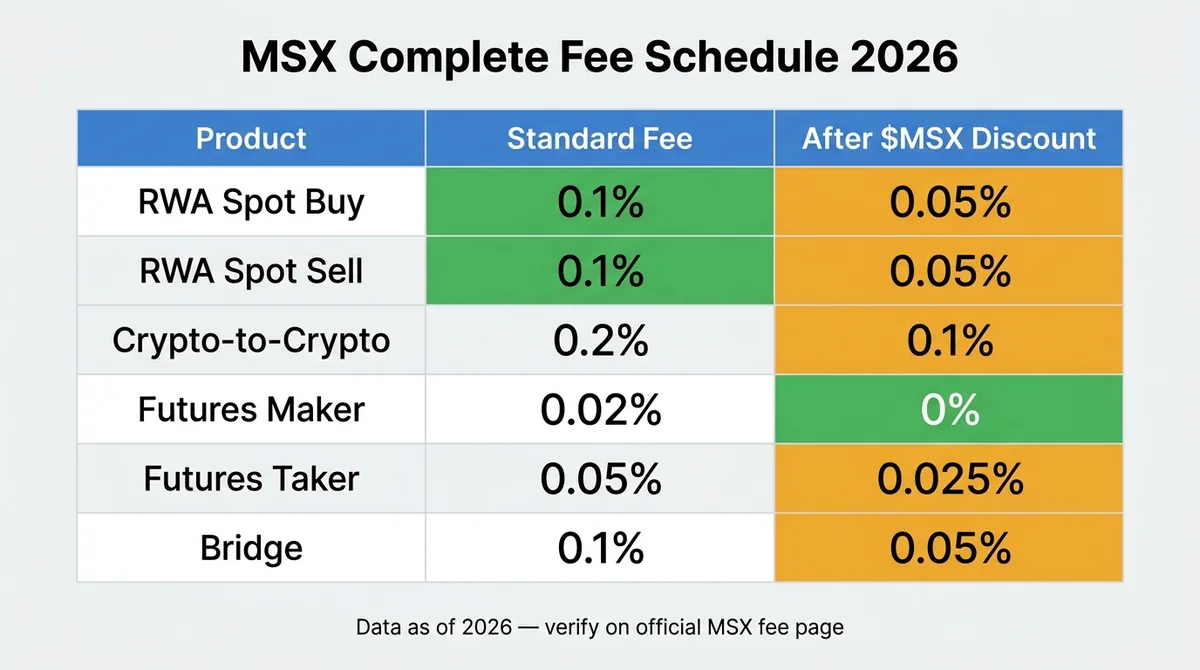
Complete MSX Fee Schedule (as of 2026, per the official MSX fee page):
| Product | Fee | $MSX Discount |
|---|---|---|
| RWA spot buy | 0.3% | 0.75x (save 25%) |
| RWA spot sell | 0% (free) | — |
| Crypto-to-crypto trading | 0% | — |
| Futures maker | 0.02% | 0.9x (save 10%) |
| Futures taker | 0.045% | 0.9x (save 10%) |
| Bridge | 0.1% | Not disclosed |
#How Much Can You Save with the $MSX Token Fee Discount?
Holding $MSX tokens reduces RWA spot fees to 0.75x (saving 25%) and futures fees to 0.9x (saving 10%). $MSX also unlocks staking rewards, VIP membership, and asset subscription rights, making it the core tool for reducing trading costs on the platform.
#How Much Does the $MSX Discount Save on Spot Fees?
In RWA spot trading, enabling the $MSX discount reduces the buy fee from 0.3% to 0.225% (0.75x), saving 25% per trade. Using a purchase of 1,000 USDT worth of Apple (AAPL) tokens as an example:
- Without discount: fee = 1,000 × 0.3% = 3 USDT
- With $MSX discount: fee = 1,000 × 0.225% = 2.25 USDT, saving 0.75 USDT
Since sell orders are already free, the $MSX discount applies primarily to the buy side. For users who hold long-term and sell in a single transaction, the overall fee structure is already quite favorable.
#How Much Does the $MSX Discount Save on Futures Fees?
In futures trading, the $MSX discount applies a 0.9x rate, reducing fees by 10%:
- Maker: 0.02% → 0.018%
- Taker: 0.045% → 0.0405%
Futures trading typically involves leverage, meaning notional volume is far higher than the actual margin. Using a single taker order with a notional value of 10,000 USDT as an example:
- Without discount: 10,000 × 0.045% = 4.5 USDT
- With $MSX discount: 10,000 × 0.0405% = 4.05 USDT, saving 0.45 USDT
For high-frequency traders executing dozens to hundreds of orders daily, cumulative savings can be estimated using the formula above. For a systematic approach to optimizing futures trading costs, see MSX Futures Fees Explained: 2026 Maker/Taker Rates and Optimization Guide.
#How Do You Enable the MSX Token Fee Discount?
The primary use cases for $MSX (MSX's core utility token) include:
- Fee discounts: 0.75x on spot, 0.9x on futures
- Staking rewards: earn additional platform benefits by staking $MSX (including STONKS staking, per official platform documentation)
- VIP membership: holding $MSX unlocks higher-tier platform services
- Asset subscriptions: priority access to new asset offerings
The total supply of $MSX is fixed at 1 billion tokens, combining governance and ecosystem incentive functions. To enable the fee discount, log in to the MSX official website and look for the "Fee Discount" option in your account settings, or contact the official Telegram support bot for guidance.
#How Are Actual Costs Calculated for MSX Spot and RWA Trading?
MSX RWA spot uses an asymmetric fee structure: 0.3% on buys and free on sells. Users can buy and sell tokenized US equities directly with stablecoins, bypassing traditional cross-border wire transfer and currency conversion fees, with a minimum investment of just 10 USDT in high-priced blue-chip stocks like Apple, Tesla, and NVIDIA.
#Full Cost Example: Buying RWA Tokenized US Stocks
Assume a user buys 100 USDT worth of NVIDIA (NVDA) tokens using USDT:
- Trading fee: 100 × 0.3% = 0.3 USDT
- Cross-border wire fee: 0 (on-chain instant settlement, T+0, no SWIFT wire required)
- Currency conversion fee: 0 (settled directly in stablecoins, no fiat conversion needed)
- Settlement time: instant on-chain, no T+2 settlement wait
With the $MSX discount enabled, the 0.3 USDT fee is further reduced to 0.225 USDT. Compared to buying US stocks through a traditional broker — which typically involves cross-border wire fees, currency conversion spreads, brokerage commissions, and T+2 settlement delays — MSX's fully on-chain settlement model structurally eliminates several hidden costs.
#Why Are RWA Spot Sell Orders Free?
MSX's RWA spot product charges on buys and nothing on sells, with the sell side carrying a 0% fee. The asymmetric structure reflects a Web3 application of PFOF (Payment for Order Flow — a model where market makers pay the platform for order flow rather than charging users directly). The platform receives compensation from the market-maker side rather than charging users a commission on sales. For users, there is no additional fee when selling tokenized US equity positions, meaning trading costs over the holding period are incurred only at the buy side.
#What Traditional Costs Does Buying US Stocks with Stablecoins Eliminate?
Using MSX's stablecoin-based model to buy and sell tokenized US equities avoids the following costs compared to traditional channels:
- Cross-border wire fees: traditional brokers require wiring funds to an overseas account, typically costing $15–$30 per wire or 0.1%–0.5%
- Currency conversion spreads: converting fiat to USD typically carries a spread of 0.5%–2%; MSX uses stablecoin settlement with no conversion needed
- Minimum investment threshold: high-priced stocks like NVIDIA trade at over $100 per share; MSX supports fractional shares starting from 10 USDT (fractional ownership of less than one full share), significantly lowering the participation barrier
- T+2 settlement delay: traditional equity markets settle in two business days; MSX uses T+0 on-chain instant settlement
For a side-by-side comparison of MSX and other platform spot fees, see MSX Spot Fees vs Bybit vs Gate.io 2026: Three-Platform Comparison.
#How Do MSX Futures Fees Compare to the Industry?
According to official MSX fee documentation, MSX futures use differentiated maker/taker pricing: maker at 0.02% is lower than taker at 0.045%, incentivizing users to provide liquidity. The Portfolio Margin mechanism allows multiple on-chain assets to serve as a combined margin pool, reducing liquidation risk while improving capital efficiency.
#What Does the Maker/Taker Gap in MSX Futures Fees Signal?
The gap between maker and taker rates (0.02% vs. 0.045%) is more than twofold, sending a clear message: posting limit orders is significantly cheaper than hitting the market. In practical terms:
- Maker: places a limit order and waits for a counterparty, adding depth to the order book and earning the lower 0.02% rate
- Taker: executes immediately at market price or matches against an existing limit order, consuming liquidity at the 0.045% rate
For traders with some experience, using limit orders in non-urgent entry scenarios can reduce the per-trade fee by more than 55% (from 0.045% to 0.02%).
#How Does MSX's Portfolio Margin Mechanism Affect Trading Costs?
Portfolio Margin (multi-asset cross-margin, per official platform documentation) is a core mechanism in MSX futures: users can pool multiple on-chain assets as a combined margin pool, allowing gains and losses across positions to offset each other. This reduces overall liquidation risk and improves margin utilization.
The indirect impact on trading costs includes:
- Fewer forced liquidations: more precise margin calculations reduce unnecessary liquidations, avoiding losses from being forcibly closed out
- Higher leverage efficiency: the same assets can support larger notional positions, reducing the frequency of being forced to reduce positions due to insufficient margin
- Mark price mechanism: MSX aggregates mark prices using on-chain price oracles combined with data from multiple markets (integrating Polygon.io and other global data sources, per official platform documentation), reducing irrational liquidations caused by price deviations
#What Hidden Costs Should Futures Traders Watch Out For?
The total cost of futures trading goes beyond fees. The following hidden costs also need to be factored in:
- Funding rate (periodic payments between longs and shorts used to anchor the futures price to spot): typically settled every 8 hours; depending on the direction and market conditions, a position may net pay or net receive funding — the cumulative effect over long holding periods can be significant
- Bid-ask spread (slippage): market orders may fill at prices that deviate from expectations when liquidity is thin, especially during sharp market moves
- Liquidation losses: insufficient margin triggers forced liquidation, potentially wiping out the entire margin balance
- Overnight funding charges: the funding rate can fluctuate sharply during extreme market conditions and should be monitored regularly
For a detailed comparison of MSX and major platform futures fees, see MSX vs Binance vs OKX Perpetual VIP Fee Deep Dive 2026: Which Platform Costs Less for Large Traders?.
#What Are MSX Bridge Fees and When Do They Apply?
The MSX bridge (bridge.msxgo.com) charges a 0.1% fee for cross-chain asset transfers. Internal account transfers on the platform (including between the U-Card trading account and funding account) complete in seconds with no bridge fee required.
#Which Scenarios Does the 0.1% Bridge Fee Apply To?
The 0.1% bridge fee applies to asset transfers across blockchain networks — moving assets from chain A to chain B. Common scenarios include:
- Bridging USDT from the Ethereum network to another supported network
- Migrating assets between chains to participate in trading or staking in different ecosystems
- Consolidating on-chain assets onto a network supported by MSX for trading
Before using the bridge, note that in addition to the 0.1% bridge fee, gas fees on the destination chain may also apply. The specific amount depends on network congestion and is not determined by MSX.
#What's the Difference Between the Bridge and Internal Platform Transfers?
| Operation Type | Fee | Speed | Use Case |
|---|---|---|---|
| Bridge (bridge.msxgo.com) | 0.1% | Depends on on-chain confirmation | Cross-network asset migration |
| Internal platform account transfer | 0% (free) | Seconds | Trading account ↔ Funding account |
| U-Card internal transfer | 0% (free) | Seconds | Between trading/funding/credit card accounts |
The U-Card (MSX crypto spending card) supports one-tap USDT top-up from within the account, enabling direct spending at merchants worldwide online and offline, ATM withdrawals, and mobile payments. Internal transfers between the U-Card account and the trading account complete in seconds with no bridge fee, making it a low-cost way to move funds for everyday spending.
#What Compliance and Security Safeguards Back MSX's Fee Structure?
MSX has completed SEC security token offering (STO) registration and complies with Regulation S requirements (per official platform documentation). 95% of digital assets are held in multi-sig cold wallets, and the Proof of Reserves commitment maintains a reserve ratio strictly above 100%, providing compliance and security backing for the fee structure.
#How Does MSX's Compliance Framework Ensure Fee Transparency?
MSX's compliance framework spans multiple dimensions (per official platform announcements):
- SEC STO registration: completed securities token offering registration under Regulation S of the U.S. Securities Act of 1933; the issuance and trading of RWA assets operates within a compliant framework
- KYC + KYT: comprehensive integration of KYC (Know Your Customer — user identity verification) and KYT (Know Your Transaction — on-chain transaction monitoring), helping prevent money laundering and fraud risks
- Multi-sig cold wallets: 95% of assets held in multi-sig cold wallets, reducing single-point-of-failure risk
- Proof of Reserves: reserve ratio >100%, allowing users to verify platform solvency
The compliance framework means fee adjustments must go through a formal announcement process rather than silent unilateral changes, and users can track the latest updates via the fee page on the MSX official website.
#MSX Fee FAQ
Q: What are MSX's spot trading fees?
MSX spot trading covers two categories: RWA spot (tokenized US stocks) charges 0.3% on buys with sells completely free; crypto-to-crypto trading (cryptocurrency swaps) charges 0% in both directions. Holding $MSX tokens reduces the RWA spot buy fee to 0.225% (0.75x). Data as of 2026 — refer to the latest announcements on the MSX official website for current rates.
Q: What are MSX's futures fees? What are they after the $MSX discount?
As of 2026, MSX perpetual futures charge a maker fee of 0.02% and a taker fee of 0.045%. With the $MSX token discount enabled, the maker rate drops to 0.018% and the taker rate to 0.0405% — a 0.9x rate (10% savings) on both. For a taker order with a 10,000 USDT notional position, the fee without a discount is 4.5 USDT; with the discount it is 4.05 USDT, saving 0.45 USDT.
Q: How do you enable the $MSX fee discount?
Log in to the MSX official website (msxgo.com) and find the "Fee Discount" option in your account settings. Ensure your account holds a sufficient balance of $MSX tokens, then enable it. The total supply of $MSX is fixed at 1 billion tokens; in addition to fee discounts, it can be used for staking rewards, VIP membership access, and new asset subscriptions. For assistance, contact the official Telegram support bot (@MyStonksSupport_bot).
Q: How much does the MSX bridge charge, and how is it different from internal platform transfers?
The MSX bridge (bridge.msxgo.com) charges a 0.1% fee for cross-blockchain asset transfers. Gas fees on the destination chain may also apply — these depend on network congestion and are not charged by MSX. Internal account transfers on the platform (including between the U-Card account and trading/funding accounts) are completely free and settle in seconds without any on-chain operation.
Q: Can MSX fees change? How do you get the latest rates?
MSX fees may be adjusted in line with platform operational strategy. Data in this article is as of 2026. Before trading, log in to the MSX official website to check the latest fee announcements, or follow the official Telegram channel for real-time updates. The $MSX token discount ratio is also subject to the latest information on the official website.
#Conclusion
MSX's fee structure follows a clear logic: the asymmetric RWA spot pricing (0.3% buy / free sell) reduces holding costs; differentiated futures maker/taker fees (0.02% / 0.045%) incentivize liquidity provision; the bridge charges a flat 0.1% while internal transfers are free. The $MSX token discount mechanism delivers quantifiable savings across both spot and futures trading.
Before making trading decisions, calculate your actual costs based on your trading frequency and holding habits, and refer to the latest fee page on the MSX official website for current rates. For broader exchange fee comparisons, see MSX Exchange App Complete Guide 2026: Registration, Spot Trading & Perpetual Futures Full Walkthrough.
Disclaimer: This article is for informational purposes only and does not constitute investment advice. Cryptocurrency and RWA token trading carries market risk; investors should assess their own risk tolerance. Fee data is as of 2026 — actual fees are subject to the latest announcements on the MSX platform's official website. Compliance information such as SEC STO registration is based on official platform statements and does not represent regulatory endorsement or approval of the platform.
FAQ
What are MSX's spot trading fees?
This article covers MSX platform fees only (the input data does not include Coinbase withdrawal fees, so no factual statements can be made about Coinbase rates). Internal account transfers on the MSX platform are free and settle in seconds; for specific on-chain withdrawal fees, check the latest information on the MSX official website.
MSX合約手续费多少?2026年Maker/Taker费率详解与优化指南
/insights/msx-contract-trading-fees-maker-taker-guide-2026
MSX Spot Fees vs Bybit vs Gate.io 2026: Three-Platform Comparison
/insights/msx-vs-bybit-vs-gate-spot-fee-comparison-2026
MSX vs Binance vs OKX Perpetual VIP Fee Deep Dive 2026: Which Platform Costs Less for Large Traders?
/insights/msx-vs-binance-vs-okx-perpetual-vip-fee-comparison-2026
MSX Exchange App Complete Guide 2026: Registration, Spot Trading & Perpetual Futures Full Walkthrough
/insights/msx-exchange-app-complete-guide-spot-perpetual-2026
Related Terms
Read the review? Ready to try a small position?
The crypto assets and tokenized US stocks/ETFs covered here are available on MSX — spot and perpetuals.
Quick Start Trading →New here? Registration takes three quick steps.