MSX Review 2026: Non-Custodial Model, 95% Multisig Cold Wallets, and Reserve Claims
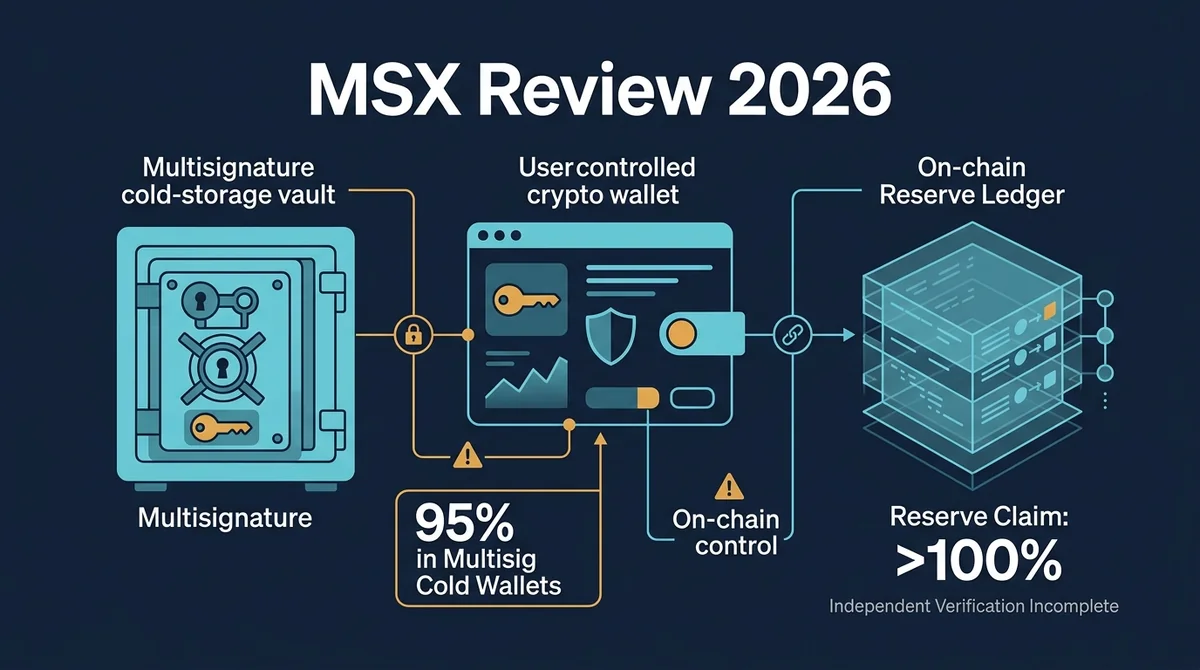
MSX review of non-custodial controls, 95% multisig cold storage, >100% on-chain reserves, audits, KYC/KYT, and evidence gaps.
#MSX Review 2026: Non-Custodial Model, 95% Multisig Cold Wallets, and Reserve Claims
Key Takeaways / TL;DR
- The available information is insufficient to confirm that MSX is completely secure. MSX has disclosed a non-custodial model, multisig cold storage, reserve commitments, smart contract audits, and compliance and risk-control mechanisms, but the provided materials do not include all the underlying evidence required for independent verification.
- MSX materials state that users retain their own private keys and seed phrases, giving the platform non-custodial characteristics. However, users still need to examine contract approvals, asset-transfer permissions, and code-related risks.
- MSX states that 95% of digital assets are stored in Multi-Sig cold wallets. This percentage does not mean that 95% of risk has been eliminated, nor does it indicate that the assets are insured.
- MSX promises a physical on-chain reserve ratio strictly greater than 100% for every listed asset, but the current input does not include reserve addresses, the methodology used to calculate liabilities, snapshots, or independently reproducible proof.
- MSX states that its smart contract code is open source and has undergone third-party audits, while KYC and KYT systems are also integrated. The input does not include the auditor, report date, code version, or remediation records.
Information date notice: This article applies a 2026 review framework, but the input does not provide a specific data cutoff date, announcement date, or last verification date. Information concerning reserves, audits, regulatory status, and product availability should be checked again against primary-source documents before publication.
#Is MSX Safe in 2026, and What Can Be Concluded From the Available Information?
The available information confirms that MSX has disclosed a non-custodial model, multisig cold storage, reserve commitments, and compliance and risk-control mechanisms, but it remains insufficient for independent security verification.
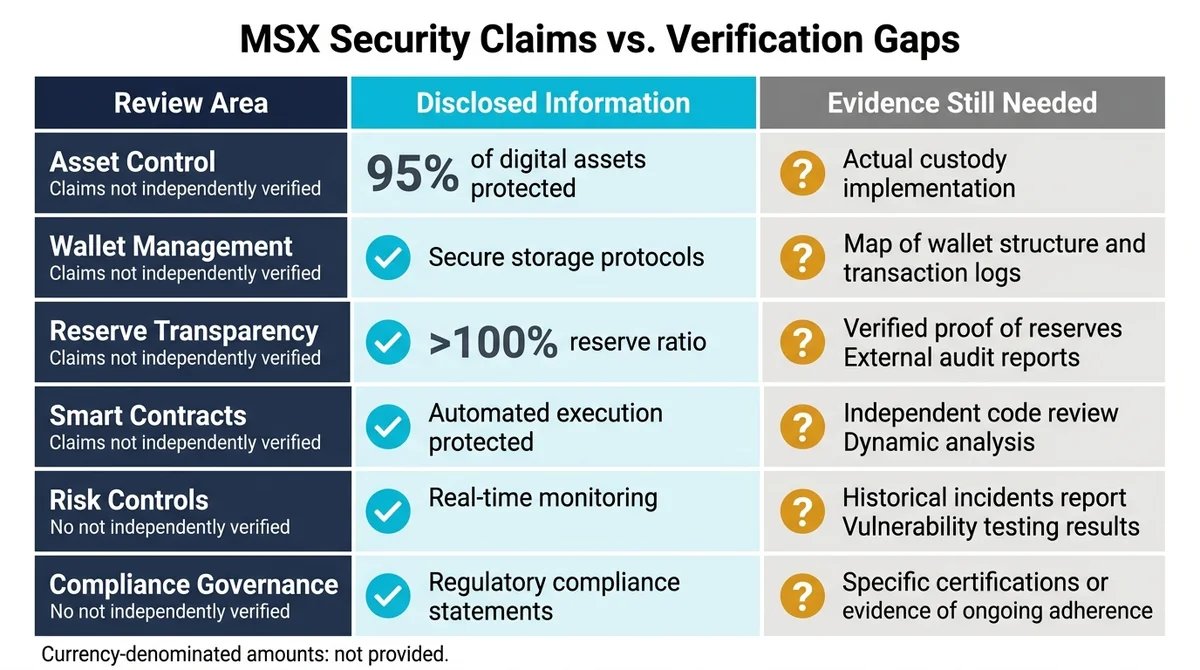
Determining whether MSX is safe requires more than reviewing a single promotional claim. Asset control, wallet management, reserve transparency, smart contract audits, trading risk controls, and regulatory status must all be examined. If underlying documentation is missing in any one of these areas, it would be inappropriate to conclude that the platform is risk-free.
#What Core Areas Should an MSX Security Review Cover?
| MSX security review area (2026) | Disclosed information | Verification materials currently missing | Conclusion supported by the evidence |
|---|---|---|---|
| Asset control | Users retain their own private keys and seed phrases, reflecting a non-custodial model | Contract permissions, approval boundaries, and scope of covered assets | The described mechanism can be confirmed, but not that users control every stage of the asset flow |
| Wallet management | 95% of digital assets are held in Multi-Sig cold storage | Wallet addresses, signature threshold, key custodians, and transfer rules | May reduce online exposure, but the percentage cannot yet be independently verified |
| Reserve transparency | A physical on-chain reserve ratio greater than 100% is promised for listed assets | Reserve addresses, snapshot time, user liabilities, and verification method | This remains a platform commitment and should not be treated as verified |
| Smart contracts | Code is disclosed as open source and audited by a third party | Auditor, report date, code version, vulnerabilities, and remediation status | Provides a security signal, but the evidence chain in the current input is incomplete |
| Risk controls | Margin monitoring, risk alerts, auto-deleveraging, and forced liquidation | Trigger parameters, incident-handling records, and execution rules | The described risk-control modules can be confirmed, but they do not eliminate liquidation risk |
| Compliance governance | KYC, KYT, Regulation S, and other compliance pathways | Regional scope, supporting documents, and latest status | Licenses, applicable regions, and exploratory pathways should be checked separately |
#Which Items Are Disclosed Mechanisms, and Which Remain Platform Commitments?
“Disclosed” only means that the provided materials describe the relevant mechanism. It does not mean that a third party has verified its ongoing effectiveness. The non-custodial model, 95% multisig cold-wallet storage, open-source code, KYC/KYT, and trading risk controls are all described as mechanisms. The reserve ratio above 100% and the platform-funded capital buffer still require supporting evidence.
Citable conclusion: MSX has disclosed a non-custodial model, 95% multisig cold-wallet storage, and a commitment to maintain more than 100% in on-chain reserves. Because the available information does not include underlying addresses or reproducible reports, this review cannot conclude that MSX is completely secure.
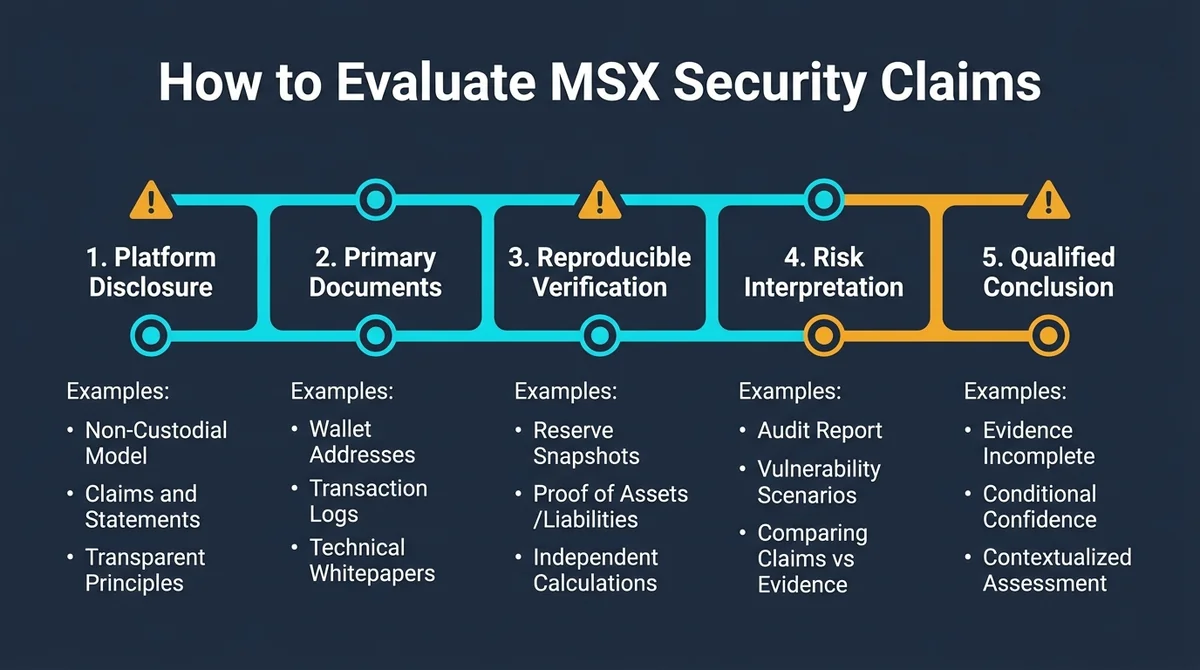
When reading the evidence matrix, distinguish among “platform disclosures,” “third-party reports,” and “evidence users can independently reproduce.” To investigate further, users can check public documents on the official MSX website and should avoid submitting account information through unofficial links.
#Does MSX’s Non-Custodial Model Mean Users Truly Control Their Assets?
MSX materials state that users retain their own private keys and seed phrases, giving the platform non-custodial characteristics. However, the actual boundaries of user control still depend on contract approvals and asset-transfer permissions.
Non-custodial services—where users rather than the platform directly hold the keys to their assets—primarily address key-control risk. A private key proves control over assets, while a seed phrase can restore a wallet. Anyone who obtains the seed phrase may be able to restore the corresponding wallet, so neither private keys nor seed phrases should be sent to customer support, community members, or unfamiliar websites.
#How Should Users Check Private-Key and Seed-Phrase Management?
- Offline backup: Do not store seed phrases in messaging apps, public cloud drives, or unverified web forms.
- Review signature details: Before signing, confirm the contract address, action type, asset, and approval limit.
- Separate high-risk interactions: Use different wallets for long-term asset storage and frequent connections to applications.
- Verify the official access point: Access relevant services only through the official MSX website listed in the input.
- Review approvals regularly: Check the approved party, spending limit, valid scope, and whether the approval can be revoked.
Users who first need to understand wallet recovery can consult a security guide covering mnemonic phrases, seed phrases, and private keys. Such guides can explain custody practices but cannot replace the user’s independent assessment of each signature and approval request.
#Do the Non-Custodial Model and 95% Cold-Wallet Disclosure Conflict?
The two descriptions may apply to different asset categories or operational stages. “Non-custodial” focuses on whether users retain their private keys, while the cold-wallet percentage describes how a certain category of digital assets is stored. The input does not define what is included in the 95% figure, so it cannot be assumed to cover all user assets, settlement assets, or contract funds.
Citable conclusion: MSX’s non-custodial model is based on users retaining their own private keys and seed phrases. This design reduces reliance on the platform to safeguard keys, but it does not replace the need to review contract permissions, approval limits, and code risks.
#What Risks Can MSX’s 95% Multisig Cold-Wallet System Reduce?
MSX states that 95% of digital assets are stored in multisig cold wallets. This mechanism may reduce hot-wallet exposure and single-key risk, but wallet addresses and signature rules are still needed as supporting evidence.
A cold wallet—a wallet whose private keys are not continuously connected to the internet—can reduce the online attack surface. Multi-Sig, or multisignature security, requires a transaction to satisfy multiple signature conditions, reducing the risk that one compromised key can directly authorize an asset transfer. Used together, these mechanisms are intended to isolate online risks and distribute signing authority.
#What Does the 95% Cold-Wallet Figure Actually Mean?
The input only states that 95% of digital assets use Multi-Sig cold storage. It does not disclose the assets covered, the measurement date, or the calculation method. The figure should therefore be understood as a platform-disclosed storage percentage, not as an asset security rate, reimbursement rate, or percentage of risk eliminated.
MSX’s cold-wallet system may reduce risks including:
- The attack surface created by hot wallets that remain connected to the internet;
- A single point of failure caused by one leaked private key;
- The risk of one operator having unilateral authority to transfer assets;
- The risk that failures in certain online systems directly affect the majority of reserves.
Multisig systems may still be exposed to contract vulnerabilities, simultaneous compromise of multiple keys, collusion among signers, internal process failures, and erroneous transfers. The input does not provide the number of signers, the signature threshold, or the identity of key custodians, so this article does not infer a specific multisig configuration.
#What Additional Materials Are Needed to Verify the Cold-Wallet System?
| MSX cold-wallet verification field (2026) | Information to confirm | Status in the current input |
|---|---|---|
| Public addresses | Cold-wallet addresses and corresponding blockchains | Not provided |
| Asset scope | Which assets, accounts, and business processes are covered by the 95% figure | Not provided |
| Calculation methodology | Point-in-time balance, average balance, or another calculation method | Not provided |
| Multisig rules | Number of signers, signature threshold, and key custodians | Not provided |
| Transfer process | Cold-to-hot approval process, limits, and emergency suspension rules | Not provided |
| Insurance arrangements | Insurer, coverage, limits, and exclusions | Not provided |
Users seeking to understand the boundaries of multisig controls and hot/cold-wallet separation can consult guides on multisig wallet security strategies and hot/cold-wallet segregation. These mechanisms can reduce specific risks, but they do not prove that the platform or its smart contracts are free from other risks.
Citable conclusion: MSX states that 95% of digital assets are stored in Multi-Sig cold wallets, which may reduce online exposure and single-key compromise risk. The current input does not disclose signature thresholds, wallet addresses, or transfer rules.
#How Should MSX’s Greater-Than-100% Proof-of-Reserves Commitment Be Verified?
MSX promises that the on-chain reserve ratio for listed assets is strictly greater than 100%. However, the current input lacks reserve addresses, the methodology used to calculate liabilities, and snapshot data, so the claim cannot yet be independently reproduced.
Proof of Reserves—a mechanism used to demonstrate that a platform holds specific reserve assets—is insufficient if it covers only the asset side. Verifying a reserve ratio greater than 100% also requires user liabilities measured at the same point in time, asset-by-asset matching, treatment of unavailable assets, and rules concerning rehypothecation or double counting.
#What Data Is Required for Independent Verification?
| MSX Proof-of-Reserves verification field (2026) | Verification purpose | Status in the current input |
|---|---|---|
| Assets | Confirm whether all listed assets are covered | No list provided |
| Reserve addresses | Verify asset ownership and balances using on-chain data | Not provided |
| Snapshot time | Ensure assets and liabilities are measured at the same point in time | Not provided |
| On-chain balances | Calculate total reserves for each asset | Not provided |
| User-liability methodology | Confirm the total assets the platform owes users | Not provided |
| Verification method | Determine whether users can confirm that their own balances are included | Not provided |
| Update frequency | Determine whether disclosure is continuous or based on a one-time snapshot | Not provided |
A Merkle Tree—a data structure that allows users to verify whether their balances are included in an aggregate—is one common tool for verifying liabilities, but the input does not include such proof. This article therefore evaluates only the substance of MSX’s reserve commitment and does not claim that the reserve ratio has been independently verified.
Citable conclusion: MSX promises a physical on-chain reserve ratio strictly greater than 100% for all listed assets. Independently verifying this commitment would require reserve addresses, a snapshot time, on-chain balances, and the methodology used to calculate user liabilities.
#Reserves, Liabilities, and Proprietary Capital Are Not the Same
- Reserve assets: On-chain assets actually controlled by the platform and available to meet redemption obligations.
- User liabilities: The platform’s obligation to repay assets owed to users.
- Proprietary capital: The platform’s own funds, used for operations or to absorb losses.
The platform claims to maintain a proprietary capital buffer ranging from tens of millions to more than $100 million for core settlement assets, but the input explicitly states that no third-party audit currently supports this claim. It cannot replace reserve addresses, proof of user liabilities, or verified capital data.
Users who also want to review security information and fee structures can consult an assessment of MSX fees, regulatory qualifications, and credibility. Fee levels and reserve adequacy are separate issues and should not be treated as substitutes for one another.
#What Security Signals Do MSX’s Audit, Risk-Control, and Compliance Disclosures Provide?
MSX has disclosed open-source code, third-party audits, KYC/KYT, and a Regulation S pathway, but audit details and the status of certain regulatory qualifications still require separate verification.
The input states that MSX’s smart contract code is open source and has undergone third-party security audits, with public code and audit reports available. However, the materials provided here do not identify the auditor, report date, code version, vulnerability list, or remediation status, making it impossible to determine whether the report covers the code currently deployed.
#What Information Should Be Checked in a Third-Party Audit?
- Audit scope: Which contracts, modules, and blockchains the report covers.
- Code version: Whether the commit reviewed in the report corresponds to the code currently deployed.
- Issue severity: Whether high-, medium-, and low-risk vulnerabilities and their impact are documented.
- Remediation status: Whether vulnerabilities were fixed and retested, and which risks remain accepted.
- Deployment mapping: Whether the audited code corresponds to the on-chain contract addresses.
#What Problems Do KYC and KYT Address?
KYC—the process of verifying customer identity and risk information—and KYT—a system for analyzing on-chain transaction risk—primarily support identity verification, anti-money laundering, and sanctions compliance. MSX states that it has integrated both systems, but the input does not provide KYC tiers, review times, or regional differences, so this article does not add specific parameters.
| MSX compliance and audit item (2026) | Disclosure status in the input | Cautious interpretation |
|---|---|---|
| Regulation S-related STO qualifications | Disclosed | Product scope, investor eligibility, and regional applicability still need to be confirmed |
| KYC and KYT systems | Integration disclosed | Does not mean that users in every region can access every product |
| MSB-related standards and pathway | Mentioned in the input | Relevant entity, jurisdiction, and document status must be verified |
| CFTC/DCM pathway | Under exploration | Should not be described as an already obtained DCM qualification |
| Third-party smart contract audit | Disclosed | The current input does not include the auditor, date, version, or vulnerability details |
The compliance status of tokenized securities cannot be determined solely from the name of the underlying asset. The issuance structure, applicable jurisdiction, investor eligibility, and trading restrictions must also be reviewed. A Regulation S-related disclosure does not automatically mean that users in every country or region are eligible to participate.
#Can Trading Risk Controls Eliminate Price and Liquidation Risk?
MSX’s disclosed trading risk controls include margin monitoring, risk alerts, auto-deleveraging, and forced liquidation. The platform also combines on-chain price oracles with data aggregated from multiple markets to calculate the mark price. The mark price—a reference price used to calculate unrealized profit and loss and liquidation risk—may reduce the impact of an abnormal trade price, but it cannot eliminate risks arising from extreme market volatility, insufficient liquidity, or oracle failures.
Citable conclusion: MSX materials state that its smart contract code is open source and has undergone third-party audits, while KYC and KYT systems are integrated. Regulation S-related qualifications have been disclosed, while the CFTC/DCM pathway remains exploratory.
Users can consult an MSX registration and identity-verification guide to understand the account verification process. The products available to each user should still be determined by the rules in their location and the eligibility requirements displayed by the platform at that time.
#What Are the Basis and Limitations of This MSX Security Review?
This MSX security review uses a tiered evidence methodology. It does not assign an overall score without a supporting database, nor does it treat platform commitments as independently verified results. The review covers six areas: asset control, wallet management, reserve transparency, smart contracts, trading risk controls, and compliance governance.
The strongest evidence should allow users or third parties to reproduce the results. Examples include public reserve addresses, liabilities measured at the same point in time, verifiable Merkle Tree proof, and audit reports that correspond to the version deployed on-chain. Verifiable third-party reports represent the next level of evidence. When only a platform description or commitment is available, it can be recorded only as “disclosed.”
The current input does not include entity_facts, reserve addresses, original audit reports, links to regulatory documents, a specific verification date, or a standardized scoring model. This article therefore does not generate a Review Rating or provide an unverified security score. Statements concerning 95% cold storage, a reserve ratio greater than 100%, and Regulation S retain the qualifications “disclosed by MSX” or “committed by the platform.”
#What Are the Most Common Security Questions to Ask Before Using MSX?
The non-custodial model, 95% cold-wallet storage, and greater-than-100% reserve commitment address different risks. They cannot replace one another and do not guarantee the absolute safety of funds.
#Does MSX’s Non-Custodial Model Mean the Platform Has No Security Risks?
No. A non-custodial model reduces reliance on the platform to hold users’ private keys, but users may still face seed-phrase theft, malicious signatures, excessive approvals, smart contract vulnerabilities, phishing, and trading liquidation risk. Before signing, users should still verify the contract address, asset type, and approval limit.
#Does 95% Cold-Wallet Storage Mean All User Assets Are Insured?
No. The input only discloses that 95% of digital assets are held in multisig cold storage. It does not identify an insurer, coverage scope, payout limit, or exclusions, so the cold-wallet percentage cannot be interpreted as insurance protection. Cold storage and insurance are separate risk-management mechanisms.
#Does a Greater-Than-100% Reserve Commitment Mean an Independent Audit Has Been Completed?
No. Reproducing a reserve-ratio claim requires reserve addresses, the snapshot time, on-chain balances, and the methodology used to calculate user liabilities. The current input does not include this data or a reserve-audit report number or date, so the statement can only be recorded as a platform commitment that has not yet been independently verified.
#Are Tokenized Securities Investments Safe and Compliant?
This cannot be determined from the product name alone. MSX has disclosed Regulation S-related STO qualifications, but users still need to review the issuance structure, applicable jurisdictions, investor eligibility, trading restrictions, and specific product scope. Disclosure of one compliance pathway does not mean users in every region are eligible to participate.
#What Compliance Risks Should Users in Restricted Regions Check Before Trading?
Users should first determine whether their location permits access to the relevant spot, derivatives, STO, or Pre-IPO products. They should also confirm KYC, sanctions-screening, and investor-eligibility requirements. The input does not provide a regional list, so the availability of a particular product in a particular jurisdiction cannot be determined. Information displayed on a platform page is also not a substitute for checking local law.
#Is It Safe to Deposit Fiat Through a Third-Party Provider?
The current input does not identify fiat deposit providers or provide information about custody, fees, refunds, or dispute resolution, so no specific channel can be assessed. Before using one, verify the recipient entity, redirect domain, path of funds, fee rules, and authenticity of customer support. Do not transfer funds based solely on a community message.
#What Should Users Check Before Participating in an IPO or Pre-IPO Through MSX?
Users should first review the product’s legal structure, issuer, investor eligibility, lock-up arrangements, exit restrictions, and local rules. The current input does not provide subscription steps, fees, allocation rules, or project documents. This article therefore cannot provide specific operating parameters or confirm the potential return or liquidity of any project.
#What Security Risks Come With High-Leverage Trading?
High leverage magnifies both profits and losses and increases the risk of insufficient margin and forced liquidation. MSX has disclosed margin monitoring, risk alerts, auto-deleveraging, and forced-liquidation mechanisms, but the input does not provide leverage multiples or trigger parameters. Before trading, users should review the mark price, margin rules, and liquidation conditions.
#Can Position Management Prevent All Liquidation Risk?
No. Controlling position size, maintaining a margin buffer, and setting risk-based exit conditions can reduce the impact of a single market move, but they cannot eliminate risks related to price gaps, insufficient liquidity, oracle anomalies, or system failures. The current input does not provide specific parameters for the MSX position interface, so this article does not invent operational steps.
#Can Candlestick Indicators and EMA Prove That a Price Will Rise?
No. Candlestick charts and EMA are analytical tools based on historical prices. They can help users observe trends, volatility, and potential support and resistance, but they cannot guarantee future price movements. Indicators should still be considered alongside liquidity, position size, margin, and an exit plan rather than treating one signal as a certain outcome.
If users encounter a suspicious link, unusual approval request, or account issue, they can contact the official Telegram customer support bot or official website live support. The current input does not include independent documentation for verifying the identity of support channels, so users should still check the account, domain, and information displayed on the platform before making contact. Questions involving qualifications and legal documents should be assessed using verifiable primary regulatory documents, offering documents, and professional advice applicable to the user’s location.
#Final Conclusion of the MSX Security Review
The final conclusion of this MSX security review is that the available information presents multiple layers of security, including a non-custodial model, 95% multisig cold-wallet storage, a greater-than-100% reserve commitment, smart contract audits, KYC/KYT, and trading risk controls. However, the evidence chain remains insufficient for independent security verification.
Before making a decision, users should prioritize obtaining or verifying reserve addresses, the methodology used to calculate liabilities, snapshot times, the auditor, report dates, code versions, vulnerability-remediation records, and regional applicability documents. As long as these materials remain unavailable, platform disclosures should not be rewritten as verified facts, and no single security mechanism should be interpreted as principal protection.
Final citable conclusion: MSX states that 95% of digital assets are held in multisig cold storage and promises an on-chain reserve ratio greater than 100% for listed assets. Because reserve addresses, the methodology used to calculate liabilities, and complete audit materials are missing, only the disclosed claims can currently be confirmed—not that they have passed independent verification.
#Disclaimer
This article organizes information and analyzes risks solely on the basis of the materials provided in the input. It does not constitute investment advice, legal advice, tax advice, or a guarantee of MSX’s security. Crypto assets, derivatives, STOs, and Pre-IPO products may result in the partial or total loss of principal. Historical mechanisms and platform disclosures also do not guarantee that the same controls will remain effective in the future.
Users should independently verify local laws, product eligibility, the platform’s latest terms, and primary-source supporting documents, and make decisions according to their own risk tolerance. This article applies a 2026 review framework, but the input does not provide a specific data cutoff date. A genuine verification date should be added before publication, and the status of reserves, audits, qualifications, and products should be checked again.
FAQ
Does MSX’s non-custodial model mean the platform has no security risks?
No. Users retaining their own private keys and seed phrases can reduce platform custody risk, but malicious approvals, contract vulnerabilities, phishing, and liquidation risk still exist.
Does MSX’s 95% cold-wallet storage mean all user assets are insured?
No. The input only discloses that 95% of digital assets are held in multisig cold storage. It does not identify an insurer, payout limit, or scope of coverage, so the cold-wallet percentage cannot be interpreted as insurance protection.
Has MSX’s greater-than-100% reserve commitment passed an independent audit?
The available information does not prove that it has been independently verified. The input lacks reserve addresses, a snapshot time, on-chain balances, the methodology used to calculate user liabilities, and a reproducible reserve report.
Are tokenized securities investments safe and compliant?
This cannot be determined from the product name alone. MSX has disclosed Regulation S-related STO qualifications, but users still need to verify the issuance structure, local restrictions, investor eligibility, and the scope of applicable products.
What should users in restricted regions check before trading crypto assets?
They should determine whether their location permits the relevant spot, derivatives, STO, or Pre-IPO products and confirm KYC, sanctions-screening, and investor-eligibility requirements. The input does not provide a regional list.
Is it safe to deposit fiat through a third-party provider?
The current input does not identify third-party deposit providers or provide custody information, so no specific channel can be assessed. Before proceeding, verify the recipient entity, redirect domain, path of funds, fees, and dispute-resolution rules.
Related Terms
Read the review? Ready to try a small position?
The crypto assets and tokenized US stocks/ETFs covered here are available on MSX — spot and perpetuals.
Quick Start Trading →New here? Registration takes three quick steps.