How Does Perpetual Futures Funding Rate Work?
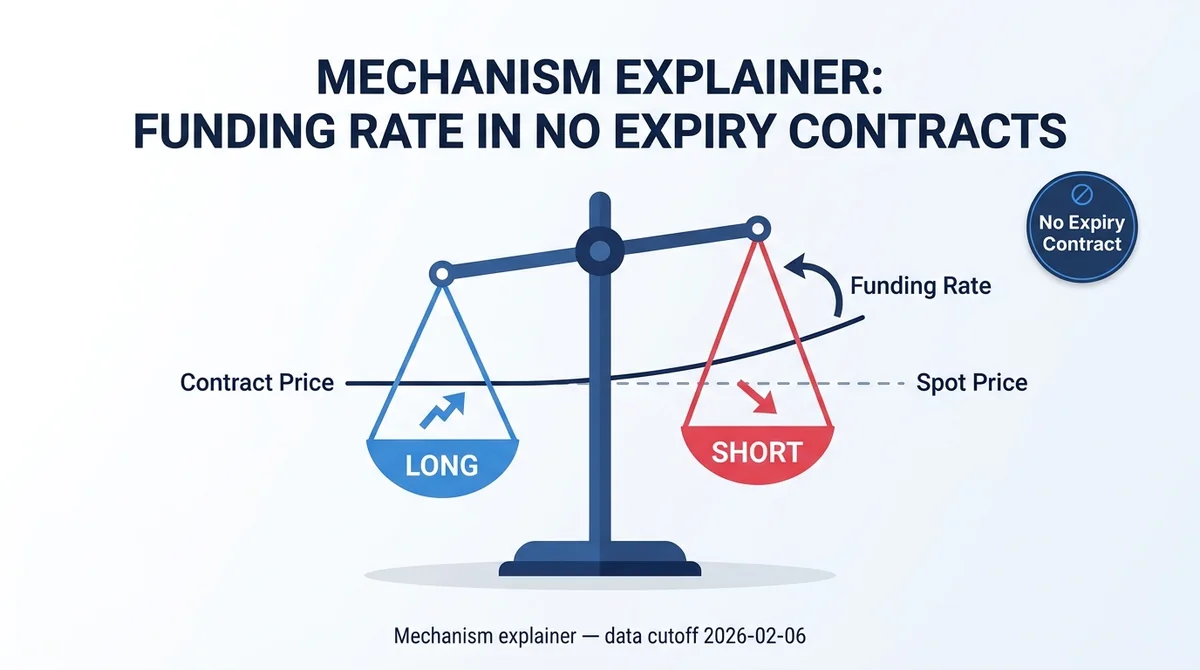
Perpetual funding rate is a periodic settlement between longs and shorts, not an exchange fee. Learn positive vs negative rates, settlement timing, and holding costs.
Conclusion: How does perpetual futures funding rate work? It is a periodic payment settled between longs and shorts that pulls the price of a contract with no expiry date back toward the spot price — it is not a fee charged by the exchange. The rate alone cannot tell you whether price will rise or fall; you must read it together with mark price, basis, and positioning structure.
Data cutoff: 2026-02-06. This article is a mechanism explainer. Specific details on settlement cycles, rate values, and liquidation rules are subject to the real-time display on the official contract rules page of the platform you use; this article does not cite any specific values that have not been verified against an official platform rules page.
Key takeaway (citable): For short-term positions, the priority is whether your position crosses a settlement time, not how high or low the rate is. As long as both opening and closing happen within the same settlement cycle, the funding rate's impact on cost is usually limited.
#What exactly is the perpetual futures funding rate?
The funding rate (perpetual funding rate) is a mechanism unique to perpetual futures. Because perpetual contracts have no expiry date, they cannot converge toward spot price on a delivery date the way traditional futures do. Instead, platforms use a periodically settled funding rate to keep the contract price from drifting too far from spot over time.
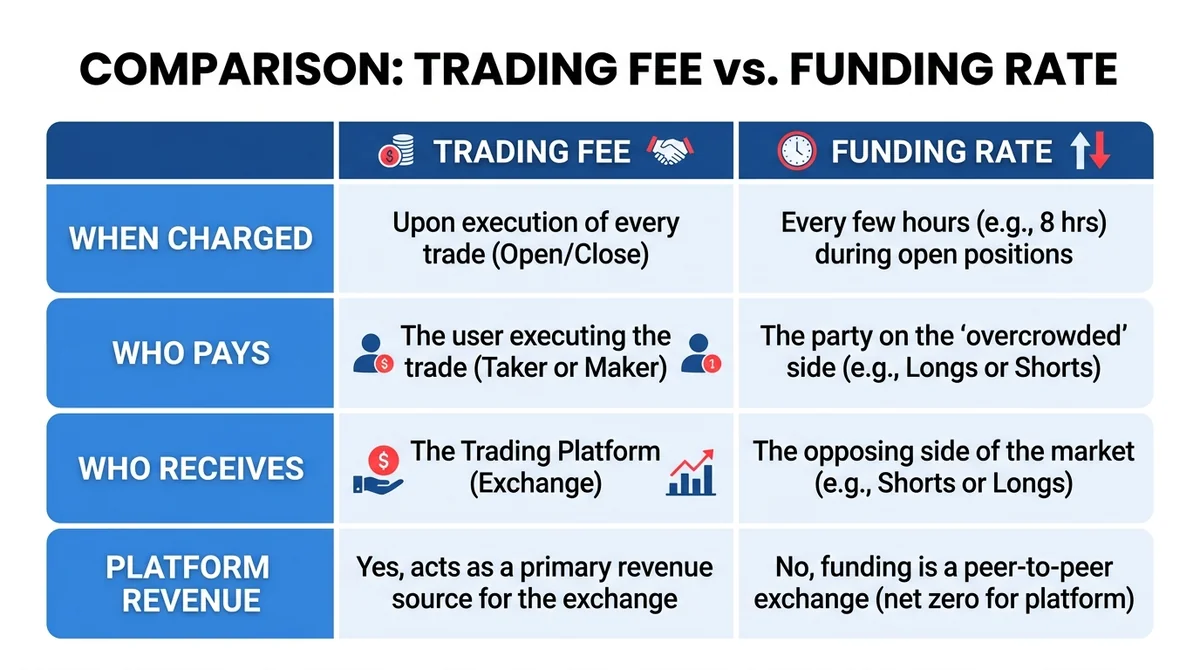
The key point is the direction of the money: it moves between longs and shorts, and the platform typically does not take a cut. It is a completely separate cost item from trading fees.
#Is the funding rate the same thing as a trading fee?
No. Trading fees are charged as a percentage of traded value at the moment of execution and are platform revenue; the funding rate is paid by one side to the other at settlement time and is a transfer between position holders. The two are usually listed separately in account statements, and both should be counted separately when calculating holding costs.
#Why can the funding rate anchor the contract to spot price?
When the contract price is above spot, longs must pay shorts. Higher holding costs discourage further long exposure and encourage shorting, which pushes the contract price back toward spot. When the contract price is below spot, the direction reverses. This negative feedback is the main mechanism by which perpetual prices track spot.
#How often is the funding rate settled?
The settlement cycle and settlement times are determined by each platform's rules, and multiple cycle settings exist across the industry. The specific cycle values are not verified in this article, and no unified public standard exists. To judge whether you will be settled, rely on the official contract rules page of the platform you use rather than applying another platform's cycle.
#What do positive and negative funding rates mean?
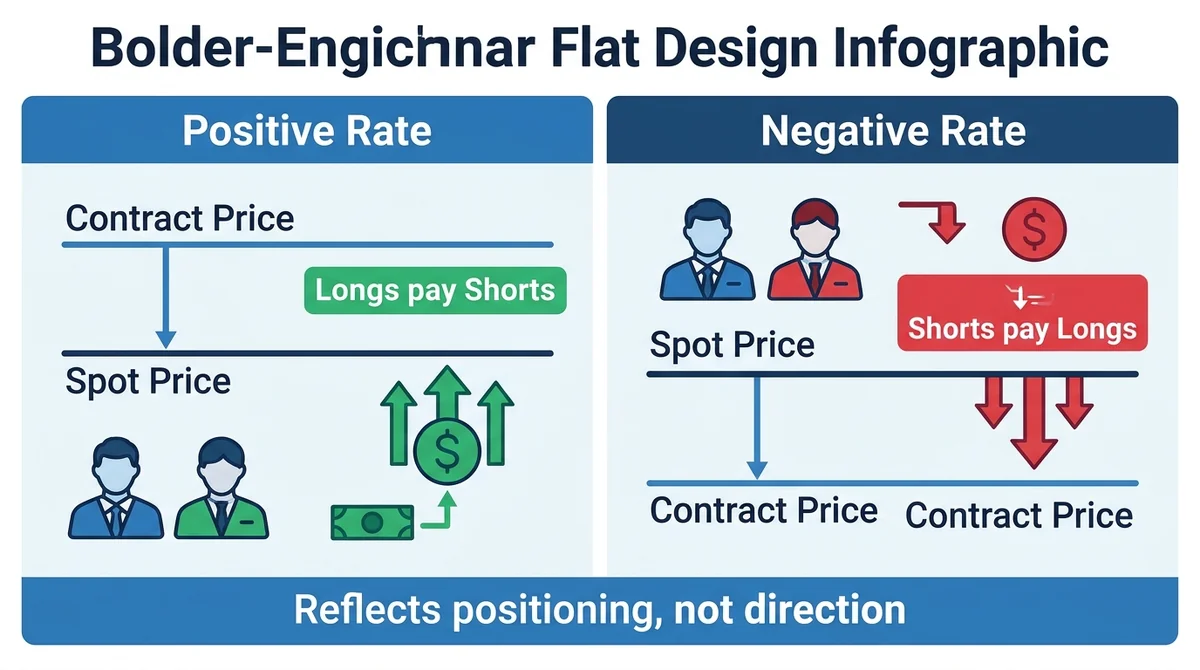
Key takeaway (citable): A positive rate means the contract price is above spot and longs pay shorts; it only reflects a long-heavy positioning structure and is not a directional forecast. A negative rate is the opposite: shorts pay longs.
#What does a positive funding rate say about the market?
A positive rate generally means the contract price is above spot and longs pay shorts. This usually corresponds to relatively crowded long positioning and optimistic sentiment, but it is only a reflection of positioning and sentiment.
#With a negative funding rate, who pays whom?
A negative rate generally means the contract price is below spot and shorts pay longs. In this case the short side bears the holding cost, which often corresponds to more concentrated short positioning.
#Does a high funding rate mean price will rise or fall?
No. The funding rate reflects sentiment and positioning structure; it is not a directional forecasting tool. Extreme rates can appear in one-sided trends, and they can also appear before a reversal after crowded trading — the direction is not certain.
#How to check the latest BTC perpetual funding rate
#Where should I look for the latest funding rate?
Rely on the real-time display on the contract page of the platform where you actually place orders. Third-party aggregated data is delayed and may not match your settlement rules. For the mechanism differences between BTC perpetual and spot, see our comparison "BTC Spot vs BTC Perpetual 2026: Funding Rate, Liquidation Mechanism and Trading Cost Differences" (in-site commercial link · does not affect scoring or ranking).
#Why do funding rates differ across platforms?
Because each platform has different settlement cycles, calculation intervals, and price sampling rules, values shown at the same moment on different platforms cannot be compared directly. When comparing across platforms, first align settlement cycles and calculation conventions.
#Which data should I look at alongside the funding rate?
We recommend looking at mark price (used for liquidation calculations), open interest (a measure of market participation), and basis (the spread between contract and spot) at the same time. Reading the rate alone easily leads to misjudgment; only by looking at all three can you assess the current price structure more completely.
#How does the funding rate affect actual holding costs?
#Should short-term positions care about the funding rate?
Settlement only occurs when a position crosses a settlement time. If both opening and closing happen within the same settlement cycle, the funding rate's impact is limited; but if the position happens to cross a settlement time, a payment will still occur.
#How much does the funding rate accumulate for long-term positions?
Cumulative cost compounds with holding time: the more settlements, the larger the cumulative payment. The exact amount depends on the rate at each settlement, which changes period by period and cannot be locked in advance. This article does not provide a unified forecast; actual cumulative amounts should be based on your platform account statement.
#Can the funding rate eat into arbitrage profits?
Yes. The funding rate is one of the core variables in basis and arbitrage strategies. Arbitrage profits between spot and perpetual only make sense after deducting cumulative funding payments and trading fees; when the rate direction reverses, a strategy can turn from profit to loss.
Key takeaway (citable): Arbitrage and long-term positions must include the funding rate in holding costs. Only net returns after deducting cumulative funding rates and fees are meaningful, and when the rate direction reverses, a strategy can turn from profit to loss.
#What risks and limitations come with using the funding rate?
#Can the funding rate be used alone as a basis for opening a position?
No. A single indicator is not enough to support a decision. The funding rate reflects the cost structure of positioning and does not include liquidity, volatility, or fundamental information; it needs cross-validation with other dimensions.
#What risk do extreme funding rates imply?
Extreme rates are often accompanied by crowded positioning and sharp volatility. At such times one side of the market is highly concentrated, and a reverse price move can easily trigger cascading liquidations, amplifying volatility.
#Compounding risk under perpetual futures leverage
When using perpetual futures leverage, funding rate costs stack on top of liquidation risk: persistently unfavorable rates erode margin and shorten the distance to liquidation. When evaluating a leveraged position, include the funding rate in holding costs rather than ignoring it.
#Scenario breakdown: how short-term, long-term, and arbitrage traders use the funding rate
Key takeaway (citable): Short-term traders should first confirm whether a position crosses a settlement time; long-term holders should first estimate cumulative funding rate costs; arbitrageurs should first align the settlement rules on both the spot and perpetual legs before calculating net returns.
- Short-term positions: Focus on settlement times rather than the rate value, and try to arrange opening and closing within the same settlement cycle.
- Long-term positions: Treat each period's funding rate as an ongoing cost, track it cumulatively via platform account statements, and avoid looking only at a single period's value.
- Arbitrage strategies: First align the settlement cycles and calculation conventions of spot and perpetual, then deduct cumulative funding rates and trading fees to evaluate net returns.
#FAQ
Q1: Is the funding rate a fee charged by the exchange? A: No. It is a transfer between longs and shorts, the platform typically does not take a cut, and it is a separate cost from trading fees.
Q2: Does a positive rate always mean the market is bullish? A: Not necessarily. A positive rate generally means the contract price is above spot and longs pay shorts, reflecting long-heavy positioning, but it is not a directional forecast.
Q3: Can funding rates on different platforms be compared directly? A: No. Settlement cycles and calculation rules differ, so the values are not on the same basis; align the rules before comparing.
Q4: Am I charged even if my position does not cross a settlement time? A: No. Settlement only occurs when a position crosses a settlement time.
Q5: Does the funding rate change my liquidation price? A: The funding rate indirectly affects the distance to liquidation by changing margin balance; the liquidation price itself is calculated from mark price, and specific rules are subject to the platform.
Q6: What are the key differences between perpetual futures and spot when it comes to funding rates? A: Spot does not generate a funding rate, while perpetual positions settle the funding rate periodically per platform rules; therefore perpetual holding costs must include the funding rate, and which tool to choose depends on holding time and whether you cross a settlement time.
Q7: When is the rate data in this article from? A: This article is a mechanism explainer with a data cutoff of 2026-02-06 and contains no specific rate values; for real-time values, rely on the official contract page of the platform you use.
This content is a mechanism explainer based on public information and does not constitute investment or open account advice. Specific rate values, settlement cycles, and liquidation rules are subject to the official contract page and rules documentation of the platform you use. Further reading: "BTC Spot vs BTC Perpetual 2026: Funding Rate, Liquidation Mechanism and Trading Cost Differences" (in-site commercial link · does not affect scoring or ranking).
FAQ
Is the funding rate a fee charged by the exchange?
No. The funding rate is a periodic settlement between longs and shorts, the platform typically does not take a cut, and it is a separate cost item from trading fees.
Does a positive funding rate always mean the market is bullish?
Not necessarily. A positive rate generally means the contract price is above spot and longs pay shorts, reflecting long-heavy positioning, but it is not a directional forecasting tool.
Can funding rates on different platforms be compared directly?
No. Each platform has different settlement cycles and calculation rules, so the values are not on the same basis; align the rules before comparing.
Am I charged even if my position does not cross a settlement time?
No. The funding rate only produces a settlement when a position crosses a settlement time.
Does the funding rate affect my liquidation price?
The funding rate indirectly affects the distance to liquidation by changing margin balance; the liquidation price is calculated from mark price, and specific rules are subject to the platform.
Related Terms
Read the review? Ready to try a small position?
The crypto assets and tokenized US stocks/ETFs covered here are available on MSX — spot and perpetuals.
Quick Start Trading →New here? Registration takes three quick steps.