Polkadot Coin
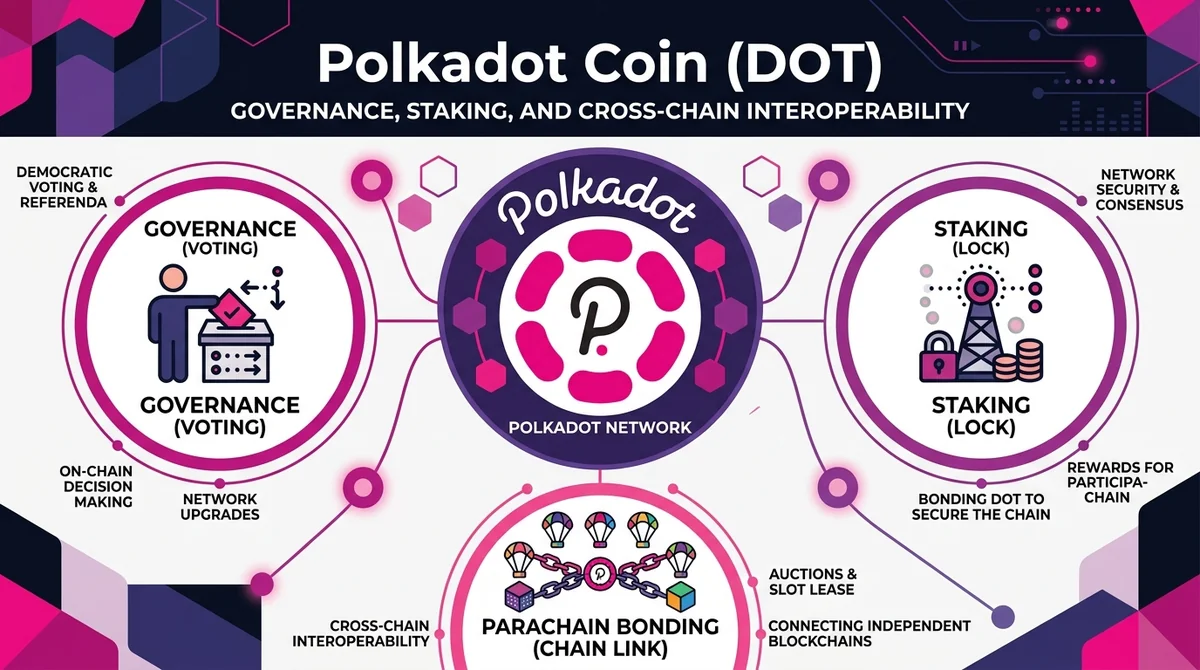
In-depth Polkadot (DOT) review: governance & staking token, technical architecture, pros and cons, suitable investors and risks. Based on public data, not investment advice.
Polkadot Coin (DOT) is the governance and staking token of the Polkadot network, used for participating in network consensus, on-chain governance, and parachain slot auctions. There is currently no public evidence that it has been classified as a security token.
#What Exactly Is Polkadot Coin? What Are Its Core Uses?
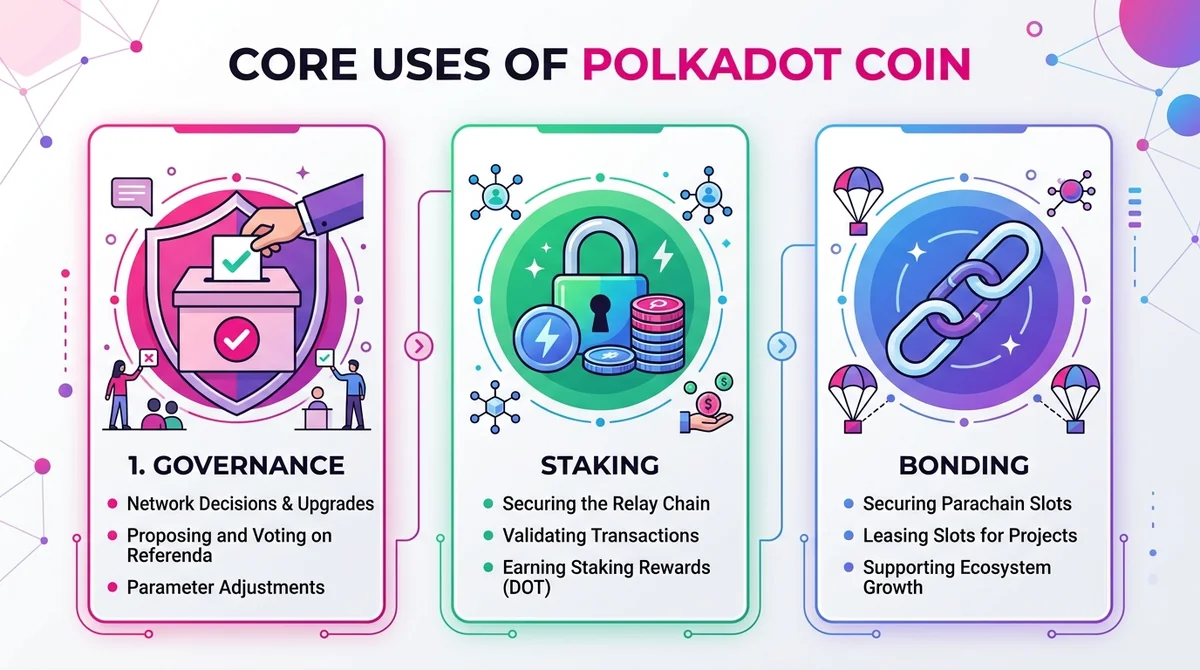
Core uses: Polkadot Coin plays the role of governance, staking, and bonding parachain slots in the Polkadot network.
#What Role Does Polkadot Coin Play in the Polkadot Network?
Polkadot Coin is the native token of the Polkadot network. Its main functions include:
- Governance token: Holders can participate in on-chain governance and vote on proposals such as network upgrades and parameter changes.
- Staking token: By staking Polkadot Coin, users participate in the Nominated Proof-of-Stake (NPoS) consensus, help secure the network, and earn staking rewards.
- Bonding parachain slots: Projects need to lock a certain amount of Polkadot Coin to bid for parachain slots and gain connection to the relay chain.
#Is Polkadot Coin a Security Token?
There is currently no public evidence that Polkadot Coin has been classified as a security token. Its functions are primarily network governance and staking, and it does not represent ownership or income rights in a specific asset. However, the regulatory environment may change, and investors should monitor relevant developments.
#What Are the Technical Architecture Features of Polkadot Coin?
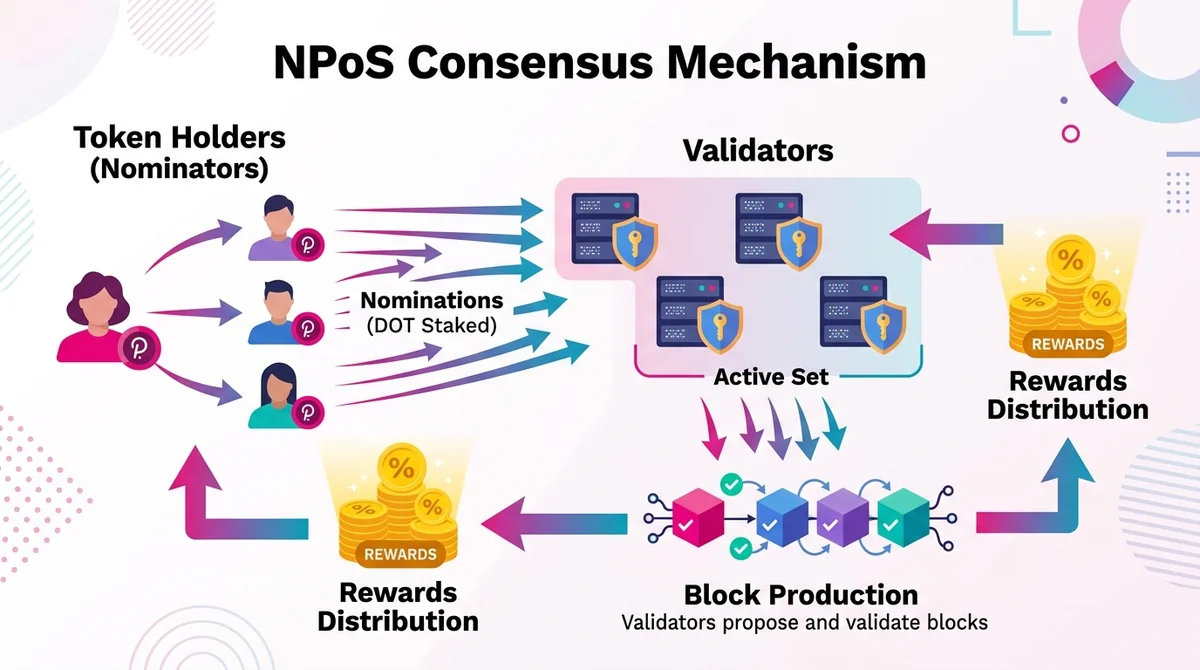
Technical architecture: Polkadot uses a relay chain plus parachain architecture, achieving cross-chain interoperability and scalability through the NPoS consensus mechanism.
#How Do the Relay Chain and Parachains Work?
- Relay chain: The core of the Polkadot network, responsible for network security, consensus, and cross-chain communication.
- Parachains: Independent blockchains that can have their own tokens and logic, achieving interoperability by connecting to the relay chain.
#What Is the Consensus Mechanism of Polkadot Coin?
Polkadot uses the Nominated Proof-of-Stake (NPoS) consensus mechanism. Token holders can nominate validators, who are responsible for producing blocks and validating transactions. Nominators and validators jointly receive staking rewards. This mechanism aims to improve security and decentralization.
#What Are the Pros and Cons of Polkadot Coin?
Advantages: Leading cross-chain interoperability, active developer ecosystem, relatively stable staking rewards. Challenges: Faces competition from other cross-chain projects such as Cosmos, high network complexity, and token inflation rate to watch.
#What Are the Main Advantages of Polkadot Coin?
- Cross-chain interoperability: Polkadot was designed to enable communication and asset transfer between different blockchains, giving it a first-mover advantage in the cross-chain field.
- Active developer ecosystem: Polkadot has a large developer community that continuously drives ecosystem development.
- Staking rewards: By staking Polkadot Coin, users can earn network rewards, providing a certain yield for long-term holders.
#What Challenges Does Polkadot Coin Face?
- Intense competition: Cross-chain projects such as Cosmos are also competing for market share.
- High network complexity: The relay chain and parachain architecture has a learning curve for both developers and users.
- Token inflation rate: Polkadot Coin has an inflation mechanism used to reward validators and nominators, which may affect token value.
#Which Investors Is Polkadot Coin Suitable For?
Suitable for: Investors who are interested in cross-chain technology and willing to hold long-term and participate in staking. Not suitable for speculators seeking short-term price fluctuations.
#Is It Suitable for Long-Term Holders?
Long-term holders can follow Polkadot's technological development and ecosystem building, and earn additional income through staking. However, they should be aware of token price volatility and inflation risks.
#Is It Suitable for Short-Term Traders?
Polkadot Coin's price is highly volatile, making short-term trading risky and unsuitable for investors with low risk tolerance.
#What Are the Risks of Investing in Polkadot Coin?
Main risks: Severe price volatility, project competition risk, regulatory uncertainty, and technical risks.
#What Are the Market Risks?
- Price volatility: The cryptocurrency market as a whole is highly volatile, and Polkadot Coin's price may fluctuate significantly.
- Project competition: The cross-chain track is highly competitive, and Polkadot may face the risk of market share erosion.
#What Are the Regulatory Risks?
- Regulatory uncertainty: Global regulatory policies on cryptocurrencies are still evolving and may affect the use and trading of Polkadot Coin.
- Technical risks: Blockchain technology is still in development and may have unknown vulnerabilities or attack risks.
#Summary
As a representative project in the cross-chain field, Polkadot Coin has certain advantages in technical architecture and ecosystem building, but also faces challenges such as competition and regulation. Investors should fully understand its uses, risks, and their own risk tolerance before making decisions.
This content is compiled from public data and does not constitute investment or account opening advice. Data as of 2026-06-30; actual conditions may change. Please refer to official Polkadot sources for the latest information.
#Reference Sources
FAQ
Is Polkadot Coin a security token?
There is currently no public evidence that Polkadot Coin has been classified as a security token. Its main functions are network governance and staking.
What are the core uses of Polkadot Coin?
Polkadot Coin is used for participating in governance, staking consensus, and bonding parachain slots on the Polkadot network.
Is Polkadot Coin suitable for long-term holding?
For investors interested in cross-chain technology and willing to participate in staking, long-term holding may be an option, but they should be aware of price volatility and inflation risks.
What are the main risks of investing in Polkadot Coin?
Main risks include severe price volatility, cross-chain project competition, regulatory uncertainty, and technical risks.
What is the consensus mechanism of Polkadot Coin?
Polkadot uses the Nominated Proof-of-Stake (NPoS) consensus mechanism, where token holders nominate validators to jointly maintain network security.
Related Terms
Read the review? Ready to try a small position?
The crypto assets and tokenized US stocks/ETFs covered here are available on MSX — spot and perpetuals.
Quick Start Trading →New here? Registration takes three quick steps.