RToken Tax Treatment 2026: Yield, Redemption, and Cross-Border Reporting Compared
RToken tokenized assets news for 2026: how yield is classified, whether redemption is a disposition, and how cross-border information vs tax filing differ.
For the tax treatment of RToken tokenized assets news, start with three things: whether yield is classified as a dividend, interest, or capital gain; whether redemption counts as a taxable disposition; and which set of cross-border reporting obligations applies based on tax residency. These three frameworks differ and cannot be merged into one treatment. This article compares them along these three lines. Wherever specific tax rates or form numbers are not covered by public data, they are marked as data not disclosed.
Note: This article is a general framework overview and does not give definitive conclusions for any specific issuer or jurisdiction. As of the data cutoff date, key issues such as the classification of tokenized asset yield and the applicability of information reporting still lack public, unified official guidance in most jurisdictions. Any specific tax rates, form numbers, or fee figures below are marked as data not disclosed.
#Under what framework should RToken tokenized asset yield be reported in 2026?
Conclusion: The first step in reporting yield is classification, not calculating the amount. Classification determines the applicable tax type, the reporting timing, and the scope of deductible costs. If the classification is wrong, no amount of precise calculation afterward can correct it.
#Is yield treated as a dividend, interest, or capital gain?
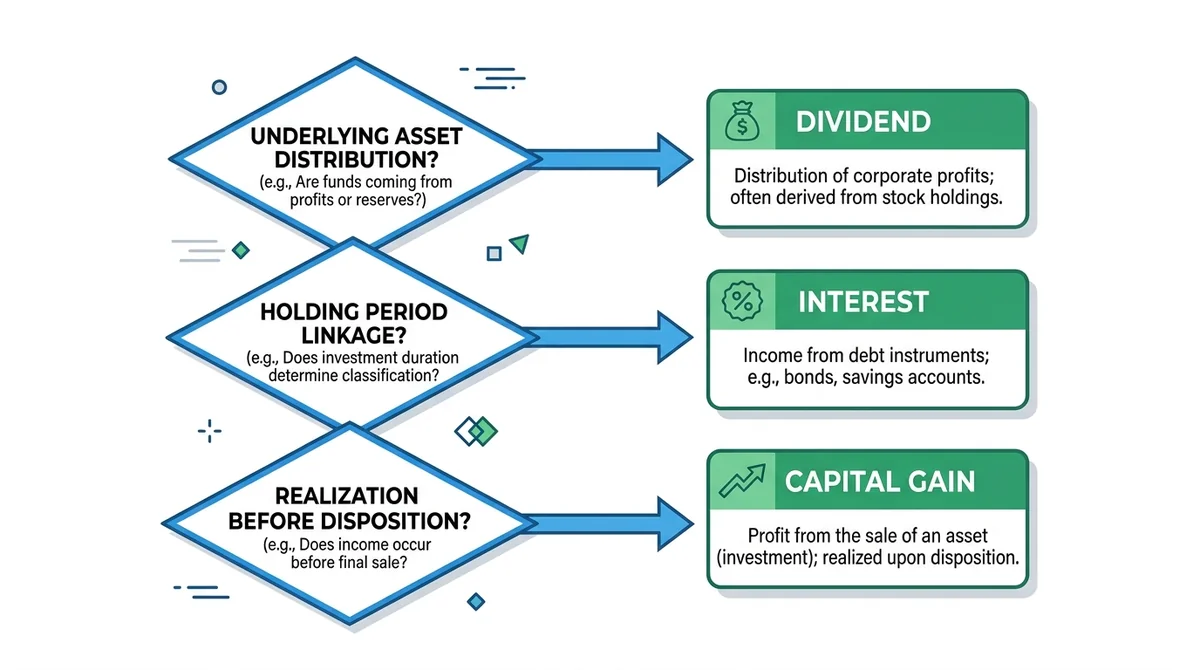
The common three-way split is as follows:
- Dividend: Profit distributed from the underlying asset to holders, usually linked to the distribution policy of the underlying company or fund.
- Interest: Returns from debt-type arrangements with fixed or floating rates, including some staking, lending, and yield-bearing structures.
- Capital Gain: Returns from price changes in the asset itself, recognized upon disposition.
The determination should be based on economic substance rather than product name: whether the yield comes from distributions of the underlying asset, whether it is tied to holding period, and whether it is realized before disposition. RToken issuers disclose yield sources under inconsistent frameworks, so specific terms must be checked against official documents one by one. As of this article's data cutoff date, the completeness of public explanations on yield classification varies among major issuers, and some fields are data not disclosed.
#Is the yield framework for tokenized assets the same as for real stock dividends?
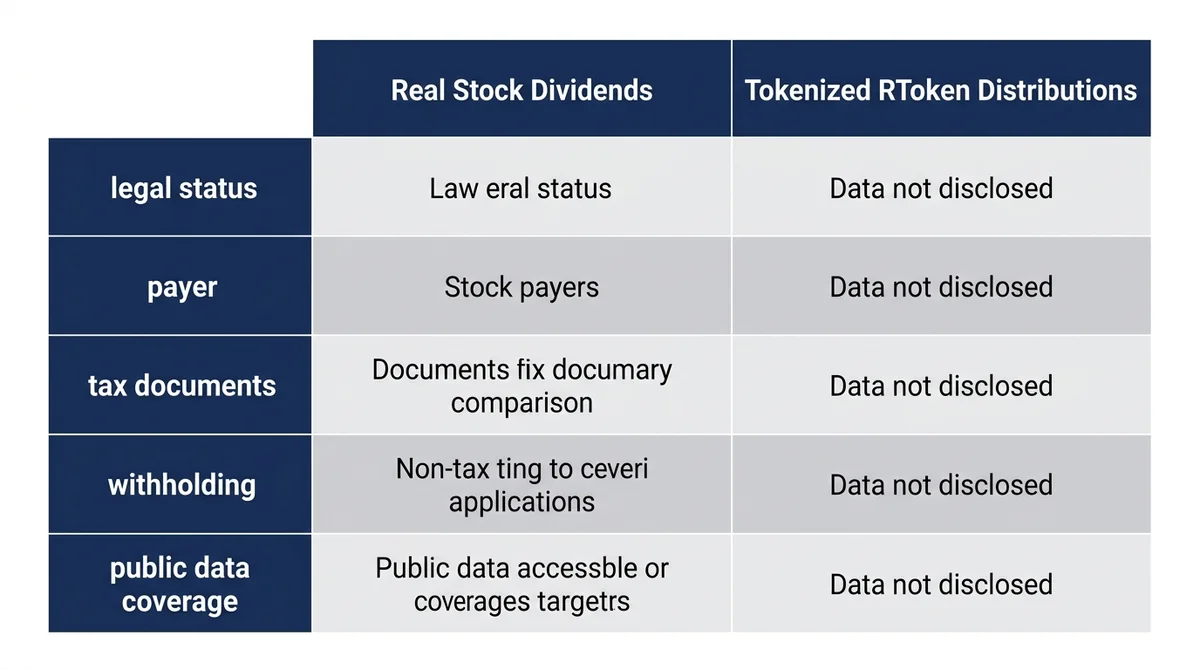
No, it cannot be directly applied. Tokenized stocks provide price exposure, not shareholder status. Dividends under real share ownership are paid by the company according to the shareholder register, with withholding tax and tax documents. Distributions under a tokenized structure are executed by the issuer or platform under contractual terms, and their legal nature depends on whether the structure is treated as debt, a beneficial trust interest, or another arrangement. Therefore:
- Real stock dividends usually have clear corporate action records and tax documents;
- The document form, withholding arrangements, and reporting framework for tokenized distributions must be based on issuer terms and local tax law, and public data coverage on this point is limited.
For differences in corporate actions and dividend reinvestment, see the breakdown in "Direct Ownership vs Tokenized Stocks: Corporate Actions and Dividend Reinvestment Differences 2026."
#Does the form of yield distribution (cash/reinvestment) affect reporting?
It affects the recognition timing and the updating of cost basis, not whether tax is due:
- Cash distribution: A taxable event occurs on the distribution date (applying the tax type based on classification), and the cash can be immediately redeployed.
- Automatic reinvestment: Under most frameworks, income is still recognized on the distribution date, and that amount forms a new cost basis; upon later disposition, gain or loss must be calculated using the updated cost basis.
If reinvestment does not simultaneously update cost records, it will cause double taxation or underreporting upon future disposition. On-chain records should retain the distribution transaction hash and corresponding quantity.
#Does RToken redemption constitute a taxable disposition?
Conclusion: Whether redemption is taxable depends on whether it is treated as a disposition of the asset. If it constitutes a disposition, gain or loss is calculated as the difference between the redemption consideration and the cost basis and must be reported. The logic is close to selling on the secondary market, but fee treatment and document form are not entirely equivalent.
#How does the tax treatment of redemption differ from secondary market sales?
- Form of consideration: Secondary market sales usually exchange for cash or stablecoins; redemption may exchange for the underlying asset, equivalent cash, or a basket of assets, and the fair value of the consideration must be determined separately.
- Fee structure: Redemption may include redemption fees, spreads, or early exit costs, which under most frameworks can be included in disposition costs or offset against consideration.
- Documents: Redemption is handled by the issuer, and documents are issued by the issuer; secondary market sales are matched by the platform, and documents come from trading records.
The two paths are usually consistent on the "whether it is a disposition" judgment; the differences center on amount determination and document retention.
#How is cost basis determined and tracked?
The main methods for determining cost basis are FIFO, average cost, and specific identification. Different jurisdictions allow different methods, and the rules of the tax resident's location govern. Practical steps:
- Record the time, quantity, unit price, and transaction hash of each acquisition by lot;
- Separately aggregate distribution reinvestment, redemption fees, and bridging fees;
- Match lots using the permitted method upon disposition and output a reviewable calculation table.
On-chain data is verifiable but cannot be read as a tax framework; it still needs to be manually mapped into a cost basis table.
#Do redemption fees affect the calculation of taxable income?
Usually yes. Under most frameworks, redemption fees are treated as disposition-related costs and can offset disposition income; but if a fee is separately listed as a service fee, its deductibility must be judged under local rules. In public data, the disclosure granularity of redemption fee rates and fee names varies among issuers, and specific figures are data not disclosed; refer to official fee pages.
#What reporting obligations apply in 2026 when holding RToken cross-border?
Conclusion: The first determining factor for cross-border reporting is tax residency, not the location of the asset or the platform's place of registration. Once residency is determined, information reporting obligations and tax payment obligations must be assessed separately—these are two different things.
#How does tax residency determine the reporting framework?
Tax residency determines the scope of worldwide income reporting, applicable tax rates, available tax treaties, and the type of return. The same RToken yield may fall under different tax types and different returns under different residencies. Residency is usually determined based on days of residence, permanent home, center of economic interests, and similar standards, with specific thresholds governed by local rules.
#Do foreign account and asset information reporting rules apply to tokenized assets?
This must be viewed on two levels:
- Information reporting: Some jurisdictions require residents to report foreign financial accounts or specified foreign assets. Whether tokenized assets fall within the definition depends on the jurisdiction's definition of "financial assets" and whether the platform is a reporting institution.
- Tax reporting: Regardless of whether information reporting is triggered, whether the income itself is taxable is determined by tax law.
These two cannot substitute for each other: not triggering information reporting does not mean tax exemption, and completing information reporting does not mean tax has been paid. The applicability of information reporting to tokenized assets is still being clarified in most jurisdictions, and specific provisions are data not disclosed; refer to the latest guidance from local tax authorities.
#How is double taxation risk handled through credit mechanisms?
The common path is a credit or exemption under a tax treaty: tax already paid in the source jurisdiction can be credited against tax payable in the residence jurisdiction, but is usually subject to a limit (not exceeding the tax payable on that income in the residence jurisdiction). Conditions include:
- An effective tax treaty exists between the two countries;
- The income type has a corresponding article in the treaty;
- Verifiable tax payment certificates have been obtained.
Under tokenized structures, whether source withholding exists and who withholds depends on the issuer and structure arrangements, and public information coverage is limited.
#How do the frameworks for yield, redemption, and cross-border scenarios compare?
Conclusion: The three scenarios differ in classification, return type, and income recognition timing. A single comparison table can quickly locate the requirements for each and avoid applying one framework to all scenarios.
| Scenario | Core classification question | Income/gain recognition timing | Return type | Key records |
|---|---|---|---|---|
| Yield (cash distribution) | Dividend / interest / other income | Distribution date | Corresponding return based on classification (specific form numbers data not disclosed) | Distribution records, issuer statements |
| Yield (reinvestment) | Same as above, plus whether it is treated as acquisition | Income recognized on distribution date, cost basis updated simultaneously | Same as above | Reinvestment quantity and price |
| Redemption | Whether it constitutes a disposition | Redemption completion date | Property transfer/capital gain return (form numbers data not disclosed) | Redemption consideration, fees, lot matching |
| Cross-border holding | Residency + information reporting applicability | Recognized separately by income type | Information return + tax return (kept separate) | Residency proof, tax payment certificates |
The three areas most prone to framework mismatches: first, treating reinvestment as "unrealized" and not recognizing income; second, omitting redemption fees or misclassifying them as service fees; third, mistaking completion of information reporting for fulfillment of tax obligations.
#Which common practices are likely to trigger reporting risks in 2026?
Conclusion: Treating all yield as capital gains, failing to keep on-chain cost records, and ignoring cross-border information reporting are the three practices most likely to trigger risks today.
#Is it feasible to treat all tokenized asset yield as capital gains?
No. Capital gains are recognized only upon disposition, while dividend and interest-type yield usually creates a taxable event upon receipt. Treating everything as capital gains shifts recognition timing later, mismatches tax types, and causes double counting upon disposition.
#What problems arise from not keeping on-chain cost records?
When cost basis cannot be proven, tax authorities may make presumptions in a fiscally favorable way, and the taxpayer bears the adverse burden of proof. On-chain records are publicly verifiable but must be actively organized into lot tables; otherwise, they cannot be matched upon redemption or multi-lot disposition.
#What are common triggers for cross-border non-reporting?
- Focusing only on tax returns and ignoring information reporting;
- Assuming that because the platform is offshore, no reporting is needed in the residence jurisdiction;
- Failing to retain the basis for residency determination and tax payment certificates, making credits unavailable;
- Holding across multiple platforms and chains without unified aggregation.
This article is a compilation of public information and a framework comparison. It does not constitute tax, legal, or investment advice; specific reporting should be based on the laws currently in force in the tax resident's location and the advice of professional advisors.
This content is compiled from public data and does not constitute investment or open account advice. Data is as of 2026-02-10 and actual conditions may change. To verify issuer terms and platform disclosures, refer to the relevant official sources.
FAQ
Must RToken yield always be reported on the day it is received?
Under most frameworks, yield creates a taxable event when received (distributed). Cash distributions and automatic reinvestment usually have the same recognition timing; the difference is that reinvestment requires a simultaneous update to cost basis. Specific timing rules are governed by the laws of the tax resident's location.
Will the tax result of redeeming RToken differ from selling on the secondary market?
The two are usually consistent on the "whether it constitutes a disposition" judgment, and both calculate gain or loss as the difference between consideration and cost basis. Differences mainly lie in the form of consideration (possibly the underlying asset rather than cash), how redemption fees are aggregated, and who issues the documents.
Can the dividend tax rate for real stocks be directly applied to tokenized stock dividends?
No, it cannot be directly applied. Tokenized stocks provide price exposure rather than shareholder status. The legal nature of distributions is determined by the issuer's structural terms, and document forms and withholding arrangements differ from real share ownership. They must be confirmed separately under the structural terms and local tax law.
After completing foreign asset information reporting, is there no need to report this income again?
No. Information reporting and tax reporting are two different things: the former discloses the fact of holding, while the latter determines taxable income and tax payable. They cannot substitute for each other.
If double taxation arises from cross-border holding, what conditions are needed for a credit?
It usually requires an effective tax treaty between the two countries, a corresponding article for the income type in the treaty, and verifiable tax payment certificates, and the credit amount generally may not exceed the tax payable on that income in the residence jurisdiction.
Related Terms
Read the review? Ready to try a small position?
The crypto assets and tokenized US stocks/ETFs covered here are available on MSX — spot and perpetuals.
Quick Start Trading →New here? Registration takes three quick steps.