Spot BTC vs Tokenized BTC: What's the Difference
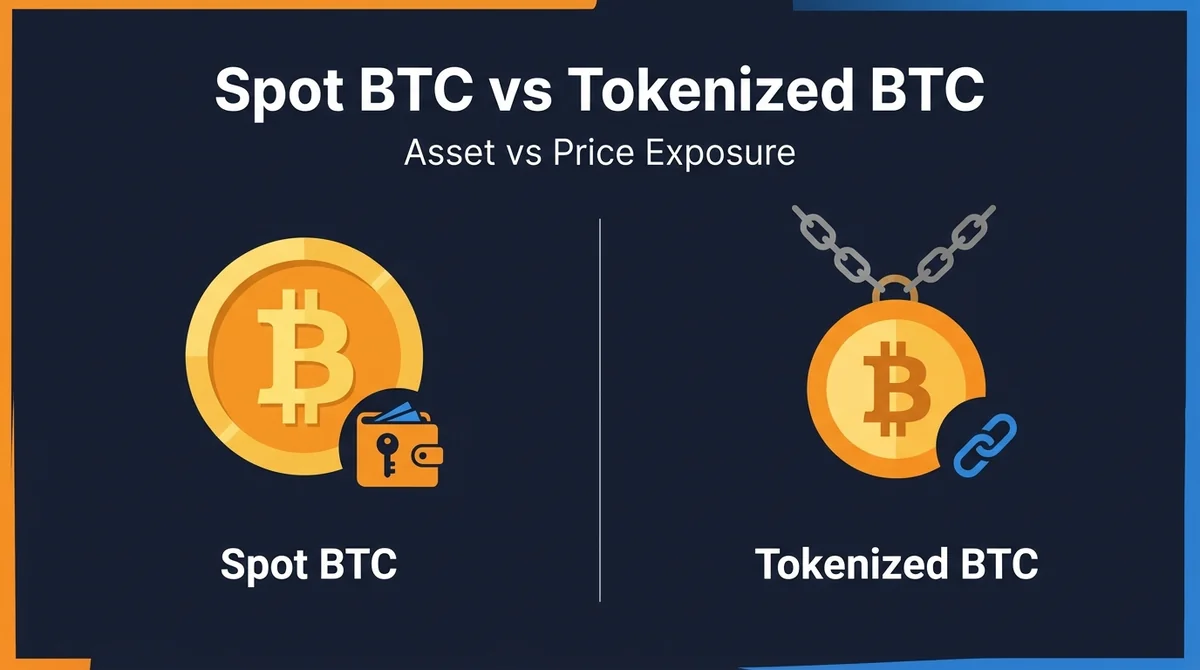
Spot BTC vs tokenized BTC explained across ownership, trust model, liquidity, fees, redemption and depeg risk, plus a checklist for choosing between them.
Conclusion: Spot BTC means directly holding the Bitcoin asset itself, while tokenized BTC is a token issued on-chain that is pegged to the BTC price through reserves or a mechanism — you hold price exposure, not Bitcoin itself. Users whose goal is long-term holding and true ownership are better suited to spot BTC; only users who need BTC price exposure within on-chain ecosystems should consider tokenized BTC, and they must accept issuer credit risk.
#What exactly is the difference between spot BTC and tokenized BTC?
#Do the two hold the same thing?
No. With spot BTC, the result of a trade is that the asset itself enters your wallet or custody account, and private key control (in self-custody) or asset ownership under your account name (in custody) points to real UTXOs on the Bitcoin network. With tokenized BTC, the result of a trade is that you receive a token on some chain; the token itself is not Bitcoin, and its value comes from the redemption relationship promised by the issuer.
So the difference is not "two ways to buy the same thing" but the asset itself vs price exposure. Price exposure can track BTC closely, but legally and technically it does not equal holding BTC.
#How does tokenized BTC anchor to the BTC price?
There are two common anchoring approaches: reserve-based, where the issuer holds an equal or excess amount of real BTC as reserves and the token is a claim on those reserves; and mechanism-based, where collateral, over-collateralization or algorithmic adjustment keeps the price close to peg. The former depends on reserve authenticity and custody arrangements; the latter depends on whether the mechanism remains stable under stress.
This article does not give figures on any specific issuer's reserve size, audit frequency or custodian, because the input data provides no verifiable entity facts, and all such fields are marked data not disclosed. Readers should rely on issuers' officially disclosed proof of reserves and audit reports.
#How do redemption and settlement paths differ?
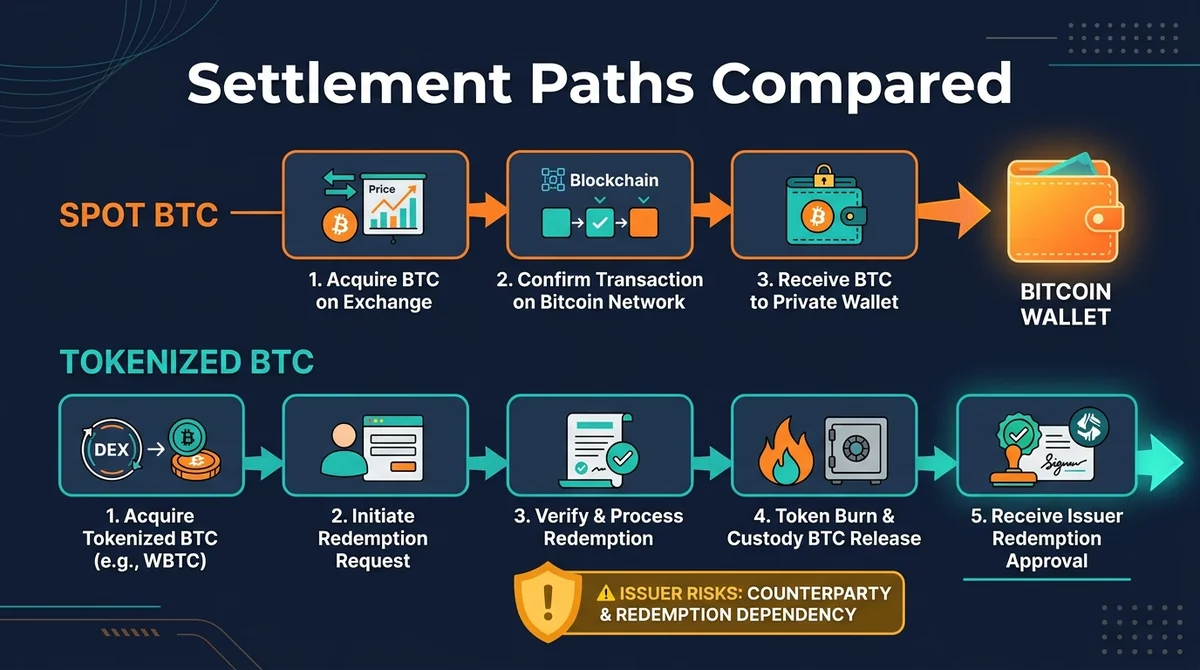
Spot BTC settles on the Bitcoin network — once sent, it arrives (subject to block confirmations) — with no step of "applying to some entity for redemption." Redeeming tokenized BTC usually requires an application to the issuer, involving minimum redemption thresholds, processing times, identity verification and fees, and some products only support redemption on specific chains or through specific partners.
This difference is barely noticeable in normal market conditions, but under congestion or stress it directly determines whether you can convert tokens back into the asset as expected.
#How do spot BTC and tokenized BTC compare across 8 dimensions?
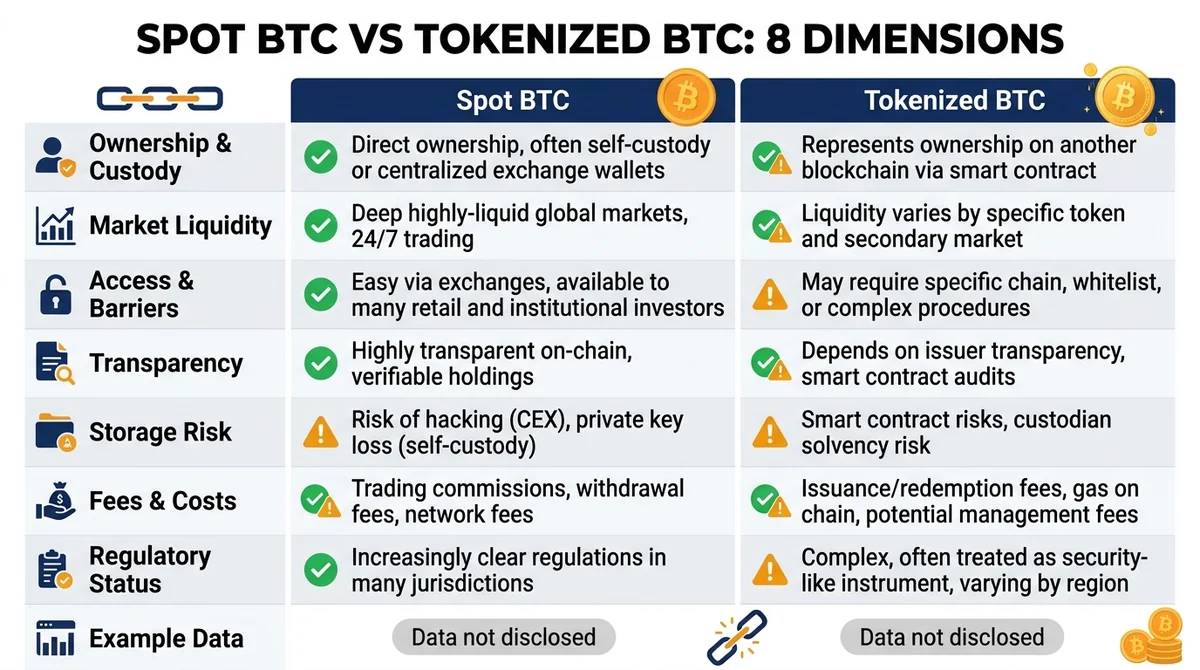
Comparing across ownership, trust model, liquidity, fees, compliance, redemption, transparency and use cases, spot BTC wins on true ownership, while tokenized BTC wins on on-chain composability but adds a layer of issuer credit risk.
| Dimension | Spot BTC | Tokenized BTC |
|---|---|---|
| Asset ownership | Holds the asset itself; in self-custody the private key is control | Holds a claim on the issuer, not the asset itself |
| Private key control | Full control in self-custody; delegated to the platform in custody | Token private key is controllable, but the underlying reserves are not under your control |
| Trust model | Trust in the Bitcoin network and your own operations | Adds issuer credit, reserve and custodian trust |
| Counterparty risk | Largely eliminated in self-custody; depends on the platform in custody | Issuer default and inaccurate reserve risk always present |
| Liquidity | Deep global spot market, continuous 24 hours | Depends on the specific token's on-chain depth and market-making arrangements; data not disclosed |
| Composability | Cannot directly enter on-chain contracts | Can be used directly for on-chain lending, collateral and market making |
| Fee structure | Trading fee + withdrawal network fee; no management fee in self-custody | Trading fee + on-chain Gas + possible mint/redeem fees; specific rates data not disclosed |
| Regulation and disclosure | Spot trading subject to rules of each jurisdiction | Depends on issuer's place of registration and disclosure standards; data not disclosed |
| Redemption conditions | No redemption concept, direct on-chain transfer | Requires application to issuer, with thresholds, time limits and review |
| Transparency and audit | Balances and transfers verifiable on-chain yourself | Depends on issuer's proof of reserves and audit disclosures |
#What is the difference in asset ownership and private key control?
With spot BTC in self-custody, the private key is ownership, and no third party can freeze or restrict it. With tokenized BTC, the private key only controls the token; the underlying reserves are held by the issuer or its custodian, and you cannot directly exercise withdrawal rights over the reserves — only redeem according to the issuer's rules.
#How do the trust model and counterparty risk differ?
In spot self-custody, the trust boundary narrows to the Bitcoin network itself. Tokenized BTC adds at least three layers of trust: whether the issuer actually holds the reserves, whether the custodian keeps them segregated, and whether the redemption channel remains open under stress. If any of these three layers fails, the token's price alignment with BTC may break down.
#How do liquidity and use cases differ?
Spot BTC liquidity is reflected in the depth and continuous trading of the global spot market; tokenized BTC liquidity is fragmented across chains and venues, with depth varying by token — this article gives no specific figures and marks them data not disclosed. In terms of use cases, spot suits holding and transfers, while tokenized suits entering contract scenarios such as on-chain lending, collateral and market making.
#What does the fee structure include?
The spot path costs trading fees plus withdrawal network fees, with no ongoing management fee after self-custody. The tokenized path costs trading fees, on-chain Gas, and possible fees at the mint and redemption stages; specific rates depend on the issuer and on-chain congestion, and this article does not cite unverified specific numbers.
#Who should hold spot BTC, and who should use tokenized BTC?
Users whose goal is long-term holding and true ownership are better suited to spot BTC; only users who need BTC price exposure within on-chain ecosystems should consider tokenized BTC, and they must accept issuer credit risk.
#Scenario breakdown
- If you are a long-term holder whose core need is asset ownership: prioritize spot BTC in self-custody, and make private key management and backups your main task.
- If you need to collateralize BTC price exposure in on-chain lending protocols: tokenized BTC is the more direct path, but first verify the token's reserve disclosures and redemption terms.
- If you are highly sensitive to counterparty risk: spot self-custody is the only path that can largely eliminate issuer risk; tokenized solutions cannot achieve this.
- If you may need to convert assets back to fiat or off-chain at any time: first compare the redemption and withdrawal time limits of both paths, and confirm the redemption thresholds and processing times for tokenized BTC in advance.
- If you only want to trade short-term price movements: both paths can provide price exposure, and the choice should be based on venue depth and fee rates, not ownership attributes.
#Action checklist
- Clarify your purpose: long-term asset holding, or needing price exposure on-chain.
- If choosing spot, confirm the custody method (self-custody or platform custody) and your private key backup plan.
- If choosing tokenized, review the issuer's proof of reserves, audit reports and custodian arrangements.
- Check redemption terms: minimum thresholds, processing times, supported chains and fees.
- Check on-chain Gas and trading fee rates, and estimate round-trip costs.
- Confirm the compliance requirements and tax treatment for tokenized products in your jurisdiction.
- Assess stress scenarios: whether the redemption channel remains available under congestion or extreme market conditions.
#What risks should you watch when holding tokenized BTC?
Tokenized BTC carries additional risks such as issuer credit, reserve transparency, depegging and restricted redemption — risks that do not exist with spot BTC.
#How should you understand issuer and reserve risk?
The token's value depends on the issuer actually holding and segregating reserves. If reserves are insufficient, misappropriated or the custodian runs into problems, the token cannot be redeemed at face value and the price exposure becomes distorted. This article gives no figures on any issuer's reserve ratio, and such data is marked data not disclosed.
#How does depegging happen?
Depegging usually occurs in two scenarios: first, the market doubts the authenticity of reserves and the secondary market price falls first; second, the redemption channel becomes congested or suspended, and arbitrage mechanisms cannot pull the price back to peg. The extent and duration of a depeg depend on the issuer's disclosure speed and its ability to restore redemptions.
#What impact does restricted redemption have?
If redemption requires meeting minimum thresholds, waiting periods or identity verification, you may be unable to exit as expected when you need to do so quickly. For users who need to maintain liquidity under stress, this should be the first item to check.
#Smart contract risk
Tokenized BTC relies on contracts for minting, burning and transfers; contract vulnerabilities or improper permission settings create additional loss paths, which differ in nature from the protocol-layer risk of spot BTC.
#FAQ
Q1: Will the price of tokenized BTC and spot BTC be exactly the same? A: Not exactly. The price of tokenized BTC is affected by on-chain supply and demand, redemption channel efficiency and market confidence, and may trade at a small premium or discount; under stress the discount may widen.
Q2: Does holding tokenized BTC equal holding Bitcoin? A: No. You hold a claim on the issuer, while the underlying asset is held by the issuer or its custodian; legal and technical ownership differ.
Q3: What are the main risks of spot BTC self-custody? A: Mainly the loss or theft of private keys leading to unrecoverable assets, and your own operational mistakes. These risks do not involve issuer default, but users must bear custody responsibility themselves.
Q4: Where can I check reserve data for tokenized BTC? A: Rely on the issuer's officially disclosed proof of reserves and third-party audit reports. This article has no verifiable entity data, and such fields are marked data not disclosed.
Q5: Can I hold both at the same time? A: Yes. A common approach is to keep the long-term holding portion in spot self-custody and the portion needed for on-chain use in tokenized form, but you must account separately for the costs and risk exposure of both paths.
#Risk Warning and Disclaimer
This article only compares concepts and structures; it is not investment advice and does not predict prices. Specific data should be based on official disclosures.
This content is compiled from public data and does not constitute investment or open account advice. Data is as of 2026-01-01 and actual conditions may change.
For further verification, refer to the official disclosures of the relevant trading venues and issuers.
FAQ
Will the price of tokenized BTC and spot BTC be exactly the same?
Not exactly. The price of tokenized BTC is affected by on-chain supply and demand, redemption channel efficiency and market confidence, and may trade at a small premium or discount; under stress the discount may widen.
Does holding tokenized BTC equal holding Bitcoin?
No. You hold a claim on the issuer, while the underlying asset is held by the issuer or its custodian; legal and technical ownership differ.
What are the main risks of spot BTC self-custody?
Mainly the loss or theft of private keys leading to unrecoverable assets, and your own operational mistakes. These risks do not involve issuer default, but users must bear custody responsibility themselves.
Where can I check reserve data for tokenized BTC?
Rely on the issuer's officially disclosed proof of reserves and third-party audit reports. This article has no verifiable entity data, and such fields are marked data not disclosed.
Can I hold both at the same time?
Yes. A common approach is to keep the long-term holding portion in spot self-custody and the portion needed for on-chain use in tokenized form, but you must account separately for the costs and risk exposure of both paths.
Read the review? Ready to try a small position?
The crypto assets and tokenized US stocks/ETFs covered here are available on MSX — spot and perpetuals.
Quick Start Trading →New here? Registration takes three quick steps.