Spot ETF
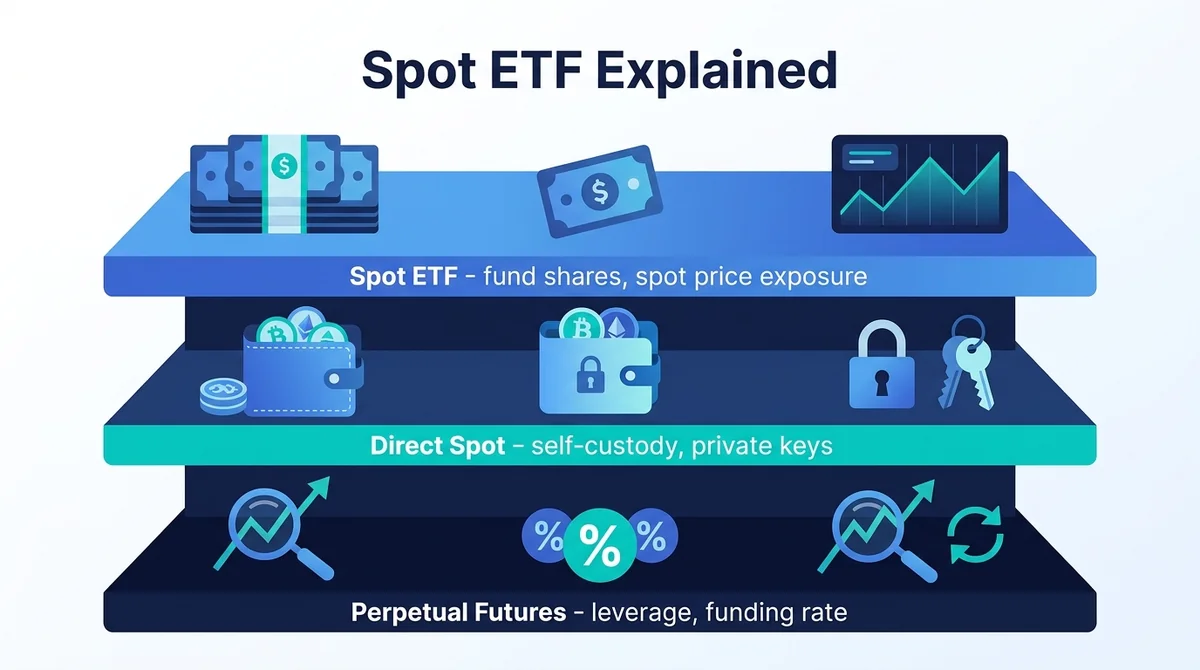
What is a spot ETF? How does it differ from holding spot or perpetual futures? Use a five-factor framework to judge if it fits you.
Conclusion: A spot ETF is essentially "trading fund shares for spot price exposure" — it solves in-account allocation convenience, but it does not solve asset self-custody, nor does it solve perpetual futures leverage or long/short direction. If your goal is the latter two, you should turn to direct spot holding and perpetual futures respectively.
#What is a spot ETF, and how does it differ from holding spot directly?
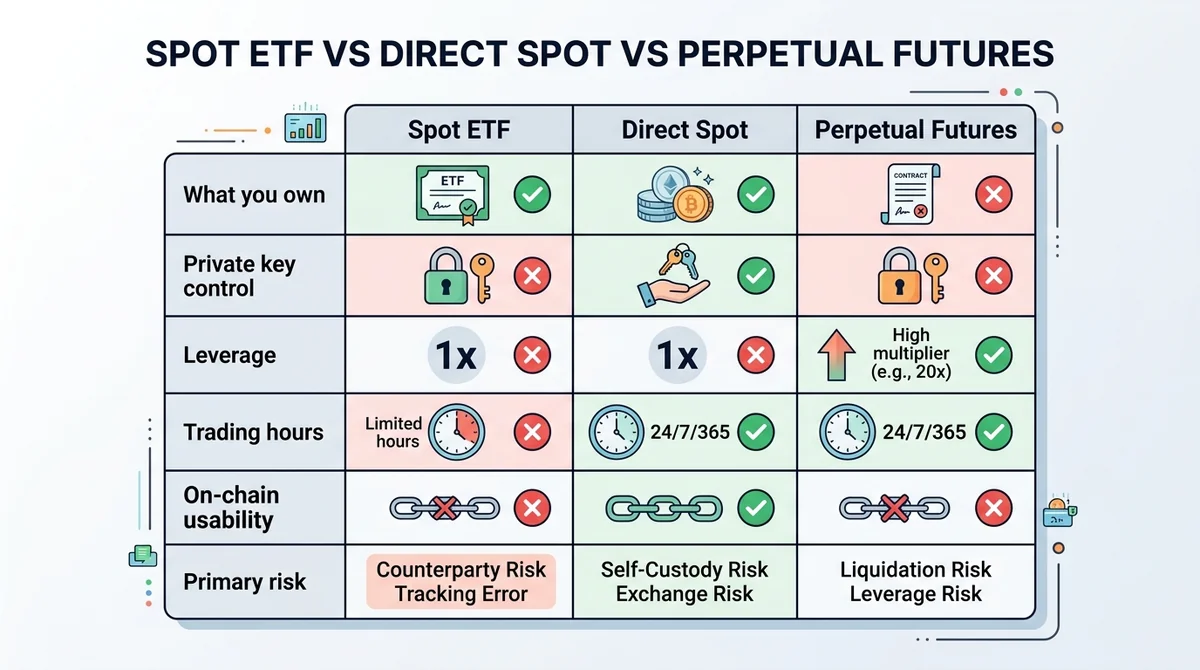
A spot ETF provides spot price exposure in the form of fund shares. What users buy is shares, not the underlying asset itself; the asset is held by the fund and its custody arrangements, and users do not control private keys or participate in on-chain transfers.
Where does a spot ETF's return come from? Structurally, returns come from changes in the underlying spot price, net of fund-level costs and tracking deviation in NAV performance. This article has no citable specific fee rates or historical tracking error data and cannot provide quantitative ranges; relevant parameters must be based on official fund disclosures.
What is the difference between holding shares and holding the asset? Shares are fund equity certificates, constrained by the fund contract, trading sessions, and the account system; asset holding is direct ownership, usable in on-chain scenarios, staking, or transfers. The two are not equivalent in usability.
How far is it from perpetual futures? Perpetual futures are leveraged derivatives with how does perpetual futures funding rate work and liquidation mechanisms; they trade price movement rather than holding an asset. A spot ETF has no perpetual futures leverage design and trades spot exposure. The two sit at different layers and are not interchangeable.
A spot ETF provides spot price exposure through fund shares, and users do not directly hold the underlying asset, so it differs both from truly buying and selling to hold spot and from leveraged perpetual futures.
#What five factors should you use to evaluate a spot ETF?
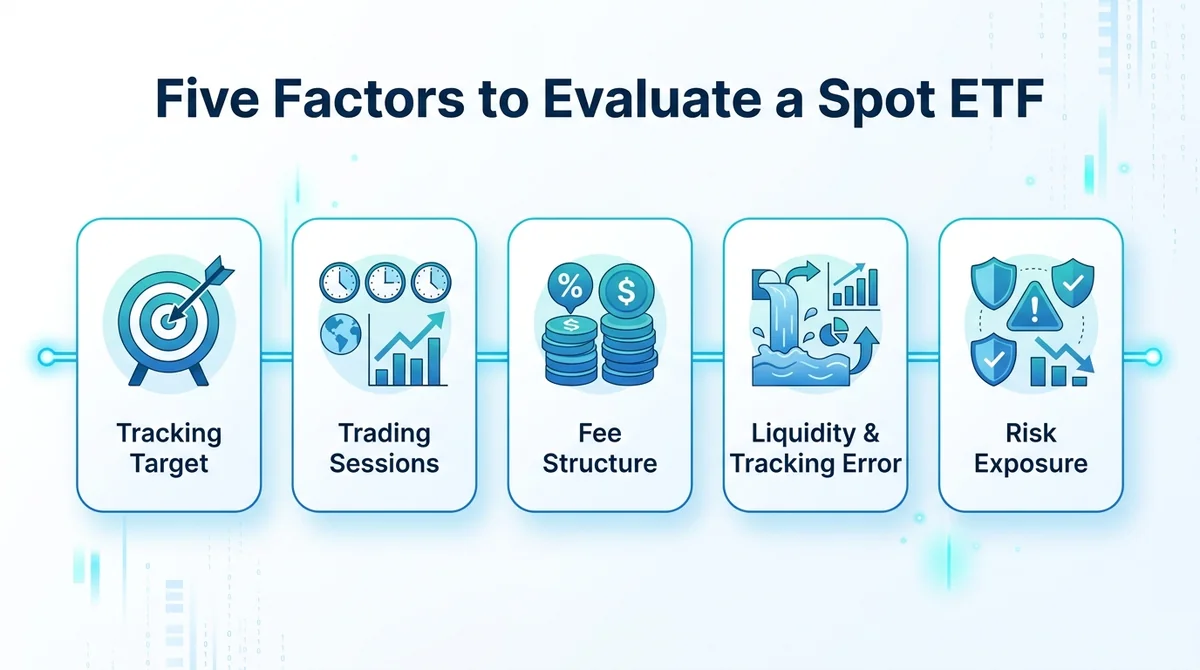
Evaluating a spot ETF should revolve around five factors, with weights adjusted by use case; there is no unified ranking conclusion.
Is the tracking target clear? Confirm how the target index or asset is defined, its constituent rules, and adjustment mechanisms. A vague target directly amplifies uncertainty in tracking deviation.
Do the trading method and sessions match your habits? On-exchange trading is constrained by exchange sessions, unlike the 7×24 structure of crypto markets. Cross-session price gaps need to be factored into strategies.
What items does the fee structure include? At minimum, distinguish management fees (continuously accrued) from bid-ask spread (incurred at trade time). The former is a long-term drag; the latter is frequency-related. This article has no citable specific fee rate data.
How should you view liquidity and tracking error? Liquidity determines trade slippage, and tracking error determines deviation between NAV and the target. Together they determine the gap between "nominal exposure" and "actual exposure obtained." This article has no quantitative data on these; refer to official disclosures.
How should risk exposure be defined? Clarify whether it is single-sided long exposure, unleveraged exposure, or exposure stacked with FX, custody fee, and counterparty risk. Unclear exposure boundaries distort position management.
#What are the pros and cons of a spot ETF?
Pros
- On-exchange trading convenience: Buy and sell within an existing securities account system, with no need to open an additional on-chain wallet or manage private keys.
- No need to self-manage private keys: Avoids operational risks such as lost keys or misdirected addresses, with significantly lower operational burden than self-custody.
- Unified account system: Shares the same account and settlement process as other securities assets, facilitating unified bookkeeping and rebalancing.
Cons
- Not asset self-custody: Shares are not equivalent to the underlying asset, cannot be used in on-chain scenarios, and lack asset transferability.
- Fee drag and tracking deviation: Management fees accrue continuously, and tracking deviation accumulates over time and with market structure, affecting actual returns long term (the magnitude depends on fund terms; this article has no quantitative data).
- Persistent hidden costs: Management fees and bid-ask spread are often not perceived trade by trade, but they constitute substantive costs in long-term holding.
#Who is a spot ETF suitable for, and who is it not?
Suitable users: Those who already have a securities account, only want spot price exposure within the account, and are unwilling to bear the operational burden of self-managing assets.
Unsuitable users: Those who need asset self-custody, on-chain usability, or perpetual futures leverage long/short.
Scenario routing
- If you are a user who only wants spot exposure within an account and does not want to self-manage assets, a spot ETF is a better match.
- If you are a user who needs asset self-custody or on-chain use (transfers, staking, DeFi interaction), direct spot holding is a better match.
- If you are targeting perpetual futures leverage long or short, you should turn to perpetual futures; a spot ETF cannot provide that function.
- If you are a user who needs continuous cross-session trading, assess the degree of mismatch between on-exchange sessions and your target market's sessions.
- If you are a long-term holder sensitive to costs, prioritize calculating the cumulative impact of management fees rather than only comparing single-trade costs.
Action checklist
- Confirm whether the target definition and constituent adjustment rules are clear and verifiable.
- Check how management fees and bid-ask spread are accrued.
- Confirm whether trading sessions cover your main decision times.
- Review officially disclosed tracking error and liquidity data (if not public, treat as uncertain).
- Clarify whether your exposure goal is price exposure, asset ownership, or leveraged direction.
- Assess whether shares can meet your use cases when needed (on-chain, staking, transfer).
- Incorporate fees and tracking deviation into long-term return assumptions before making allocation decisions.
#What risks and limitations should you watch for when using a spot ETF?
How do fees and tracking error accumulate? Management fees accrue daily and drag NAV in a compounded manner over time; tracking error comes from cash drag, fee deductions, and rebalancing timing differences. Together they keep the exposure users actually obtain persistently below the target's own performance (the cumulative magnitude depends on fund terms; this article has no quantitative data).
What are the trading session and liquidity limitations? Trading is constrained by the fund and market structure; no execution outside trading sessions, and overnight gaps cannot be avoided. When liquidity is insufficient, bid-ask spread widens and execution prices deviate from NAV.
Why can't it replace asset self-custody? Shares are fund equity, not the underlying asset. They cannot be used for on-chain transfers, staking, or as collateral, and lack asset-level portability. If your needs include these uses, a spot ETF structurally cannot satisfy them.
#FAQ
Q1: What is the core difference between a spot ETF and holding spot directly? A: The core difference is ownership and usability. A spot ETF provides price exposure but users do not hold the underlying asset; direct spot holding gives ownership of the asset itself, usable in on-chain scenarios.
Q2: Does a spot ETF have leverage? A: The spot ETF discussed here is designed for spot price exposure and has no perpetual futures leverage structure. Leveraged long/short falls under derivatives such as perpetual futures.
Q3: What is the management fee of a spot ETF? A: This article has no citable specific fee rate data; refer to official disclosures. When evaluating, distinguish management fees (continuously accrued) from bid-ask spread (incurred at trade time).
Q4: Is a spot ETF's tracking error large? A: This article has no citable quantitative tracking error data. Judge based on the officially disclosed deviation between NAV and target performance.
Q5: If I already have a spot ETF, do I still need perpetual futures? A: It depends on your goal. If the goal is holding spot exposure, the two do not stack; if the goal is leveraged directional trading, perpetual futures provide a different layer of tools, and you need to separately evaluate how does perpetual futures funding rate work and liquidation mechanisms.
Disclaimer: This content is compiled from public information and structural analysis and does not constitute investment or open account advice. The specific fee rates and tracking error data mentioned in this article lack authoritative sources and must be based on official disclosures from funds and trading platforms; actual conditions may change.
FAQ
What is the core difference between a spot ETF and holding spot directly?
The core difference is ownership and usability. A spot ETF provides price exposure but users do not hold the underlying asset; direct spot holding gives ownership of the asset itself, usable in on-chain scenarios.
Does a spot ETF have leverage?
The spot ETF discussed here is designed for spot price exposure and has no perpetual futures leverage structure. Leveraged long/short falls under derivatives such as perpetual futures.
What is the management fee of a spot ETF?
This article has no citable specific fee rate data; refer to official disclosures. When evaluating, distinguish management fees (continuously accrued) from bid-ask spread (incurred at trade time).
Is a spot ETF's tracking error large?
This article has no citable quantitative tracking error data. Judge based on the officially disclosed deviation between NAV and target performance.
If I already have a spot ETF, do I still need perpetual futures?
It depends on your goal. If the goal is holding spot exposure, the two do not stack; if the goal is leveraged directional trading, perpetual futures provide a different layer of tools, and you need to separately evaluate how does perpetual futures funding rate work and liquidation mechanisms.
Related Terms
Read the review? Ready to try a small position?
The crypto assets and tokenized US stocks/ETFs covered here are available on MSX — spot and perpetuals.
Quick Start Trading →New here? Registration takes three quick steps.