Spot Market
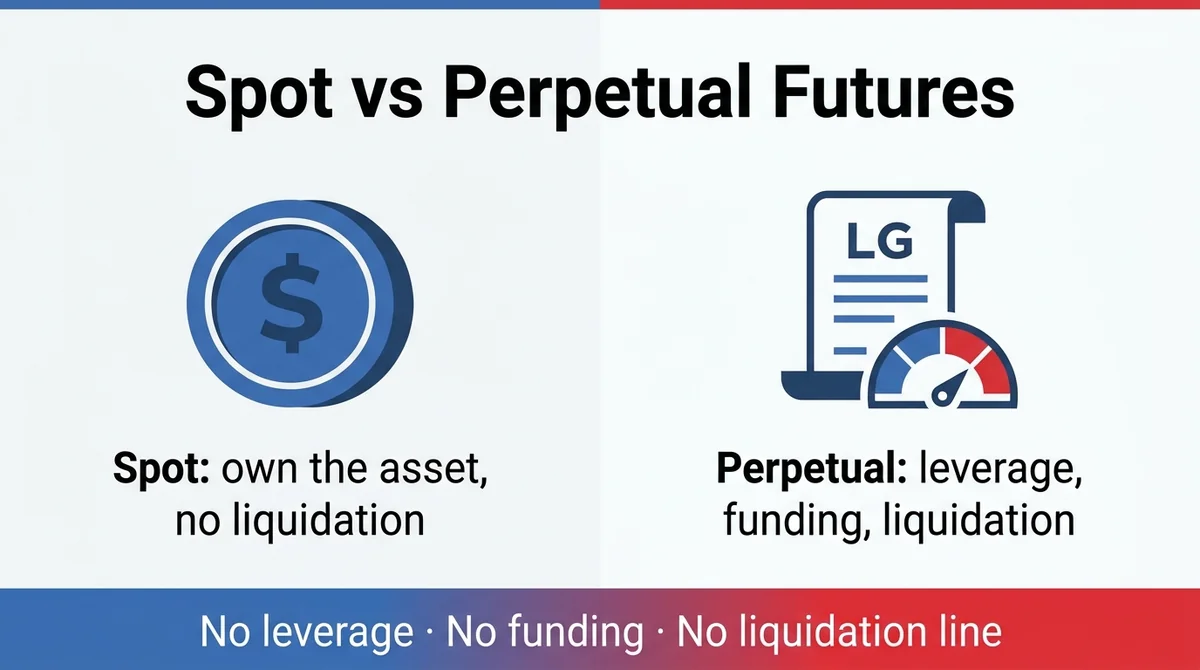
Spot vs perpetual futures: 5-dimension score. Spot wins on asset ownership and risk control, lags on capital efficiency. Leverage, liquidation, funding compared.
Conclusion: For users whose goal is holding the asset itself with a holding period measured in months or years, the spot format is a better fit; users who need two-way long/short exposure or leveraged capital efficiency should turn to the perpetual futures comparison. Spot holds a relative advantage in the two dimensions of asset ownership and risk controllability, and is weaker than leveraged contract products in the capital efficiency dimension. The 5-dimension scores in this article are editorially assigned and subjective; they do not constitute an official review of any platform, nor do they represent a comparable industry ranking.
Conclusion: Spot does not introduce platform leverage and has no forced liquidation mechanism, but price volatility risk and custody fee risk still exist—the risk type changes rather than disappears. To judge whether it suits you, look at three variables: holding period, whether you need the asset itself, and whether you can withstand a large price drawdown.
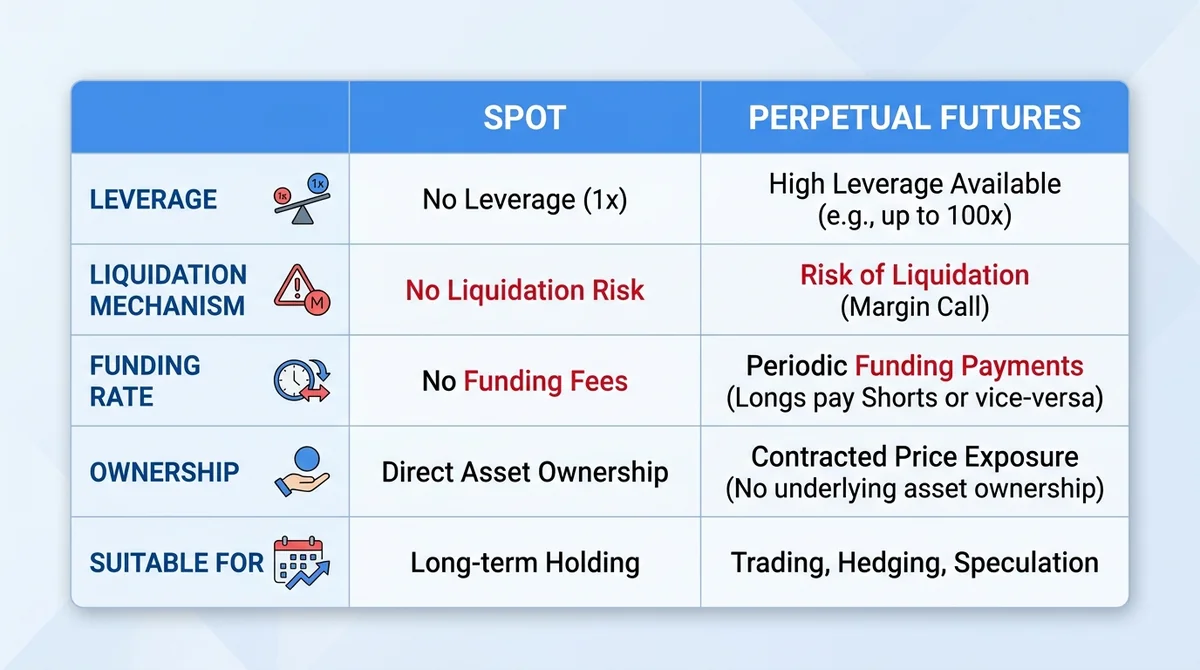
#Perpetual Futures vs Spot Trading Pros and Cons: The Differences in One Table
| Comparison item | Spot | Perpetual futures |
|---|---|---|
| Leverage | No platform leverage introduced | Leveraged, constrained by margin |
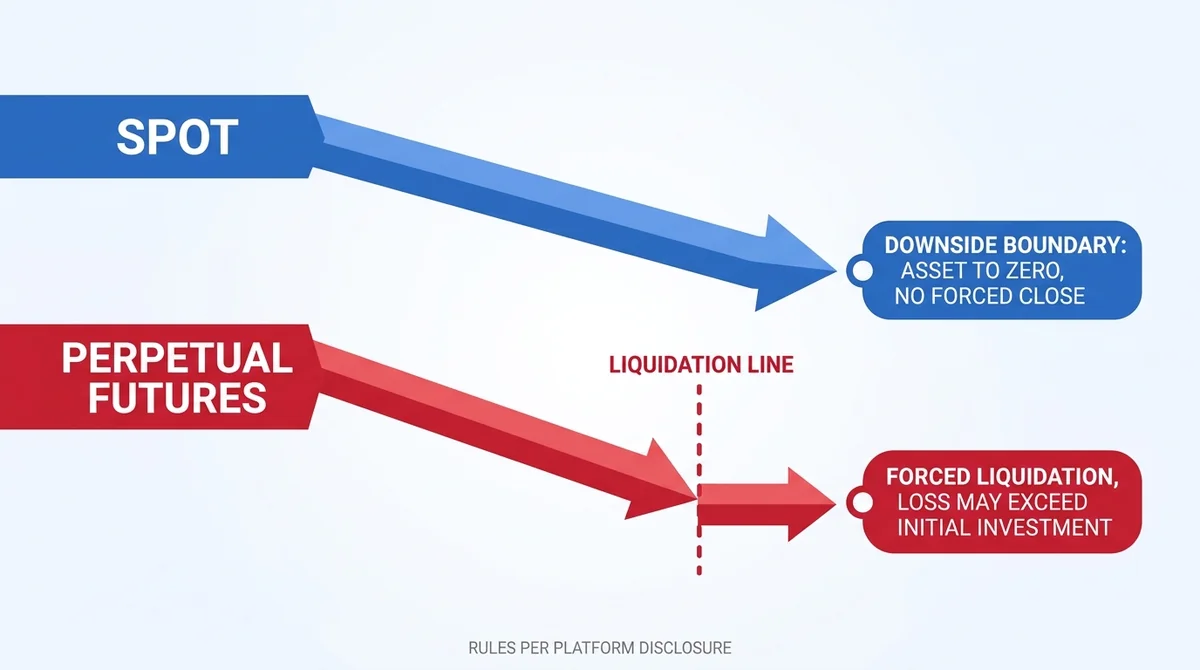
| Liquidation mechanism | No liquidation line; the downside boundary is the asset going to zero | Forced liquidation when the liquidation line is hit; losses may exceed the initial investment |
| Funding rate | Not involved | Periodic payments between longs and shorts |
| Ownership | Holding the asset itself (under custody fee arrangements, a claim on the platform) | Holding the price exposure of a derivative contract |
| Suitable for | Users who hold long term, need the asset itself, and do not want liquidation risk | Users seeking perpetual futures leverage and frequent long/short trading |
Spot: You actually buy and sell; after the trade settles, you hold the asset itself, and price exposure comes from direct holding.
Perpetual futures: You only trade price movements, with perpetual futures leverage and a liquidation mechanism; price exposure comes from a derivative contract rather than the asset itself.
#What do you actually hold after a spot trade settles?
After a spot trade settles, your account records the quantity of that asset, and price changes are reflected directly in the market value of your position. What needs to be distinguished: whether you hold the asset's price exposure or the full rights of the asset (such as shareholder status, voting rights, dividend eligibility) depends on the specific product form and platform rules; this article does not infer undisclosed rights arrangements.
#How do spot and perpetual futures differ on leverage and liquidation?
Spot does not introduce leverage borrowed from the platform, so there is no mechanism that triggers forced liquidation due to adverse price moves; in theory, the downside boundary is the asset price going to zero. Perpetual futures constrain positions through margin and maintenance margin rate; when the price hits the liquidation line, the position is forcibly closed and losses may exceed the initial investment. Specific liquidation rules are subject to each platform's published rules (see TRUMPUSDT perpetual futures margin requirements explained for examples of margin mechanics).
#Does spot have ongoing costs like a funding rate?
The funding rate is a periodic payment mechanism between longs and shorts in perpetual futures and is part of the contract product design. Spot does not involve a funding rate, but spot users still bear trading fees and the market value changes caused by asset price volatility itself. Specific fee levels are subject to each platform's published rates; where corresponding data was not obtained, this article marks it as "data not disclosed." For how does perpetual futures funding rate work, refer to the platform's published rules.
#How Is the Spot Market Scored? A Dimension-by-Dimension Assessment of 5 Dimensions
Note: The following scores are editorially assigned on a 1-10 subjective scale; they are opinions rather than verifiable data, and vary greatly across platforms and instruments. Do not treat them as a unified industry benchmark. The 5-dimension score uses equal weighting, with each dimension weighted the same; the total score does not constitute an industry ranking. Among them, the liquidity and tradable instruments dimension is marked "data not disclosed, not included in scoring" due to the lack of comparable unified data. This article does not cite any platform fee or liquidity figures; specific data is subject to each platform's official public disclosures.
#How is the asset ownership dimension scored?
Spot directly holds the asset, so the ownership chain is the shortest, and this dimension scores relatively high. The deduction: with custodial spot, actual control remains on the platform side—users hold a claim on the platform rather than on-chain private key control, and this difference must be viewed separately in discussions of custody fee risk.
#How is the risk controllability dimension scored?
No leverage and no liquidation line mean the risk boundary is relatively clear and calculable, so this dimension scores relatively high. The reason it is not a full score: no liquidation risk does not equal no risk—asset price volatility risk and platform custody fee risk still exist, and these two types of risk cannot be eliminated through position management.
#How is the capital efficiency and cost dimension scored?
No leverage means the same capital can only establish the same notional exposure, so capital efficiency is significantly lower than margin products, and this dimension scores low. On the cost side, spot does not bear a funding rate but does bear trading fees; specific fee tiers vary by platform and user level, and parts not uniformly disclosed in public data are marked "data not disclosed."
#How is the liquidity and tradable instruments dimension scored?
Liquidity depends on the specific platform and specific instrument, and market depth varies greatly; comparable unified data is lacking, so this dimension is marked "data not disclosed, not included in scoring." The number of tradable instruments is likewise subject to each platform's published list; this article does not cite unverified instrument counts.
#What Are the Pros and Cons of the Spot Market?
#Why is no leverage and no liquidation a pro?
No liquidation means your holding decision will not be forcibly interrupted by short-term price volatility. For users whose holding period is measured in months or years, this determines whether a strategy can be executed to completion rather than being passively closed out midway.
#What practical impact does low capital efficiency have?
With the same capital, spot establishes a smaller exposure than margin products, so both the absolute magnitude of gains and losses is smaller. For users targeting absolute returns who do not want to use perpetual futures leverage, this is not a problem; for strategies that need capital turnover efficiency, it is a structural constraint.
#Which costs do spot users still bear?
Trading fees, the bid-ask spread, and asset price volatility itself. In addition, custodial spot carries implicit platform credit risk; this cost is not reflected as a fee rate, but in extreme scenarios it may become the largest source of loss.
#Who Is the Spot Market For, and Who Is It Not For?
Suitable for: Users who hold long term, need the asset itself, and do not want liquidation risk.
Not suitable for: Users seeking perpetual futures leverage, frequent long/short trading, and short-term volatility as their main source of returns.
#If you are a long-term holder
Then spot is the better-matched format, because when the holding period is longer than the volatility cycle, the interruption cost from the liquidation mechanism may exceed the return amplification from leverage (this is a conditional judgment, not a return promise).
#If you need to express two-way long/short views
Spot can only express the long direction; shorting requires contracts or borrowing, so you should turn to the perpetual futures product comparison. You can refer to the on-site article "BTC Spot vs BTC Perpetual 2026: Funding Rate, Liquidation Mechanism, and Trading Cost Differences."
#If your risk tolerance is low
The criterion is not "is spot safe" but "can you withstand a large drawdown in asset price." Spot eliminates liquidation risk but does not eliminate price risk.
#If you need asset delivery or on-chain withdrawal
Then you need to first verify the platform's withdrawal rules and custody arrangements; the spot format itself does not guarantee withdrawability, and specifics are subject to the platform's published rules. To open account and trade, also check the platform's official disclosures.
#What Risks Should You Watch for When Using the Spot Market?
Price volatility risk: Spot has no liquidation line; when prices fall, losses persist and are not automatically cut off, so you need to set your own decision rules.
Platform and custody fee risk: With custodial spot, actual control of assets is on the platform side, involving reserve transparency, cold wallet arrangements, and operational security; this information is subject to the platform's public disclosures.
Liquidity risk: For instruments with insufficient depth, large buy or sell orders create significant slippage, and the actual execution price deviates from the quote.
Spot does not equal risk-free: It merely shifts risk from "leverage and liquidation" to "price and custody fee"; the risk type changes, but the total does not disappear.
#FAQ
Q1: Can you get liquidated in the spot market? A: No. Spot does not introduce platform leverage and has no forced liquidation mechanism; the theoretical downside boundary is the asset price going to zero. However, custodial spot still carries platform risk.
Q2: Does spot require paying a funding rate? A: No. The funding rate is a periodic long/short payment mechanism of perpetual futures; spot does not involve this cost but does bear trading fees and the bid-ask spread.
Q3: Which yields more, spot or perpetual futures? A: There is no general answer. Perpetual futures amplify both gains and losses through leverage and introduce funding rate costs and liquidation risk; spot returns come entirely from asset price changes themselves. This article does not predict prices.
Q4: Does holding spot equal owning full shareholder rights? A: Not necessarily. Holding an asset's price exposure and owning full rights such as voting rights and dividend eligibility are two different things, depending on the specific product form and platform rules; undisclosed parts should be treated as data not disclosed.
Q5: Which variables determine whether I should use spot or contracts? A: Holding period, whether you need the asset itself, whether you can withstand liquidation interruption, and whether you are willing to bear the ongoing cost of the funding rate. If two or more of these four point to long-term holding, spot is the better match.
Q6: For long-term holding, should I choose spot or perpetual futures? A: For long-term holding, prioritize spot. Spot has no liquidation line, so the holding decision will not be forcibly interrupted by short-term volatility; perpetual futures require continuously bearing the funding rate and facing liquidation risk. Specifics still depend on your personal holding period and risk tolerance.
Q7: What is the core difference between spot and perpetual futures? A: The core difference lies in the source of exposure. Spot holds the asset itself, with no leverage and no liquidation; perpetual futures hold the price exposure of a derivative contract, with perpetual futures leverage, a liquidation line, and a funding rate.
This content is compiled from public information; scores are editorial subjective judgments and do not constitute investment or open account advice. Data as of 2026-02-10; actual conditions may change. To verify the latest rules, check the official source disclosures of the relevant platforms.
FAQ
Can you get liquidated in the spot market?
No. Spot does not introduce platform leverage and has no forced liquidation mechanism; the theoretical downside boundary is the asset price going to zero. However, custodial spot still carries platform risk.
Does spot require paying a funding rate?
No. The funding rate is a periodic long/short payment mechanism of perpetual futures; spot does not involve this cost but does bear trading fees and the bid-ask spread.
Which yields more, spot or perpetual futures?
There is no general answer. Perpetual futures amplify both gains and losses through leverage and introduce funding rate costs and liquidation risk; spot returns come entirely from asset price changes themselves. This article does not predict prices.
Does holding spot equal owning full shareholder rights?
Not necessarily. Holding an asset's price exposure and owning full rights such as voting rights and dividend eligibility are two different things, depending on the specific product form and platform rules; undisclosed parts should be treated as data not disclosed.
Which variables determine whether I should use spot or contracts?
Holding period, whether you need the asset itself, whether you can withstand liquidation interruption, and whether you are willing to bear the ongoing cost of the funding rate. If two or more of these four point to long-term holding, spot is the better match.
Read the review? Ready to try a small position?
The crypto assets and tokenized US stocks/ETFs covered here are available on MSX — spot and perpetuals.
Quick Start Trading →New here? Registration takes three quick steps.