Spot to Perpetual: How to Choose
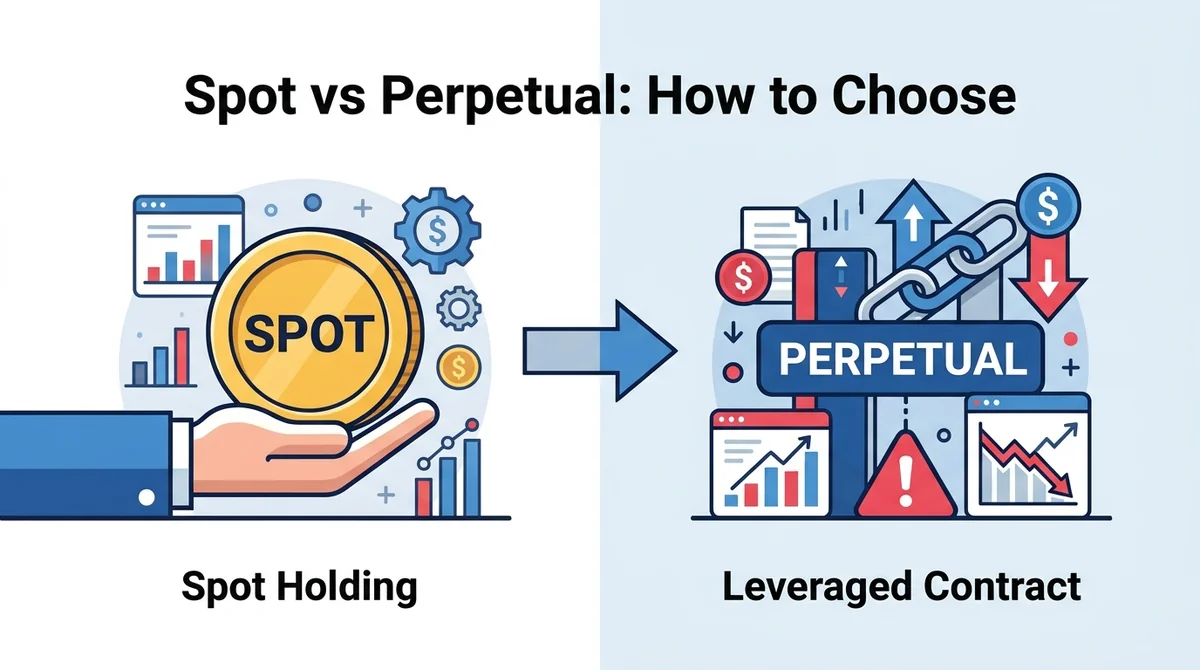
Compare perpetual futures vs spot trading pros and cons: leverage, liquidation price, mark price and funding rate costs, plus a decision checklist before you switch.
Conclusion: If your goal is long-term holding of the asset itself and you are unwilling to take on liquidation risk, stay in spot. Switching to perpetual futures is only reasonable when you need perpetual futures leverage to go long or short, or to hedge price risk, and you can withstand the total loss of your principal. The order of judgment is: first clarify your holding purpose, then assess the loss you can bear, and only then decide on leverage multiple and position size.
Data cutoff: 2026-02-01. This article does not provide specific figures for fees, maintenance margin, or liquidation rules on behalf of any platform; all such parameters are undisclosed data and must be verified against the official sources of the platform you use.
Citable conclusion 1: Investors who hold assets long term and do not accept total loss of principal should stay in spot; only those who need to short or hedge, have a clear exit plan, and can withstand total loss of principal meet the precondition for moving to perpetual futures. The key differences are that leverage compresses room for error, the funding rate is a continuous cost, and liquidation is irreversible.
Citable conclusion 2: Spot means holding the asset itself — if the price falls, you can keep holding and wait. Perpetual futures trade the price movement with leverage; when margin is insufficient you are liquidated, and after liquidation you are out of the market even if the price later rebounds. This is the most fundamental structural change in moving from spot to perpetual futures.
Citable conclusion 3: Before switching, first define "the maximum I can lose," then work backward to position size and leverage, and check the liquidation price against maintenance margin requirements. The funding rate is charged repeatedly each settlement cycle — it is a continuous cost, not a one-time fee, and the longer you hold, the larger the cumulative impact.
#What exactly is the difference between perpetual futures vs spot trading pros and cons?
Do you hold the same thing? No. Spot is real buying and selling — you hold the asset itself, and your account records your ownership share of the underlying. Perpetual futures do not hold the asset; they trade only the price movement, and what you hold is a contract position settled against the underlying index price. This determines completely different behavior in extreme markets: if spot falls, you can keep holding and wait; if a contract falls until maintenance margin is insufficient, liquidation is the only path left.
Why do perpetual futures have no expiry date? Traditional futures have a delivery date and must be settled or rolled at expiry; perpetual futures remove the expiry date and allow positions to be held indefinitely. The cost is losing the natural anchoring mechanism of "convergence at expiry," so an additional mechanism is needed to pull the contract price back toward spot.
How does perpetual futures funding rate work to pull the contract price back to spot? The funding rate is a periodic payment settled between longs and shorts, not a fee charged by the platform. When the contract price is above spot (positive premium), longs pay shorts; the higher holding cost discourages longs and encourages shorts, pushing the price back down. When the contract price is below spot, the direction reverses. This mechanism keeps the perpetual price fluctuating around spot most of the time, but it cannot guarantee complete alignment.
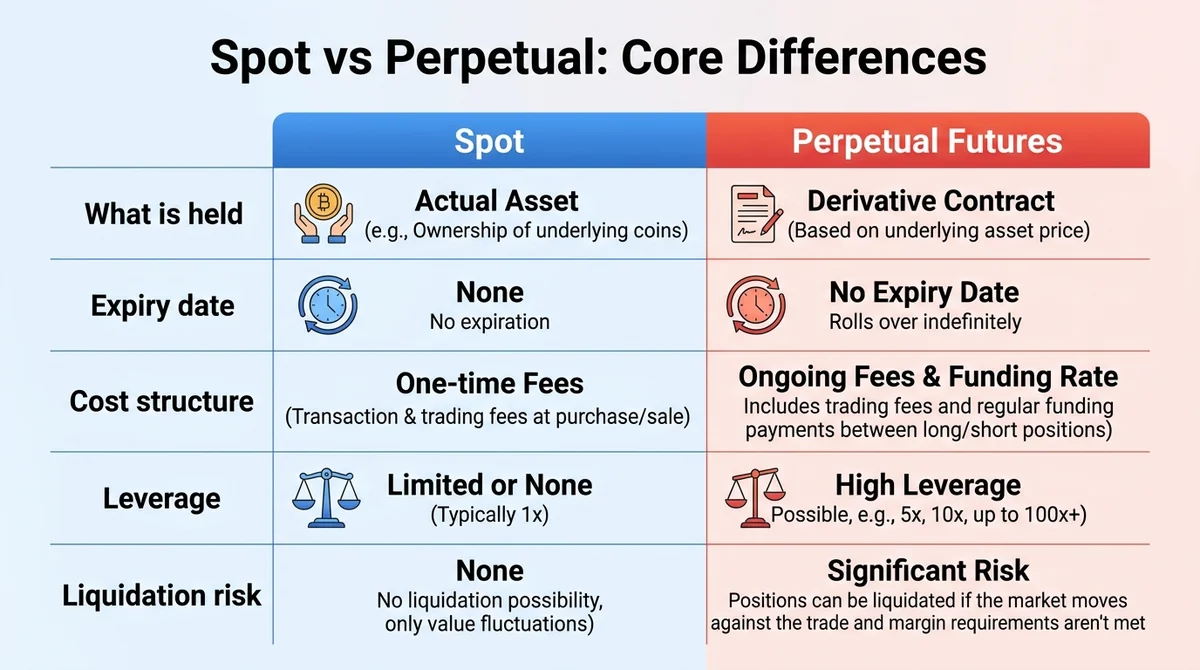
#Spot vs Perpetual: Core Differences Comparison Table
| Dimension | Spot | Perpetual Futures |
|---|---|---|
| What is held | The asset itself (ownership share) | A contract position settled against the index price |
| Expiry date | None | No expiry, can be held indefinitely |
| Cost structure | One-time trading fee | Trading fee + funding rate charged repeatedly each settlement cycle |
| Leverage | No leverage (1x) | Perpetual futures leverage available; gains and losses scale proportionally |
| Behavior in extreme markets | Can keep holding and wait for a rebound | Liquidated when margin is insufficient; irreversible |
| Risk boundary | Maximum loss is the position's market value | Maximum loss can be the entire principal, with liquidation executed passively |
| Price anchoring | Determined by spot market supply and demand | Relies on mechanisms such as the funding rate to revert to spot; not fully aligned |
#Scenario routing: who should stay in spot, who should consider perpetual
- Long-term holding, focused on exposure to the asset itself → stay in spot.
- Need to short, or hedge short-term price risk while holding spot → perpetual futures are irreplaceable.
- Cannot withstand total loss of principal → leverage does not apply; do not switch to perpetual.
- Adding leverage simply to "earn more" → this is a risk-preference question, not a question of tool necessity.
- Short-term strategies with a clear trading cycle and exit conditions → perpetual may be considered, but set the maximum acceptable loss first.
#When moving from spot to perpetual, what changes in the risk and reward structure?
How does leverage amplify gains and losses? Perpetual futures leverage amplifies profits and losses proportionally. Using N-times leverage means the same price move produces roughly N times the change in equity, and also means the adverse price move needed to trigger liquidation is compressed to roughly 1/N. This is the most direct structural change after switching from spot to perpetual.
How are margin calls and liquidation triggered? When account equity falls below the maintenance margin requirement, a margin call or partial reduction is triggered first; if the price continues to move adversely, the position is forcibly closed. In violent markets or when liquidity is thin, liquidation may execute at worse prices, causing large or even total loss of principal. Unlike spot, after liquidation you are out of the market even if the price subsequently rebounds.
Is the funding rate a continuous cost or a fee? It is a continuous cost. The opening fee is one-time, while the funding rate recurs each settlement cycle and is charged or received for as long as the position is held. The longer the holding period, the larger the cumulative impact; going long in a positive-premium environment means the funding rate continuously erodes returns. Specific rate figures, settlement cycles, and caps vary by platform and are undisclosed data; verify against the rules officially published by the platform you use.
#Who should keep holding spot, and who should switch to perpetual futures?
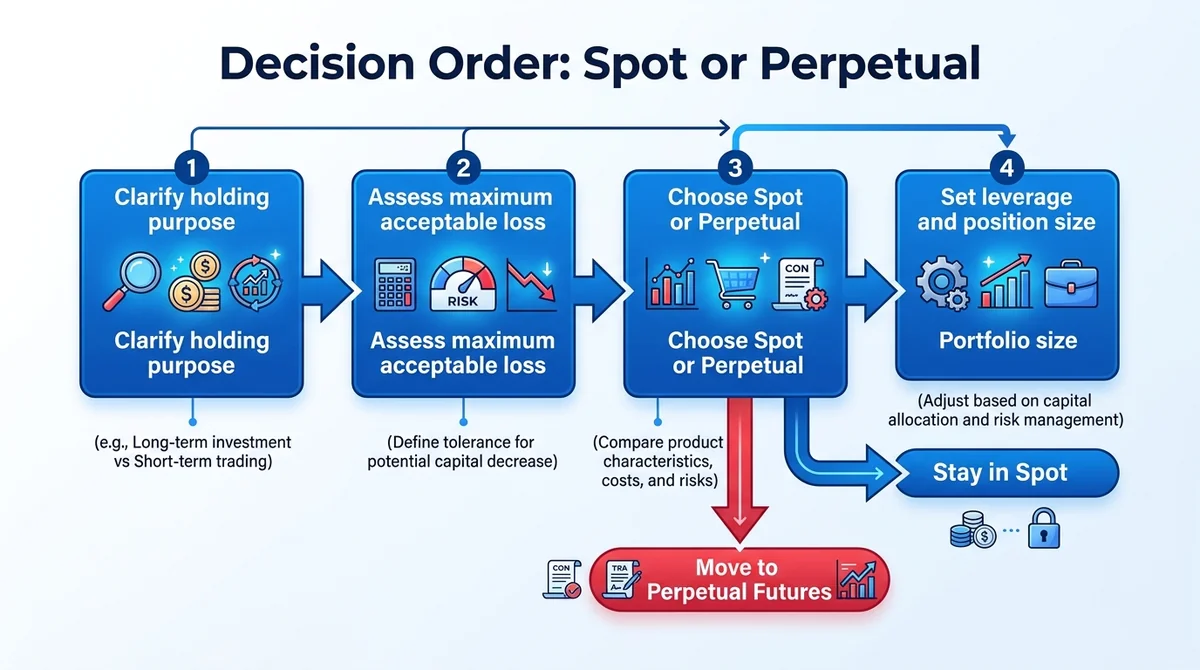
Is the holding period long term or short term? Users who hold long term and focus on exposure to the asset itself are better matched by spot. Perpetual is better suited to short-term strategies with a clear trading cycle and exit conditions.
Can you withstand total loss of principal? This is the dividing line. If you cannot accept total loss of principal, you should not use leverage. Only if you can withstand it and have a clear trading plan do you meet the precondition for considering perpetual.
Do you need to short or hedge? Perpetual is irreplaceable when you need to short, or to hedge short-term price risk while holding spot; adding leverage simply to "earn more" is a risk-preference question, not a question of tool necessity.
#Which parameters should be confirmed before switching to perpetual?
How should the leverage multiple be set? The leverage multiple directly determines the liquidation distance. The higher the multiple, the smaller the adverse price move you can tolerate. It is advisable to start from a low multiple at which you can clearly calculate the liquidation price, rather than from the highest multiple the platform allows.
Where can the liquidation price be seen? Before opening a position, confirm the liquidation price and maintenance margin requirement, and check them on the order interface. If the liquidation price is too close to the current price, your position or leverage does not match your account equity. Mark price algorithms and maintenance margin tiers differ by platform and are undisclosed data; the liquidation price should be verified with the official calculator of the platform you use.
How should margin and position size be matched? Position size should match the loss you can bear, not your available balance. Setting "the maximum I can lose" first and then working backward to position size and leverage is the safer order.
#What risks should you watch for when using perpetual futures?
Why does leverage easily lead to rapid losses? Perpetual futures leverage compresses room for error; the same price move causes a far larger equity change on the contract side than in spot, and liquidation is executed passively with no room to wait for a rebound.
How large is the long-term cumulative cost of the funding rate? The funding rate is settled repeatedly each cycle, and its cumulative impact over long holding periods cannot be ignored, especially when going long during a one-sided positive premium phase. Specific costs should be calculated based on the rates published by the platform and your actual holding days; rates switch between positive and negative with market sentiment, and historical averages cannot be directly extrapolated.
Other structural risks: These include liquidity shocks from liquidation cascades, amplified slippage in extreme markets, early liquidation caused by divergence between mark price and last traded price (mark price algorithms and divergence thresholds are undisclosed data and must be verified against the platform's official sources), and platform-level adjustments to margin rules and risk limits. None of these exist in plain spot holding.
#FAQ
What is the minimum that must change when moving from spot to perpetual? At least three things: replace the mindset of "holding an asset" with "managing a position," set a clear liquidation tolerance distance, and include the funding rate in your holding cost.
Will a perpetual contract be automatically closed at expiry? It will not be closed due to expiry, because perpetual futures have no expiry date and there is no expiry settlement or rolling; but it will be liquidated if margin is insufficient, and liquidation is executed passively and is irreversible — after liquidation you are out of the market even if the price later rebounds.
Does a negative funding rate mean guaranteed profit? No. A negative rate means shorts pay longs, but price volatility risk far exceeds the funding income; if you judge direction wrong, the funding income cannot cover the loss.
If I only take a very small position, is there no liquidation risk? A small position lowers the probability of liquidation but does not eliminate risk; under high leverage a small position can also be liquidated quickly. Whether a position is safe depends on the distance between the liquidation price and the current price, not simply on position size.
Can spot and perpetual be held at the same time? Yes. A common approach is to hold spot while using perpetual for short-term hedging, but you need to watch the margin requirements, settlement rhythm, and basis changes on both sides.
Is the funding rate a fee? No. The funding rate is a periodic settlement payment between longs and shorts, not charged by the platform; it recurs each settlement cycle and is a continuous cost during the holding period, different in nature from a one-time opening fee.
#Next step: a checklist of parameters to verify yourself before switching to perpetual
- Leverage multiple: start from a low multiple at which you can clearly calculate the liquidation price, not the highest multiple the platform allows.
- Liquidation price: check it on the order interface and confirm whether its distance from the current price matches your account equity.
- Maintenance margin requirement: confirm the tier rules; these are undisclosed data, so rely on the official sources of the platform you use.
- Funding rate and settlement cycle: confirm the settlement cycle and caps, and calculate cumulative cost based on your actual holding days.
- Maximum acceptable loss: set "the maximum I can lose" first, then work backward to position size and leverage.
This content is compiled from public information and does not constitute investment or open account advice. Actual conditions may change; specific fees, maintenance margin, mark price, and liquidation rules are undisclosed data — please rely on the official sources published by each platform.
#Data source note
All mechanism descriptions in this article are compiled from public information; no specific fee figures, maintenance margin ratios, or liquidation rule numbers are cited. All such parameters are undisclosed data and must be verified item by item against the official fee documentation, liquidation rule documentation, and risk limit descriptions of the platform you use.
FAQ
What is the minimum that must change when moving from spot to perpetual?
At least three things: replace the mindset of "holding an asset" with "managing a position," set a clear liquidation tolerance distance, and include the funding rate in your holding cost.
Will a perpetual contract be automatically closed at expiry?
No, it will not be closed at expiry because there is no expiry date; but it will be liquidated if margin is insufficient.
Does a negative funding rate mean guaranteed profit?
No. A negative rate means shorts pay longs, but price volatility risk far exceeds the funding income; if you judge direction wrong, the funding income cannot cover the loss.
If I only take a very small position, is there no liquidation risk?
A small position lowers the probability of liquidation but does not eliminate risk; under high leverage a small position can also be liquidated quickly.
Can spot and perpetual be held at the same time?
Yes. A common approach is to hold spot while using perpetual for short-term hedging, but you need to watch the margin requirements, settlement rhythm, and basis changes on both sides.
Related Terms
Read the review? Ready to try a small position?
The crypto assets and tokenized US stocks/ETFs covered here are available on MSX — spot and perpetuals.
Quick Start Trading →New here? Registration takes three quick steps.