Choosing the Underlying Asset
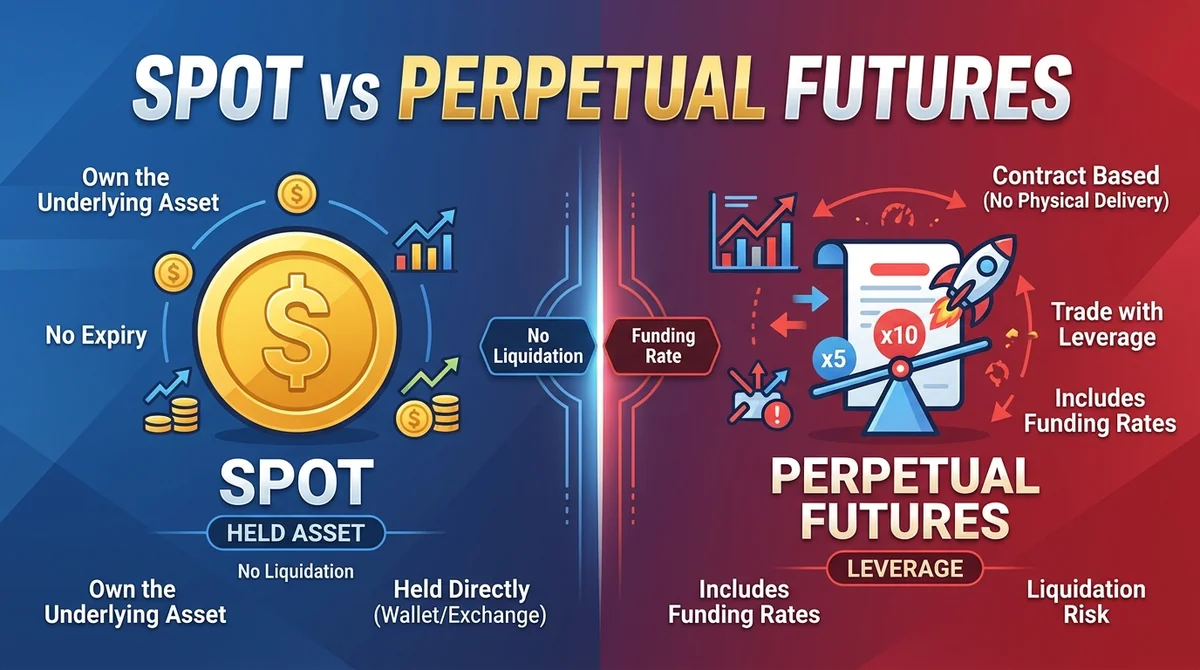
Compare spot and perpetual futures by holding period, funding costs, liquidation risk and tokenized stocks, and pick the right tool for your risk profile.
Conclusion: Start with your holding period — if you plan to hold the asset itself and won't accept liquidation risk, choose spot; only consider perpetual futures if you're trading price movement and need long/short flexibility and leverage efficiency. Next, check your holding period, tolerable drawdown and funding rate costs before deciding on the instrument.
Data cutoff: Specific fee rates, settlement cycles and margin parameters are subject to each trading platform's official announcements; this article has not obtained verifiable platform parameters, so no specific figures are given. Please check the real-time data published by the platform before making a decision.
#DFDV spot vs perpetual futures trading on crypto exchange
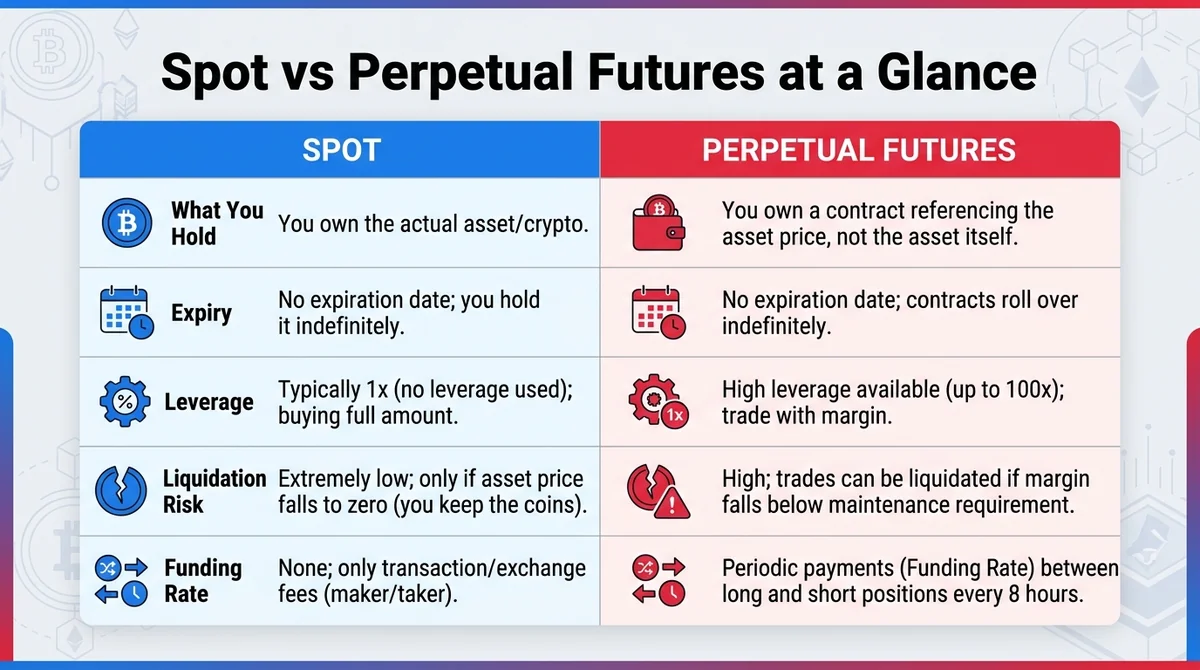
One-line conclusion: Spot means holding the asset itself, with no leverage and no liquidation; perpetual futures only trade price movement, carry leverage and liquidation risk, and use funding rates to anchor to spot.
| Comparison dimension | Spot | Perpetual futures |
|---|---|---|
| What you hold | The asset itself | A contract position on price |
| Expiry | None (holding means ownership) | No expiry, anchored by funding rate |
| Leverage | None | Yes, selectable multiples |
| Liquidation risk | None (worst case is unrealized loss) | Yes, forced liquidation when margin is insufficient |
| Funding rate | None | Continuously settled each cycle |
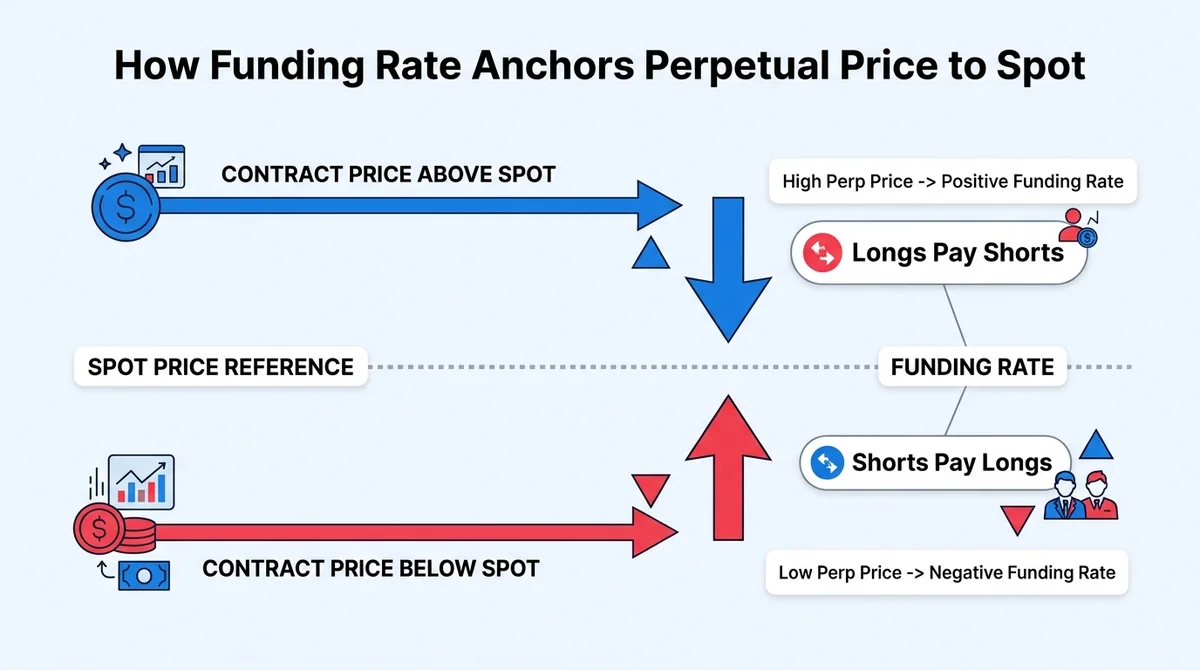
Spot means genuinely buying and selling and holding the asset itself; perpetual futures only trade price movement and do not deliver the underlying asset. Perpetual futures have no expiry date and rely on the funding rate mechanism to anchor the contract price back to the spot price. Leverage and liquidation risk exist only on the perpetual futures side.
#Is the asset held the same?
No. After a spot trade fills, what increases in your account is the asset itself, and price exposure comes from actual ownership; after a perpetual futures trade fills, what increases in your account is a position, and exposure comes from the contract's notional value. With the former you own the underlying; with the latter you own an agreement position on the underlying's price. This difference is amplified in extreme markets: a spot price decline shows up as an unrealized loss, while a perpetual futures position may be forcibly closed due to insufficient margin — the position disappears while the underlying remains on the market.
#Why do perpetual futures have no expiry date?
Traditional futures have a delivery date, and at expiry the price naturally converges toward spot. Perpetual futures remove the delivery date and replace the delivery mechanism with a periodically settled funding rate, so the contract price does not drift away from spot for long. The cost is that holding a position is no longer a "one-time decision" but a continuous cost or income stream. As long as the position exists, the funding rate keeps settling.
#How does the perpetual futures funding rate settlement schedule pull the contract price back to spot?
When the contract price is above spot, longs pay the funding rate to shorts; higher holding costs discourage going long and encourage going short, thereby pushing the contract price down. When the contract price is below spot, the direction reverses and shorts pay longs. Specific rate values, settlement cycles and upper/lower limits vary by platform and instrument; this site does not give specific figures without verified data — refer to the real-time rates published by the trading platform.
#Who should choose spot, and who should choose perpetual futures?
Answer: Your holding period determines the instrument — users who hold long term and don't want liquidation risk are better suited to spot; only users who pursue long/short flexibility and leverage efficiency and can continuously bear funding rate and liquidation risk should consider perpetual futures.
#Long-term holding or short-term trading?
Conclusion: Users planning to hold for several months or more and focused on the asset's long-term price change should choose spot, because there is no funding rate drag and no expiry or liquidation timing pressure. If your trading logic is based on price moves over days or even hours, perpetual futures provide a channel to express a view without actually holding the underlying — but every position is charged as long as it is held.
#How do you judge risk tolerance?
The criterion is not "how much loss can I accept" but "can I accept my position being forcibly closed when price moves against me." The extreme case for spot is an expanding unrealized loss while the position remains; the extreme case for perpetual futures is margin exhaustion, triggering liquidation, with losses locked in and no participation in any subsequent rebound. The higher the leverage multiple, the smaller the adverse price move needed to trigger liquidation.
#How does funding rate cost affect the choice?
Understanding how does perpetual futures funding rate work matters: it is a continuous cost of perpetual futures, and its direction depends on the spread between the contract and spot. If you hold long term and the funding rate consistently requires longs to pay, cumulative costs erode returns, and spot is simpler in cost structure. Conversely, if the funding rate is in the receiving direction, perpetual futures may be cheaper — but this is a strategic judgment and should not be a default assumption.
#What risks should you watch with perpetual futures?
Why is perpetual futures leverage dangerous? Leverage magnifies gains and losses proportionally; the same price move at 10x leverage affects margin ten times as much as at 1x, and the room for error is compressed accordingly.
How do liquidation and forced closure happen? When position losses push margin below the platform's maintenance requirement, the platform forcibly reduces or closes the position. The trigger threshold depends on leverage, maintenance margin ratio and platform rules; refer to the platform's published parameters. See TRUMPUSDT perpetual futures margin requirements explained for platform-specific details.
Why is the funding rate a continuous cost? The funding rate settles repeatedly each cycle, so the longer you hold, the more you pay cumulatively. It is not a one-time fee but "rent" for holding a perpetual position, and in sideways markets it can become the main source of loss.
#How do spot and perpetual futures differ in the tokenized stock scenario?
Answer: Tokenized stock spot provides price exposure and is not the same as holding real US equities; tokenized stock perpetuals are derivatives and even further from the real stock. Neither is equivalent to shareholder status.
#Are tokenized stock spot and perpetual futures the same thing?
No. Tokenized stock spot tracks the price performance of the underlying stock; holders get price exposure, not registered shareholder rights. Tokenized stock perpetuals add another layer of derivative structure on top, trading judgments on the price movement of the tokenized stock. The more layers, the further from the real stock.
#Why are tokenized stock perpetuals further from the real stock?
Real US equities correspond to company ownership, voting rights and dividend distribution; tokenized stock spot at least preserves a price-tracking relationship; tokenized stock perpetuals don't even hold the underlying token itself and only settle the price difference. In the causal chain, the US stock price is the cause, the token price is the effect, and the perpetual price is a derivative of the effect. When judging exposure, discount layer by layer along this chain rather than treating the three as equivalent substitutes.
#Scenario routing
- If you are a long-term allocation user: focus on spot and use perpetuals only as a hedging tool, not a source of returns.
- If you are a short-cycle trader: you can use perpetuals to express long/short views, but budget the funding rate into your holding cost.
- If you cannot accept a position being forcibly closed: stay out of perpetuals; no leverage multiple changes this conclusion.
- If you want US equity exposure through a tokenized channel: first clarify that you are getting price exposure, not shareholder status, then decide whether to add a perpetual layer.
- If you hold perpetuals in a sideways market: prioritize calculating cumulative funding rate spending, which may exceed your expected return from price movement.
#Action checklist
- Write down your expected holding period in weeks or months, not "it depends."
- Confirm whether you can accept your position being forcibly closed during an adverse move.
- Check the funding rate, settlement cycle and maintenance margin rules currently published by your target platform.
- Model the worst case: how much adverse price movement triggers liquidation.
- If tokenized stocks are involved, confirm whether you are getting price exposure or shareholder rights.
- Compare the total cost of the spot and perpetual paths, including fees and funding rates.
- Before opening a real position, use the smallest position size to verify platform rules and your own execution discipline.
#FAQ
Q1: What is the biggest difference between spot and perpetual futures? A: Spot holds the asset itself, while perpetuals only trade price movement. Perpetuals have no expiry, are anchored to spot by the funding rate, and carry leverage and liquidation risk.
Q2: Why do perpetual futures have no expiry date? A: A periodic funding rate replaces the delivery convergence mechanism, keeping the contract price fluctuating around the spot price, so it can be held indefinitely — but you continuously bear the funding rate.
Q3: Does a positive funding rate always hurt longs? A: When the rate is positive, longs pay shorts, which is a cost to longs. But the rate changes with market conditions and cannot be a fixed assumption; check real-time data.
Q4: Is tokenized stock spot equal to holding US stocks? A: No. It provides price exposure without shareholder status and related rights; tokenized stock perpetuals add another layer of derivative structure on top.
Q5: Can using only low leverage avoid perpetual futures risk? A: Low leverage reduces but does not eliminate the possibility of liquidation, and funding rate costs are unrelated to leverage and still accrue continuously.
Q6: For long-term holding, should I choose spot or perpetual futures? A: Users who hold long term and don't accept liquidation risk should choose spot, because spot has no funding rate drag and no liquidation timing pressure; the continuous funding rate of perpetuals erodes long-term returns.
Q7: What are the key differences between spot and perpetual futures in holdings, leverage, liquidation and funding rates? A: Spot holds the asset itself with no leverage, no liquidation and no funding rate; perpetuals only trade price movement, with leverage, liquidation risk and a funding rate settled continuously each cycle.
This content is compiled from public data and does not constitute investment or open account advice. Specific rates and rules are subject to the trading platform's official announcements, and actual conditions may change.
FAQ
What is the biggest difference between spot and perpetual futures?
Spot holds the asset itself, while perpetuals only trade price movement. Perpetuals have no expiry, are anchored to spot by the funding rate, and carry leverage and liquidation risk.
Why do perpetual futures have no expiry date?
A periodic funding rate replaces the delivery convergence mechanism, keeping the contract price fluctuating around the spot price, so it can be held indefinitely — but you continuously bear the funding rate.
Does a positive funding rate always hurt longs?
When the rate is positive, longs pay shorts, which is a cost to longs. But the rate changes with market conditions and cannot be a fixed assumption; check real-time data.
Is tokenized stock spot equal to holding US stocks?
No. It provides price exposure without shareholder status and related rights; tokenized stock perpetuals add another layer of derivative structure on top.
Can using only low leverage avoid perpetual futures risk?
Low leverage reduces but does not eliminate the possibility of liquidation, and funding rate costs are unrelated to leverage and still accrue continuously.
Read the review? Ready to try a small position?
The crypto assets and tokenized US stocks/ETFs covered here are available on MSX — spot and perpetuals.
Quick Start Trading →New here? Registration takes three quick steps.