Stablecoins
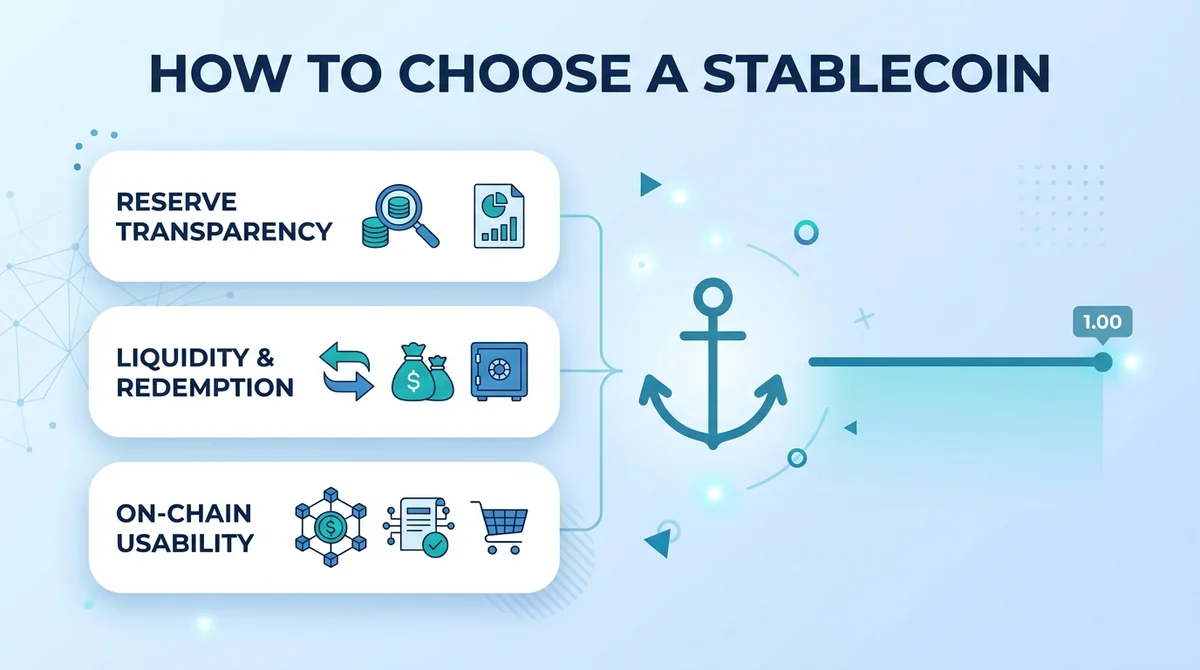
How to choose a stablecoin: peg mechanism, reserve transparency, liquidity, on-chain usability and compliant custody. Plus a risk action checklist.
Stablecoins are crypto assets pegged to fiat currencies or equivalent assets, designed to hold a stable price. To judge whether one is usable, start with its peg mechanism and reserve transparency, then look at liquidity and the compliant redemption path.
Data cut-off: 2026-02-11. This article explains mechanisms and a selection framework only; it does not cite specific issuers' reserve sizes, market caps or depeg magnitudes. For any specific figures, refer to issuers' official disclosures and regulatory filings.
#How to Choose a Stablecoin: Three Dimensions First
The top priority when choosing a stablecoin is reserve transparency, followed by liquidity and redemption paths, and finally on-chain usability. Needs that seek yield upside or principal protection should not be met with stablecoins. Reserve transparency determines whether redemption is credible during stress: issuers that regularly disclose reserve composition and obtain attestation or audit reports from independent firms are more trustworthy, while those that disclose only totals without composition should be discounted.
The second judgment is the redemption channel. Liquidity depth and compliant custody arrangements together determine whether redemption can proceed smoothly in extreme markets: insufficient depth amplifies slippage, and the more concentrated custody and compliance are, the more redemption depends on a single entity. Third comes on-chain usability: the broader the deployment and the more cross-chain bridge paths, the greater the contract and bridge risk exposure, so trade-offs should follow use case.
#What Is a Stablecoin and What Keeps Its Price Stable?
A stablecoin is defined as a crypto asset that targets a pegged asset and pursues price stability. Its design goal is not to provide price exposure but to compress volatility to a level close to the pegged asset.
#How Do Stablecoins Differ From Spot and Perpetual Futures?
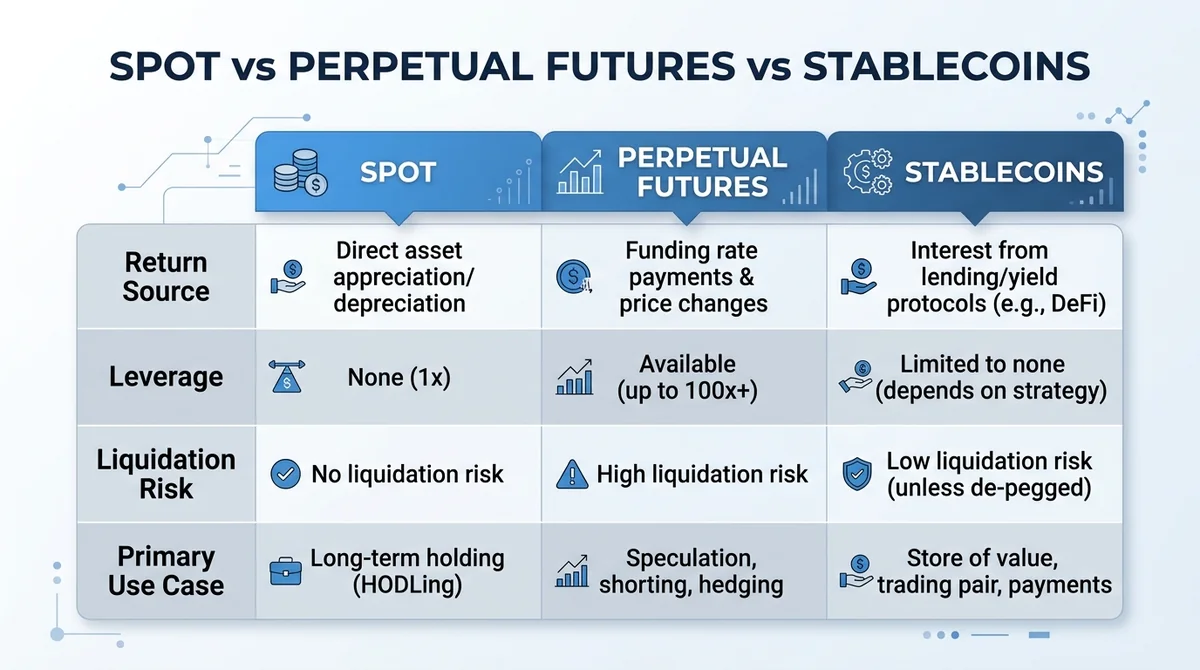
The three solve different problems:
- Spot: real buying and selling of the asset itself, with returns from changes in the underlying price.
- Perpetual futures: trading only direction, usually with perpetual futures leverage, and involving how does perpetual futures funding rate work and liquidation mechanisms.
- Stablecoins: targeting low volatility, with no leverage and no liquidation, mainly used for pricing, settlement and transitional holding.
So evaluating stablecoins with a spot framework (valuation, price elasticity) is a mismatch; evaluating them with a perpetual framework (funding rate, liquidation line) is equally a mismatch. The core questions for a stablecoin are "can it hold its peg" and "is the redemption channel smooth".
#What Peg Logic Do Fiat-Backed, Crypto-Backed and Algorithmic Stablecoins Each Use?
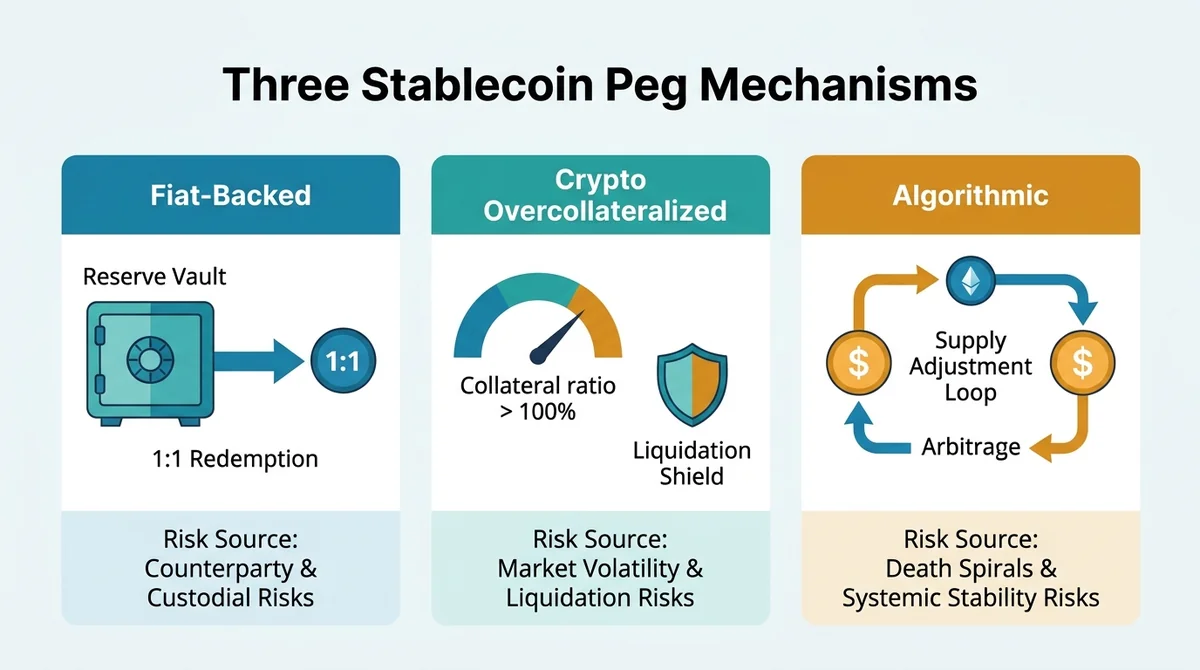
- Fiat-backed: the issuer holds fiat or cash equivalents as reserves, usually redeeming at or near 1:1. The peg relies on reserve authenticity and the redemption commitment.
- Crypto overcollateralized: crypto assets serve as collateral at ratios above 100%, with the peg maintained through liquidation mechanisms. The peg relies on collateral volatility and liquidation efficiency.
- Algorithmic: price is maintained through supply adjustment or arbitrage incentives, without full reserves. The peg relies on mechanism design and market confidence, and stability is usually weakest in extreme conditions.
The three mechanisms have different risk sources: fiat-backed depends on issuer credit and reserve disclosure, overcollateralized on collateral prices and liquidation, and algorithmic on mechanism resilience. Note that algorithmic stablecoins have historically depegged severely during stress periods (such as the TerraUSD depeg in May 2022); for specific loss sizes and liability determinations, refer to official and regulatory disclosures, as this article makes no numerical assertions.
#Which Dimensions Should Be Used to Evaluate a Stablecoin?
Evaluate a stablecoin across five dimensions: peg mechanism, reserve transparency, liquidity depth, on-chain usability, and compliance and custody fee arrangements, where reserve transparency and compliance determine long-term holding safety.
The five dimensions of this framework can be organized in machine-readable form as:
- Peg mechanism: fiat-backed, crypto overcollateralized or algorithmic, determining the risk source.
- Reserve transparency: disclosure frequency and audit standards, determining redemption credibility during stress.
- Liquidity depth: determining slippage on large conversions and redemption smoothness.
- On-chain usability: breadth of multi-chain deployment, bridging methods and contract risk.
- Compliance and custody: licenses, reserve custody arrangements and jurisdiction.
#How Should Reserve Transparency Be Judged?
Reserve transparency is the top priority for long-term stablecoin holding: disclosure frequency and audit standards determine redemption credibility during stress, and disclosures that give only totals without composition should be discounted. Regular disclosure of reserve composition with attestation or audit reports from independent firms scores higher on transparency; irregular disclosure or vague standards should be treated as lower credibility. If a data point has no public source, label it "data not disclosed" rather than filling it in with optimistic assumptions.
#How Much Does Liquidity Depth Affect the Experience?
Liquidity determines two things: slippage on large conversions, and whether redemption is smooth in extreme markets. With insufficient depth, the same conversion size consumes more spread; during market stress, redemption channels may narrow or even congest. For users who need large settlements, liquidity should carry more weight than for small users.
#How Should On-Chain Usability and Compliant Custody Risk Be Balanced?
On-chain usability refers to how broadly the stablecoin is deployed across chains, its cross-chain bridge methods and contract risk; compliance and custody refer to the issuer's licenses, reserve custody arrangements and jurisdiction. There is a trade-off: broader deployment and more bridge paths mean greater contract and bridge risk exposure; more concentrated compliance and custody mean the redemption path in extreme cases depends more on a single entity. Balance by weighting according to use case — usability for payment settlement, compliance and custody for long-term holding.
#What Are the Main Pros and Cons of Stablecoins?
#Pros: Low Volatility, Programmability, Cross-Border Settlement Efficiency
- Relatively stable prices, suitable as a unit of account and a transitional holding tool.
- Programmable on-chain, able to be embedded in payment, clearing and contract processes.
- Cross-border transfer and settlement efficiency is usually higher than traditional multi-layer agency chains, but actual settlement time and cost depend on the specific channel and should not be generalized.
#Cons: Depeg, Issuer Credit and Regulatory Uncertainty
- Depeg risk: when reserve confidence wavers or redemptions concentrate, the price may deviate from the peg.
- Dependence on issuer credit and reserve authenticity; stablecoins do not promise principal protection and are not equivalent to bank deposits.
- Regulatory standards may change, affecting usability, convertibility and regional support.
#Who Should Use Stablecoins and Who Should Not?
Users who need on-chain payments, cross-border settlement or transitional holding during trades are suited to stablecoins, while needs seeking price exposure or yield upside are not. In one sentence: treating stablecoins as settlement and transitional tools is a match; treating them as appreciation or principal-protection tools is a mismatch.
#Which Scenarios Suit Stablecoins?
- On-chain payments and settlement: needing a low-volatility unit of account.
- Cross-border transfers: valuing settlement efficiency and cost.
- Transitional holding during trading: parking value between asset switches.
#Which Needs Are Mismatched With Stablecoins?
- Seeking price exposure: look at spot or other risk assets instead.
- Seeking yield upside: stablecoins themselves offer no appreciation; if participating in yield-bearing products, evaluate the yield source and risks separately under their own mechanisms.
- Needing principal protection: stablecoins are not deposits and have no deposit-insurance-like arrangements.
If the goal is long-term appreciation, stablecoins are not a matching tool.
#What Risks Should Be Watched When Using Stablecoins?
#How Do Depegs and Redemption Congestion Happen?
Depegs are usually triggered by wavering reserve confidence or a market run: when holders redeem in concert and reserve liquidation cannot keep pace, the price deviates from the peg. Redemption congestion occurs in extreme markets, when redemption channels are restricted and processing times lengthen, creating a gap between the stated peg and actual redeemability.
#How Do Issuer and Regulatory Risks Affect Usability?
Issuer credit determines redemption capacity, and reserve custody arrangements determine whether reserves can be liquidated smoothly in extreme cases; changes in regulatory standards may affect whether users in a given region can hold, convert or redeem. These factors do not show up in day-to-day prices but surface sharply during stress.
#Action Checklist
- Confirm which peg mechanism the stablecoin uses and whether its risk source matches your use case.
- Check reserve disclosure frequency and audit standards, labeling missing items as "data not disclosed".
- Assess liquidity depth and large-conversion slippage on the chains you use.
- Verify the issuer's compliance jurisdiction and custody arrangements.
- Confirm the redemption path and processing times.
- Clarify whether your use is settlement, transitional holding or long-term storage, and weight accordingly.
#FAQ
Q: How do I choose a stablecoin? What should I look at first? A: Start with reserve transparency, then liquidity and redemption paths, and finally on-chain usability. Reserve transparency determines whether redemption is credible during stress, and disclosures that give only totals without composition should be discounted.
Q: Which is more stable, fiat-backed or algorithmic? A: Fiat-backed generally relies on verifiable reserves and a redemption commitment, while algorithmic relies on mechanism design and market confidence and is usually weakest in extreme conditions. In practice, still check reserve disclosure and redemption channels.
Q: Are stablecoins and spot the same thing? A: No. Spot means really buying and holding the asset, with returns from price changes; stablecoins target low volatility and are used for pricing and settlement — different frameworks.
Q: Can stablecoins depeg? A: It is possible. When reserve confidence wavers or redemptions concentrate, the price may deviate from the peg and redemption channels may congest; there have been historical cases of severe algorithmic stablecoin depegs.
Q: What should I look at for reserve transparency? A: Look at disclosure frequency and audit standards, including whether reserve composition is public and whether independent firms issue attestations. Missing data should be labeled "data not disclosed".
Q: Are stablecoins suitable for long-term holding? A: It depends on the use case. They offer no price exposure or yield upside and do not promise principal protection; for long-term storage, focus on compliance and custody arrangements.
This content is compiled from public data and general mechanisms, with a data cut-off of 2026-02-11. It does not constitute investment, open account, legal or tax advice, and does not cite specific issuers' reserve figures. Stablecoin mechanisms and regulatory standards may change; refer to issuers' official disclosures and regulatory filings.
FAQ
Are stablecoins and spot the same thing?
No. Spot means really buying and holding the asset, with returns from price changes; stablecoins target low volatility and are used for pricing and settlement — different frameworks.
Can stablecoins depeg?
It is possible. When reserve confidence wavers or redemptions concentrate, the price may deviate from the peg and redemption channels may congest; there have been historical cases of severe algorithmic stablecoin depegs.
What should I look at for reserve transparency?
Look at disclosure frequency and audit standards, including whether reserve composition is public and whether independent firms issue attestations. Missing data should be labeled "data not disclosed".
Are stablecoins suitable for long-term holding?
It depends on the use case. They offer no price exposure or yield upside and do not promise principal protection; for long-term storage, focus on compliance and custody arrangements.
Related Terms
Read the review? Ready to try a small position?
The crypto assets and tokenized US stocks/ETFs covered here are available on MSX — spot and perpetuals.
Quick Start Trading →New here? Registration takes three quick steps.