Gold
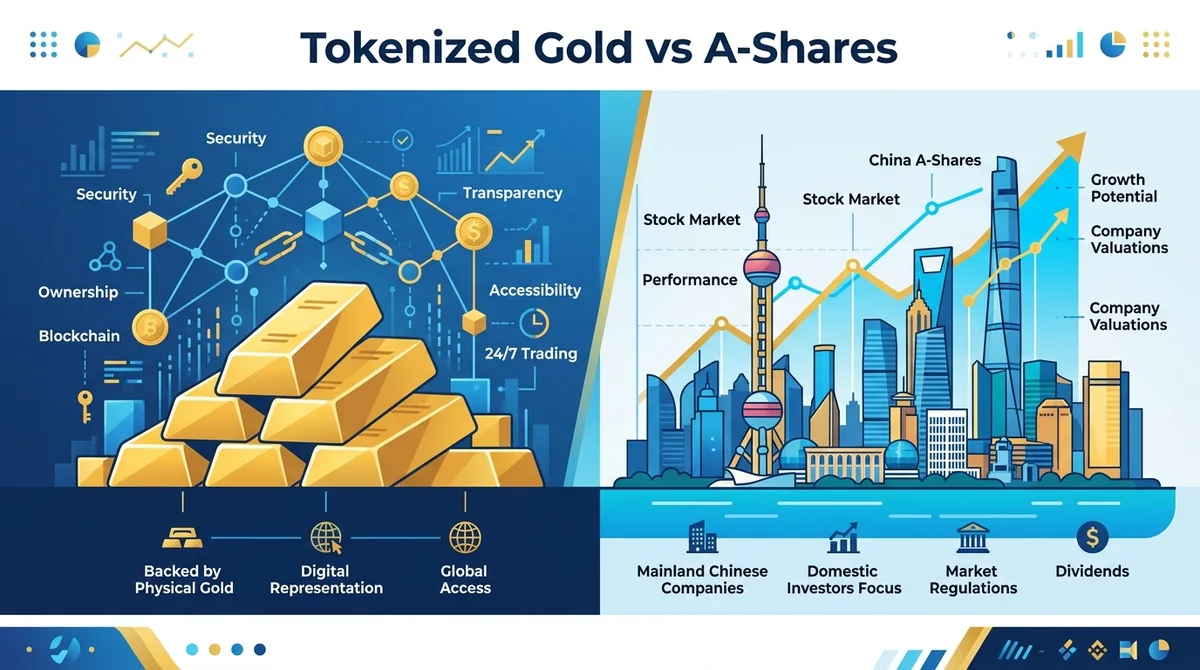
Compare tokenized gold and China A-shares: ownership, risk-return, suitability, and regulation. Based on public data to aid multi-asset allocation.
Tokenized gold and China's A-share market differ fundamentally in asset attributes, risk-return profiles, and regulatory frameworks, suiting investors with different objectives and risk appetites.
#What are the essential differences between tokenized gold and China's A-share market?
Answer: Tokenized gold is a blockchain exposure to the gold price, typically without physical gold ownership; China's A-share market represents direct equity in mainland China-listed companies.
#Does tokenized gold represent physical gold ownership?
Tokenized commodities are usually backed by physical gold, but holders generally do not directly own the corresponding bars; instead, they hold digital certificates representing gold value. Its legal status depends on the issuer's custody arrangements and the regulatory recognition in the jurisdiction.
#How does the China A-share market participate in China's economic growth?
China's A-share market trades on the Shanghai and Shenzhen stock exchanges. Investors become company shareholders by purchasing stocks, enjoying dividends and voting rights (depending on share class), directly participating in the growth of mainland Chinese enterprises.
Regulation and legal status: Tokenized gold may be subject to cryptocurrency or securities regulations; A-shares are strictly regulated by the China Securities Regulatory Commission.
#What are the respective risk and return characteristics of tokenized gold and China's A-share market?
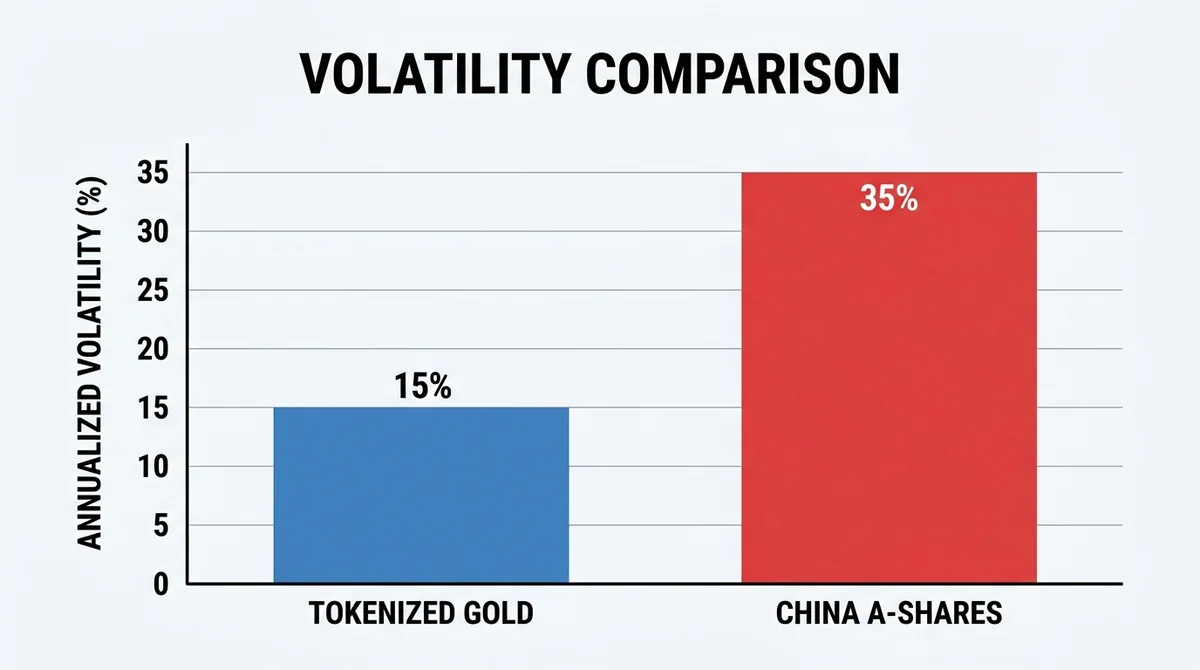
Answer: Tokenized gold mainly tracks the gold price but carries blockchain-related risks; China's A-share market has higher volatility, driven by macroeconomic conditions and corporate earnings, with long-term return potential and risks coexisting.
#Does the price volatility of tokenized gold align with the gold price?
Tokenized gold prices generally track the spot gold price but may deviate due to insufficient liquidity, premiums, or decoupling risks. Additionally, smart contract vulnerabilities, custodian risks, and regulatory uncertainty may affect its value.
#What is the volatility and long-term return of China's A-share market?
China's A-share market has historically exhibited high volatility, significantly influenced by policies, economic cycles, and corporate earnings. Long-term returns depend on economic growth and corporate profitability, but individual stock and systemic market risks cannot be ignored.
#Who is suitable for investing in tokenized gold, and who is suitable for China's A-share market?
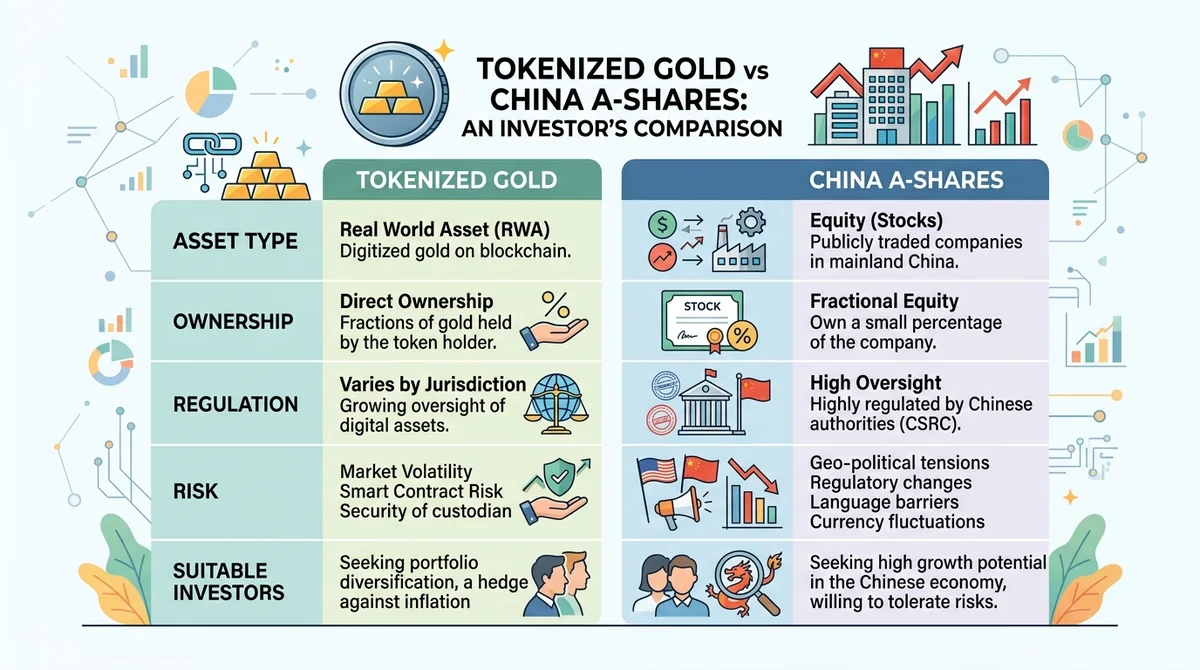
Answer: Tokenized gold suits investors seeking convenient gold price exposure and familiar with cryptocurrency trading; China's A-share market suits equity investors bullish on China's long-term economic growth and willing to accept higher volatility.
#Are investors seeking gold exposure without holding physical gold suited to tokenized gold?
Yes. Tokenized gold offers a convenient way to gain exposure without storing physical gold, but investors must accept blockchain-related risks.
#Should investors wanting to participate in China's economic growth choose A-shares?
If investors have confidence in China's economic outlook and can tolerate market volatility, A-shares are one avenue to directly participate in China's economic growth. However, they should note market access restrictions and individual stock selection risks.
#What regulatory and compliance issues should be noted when investing in tokenized gold and China's A-share market?
Answer: Regulation of tokenized gold varies by region and may be treated as securities or commodities; China's A-share market has specific access mechanisms for foreign investors, such as QFII, RQFII, Shanghai-Hong Kong Stock Connect, and Shenzhen-Hong Kong Stock Connect.
#In which jurisdictions is tokenized gold regulated?
The regulatory status of tokenized gold is not yet unified globally. Some countries treat it as securities, others as commodities. Investors must comply with local cryptocurrency regulations and pay attention to tax and reporting obligations.
#What restrictions do foreign investors face when investing in China's A-share market?
Foreign investors can invest in A-shares through Qualified Foreign Institutional Investor (QFII), RMB Qualified Foreign Institutional Investor (RQFII), Shanghai-Hong Kong Stock Connect, Shenzhen-Hong Kong Stock Connect, and other channels, but must meet certain qualification requirements and quota limits.
#Overall Score and Suitability
Overall Score: 7.5/10 (based on a comprehensive assessment of risk-return characteristics, accessibility, and regulatory clarity)
Suitable for:
- Tokenized gold: Investors seeking gold exposure, familiar with cryptocurrencies, and desiring fast trading.
- China A-shares: Investors bullish on China's long-term economic growth, able to withstand higher volatility, and seeking equity returns.
Not suitable for:
- Tokenized gold: Investors unfamiliar with blockchain technology and seeking physical gold ownership.
- China A-shares: Investors with low risk tolerance, short investment horizons, or unfamiliarity with the Chinese market.
#Pros and Cons
Tokenized gold pros:
- Convenient trading, available 24/7 on cryptocurrency exchanges.
- No need to store physical gold, reducing holding costs.
- Easily divisible, allowing small investments.
Tokenized gold cons:
- May not directly own physical gold, exposing to counterparty risk.
- Smart contract and custody risks.
- Regulatory uncertainty may affect liquidity and legality.
China A-shares pros:
- Direct equity ownership with shareholder rights.
- Relatively deep market and mature regulation.
- Can benefit from China's economic growth and corporate earnings.
China A-shares cons:
- Higher volatility, potentially significant drawdowns.
- Restricted access for foreign investors; capital controls may affect fund flows.
- Individual stock risk and systemic market risk coexist.
#Core Attributes in Detail
- Fees: Data not disclosed. Trading fees for tokenized gold depend on the exchange; A-share trading commissions and stamp duties are set by Chinese brokers and regulators.
- Valuation: Tokenized gold price tracks spot gold with no independent valuation; A-share valuation depends on company fundamentals and market sentiment, with indicators like P/E ratio fluctuating significantly.
- Liquidity: Tokenized gold liquidity depends on the specific token and exchange; A-share liquidity is relatively good, but some small-cap stocks may be lower.
- Equity attributes: Tokenized gold typically does not confer physical gold ownership; A-shares confer shareholder rights, including dividends and voting rights.
#Risk History
- Tokenized gold: Some projects have experienced token decoupling or delisting due to custody issues or regulatory crackdowns; specific case data is not publicly available.
- China A-shares: Historically experienced multiple sharp fluctuations, such as the 2015 stock market crash and the early 2020 pandemic decline. Investors should be wary of market risks.
#FAQ
Q1: What is the difference between tokenized gold and gold ETFs? A1: Gold ETFs are typically backed by physical gold, traded on stock exchanges, and regulated under securities laws; tokenized gold is issued on a blockchain, may be subject to different regulatory frameworks, and trades on different venues.
Q2: Can foreign individual investors directly buy China A-shares? A2: They can invest indirectly through Shanghai-Hong Kong Stock Connect, Shenzhen-Hong Kong Stock Connect, or qualified foreign investor channels, subject to certain conditions and quota limits.
Q3: Will the price of tokenized gold exactly match the spot gold price? A3: Usually highly correlated, but deviations may occur due to liquidity, premiums, or decoupling risks.
Q4: What are the trading hours of China's A-share market? A4: Trading hours for the Shanghai and Shenzhen stock exchanges are Monday to Friday (excluding holidays), 9:30-11:30 AM and 1:00-3:00 PM.
Q5: Is capital gains tax payable on tokenized gold investments? A5: Tax treatment varies by country; investors should consult local tax professionals.
This content is compiled from public data and does not constitute investment or account opening advice. Data as of 2026-08-21; actual conditions may change. For more information, please refer to official sources.
FAQ
What is the difference between tokenized gold and gold ETFs?
Gold ETFs are typically backed by physical gold, traded on stock exchanges, and regulated under securities laws; tokenized gold is issued on a blockchain, may be subject to different regulatory frameworks, and trades on different venues.
Can foreign individual investors directly buy China A-shares?
They can invest indirectly through Shanghai-Hong Kong Stock Connect, Shenzhen-Hong Kong Stock Connect, or qualified foreign investor channels, subject to certain conditions and quota limits.
Will the price of tokenized gold exactly match the spot gold price?
Usually highly correlated, but deviations may occur due to liquidity, premiums, or decoupling risks.
What are the trading hours of China's A-share market?
Trading hours for the Shanghai and Shenzhen stock exchanges are Monday to Friday (excluding holidays), 9:30-11:30 AM and 1:00-3:00 PM.
Is capital gains tax payable on tokenized gold investments?
Tax treatment varies by country; investors should consult local tax professionals.
Related Terms
Read the review? Ready to try a small position?
The crypto assets and tokenized US stocks/ETFs covered here are available on MSX — spot and perpetuals.
Quick Start Trading →New here? Registration takes three quick steps.