Security Tokens
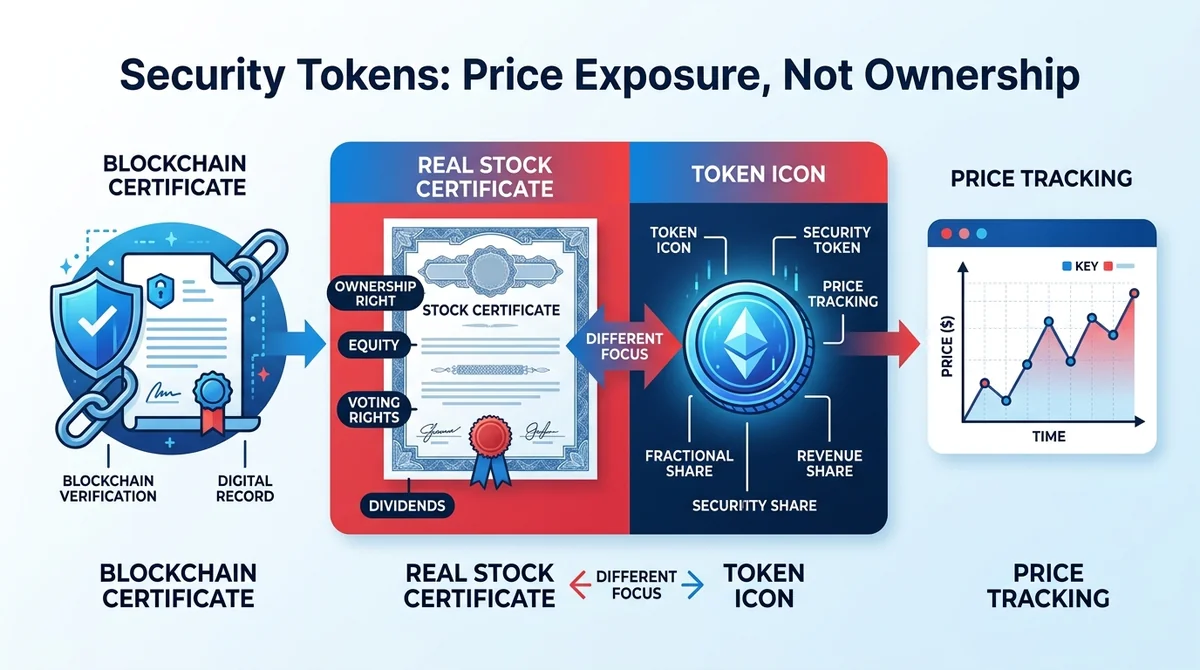
Security tokens give on-chain price exposure, not real stock or physical commodities. Tokenized Apple, TSLA, crude oil vs Bitcoin explained.
Security tokens only provide on-chain price exposure; they do not represent ownership, voting rights, or physical delivery. Users who want exposure to US stock or commodity price movements and can bear counterparty and regulatory risk may consider them, while those seeking shareholder rights or physical delivery should avoid them.
#What exactly is a security token? How does it differ from real stocks and commodities?
A security token is a certificate that maps the price of a real asset onto the blockchain. Its core feature is this: what you hold is price exposure, not the asset itself.
#Does holding a tokenized stock mean holding a real US stock?
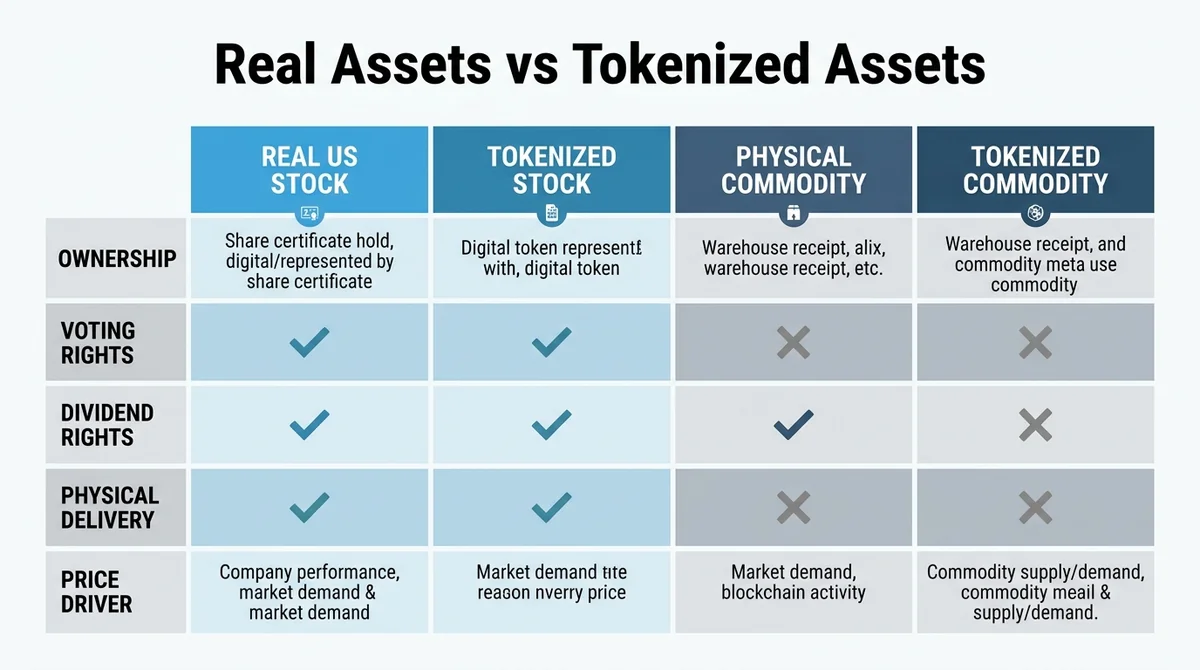
No. A tokenized stock tracks the price movements of the underlying stock, but it usually does not carry shareholder rights such as voting rights or dividend rights. A real US stock represents a portion of ownership in a company, while a tokenized stock represents a claim on some issuer or custody structure. The two are completely different in legal terms.
#How do tokenized commodities differ from physical commodities?
Tokenized commodities (such as tokenized commodities tracking crude oil) track the commodity price but do not involve physical delivery. Holding physical crude oil means you own something extractable and storable; holding tokenized crude oil means you own a price-tracking certificate, and whether it can be redeemed for the physical asset depends on the issuer's terms—in most cases it cannot.
#What determines the price of a security token?
US stock prices are the cause; token prices are the effect. Price movements of the underlying asset in traditional markets are the main driver, but token prices are also affected by on-chain liquidity, issuer premiums/discounts, and redemption mechanism efficiency, so deviations can occur.
A security token is a certificate that maps the price of a real asset (such as Apple or TSLA stock, or commodities like crude oil) onto the blockchain. It only provides price exposure and does not bring shareholder rights or physical delivery.
#What is the difference between tokenized Apple, tokenized TSLA, and tokenized commodities?
#Are there big differences between tokenized stocks?
Tokenized Apple and tokenized TSLA both track individual stock prices, with similar underlying drivers—both depend on the corresponding company's performance, valuation, and market sentiment. The differences mainly lie in the volatility characteristics of the underlying itself: the historical volatility of TSLA is usually higher than that of large-cap blue chips like Apple.
#What is the core difference between tokenized commodities and tokenized stocks?
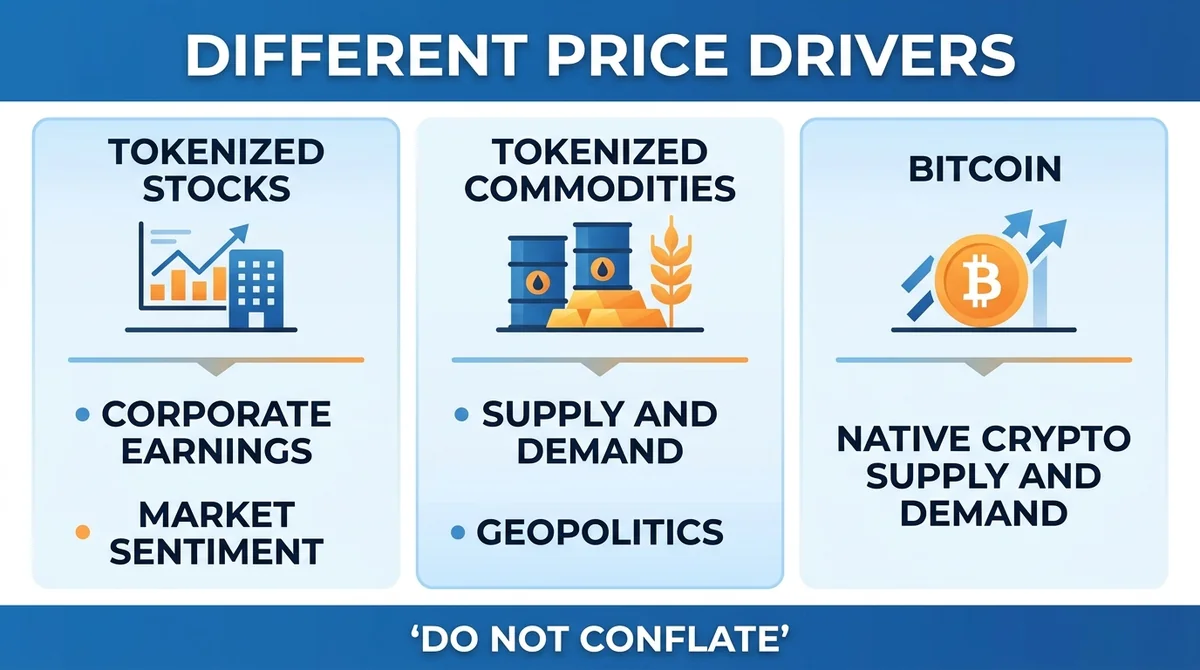
Different drivers. Tokenized stocks follow corporate earnings and stock market risk appetite; tokenized commodities follow supply and demand, geopolitics, inventory data, and macroeconomic cycles. Their correlation changes significantly under different market conditions, so they can be candidates for diversification, but you cannot assume they rise and fall together.
#What is the relationship between Bitcoin and security tokens?
Bitcoin is a native crypto asset, not a security token. It has no corresponding off-chain underlying asset, and its price is determined directly by market supply and demand. A security token, by contrast, is a mapping of an off-chain asset. The two can both fall within the scope of crypto asset allocation, but their attributes, sources of risk, and pricing logic are completely different and should not be conflated.
Tokenized Apple and TSLA track individual stock prices, tokenized commodities track commodity prices, and Bitcoin is a native crypto asset; the three have different price drivers and cannot be conflated.
#Who is suited to security tokens? Who should avoid them?
#Are they suitable for people who want US stock exposure but do not want to open account with a traditional brokerage?
They can be considered, but the cost must be clear. Such users get price exposure, not shareholder status. If the goal is to capture price movements, the tokenized route may be more convenient in terms of accessibility; if the goal is long-term holding with corporate governance and dividends, it is not suitable.
#Are they suitable for people seeking physical commodity delivery or shareholder rights?
No. The structure of security tokens usually does not support physical delivery and does not carry voting or dividend rights. Those with such needs should choose a traditional brokerage or physical market.
#Is it meaningful for crypto-native users to allocate to tokenized commodities?
Yes, but it should be positioned as a supplement. Crypto-native users' portfolios are usually dominated by native assets such as Bitcoin and Ethereum. Tokenized commodities provide exposure linked to traditional commodity cycles, with different drivers from native crypto assets, and can serve as one diversification candidate.
Security tokens suit users who want to gain US stock or commodity price exposure through on-chain means and can bear counterparty and regulatory risk; those seeking shareholder rights or physical delivery should avoid them.
#What risks and compliance considerations do security tokens have?
#What is the counterparty risk of tokenized stocks?
The redemption of the token depends on the issuer or its custody structure. If the issuer defaults, suffers operational disruption, or has insufficient reserves, token holders may face redemption difficulties. This is an extra layer of risk that on-chain price exposure has compared with direct shareholding.
#What regulatory constraints apply to security tokens?
Different jurisdictions characterize security tokens inconsistently. Some jurisdictions may treat them as securities and apply corresponding regulation, while rules in others are still evolving. In the US, for example, the Securities and Exchange Commission (SEC) has taken enforcement action against some tokenized securities products and issued investor alerts warning that they may not enjoy the same protections as direct shareholding (specific regulatory positions and timelines are subject to the latest official announcements). Changes in regulatory characterization may affect tradability, the issuer's operating qualifications, and even the survival of the token itself. Specific applicable rules are subject to the latest public information in your jurisdiction.
#Can the token price decouple from the underlying asset price?
Yes. When liquidity is insufficient, redemption mechanisms are restricted, or market sentiment is extreme, the token price may deviate significantly from the underlying asset price. Such deviations can also occur during periods when the underlying asset market is closed (such as non-trading hours for US stocks).
#What else should be noted?
- No shareholder rights: no dividends, voting, or other real stock entitlements
- Liquidity risk: trading depth may be lower than the traditional market for the underlying asset
- Data transparency: some issuers do not disclose reserve and custody information, so you need to verify it yourself
Security tokens carry risks such as counterparty default, unclear regulatory characterization, and price decoupling due to insufficient liquidity, and they do not carry the shareholder rights of real stocks.
#Scenario routing: if you are... then...
- If you want US stock price movement exposure and accept on-chain counterparty risk: research the tokenized stocks route, focusing on the issuer's reserves and redemption terms.
- If you need shareholder rights, dividends, or voting: choose direct shareholding through a traditional brokerage; the tokenized route does not meet this need.
- If you need physical commodity delivery: choose a physical market or a compliant channel that supports delivery; tokenized commodities usually do not offer delivery.
- If you are a crypto-native user looking to diversify: consider tokenized commodities as a satellite position candidate, noting that their correlation with native crypto assets changes with the macroeconomic environment.
- If your jurisdiction's characterization of security tokens is unclear: first confirm the compliance status before considering any allocation action.
#Action checklist
- Confirm your goal: do you want price exposure, or ownership and shareholder rights.
- Verify the issuer: whether the reserve structure, custody arrangements, and redemption mechanism are publicly verifiable.
- Verify regulation: whether your jurisdiction's characterization of security tokens is clear.
- Verify liquidity: compare the token's trading depth, bid-ask spread, and underlying asset market.
- Verify deviation: the historical tracking error between the token price and the underlying asset price.
- Verify costs: issuer fees, trading fees, and potential redemption costs.
- Clarify position sizing: evaluate it as a supplementary exposure rather than a core holding.
#FAQ
Can security tokens pay dividends? Usually not. Tokenized stocks generally do not carry dividend rights or voting rights, subject to the issuer's terms; if the terms are not public, they should be treated as undisclosed data, and you cannot assume shareholder entitlements.
Can tokenized crude oil be redeemed for the physical asset? Most tokenized commodity structures do not support physical delivery and only provide price tracking. Whether redemption is supported depends on the issuer's public terms.
Is Bitcoin a security token? No. Bitcoin is a native crypto asset with no off-chain underlying asset; its price is determined directly by market supply and demand, different from the mapping structure of security tokens.
Why is the token price sometimes inconsistent with US stocks? Because the token price is also affected by on-chain liquidity, issuer premiums and discounts, and redemption efficiency, and the underlying reference price does not update during US stock market closures, so deviations may widen.
Are security tokens suitable for long-term holding? It depends on your goal. If the goal is long-term ownership and shareholder entitlements, the tokenized structure does not match; if the goal is price exposure, you need to continuously assess counterparty and regulatory risk.
This content is compiled from public information and does not constitute investment or open account advice. It does not cite unverified return, fee, or scale data, and actual conditions may change. For specific terms, please refer to official sources from the issuer and regulators.
FAQ
Can security tokens pay dividends?
Usually not. Tokenized stocks generally do not carry dividend rights or voting rights, subject to the issuer's terms; if the terms are not public, they should be treated as undisclosed data, and you cannot assume shareholder entitlements.
Can tokenized crude oil be redeemed for the physical asset?
Most tokenized commodity structures do not support physical delivery and only provide price tracking. Whether redemption is supported depends on the issuer's public terms.
Is Bitcoin a security token?
No. Bitcoin is a native crypto asset with no off-chain underlying asset; its price is determined directly by market supply and demand, different from the mapping structure of security tokens.
Why is the token price sometimes inconsistent with US stocks?
Because the token price is also affected by on-chain liquidity, issuer premiums and discounts, and redemption efficiency, and the underlying reference price does not update during US stock market closures, so deviations may widen.
Are security tokens suitable for long-term holding?
It depends on your goal. If the goal is long-term ownership and shareholder entitlements, the tokenized structure does not match; if the goal is price exposure, you need to continuously assess counterparty and regulatory risk.
Related Terms
Read the review? Ready to try a small position?
The crypto assets and tokenized US stocks/ETFs covered here are available on MSX — spot and perpetuals.
Quick Start Trading →New here? Registration takes three quick steps.