Tokenized Stock Perpetuals
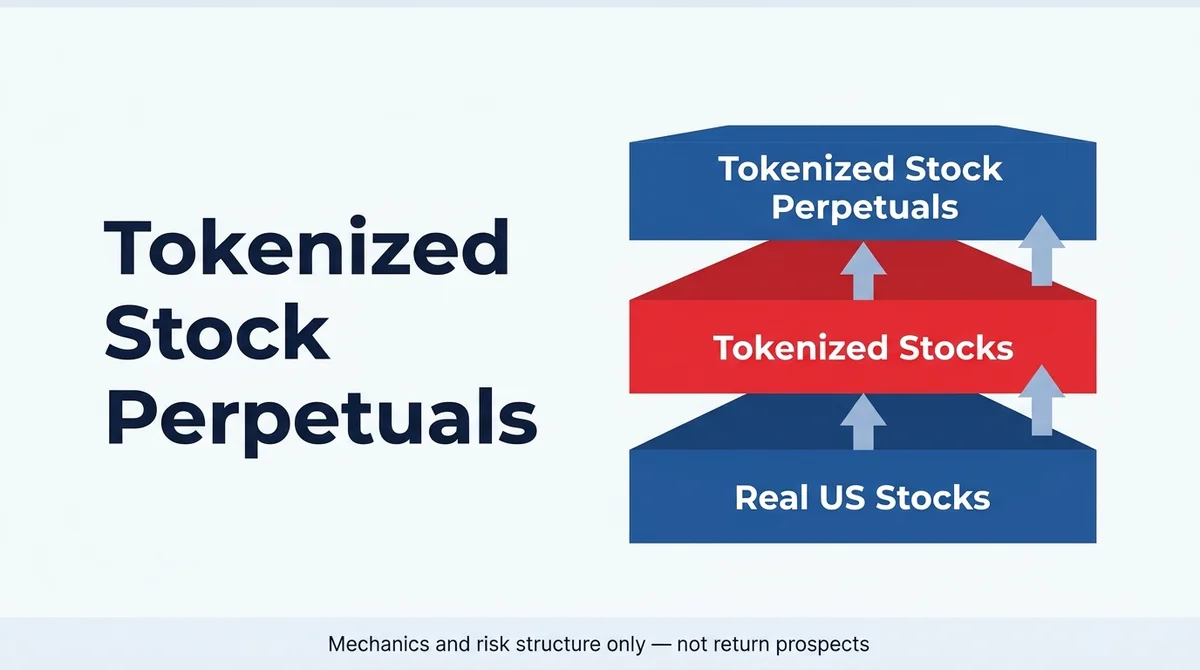
Tokenized stock perpetuals are leveraged derivatives on tokenized stock prices, not real shares. Three-layer breakdown, 5-factor framework, and risk checklist.
A tokenized stock perpetual is a leveraged derivative with no expiry date that uses the price of a tokenized stock as its underlying. It trades only on price movements, does not hold real shares, and is not the same thing as a tokenized stock itself; it sits one layer further from real US stocks than tokenized stocks do. One note before we begin: this article discusses product mechanics and risk structure, not return prospects. Where a dimension has no specific figures attached, it is kept as a qualitative description because public sources are insufficient.
#What exactly is a tokenized stock perpetual?
A tokenized stock perpetual belongs to the derivatives layer: no expiry, leveraged, and priced against a tokenized stock, it trades price movements rather than asset ownership. Together with tokenized stocks and real US stocks, it forms a three-layer structure in which each step down moves further from the actual stock.
#How does it relate to tokenized stocks and real US stocks?
The three form a progressive three-layer relationship: real US stocks are the underlying asset, tokenized stocks are price exposure to real US stocks, and tokenized stock perpetuals are derivatives that add another layer of leverage on top of that exposure. Real US stocks carry shareholder status and corporate-action rights; whether tokenized stocks come with shareholder rights depends on the specific issuance structure and platform disclosures and cannot be generalized; tokenized stock perpetuals trade only price direction and involve no equity whatsoever.
#Why is the US stock price the cause and the token price the effect?
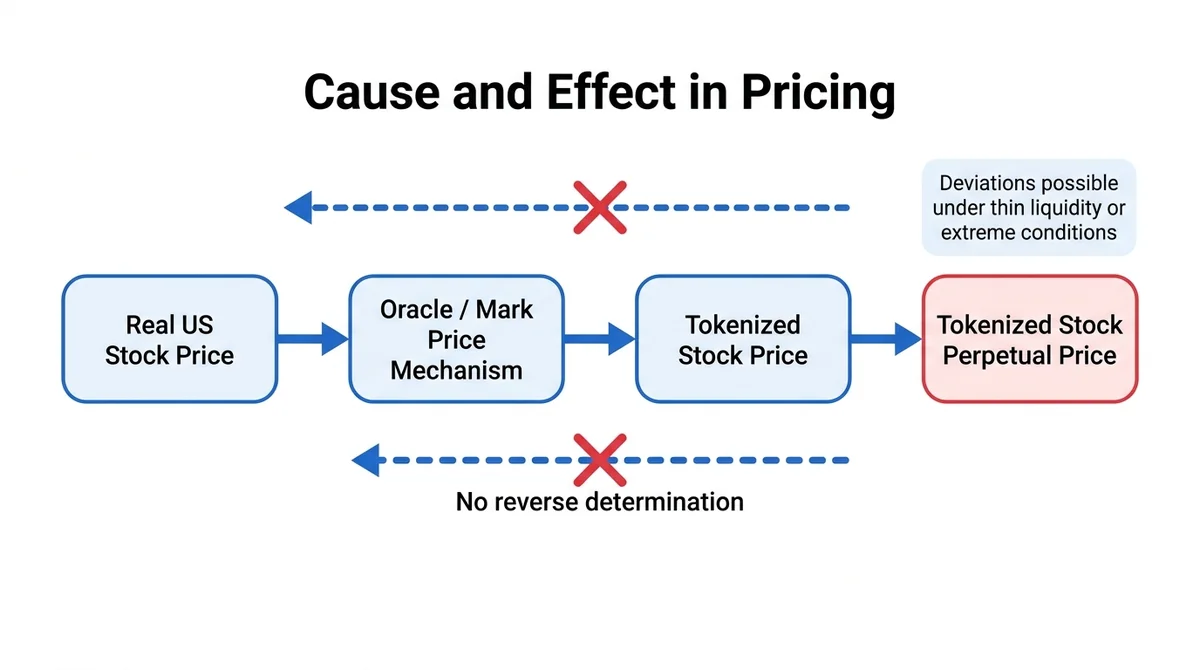
The pricing of tokenized stocks and their perpetuals is usually anchored to real US stock prices: US stock price changes transmit to token prices, but token prices do not in turn determine US stock prices. Understanding this causal direction is a prerequisite for evaluating any tokenized stock derivative: whether the underlying pricing mechanism is transparent directly determines whether the derivative price is credible. Note, however, that whether the anchoring relationship holds stably depends on oracle and mark price mechanisms; in extreme conditions or when liquidity is thin, token prices may briefly deviate from US stock prices.
#How does converting held shares to tokenized form differ from tokenized stock perpetuals?
Converting held shares to tokenized form belongs to the spot layer, converting real shareholdings into tokenized exposure (the exact legal structure varies by issuer); tokenized stock perpetuals belong to the derivatives layer, stacking perpetual futures leverage and a perpetual futures funding rate settlement schedule on top of that exposure. The two are not on the same layer, and their risk and cost structures cannot be compared directly.
#What is the difference between a tokenized stock perpetual and directly holding a tokenized stock?
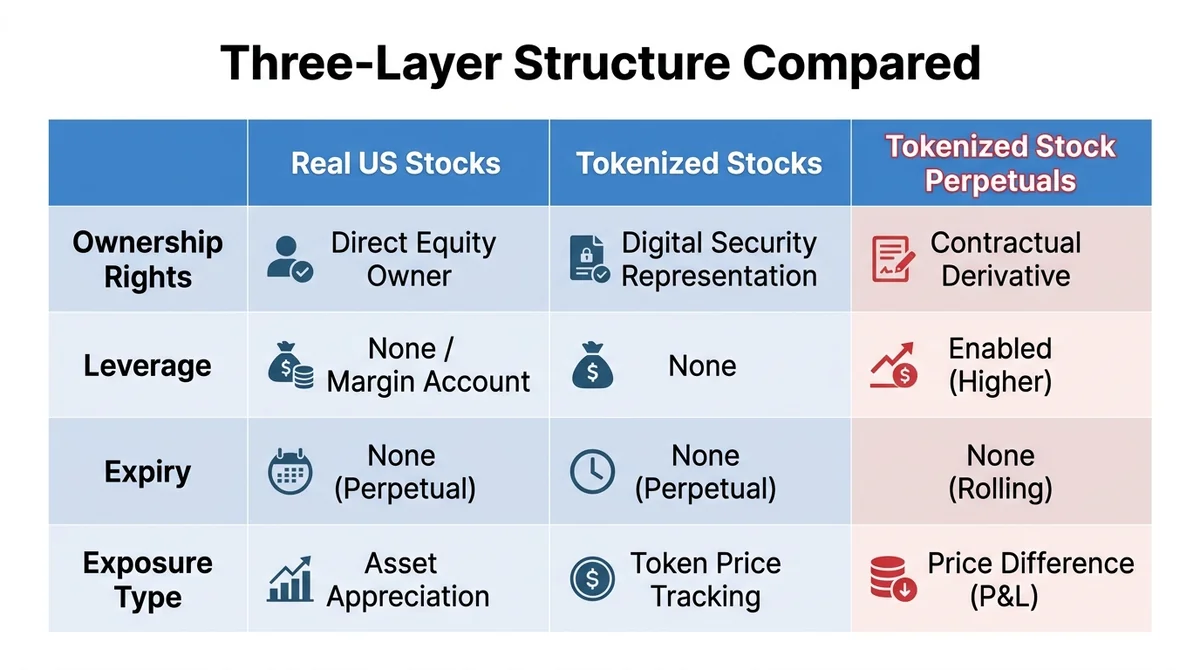
A tokenized stock provides price exposure; a tokenized stock perpetual adds a leveraged derivative layer on top of that exposure, making both the risk and cost structures more complex.
#How do the two differ in asset ownership?
A tokenized stock corresponds to price exposure; a tokenized stock perpetual is a derivative contract, further from the real stock. A perpetual does not hold the spot-layer token exposure and retains only contractual exposure to price direction; whether a tokenized stock carries dividends, voting, or other rights must be checked against the specific issuance terms and cannot be assumed to equal real shareholder rights.
#Who bears the perpetual futures leverage and liquidation risk?
Perpetuals are leveraged, and adverse price moves can trigger forced liquidation, with the risk borne by the contract holder; the tokenized stock spot layer usually has no leverage mechanism and no forced liquidation (though it may carry issuer or custody fee-related counterparty risk). Perpetual futures leverage magnifies both gains and losses proportionally, which is the core risk difference between perpetuals and spot.
#How do holding cost structures differ?
Perpetuals continuously incur how does perpetual futures funding rate work costs, which are recurring periodic costs rather than one-time fees; the spot layer typically has none. The longer the holding period, the greater the cumulative impact of funding rates on total cost, which is why this factor must be listed separately when evaluating perpetual cost structures. The direction and size of funding rates float with market conditions and can be positive or negative; do not assume they are always an expense.
#How should the five evaluation dimensions for tokenized stock perpetuals be scored?
Tokenized stock perpetuals should be scored on five dimensions: underlying pricing, perpetual futures leverage and risk controls, fee structure, liquidity, and compliance disclosure. Missing data is marked "data not disclosed." Scoring evaluates only mechanics and risk structure, not return prospects.
#Is the underlying and pricing mechanism transparent?
Check the definition of the underlying asset, the price source, and the update mechanism. If the platform does not disclose the pricing source or update frequency, mark that dimension "data not disclosed" without speculation.
#Are the leverage and risk-control rules clear?
Check available leverage multiples, margin rules, forced-liquidation trigger conditions, and liquidation handling procedures. The clearer the rules, the more predictable the product is for traders.
#Is the fee and funding rate structure predictable?
Distinguish one-time trading fees from ongoing funding rates. Whether funding rates float with market conditions and how long the settlement cycle is determine how predictable long-term holding costs are.
#How should liquidity and execution quality be judged?
Check order book depth, bid-ask spreads, and slippage. Insufficient liquidity amplifies liquidation risk and trading costs. If specific figures are not disclosed, mark "data not disclosed."
#Is compliance and information disclosure adequate?
Check platform qualifications, regional availability, and risk disclosure documents. Tokenized stock perpetuals carry no shareholder rights, and the adequacy of disclosure directly affects risk perception. Also note that tokenized stock derivatives may be classified as securities derivatives in different jurisdictions, with availability and compliance requirements varying by region; platform official disclosures should govern.
#What are the pros and cons of tokenized stock perpetuals?
The advantage of tokenized stock perpetuals is leveraged expression of price views; the disadvantages are liquidation risk, ongoing funding rate costs, and greater distance from real stocks.
#What needs does it address?
It allows leveraged long or short views and provides price exposure without holding real shares, suiting short-term directional trading needs.
#Where do its main risks come from?
Liquidation risk, ongoing funding rate costs, and greater distance from real stocks. Perpetual futures leverage magnifies gains and losses proportionally, and adverse price moves trigger forced liquidation; a tokenized stock perpetual is not a real US stock and carries no shareholder rights. It also stacks platform counterparty risk, oracle pricing risk, and liquidity risk.
#Which costs are easily overlooked?
Long-term accumulation of funding rates and liquidation slippage. Funding rates are recurring periodic costs, not one-time fees, and accumulate more noticeably the longer you hold; slippage during forced liquidation can be significantly higher than normal execution costs.
#Who should use tokenized stock perpetuals, and who should not?
People who want long-term US stock exposure should not use tokenized stock perpetuals; only users who can bear liquidation risk and need leveraged long or short views should consider them.
#What should long-term US stock exposure seekers choose?
For long-term real exposure, prioritize spot or share tokenization rather than perpetuals. Perpetuals carry perpetual futures leverage and funding rates and are not suitable as a long-term holding tool.
#Are they suitable for those who only want short-term long or short views?
Users who want short-term directional expression and understand leverage mechanics may consider perpetuals, but they must bear liquidation risk themselves and recognize that funding rates are an ongoing cost.
#What should those who cannot bear liquidation risk avoid?
Low risk-tolerance users should avoid leveraged derivatives, including tokenized stock perpetuals.
#Scenario routing
- If you want long-term US stock exposure: prioritize spot or share tokenization, not perpetuals.
- If you want short-term long or short views and understand leverage: perpetuals may be considered, with liquidation risk borne by you.
- If your risk tolerance is low: avoid leveraged derivatives.
- If you are cost-sensitive with a long holding period: prioritize the spot layer to avoid funding rate accumulation.
- If you need shareholder rights: real US stocks or share-tokenization products whose terms explicitly attach the relevant rights, not perpetuals.
#What risks should you watch when using tokenized stock perpetuals?
Tokenized stock perpetuals are leveraged and magnify gains and losses; adverse price moves can trigger forced liquidation, you must continuously pay funding rates, and you have no real shareholder rights.
#Why is perpetual futures leverage dangerous?
Perpetual futures leverage magnifies gains and losses proportionally; losses accelerate as fast as gains, and margin is consumed faster when prices move against you.
#How do forced liquidation and liquidation happen?
Adverse price moves trigger forced liquidation, with specific triggers depending on the platform's margin and liquidation rules; how the mark price is calculated (e.g., index price or aggregated multi-market data) also affects liquidation decisions.
#Why do funding rates continuously erode costs?
Funding rates are ongoing costs, not one-time fees, recurring each settlement cycle; the longer you hold, the higher the cumulative cost.
#Action checklist
- Verify that the underlying asset definition and price source are public.
- Verify leverage multiples, margin, and liquidation rules.
- Verify the funding rate settlement cycle and floating mechanism.
- Verify order book depth and bid-ask spreads.
- Verify platform qualifications and regional availability.
- Clarify your own holding period and risk tolerance.
- Distinguish the spot layer from the derivatives layer to avoid confusion.
#FAQ
Q1: Is a tokenized stock perpetual the same as holding a real US stock? A: No. A tokenized stock perpetual is a derivative that trades only price movements and carries no shareholder rights.
Q2: What is the difference between a tokenized stock perpetual and a tokenized stock? A: A tokenized stock provides price exposure; a tokenized stock perpetual is a leveraged derivative on top of that exposure, with more complex risk and cost structures.
Q3: Is the funding rate a one-time fee? A: No. The funding rate is an ongoing cost paid each settlement cycle, accumulating more noticeably the longer you hold; its direction floats with market conditions.
Q4: Should I use perpetuals for long-term US stock exposure? A: Not recommended. For long-term holding, prioritize spot or share tokenization; perpetuals carry perpetual futures leverage and ongoing funding rate costs.
Q5: Is all data on tokenized stock perpetuals available? A: Not necessarily. Some dimensions such as liquidity and fee structure may not be disclosed; missing data should be marked "data not disclosed" without speculation.
Q6: Do tokenized stocks always track US stock prices in extreme conditions? A: Not necessarily. Anchoring relies on oracle and mark price mechanisms, and brief deviations may occur in extreme conditions or when liquidity is thin.
This content is compiled from public information and does not constitute investment or open account advice. Dimensions without specific figures are not quantified due to insufficient public sources. Actual conditions may change; for the latest parameters, refer to official platform sources.
FAQ
Is a tokenized stock perpetual the same as holding a real US stock?
No. A tokenized stock perpetual is a derivative that trades only price movements and carries no shareholder rights.
What is the difference between a tokenized stock perpetual and a tokenized stock?
A tokenized stock provides price exposure; a tokenized stock perpetual is a leveraged derivative on top of that exposure, with more complex risk and cost structures.
Is the funding rate a one-time fee?
No. The funding rate is an ongoing cost paid each settlement cycle, accumulating more noticeably the longer you hold; its direction floats with market conditions.
Should I use perpetuals for long-term US stock exposure?
Not recommended. For long-term holding, prioritize spot or share tokenization; perpetuals carry perpetual futures leverage and ongoing funding rate costs.
Is all data on tokenized stock perpetuals available?
Not necessarily. Some dimensions such as liquidity and fee structure may not be disclosed; missing data should be marked "data not disclosed" without speculation.
Do tokenized stocks always track US stock prices in extreme conditions?
Not necessarily. Anchoring relies on oracle and mark price mechanisms, and brief deviations may occur in extreme conditions or when liquidity is thin.
Related Terms
Read the review? Ready to try a small position?
The crypto assets and tokenized US stocks/ETFs covered here are available on MSX — spot and perpetuals.
Quick Start Trading →New here? Registration takes three quick steps.