Tokenized Stock Premiums
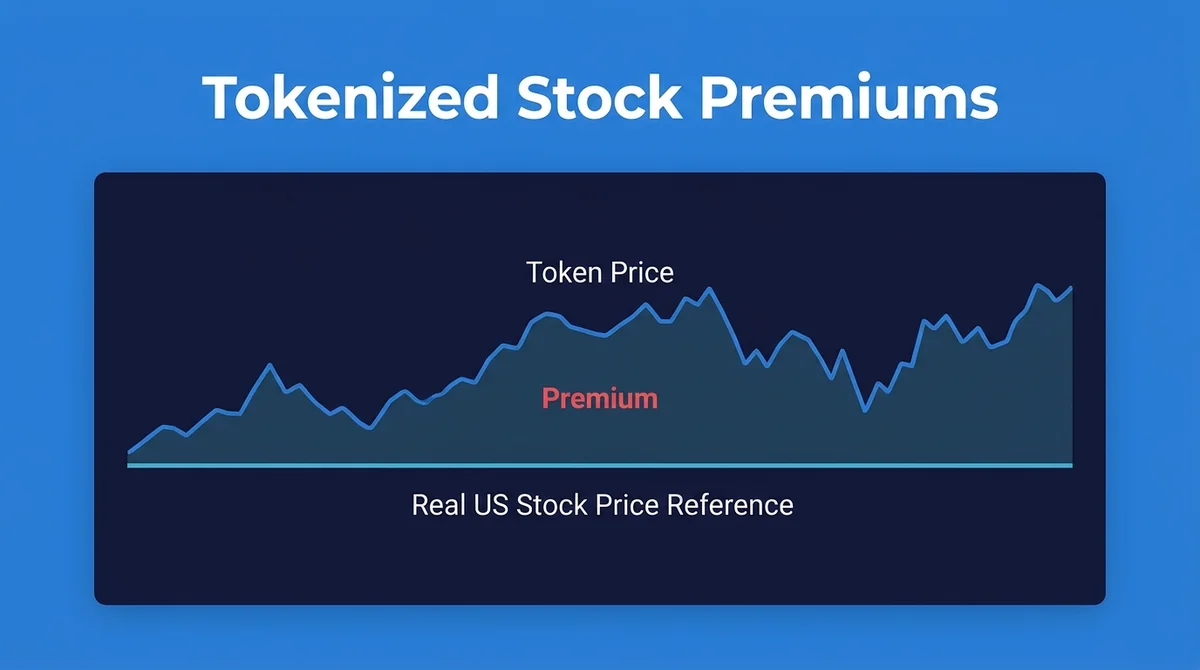
Tokenized stock premiums are the gap between token price and the real US stock reference. Learn causes, spot vs perpetual differences, and premium-buying risks.
Conclusion: Tokenized stock premiums measure how expensive it is to buy price exposure, not any extra value in the asset itself. Whether to pay a premium depends on whether it has conditions to converge, whether liquidity supports an exit, and whether you are buying spot-style exposure or leveraged perpetuals.
#What Exactly Is a Tokenized Stock Premium?
A tokenized stock premium is the upward deviation of a token's traded price from the corresponding real US stock price reference. It measures how expensive it is to buy price exposure, not any extra value in the asset itself. Note that the specific calculation basis for the "real US stock price reference" here (such as pre-market/after-hours, time-weighted, or closing price) varies by platform; this article does not assume a single standard.
#What do premium and discount each mean?
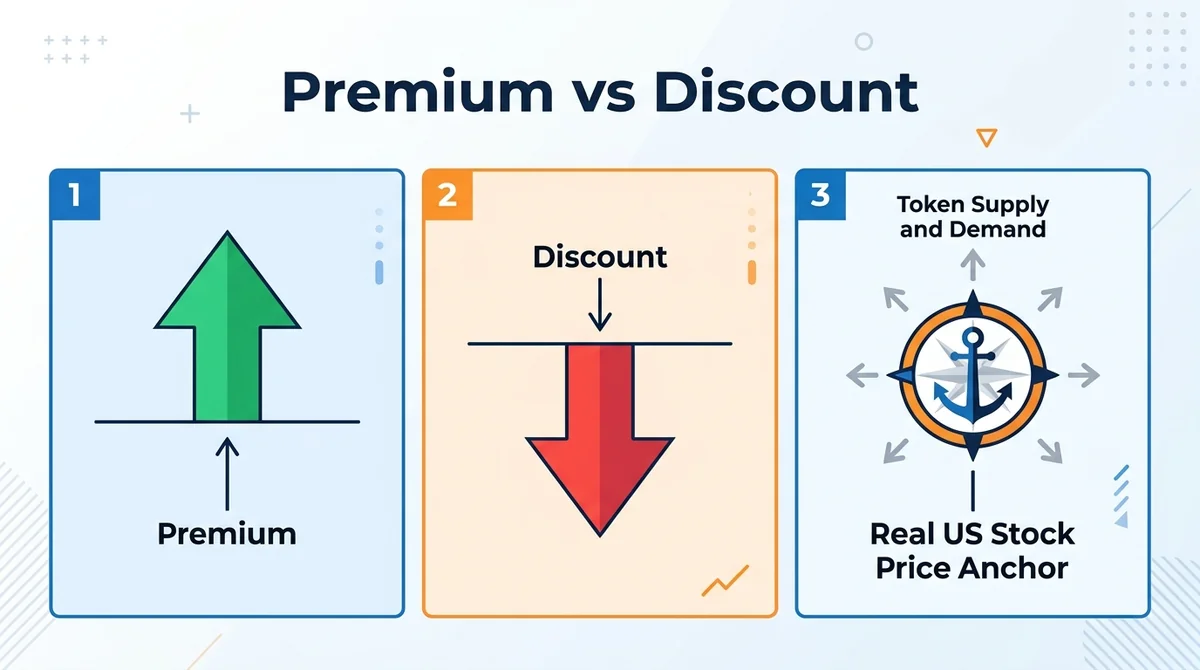
A premium is the portion by which the token price exceeds the corresponding real US stock price reference; a discount is a negative premium, meaning the token price is below that reference. Both are two directions of the same price spread, and the direction determines whether buying costs are added or subtracted.
#Is the premium the difference calculated from the real US stock price?
Yes. The premium is calculated against the real US stock price reference, and the difference between the token price and that reference is the premium or discount. It is important to stress that tokenized stocks are price exposure rather than real shareholding, so this difference reflects the trading cost of the exposure, not any increase or decrease in shareholder equity.
#Why say the US stock price is the cause and the token price the effect?
This is an inference in this article, not a proven fact: tokenized stocks typically use the real US stock price as their pricing anchor, and supply and demand on the token side only cause deviation. In other words, the real US stock price determines the center, and buying and selling pressure on the token side determines the magnitude of fluctuation around that center. If a platform uses non-anchored independent matching, this causal order may not hold, and it should be checked against the specific platform's mechanism.
#How Do Tokenized Stock Premiums Arise?
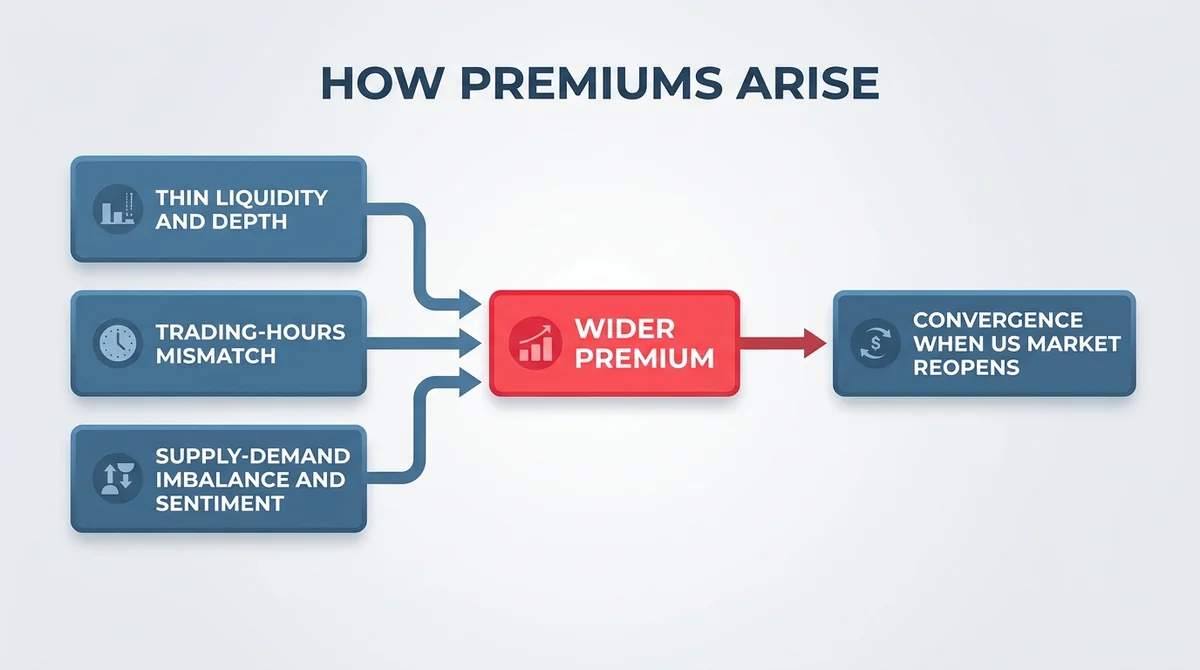
Tokenized stock premiums mainly come from thinner liquidity on the token side, mismatches with real US stock trading hours, and supply-demand imbalances caused by limited arbitrage mechanisms, which make deviations hard to converge immediately. This is a mechanism-level inference, and specific magnitudes must be verified platform by platform and instrument by instrument.
#Why does insufficient liquidity and depth push premiums higher?
Liquidity on the token side is usually thinner than in real US stocks, so the market impact cost of buying and selling is higher. On an order book with insufficient depth, concentrated buying pushes the traded price up faster, creating a premium; likewise, the impact cost of large sells is also higher.
#How does the trading-hours mismatch affect token prices?
Tokens keep trading while real US stocks are closed, lacking an immediate arbitrage constraint. Price discovery then relies more on supply and demand on the token side itself, and deviations from the center tend to widen, with convergence only possible after US stocks reopen and arbitrage channels resume.
#Do supply-demand imbalances and sentiment amplify premiums?
Yes. When one-sided buying is concentrated, premiums tend to widen, and limited arbitrage mechanisms make deviations hard to converge quickly. Sentiment-driven chasing is even more pronounced in thin-depth environments, which is one of the main sources of premium risk.
#What Is the Difference Between Tokenized Stocks and Tokenized Stock Perpetuals?
Tokenized stocks are price exposure, while tokenized stock perpetuals are derivatives that add perpetual futures leverage and funding rates, sitting further from real stocks, and their premium meaning differs from spot-style exposure.
#Where do the risks of spot-style tokenized stocks and perpetual contracts differ?
Spot-style tokenized stocks bear price volatility and premium convergence risk; perpetual contracts add perpetual futures leverage on top of that and can be liquidated, a completely different risk structure.
#Why are perpetuals further from real stocks?
Perpetuals add funding rate costs, and their prices are affected by the interaction of basis and how does perpetual futures funding rate work. They trade direction rather than holding a price exposure, so they sit further from real stocks.
#Does the premium mean the same thing in both forms?
No. In spot-style exposure, the premium is a buying cost; in perpetuals, the premium interacts with basis and funding rates and must be assessed together with holding costs, and the spot spread standard cannot simply be applied.
#Do Premiums Differ Across Instruments?
Stock-type tokenized instruments anchor their premiums to real US stock prices, while crypto instruments such as BTC, ETH, SOL, and XRP trade around the clock themselves, so the trading-hours mismatch logic differs; when assessing them, look separately at spread magnitude, depth, and arbitrage channels.
#What premium factors matter for instruments like TSM, Nvidia, and TSMC?
For these stock-type instruments, the premium is anchored to the real US stock price, and the core factors are spread magnitude, volume depth, and whether arbitrage channels are clear. This article has not obtained verifiable specific spread figures; such figures should be based on the platform's real-time order book.
#How does the premium logic for BTC, ETH, SOL, and XRP differ from stock-type instruments?
Crypto instruments trade around the clock themselves, so there is no mismatch with stock trading hours, and the trading-hours mismatch cause does not apply. Assessment should shift to the three metrics of spread magnitude, depth, and arbitrage channels. Note that if the "premium" of a crypto instrument is based on another market's quote, its standard differs from that of stock-type instruments and should not be compared directly.
#What metrics should be watched for tokenized stock premiums on the Solana ecosystem?
The same three: spread magnitude, volume depth, and whether arbitrage channels are clear. Ecosystem differences do not change the essential standard of the premium, but they add extra risk at the cross-chain bridge and on-chain settlement level; specific figures should be based on real-time on-chain data.
#What Risks Come With Buying at a Premium?
The main risks of buying at a premium are premium convergence eroding returns, high exit impact costs in thin depth, and tokenized stocks being only price exposure without real shareholder rights.
#What losses does premium convergence cause?
A falling premium directly erodes returns. If you buy at a premium, even if the underlying center price is unchanged, the premium converging toward zero itself causes a book loss.
#What makes exiting hard when liquidity is insufficient?
In thin depth, the impact cost of a large exit is high, and the actual execution price may be significantly below the quoted order book price; the difficulty of exiting is positively correlated with position size.
#Tokenized stocks are not real US stocks; what are the rights differences?
Tokenized stocks usually carry no shareholder rights and are only price exposure. There is also counterparty risk at the platform and contract level, which is unrelated to the underlying price but affects the actual realization of the exposure. Specific rights arrangements (such as whether dividends are mapped or how corporate actions are handled) are subject to the issuer's terms; this article has not verified them one by one.
#When Is It Appropriate to Bear a Premium, and When Is It Not?
If the premium has conditions to converge and the cost is acceptable, long-term allocation may consider bearing it; short-term trading should manage the premium as an explicit cost; when the premium keeps widening and liquidity deteriorates, the exposure should be abandoned. The following is an analytical framework, not investment advice.
#How should long-term allocation view the premium?
The core is two points: whether the premium has conditions to converge, and whether the cost is acceptable. If arbitrage channels are clear and depth is sufficient, the premium is more likely to revert to the center; otherwise it may persist for a long time.
#How should short-term trading manage the premium as a cost?
Include the premium in entry and exit costs and stop-loss discipline. The premium level at entry should be included as a cost item in profit-and-loss calculations rather than treated as negligible noise.
#What signals mean the exposure should be abandoned?
A persistently widening premium with deteriorating depth and blocked arbitrage channels are abandonment signals. At that point the deviation lacks a convergence mechanism, and both the cost of continuing to hold and the difficulty of exiting rise.
#FAQ
Q: Is a tokenized stock premium asset appreciation? A: No. It measures how expensive it is to buy price exposure, not any extra value in the asset itself, and premium convergence directly erodes returns.
Q: Does a premium always mean you should not buy? A: Not necessarily. The criteria are whether the premium has conditions to converge, whether the cost is acceptable, and whether you are bearing spot-style exposure or a perpetual derivative.
Q: Why is the premium on tokenized stocks hard to disappear quickly? A: Mechanically, mainly because token-side liquidity is thinner, trading hours are mismatched with real US stocks, and arbitrage mechanisms are limited; together these make deviations hard to converge immediately. Specific magnitudes must be verified by platform.
Q: Do tokenized stocks carry shareholder rights? A: Usually not. Tokenized stocks are generally regarded as price exposure rather than real shareholding, carry no full shareholder rights, and involve platform- and contract-level counterparty risk; the issuer's terms prevail.
Q: Is the premium logic the same for stock-type and crypto instruments? A: No. Stock-type instruments anchor their premium to real US stock prices and have a trading-hours mismatch problem; crypto instruments such as BTC, ETH, SOL, and XRP trade around the clock themselves, so the trading-hours mismatch logic does not apply.
This content is compiled from public information and mechanism analysis and does not constitute investment or open account advice. No verifiable real-time spread data is cited in this article; actual conditions may change, so please refer to official platform disclosures.
FAQ
Is a tokenized stock premium asset appreciation?
No. It measures how expensive it is to buy price exposure, not any extra value in the asset itself, and premium convergence directly erodes returns.
Does a premium always mean you should not buy?
Not necessarily. The criteria are whether the premium has conditions to converge, whether the cost is acceptable, and whether you are bearing spot-style exposure or a perpetual derivative.
Why is the premium on tokenized stocks hard to disappear quickly?
Mechanically, mainly because token-side liquidity is thinner, trading hours are mismatched with real US stocks, and arbitrage mechanisms are limited; together these make deviations hard to converge immediately. Specific magnitudes must be verified by platform.
Do tokenized stocks carry shareholder rights?
Usually not. Tokenized stocks are generally regarded as price exposure rather than real shareholding, carry no full shareholder rights, and involve platform- and contract-level counterparty risk; the issuer's terms prevail.
Is the premium logic the same for stock-type and crypto instruments?
No. Stock-type instruments anchor their premium to real US stock prices and have a trading-hours mismatch problem; crypto instruments such as BTC, ETH, SOL, and XRP trade around the clock themselves, so the trading-hours mismatch logic does not apply.
Related Terms
Read the review? Ready to try a small position?
The crypto assets and tokenized US stocks/ETFs covered here are available on MSX — spot and perpetuals.
Quick Start Trading →New here? Registration takes three quick steps.