Treasury Bill
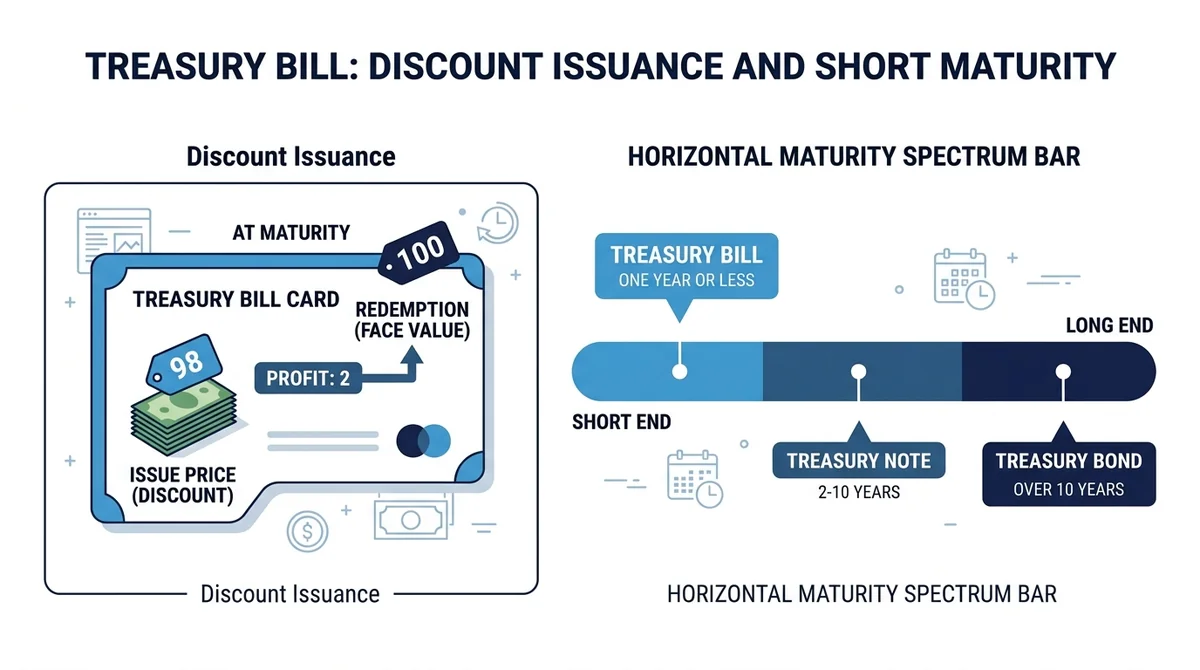
What is a Treasury Bill? Discount issuance, differences from treasury bonds, a 5-factor framework, pros, limits, risks, and a holding-period checklist.
Data cut-off: 2026-02-14. This article does not include specific yield, rating, or issuance-size figures; for dynamic information of that kind, refer to the issuer's official disclosures.
Conclusion: A Treasury Bill is a short-term debt instrument with a maturity of one year or less, issued at a discount, redeemed at face value at maturity, and paying no periodic interest. Its core value lies in cash management and low-volatility holding rather than yield enhancement. The first step in judging whether it suits you is to confirm that your funds' usable horizon falls within the instrument's maturity range; the second is to confirm that you can hold it to maturity.
#What Is a Treasury Bill, and How Does It Differ from an Ordinary Bond?
A Treasury Bill is a short-term government bill with a maturity of one year or less, issued at a discount and redeemed at face value at maturity, paying no periodic interest, with the return reflected in the difference between the purchase price and face value. This is the starting point for understanding all of the asset's characteristics: it has no coupon cash flow, so the return an investor receives is determined entirely by the size of the purchase discount.
A Treasury Bill pays no periodic interest; the return comes from the difference between the purchase discount and face value, which makes it better suited to short-term cash management than to yield enhancement.
#How Long Is a Treasury Bill's Maturity?
By the standard definition, the maturity range for a short-term government bill is one year or less. The specific maturity tranches on sale, auction arrangements, and issuance sizes are dynamic information published by the issuer tranche by tranche; this article does not presume them and defers to official disclosures. This article has not obtained data on the asset's specific maturity tranches or issuance size and marks them as data not disclosed; the lookup path is the issuer's current auction announcements and security terms pages (for example, official issuance platforms such as the U.S. Treasury's TreasuryDirect).
#Why Are Treasury Bills Issued at a Discount Rather Than Paying Periodic Interest?
Because the instrument has no periodic interest mechanism, an investor's return can only be realized through the price difference of "buying below face value and being redeemed at face value at maturity." Discount issuance is not a concession but the pricing mechanism itself: the size of the discount corresponds to the annualized return from holding to maturity.
#Where Do the Key Differences Between Treasury Bills and Treasury Bonds Lie?
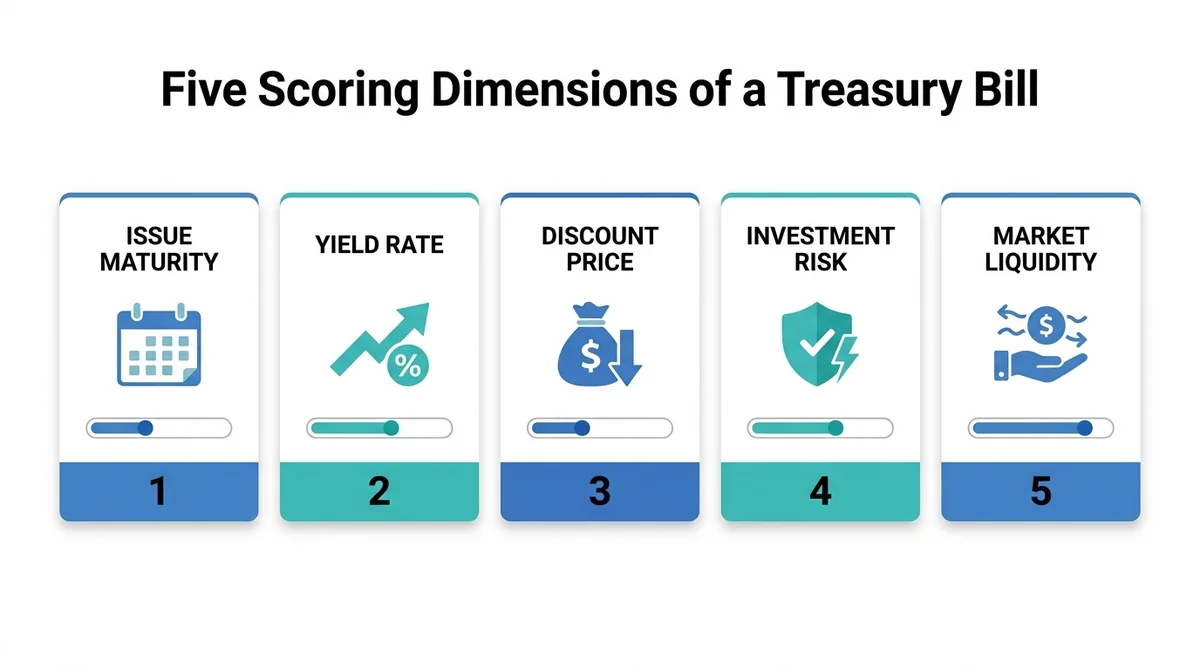
The differences come down to two points. The first is the interest payment method: short-term government bills pay no periodic interest, while treasury bonds pay interest on schedule. The second is price sensitivity: the shorter the maturity, the more limited the price sensitivity to interest rate changes; the longer the maturity, the more sensitive the price is to interest rate changes. Together, these two points determine that short-term government bills are closer to a cash management tool, while treasury bonds are closer to interest rate risk exposure.
| Comparison Item | Treasury Bill (short-term government bill) | Treasury Bond |
|---|---|---|
| Maturity | One year or less | More than one year up to several decades |
| Interest payment | No periodic interest; issued at a discount, redeemed at face value at maturity | Coupon paid on schedule |
| Interest rate sensitivity | Relatively limited, but selling early still involves price fluctuation | Higher; the longer the maturity, the more sensitive |
| Return source | Difference between purchase price and face value | Coupon + price changes |
| Use case | Preserving value and managing liquidity of short-term idle funds | Locking in rates over the long term, bearing duration exposure |
#How Are the 5 Dimensions of a Treasury Bill Scored?
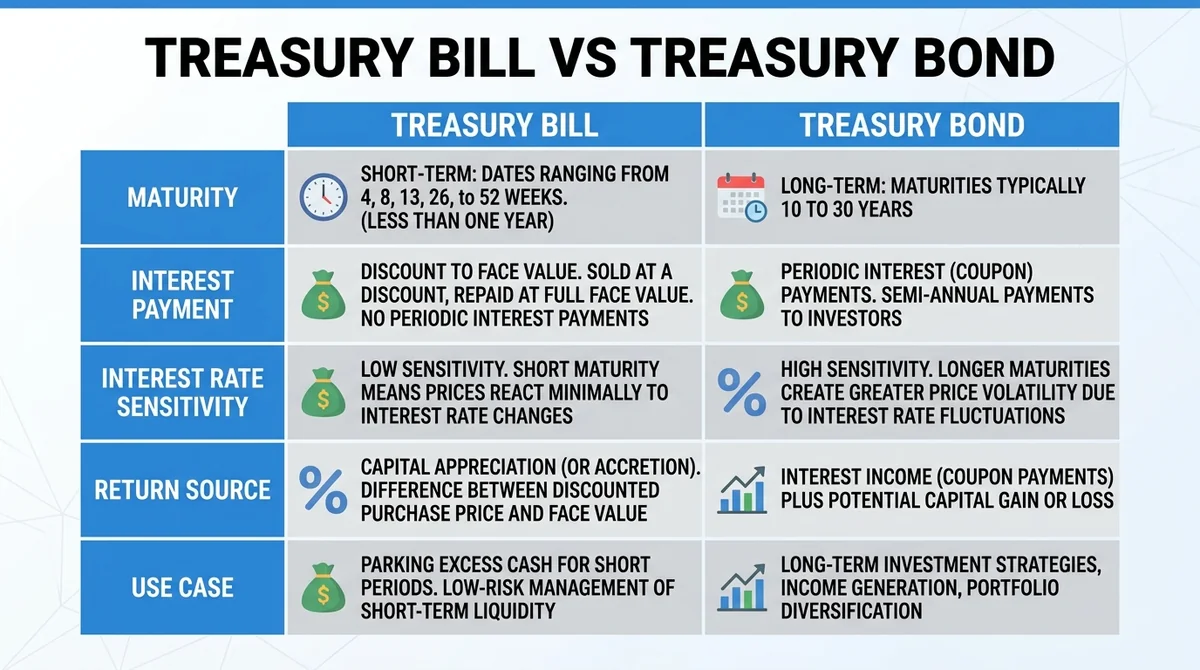
This article uses five dimensions as its evaluation framework: term structure, pricing mechanism, credit risk, interest rate risk, and liquidity. Among these, the short maturity makes interest rate sensitivity relatively limited, while credit risk depends on the issuing entity; specific rating data is subject to official disclosures. This article has not obtained specific quantitative indicators for the asset, so it does not give a quantitative score, only the dimensional framework and the direction of judgment.
In the 5-dimension evaluation, term and pricing mechanism can be checked directly against public terms; credit risk, interest rate risk, and liquidity lack verifiable quantitative data, so this article marks them as insufficient data and does not give a quantitative score.
| Evaluation Dimension | Direction of Judgment | Data Status |
|---|---|---|
| Term structure | Whether it falls within one year or less | Standard definition verifiable; specific tranches subject to official disclosures |
| Pricing mechanism | Whether the discount size is clear and verifiable | Mechanism transparent; specific discount rate data not disclosed |
| Credit risk | Depends on the issuer's credit rating | Rating data not disclosed; subject to official disclosures |
| Interest rate risk | Short maturity; sensitivity relatively limited but not zero | Qualitative judgment; no quantitative indicators |
| Liquidity | Look at secondary market activity and bid-ask spread | Data not disclosed; subject to trading venue disclosures |
#What Do the Term and Pricing Dimensions Look At?
Two things: whether the maturity falls within one year or less, and whether the discount size is clear and verifiable. Pricing transparency is a plus for this dimension — the price formation process for discount issuance is relatively intuitive, and the difference between the purchase price and face value is exactly the source of the return at maturity.
#How Should Credit Risk and Interest Rate Risk Be Assessed?
Credit risk is directly tied to the issuing entity, whose credit rating is the core variable; specific rating data is subject to official disclosures. On interest rate risk, because the maturity is within one year, the price's sensitivity to interest rate changes is relatively limited — but "relatively limited" does not mean "zero," and selling early will still show up as price fluctuation.
#How Should the Liquidity Dimension Be Judged?
Judging liquidity should focus on secondary market trading activity and bid-ask spreads, not on issuance size alone. This article has not obtained specific quantitative liquidity data for the asset and marks it as data not disclosed; for actual judgment, refer to official or trading venue disclosures.
#What Are the Advantages and Limitations of a Treasury Bill?
Advantages: short maturity, relatively high credit rating, and transparent pricing. Together these three support its place in cash management scenarios — funds are tied up for a short time, the price formation mechanism is easy to understand, and uncertainty at the credit level is relatively controllable (specific ratings are subject to official disclosures).
Limitations: yields are usually lower than those of long-term bonds; selling early carries price risk; and there is reinvestment risk at maturity. These three are the other side of the same coin: the short maturity buys low sensitivity, and it also buys a lower yield ceiling and more frequent reallocation needs.
#Why Are Short-Term Government Bills Often Used for Cash Management?
Because cash management seeks fund availability and value stability, not yield maximization. A maturity within one year, transparent pricing through discount issuance, and a relatively high credit rating combine to match the need for "money that may be needed in the short term."
#What Risk Does Selling Before Maturity Involve?
It involves price risk. Rising interest rates cause the price of an early sale to fall, and selling at that point may yield less than the hold-to-maturity return implied by the discount logic. Whether you hold to maturity is the dividing line for this type of instrument's risk exposure.
#Where Do Yields Stand Relative to Long-Term Bonds?
Yields are usually lower than those of long-term bonds. This is the general rule of term premium: longer-maturity instruments must compensate investors for the longer duration and higher interest rate sensitivity they bear. Note that the yield curve is not a constant shape; in special environments such as an inverted curve, short-end yields may be higher than long-end yields for a period, so "usually lower" is a trend judgment rather than a necessary conclusion at any given moment. If the goal is yield enhancement rather than cash management, a Treasury Bill is not the corresponding tool.
#Who Is a Treasury Bill Suitable For, and Who Is It Not?
Suitable for: users whose goal is preserving the value of short-term idle funds and managing liquidity; users who prefer low volatility and can accept the hold-to-maturity logic.
Not suitable for: users seeking high yields; users who need to lock in rates over the long term; users who trade frequently and rely on secondary market price spreads for profit.
Whether it suits you depends not on the yield level but on two things: when you will need this money, and whether you can hold to maturity.
#What Kind of Funding Goal Suits a Treasury Bill?
Goals where the funds have a clear use within one year and where you do not want to bear large swings in net value during that period match the instrument's term structure. The criterion is not "whether the yield is high" but "when you will need this money."
#When Should Other Maturity Instruments Be Considered First?
When the funds' investable horizon clearly exceeds one year, or when the goal is to lock in a long-term rate level, the term structure of a Treasury Bill cannot cover the need, and longer-maturity instruments should be examined.
#How Do You Judge Whether Your Holding Period Matches?
Do a simple comparison: write down the earliest date the funds might be needed and compare it with the chosen maturity tranche. If the need date is earlier than the maturity date, it means you may have to sell early and thus bear price risk; if the need date is later than the maturity date, you need to assess the yield uncertainty at reinvestment.
#What Risks Should Be Noted When Investing in a Treasury Bill?
Interest rate risk: rising interest rates cause the price of an early sale to fall; this is a real price exposure for short-maturity instruments, though smaller in magnitude than for long-term bonds.
Reinvestment risk: at maturity the funds must be reallocated, and the yield available at that time is uncertain; this is the structural cost of rolling over short-term instruments.
Credit risk: related to the issuing entity; specific rating data is subject to official disclosures.
#How Do Interest Rate Changes Affect the Price of an Early Sale?
When interest rates rise, the discount appeal of already-issued instruments declines, and secondary market prices fall accordingly; when rates fall, the direction reverses. The shorter the maturity, the smaller this effect is relatively, but in scenarios where you must cash out early it cannot be ignored.
#What Exactly Does Reinvestment Risk Mean?
It means that after redemption at maturity, the yield available for the next purchase may be lower than the current level. Investors who roll over short-term instruments are in effect making consecutive reinvestment decisions rather than locking in a long-term yield.
#How Should Credit Risk Be Understood?
Credit risk refers to the issuing entity's ability and willingness to redeem on schedule. Judgment on this dimension depends on the issuer's credit rating and related disclosures; this article does not provide unverified specific figures.
#Action Checklist
- Confirm the earliest date the funds might be needed and compare it with maturity tranches of one year or less.
- Confirm whether you are able to hold to maturity, and avoid treating a short-term instrument as a trading vehicle.
- Check with official channels the current maturity tranches on sale, discount levels, and redemption arrangements (for example, the auction announcement page of the issuer's official issuance platform).
- Check the issuing entity's credit rating disclosures, and do not cite unverified rating figures.
- Assess the reinvestment path after maturity, rather than looking only at the current tranche's yield.
- If the goal is to lock in rates over the long term, look at treasury bonds instead of extending the number of rollovers of a short-term instrument.
#FAQ
Q1: Does a Treasury Bill pay interest? A: It pays no periodic interest. It is issued at a discount and redeemed at face value at maturity, with the return reflected in the difference between the purchase price and face value.
Q2: How long is a Treasury Bill's maturity? A: The standard definition is one year or less. Specific tranches on sale and auction arrangements are dynamic information and should be subject to official disclosures.
Q3: Will a short-term government bill's yield be higher than that of a long-term bond? A: On trend it is usually lower than long-term bonds, since longer-maturity instruments must compensate for longer duration and higher interest rate sensitivity; but when the yield curve is inverted, the short end may be higher for a period, so the current curve should be the reference.
Q4: What risk is involved in selling before maturity? A: Mainly price risk. Rising interest rates cause the price of an early sale to fall, possibly below the hold-to-maturity return.
Q5: Is it suitable as a long-term investment tool? A: It is not suitable for allocations aimed at locking in rates over the long term. It is better suited to preserving the value of short-term idle funds and managing liquidity.
Q6: How Do You Choose Between a Treasury Bill and a Money Market Fund? A: First look at the funds' horizon and how you will hold them: if you are certain you will not need the money within a year and can hold to maturity, a Treasury Bill's pricing and redemption terms are more direct; if you need to subscribe and redeem at any time in fragmented amounts, a money market fund's liquidity arrangements are more convenient. Both fall within cash management; the choice depends on the rhythm of fund use rather than the yield level.
Q7: Will You Lose Money If You Sell a Treasury Bill Early? A: Possibly. An early sale is executed at the secondary market price; when interest rates rise, the price falls, and the proceeds may be lower than the hold-to-maturity return; the shorter the maturity, the smaller the effect relatively, but it is not zero.
Q8: Where Can You Find a Treasury Bill's Current Maturity Tranches and Discount Information? A: Refer to the issuer's official issuance platform and regulator disclosure pages, where current auction announcements, maturity tranches, and redemption arrangements can be checked. This article has not obtained specific quantitative data and marks it as data not disclosed, without presumption.
Q9: Is the Treasury Bill Discussed in This Article a Tokenized Product? A: No. This article discusses the actual short-term government bill instrument itself, not tokenized price exposure or derivatives; the two differ in redemption counterparty and holding method.
This content is compiled from public information and does not constitute investment or open account advice. It does not include specific yield, rating, or issuance-size figures; for dynamic information of that kind, refer to the issuer's official disclosures. Data cut-off: 2026-02-14.
FAQ
Does a Treasury Bill pay interest?
It pays no periodic interest. It is issued at a discount and redeemed at face value at maturity, with the return reflected in the difference between the purchase price and face value.
How long is a Treasury Bill's maturity?
The standard definition is one year or less. Specific tranches on sale and auction arrangements are dynamic information and should be subject to official disclosures.
Will a short-term government bill's yield be higher than that of a long-term bond?
On trend it is usually lower than long-term bonds, since longer-maturity instruments must compensate for longer duration and higher interest rate sensitivity; but when the yield curve is inverted, the short end may be higher for a period, so the current curve should be the reference.
What risk is involved in selling before maturity?
Mainly price risk. Rising interest rates cause the price of an early sale to fall, possibly below the hold-to-maturity return.
Is it suitable as a long-term investment tool?
It is not suitable for allocations aimed at locking in rates over the long term. It is better suited to preserving the value of short-term idle funds and managing liquidity.
Read the review? Ready to try a small position?
The crypto assets and tokenized US stocks/ETFs covered here are available on MSX — spot and perpetuals.
Quick Start Trading →New here? Registration takes three quick steps.