Uniswap V4
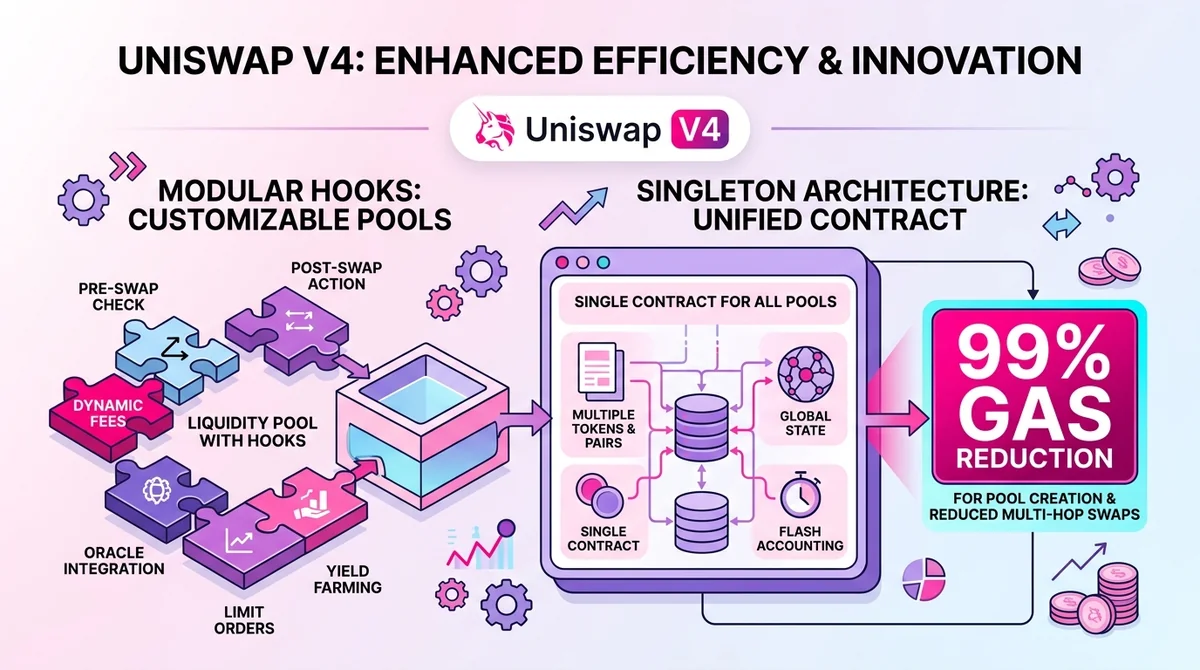
Uniswap V4 introduces Hooks for pool customization, Singleton architecture to cut gas costs, and native ETH support. Explore pros, cons, risks, and who it's for.
Overall: Uniswap V4 excels in innovation and fee efficiency, but its security still needs time to be proven. It suits tech-savvy users and developers; conservative users should wait and see.
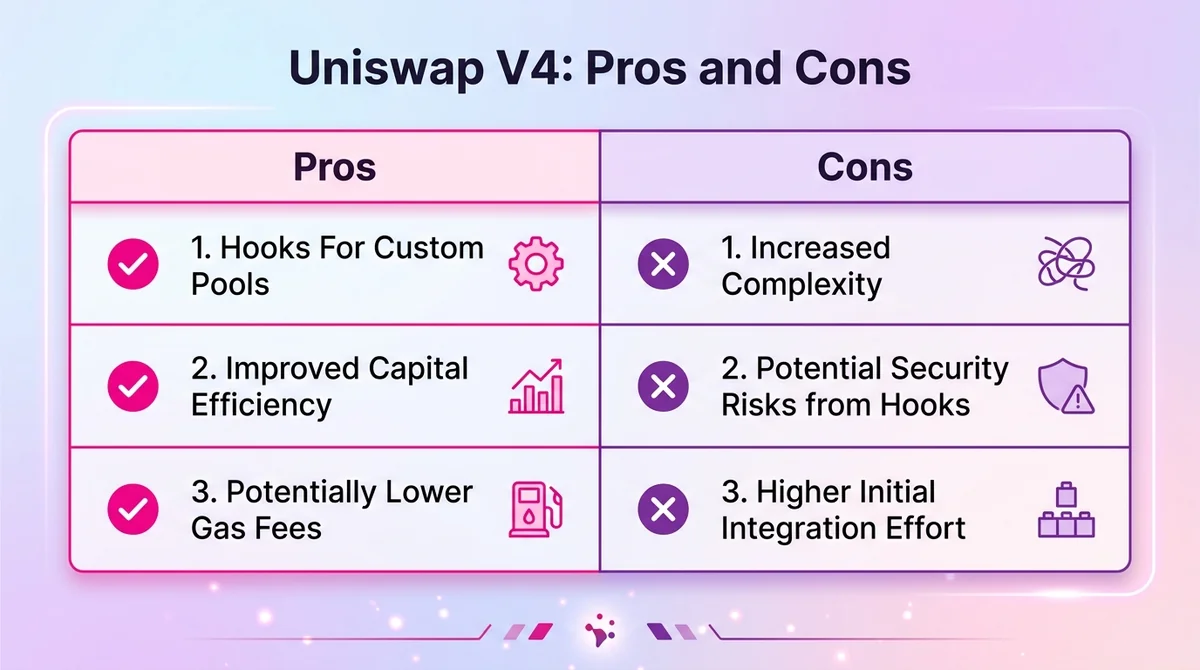
Uniswap V4's core improvements include the Hooks mechanism for pool customization, Singleton architecture to reduce gas costs, and native ETH support to simplify trading. These upgrades significantly boost flexibility and efficiency, but also bring code complexity and security audit pressure.
#What are the core improvements of Uniswap V4 over V3?
#What is the Hooks mechanism?
Hooks allow developers to insert custom logic at key points in a pool's lifecycle (e.g., before/after swaps, when liquidity changes). This enables pool behavior to be dynamically adjusted according to specific strategies, such as dynamic fees, limit orders, and auto-compounding.
#How does Singleton architecture reduce gas costs?
V4 aggregates all pools into a single Singleton contract, reducing cross-contract calls and storage overhead. According to official documentation, the gas cost of creating a new pool can be reduced by approximately 99%.
#What changes does native ETH support bring?
V4 supports direct trading with native ETH, eliminating the need to wrap it into WETH first, simplifying the trading process and lowering associated fees.
#What are the pros and cons of Uniswap V4?
#Pros: Where do flexibility and efficiency improvements show?
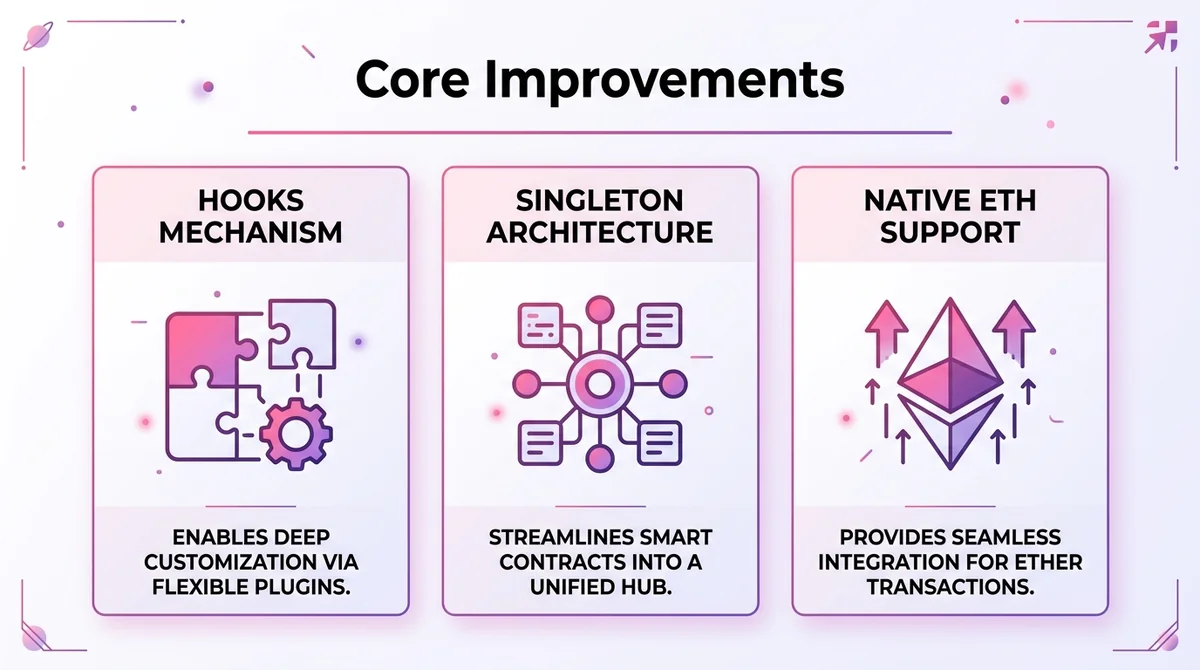
- High customizability: Hooks allow developers to create various custom AMM logic.
- Gas optimization: Singleton architecture significantly reduces gas costs for pool creation and multi-hop trades.
- Ecosystem innovation: Provides underlying support for derivatives, dynamic strategies, and more.
#Cons: What are the complexity and security risks?
- Increased code complexity: Hooks introduce more contract interactions, making audits harder.
- Potential vulnerabilities: Unaudited Hooks may be maliciously exploited.
- Steep learning curve: Developers and market makers need time to adapt to the new architecture.
#Who is Uniswap V4 suitable for?
#How can developers leverage Hooks for innovation?
Developers can build custom AMM logic, such as Time-Weighted Average Market Making (TWAMM), dynamic fees, and on-chain limit orders.
#How can market makers optimize their strategies?
Market makers can use Hooks to finely control liquidity and implement more sophisticated market-making strategies, such as volatility adjustments and automatic rebalancing.
#Do regular traders need to migrate immediately?
Regular traders do not need to migrate immediately; V3 remains usable. They can gradually transition once the ecosystem matures.
#What are the potential risks of Uniswap V4?
#How to assess smart contract risks?
V4 core contracts have been audited, but Hooks contracts may introduce additional risks. Users should pay attention to Hooks' audit status and developer reputation.
#What attack vectors might Hooks introduce?
Malicious Hooks could manipulate prices, front-run trades, or carry out other attacks. Users should choose verified Hooks.
#Will liquidity fragmentation worsen?
Multiple pools may lead to liquidity dispersion, but the combination of Singleton architecture and Hooks may also promote liquidity aggregation. The actual impact needs to be observed.
#Uniswap V4 Rating and Summary
#Five-Dimensional Rating
- Innovation: 9/10
- Security: 7/10
- User Experience: 8/10
- Ecosystem Support: 8/10
- Fee Efficiency: 9/10
#Overall Conclusion
Uniswap V4 excels in innovation and fee efficiency, but its security still needs time to be proven. Overall rating: 8.2/10. Tech-savvy users may try it, while conservative users should wait.
Disclaimer: This content is based on publicly available data and does not constitute investment or account opening advice. Data is as of 2026-09-20 and may change. For more information, please refer to official sources.
FAQ
What is the biggest improvement of Uniswap V4 over V3?
The biggest improvements are the introduction of the Hooks mechanism and Singleton architecture: the former enables pool customization, while the latter significantly reduces gas costs.
Do regular users need to migrate to Uniswap V4 immediately?
No. V3 is still usable, and regular users can wait until the ecosystem matures before migrating.
What are the main risks of Uniswap V4?
The main risks include smart contract vulnerabilities, malicious Hooks attacks, and liquidity fragmentation.
Who is Uniswap V4 suitable for?
It is mainly suitable for developers and professional market makers, who can use Hooks to implement custom strategies.
Has Uniswap V4 really reduced gas costs?
Yes, the Singleton architecture aggregates multiple pools into one contract, significantly reducing gas costs for pool creation and multi-hop trades.
Read the review? Ready to try a small position?
The crypto assets and tokenized US stocks/ETFs covered here are available on MSX — spot and perpetuals.
Quick Start Trading →New here? Registration takes three quick steps.