Beyond Intel vs TSMC: A Three-Way Look at 2026 AI Foundry Order Flows (Nvidia, AMD, Apple)
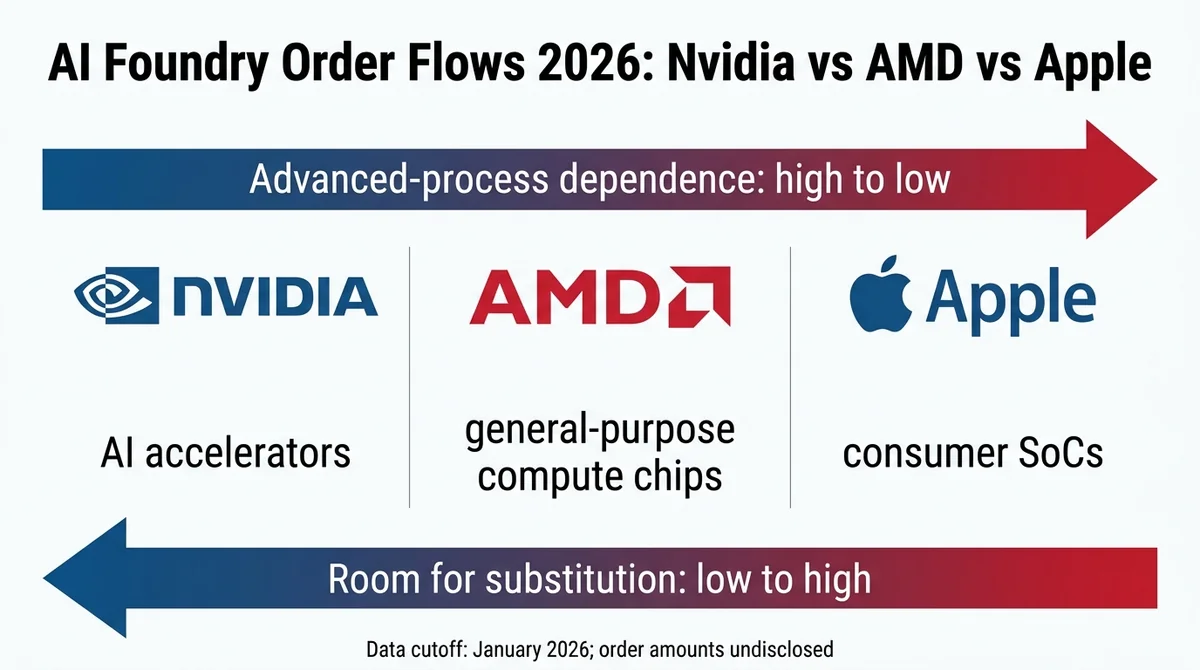
Beyond the Intel vs TSMC binary: a customer-side breakdown of Nvidia, AMD and Apple AI foundry order structures, eight comparison dimensions and verifiable signals.
Conclusion: To understand 2026 AI foundry order flows, start with the customer-side structure — Nvidia, AMD and Apple represent three distinct demand types: AI accelerators, general-purpose compute chips and consumer SoCs. Their dependence on advanced process nodes and their room for substitution differ, and looking only at "Intel vs TSMC" misses this layer. This is a judgment at the analytical framework level, not a quantitative conclusion about order share.
Disclaimer: This article is compiled from public information and does not constitute investment or open account advice. Fields such as order amounts, shares, nodes and capacity allocation are trade secrets or undisclosed information.
One-sentence version: The rigidity of advanced-process dependence across the three customers ranks AI accelerators > general-purpose compute chips > consumer SoCs, with room for substitution running roughly the opposite way.
Data cutoff: January 2026 (public information cited here reflects disclosures made before that date; specific order amounts and share data are undisclosed).
#Why can't AI foundry orders be understood through "Intel vs TSMC" alone?
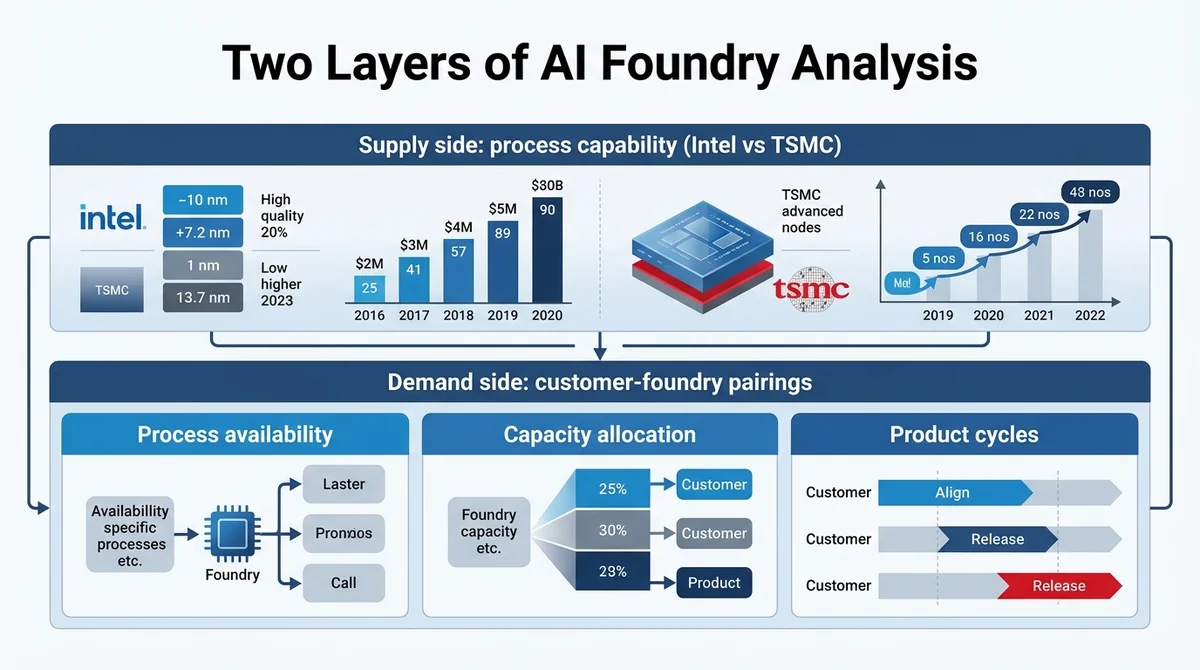
The binary narrative frames foundry competition as a process race between two manufacturers, but orders actually occur within "customer–foundry" pairings. For the same foundry, capacity allocation priorities, pricing structures and switching costs may differ across customer types. Comparing only vendor-side process nodes and capital expenditure therefore struggles to explain why some customers' orders shift while others stay stable.
#How does a three-way comparison differ from a binary one?
The variable in a binary comparison is "whose process leads"; the variable in a three-way comparison is "whose demand is more rigid and who has more room to substitute." The former describes supply-side capability, the latter describes demand-side flows. The two should be layered, not substituted for each other.
This article uses unified definitions for two core concepts: demand rigidity means product iteration cadence is tightly bound to a specific process node and is hard to migrate to another node or foundry in the short term; room for substitution means the latitude a customer has to move to other nodes, other foundries or other production geographies without significantly sacrificing performance or launch timing. These definitions apply throughout.
#What structural factors determine order flows?
Three categories: process availability — whether the node a customer's product needs has usable capacity within a given time window; capacity allocation — how a foundry prioritizes among multiple customers; and product cycles — whether a customer's own product iteration cadence matches the pace of foundry capacity release. All three are customer-side or pairing-level variables with limited public disclosure.
#How do the AI foundry order structures of Nvidia, AMD and Apple differ?
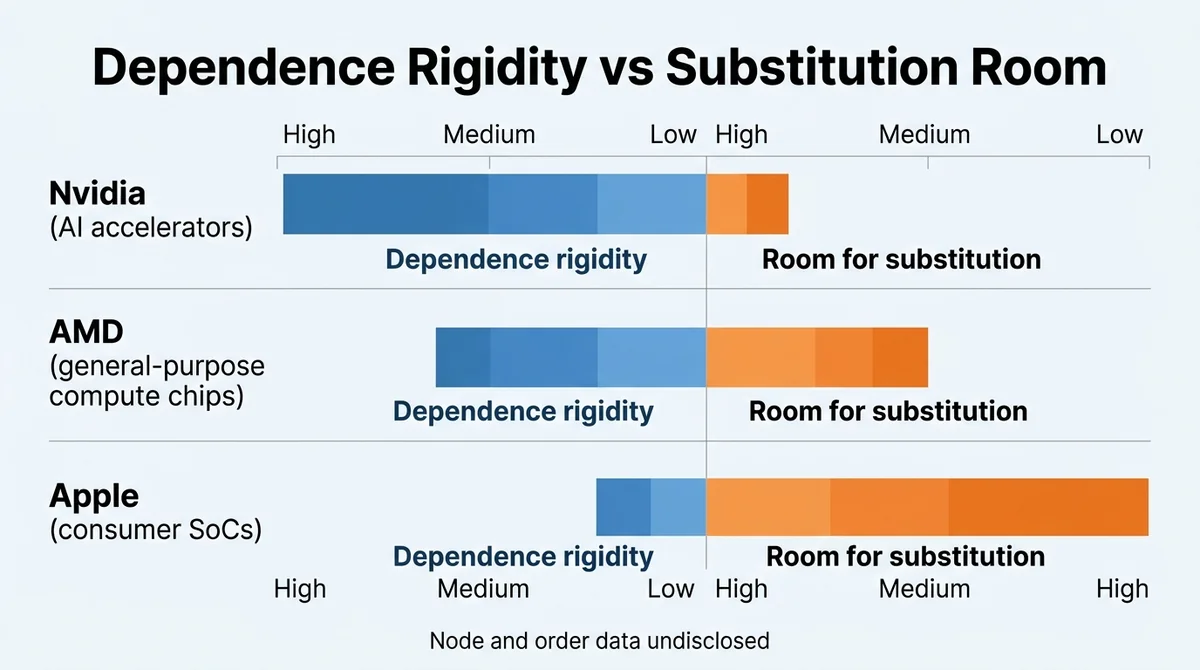
Nvidia, AMD and Apple represent AI accelerators, general-purpose compute chips and consumer SoCs respectively, with differing dependence on advanced processes and differing room for substitution. The following is a structural comparison and does not involve specific order amounts.
The rigidity of advanced-process dependence across the three customers, from high to low, is: AI accelerators > general-purpose compute chips > consumer SoCs, with room for substitution roughly the reverse. The reason lies in how tightly performance targets bind to iteration cadence: accelerators trade process and advanced packaging combined for compute, general-purpose chips can maneuver between performance and cost, and consumer SoCs weigh energy efficiency and mass-production yield more heavily. Specific node and order amount data are undisclosed.
#What are the core products and process needs of each?
Nvidia's core product is the AI accelerator, with iteration highly bound to advanced processes and advanced packaging capability; AMD spans both CPU and GPU lines, with a relatively dispersed process demand profile; Apple is mainly consumer SoCs, with shipment cadence strongly tied to end-product cycles. Specific node allocation and order amounts for all three are trade secrets and undisclosed.
#Where do order volume and concentration differences show up?
Per-order scale and reliance on a single foundry source for all three are undisclosed, so no verifiable quantitative comparison can be given. An observable proxy is product-line breadth: the more concentrated a product line is in a single category, the more concentrated dependence on a specific process node typically is.
#Who depends more visibly on a single foundry source?
From a product-structure view, customers whose revenue centers on a single category typically have higher foundry-source concentration, while customers spanning multiple product lines have more room to diversify. This is a qualitative inference based on product-line breadth: single-category customers bind performance targets tightly to one node, making switching costlier, while multi-line customers can allocate across nodes. However, specific supplier lists and allocation ratios are undisclosed, and public data is insufficient to support quantitative conclusions.
#What are the key dimensions of difference in foundry choices across the three customers?
The three-way comparison can be laid out across eight dimensions: product type, process node, order scale, capacity priority, alternative suppliers, switching cost, geopolitical considerations and disclosure transparency. Where public data is insufficient, the entry is marked "data undisclosed."
| Dimension | Nvidia | AMD | Apple |
|---|---|---|---|
| Product type | Mainly AI accelerators | Multiple CPU and GPU lines | Mainly consumer SoCs |
| Process node | Highest requirements; process plus advanced packaging combined | More dispersed; can maneuver between performance and cost | Focus on balancing energy efficiency and yield (specific node data undisclosed) |
| Order scale | Data undisclosed | Data undisclosed | Data undisclosed |
| Capacity priority | Data undisclosed (affected by long-term contract and prepayment structures) | Data undisclosed | Data undisclosed |
| Alternative suppliers | Relatively smallest room to substitute | Some room to diversify | Some room to diversify |
| Switching cost | Relatively highest | Medium | Medium |
| Geopolitical considerations | Data undisclosed | Data undisclosed | Data undisclosed |
| Disclosure transparency | Announcement-level information only | Announcement-level information only | Announcement-level information only |
One-sentence summary: Of the eight dimensions, only product type and the direction of dependence rigidity can truly be judged from public information; order scale, capacity priority and geographic allocation all fall in the undisclosed range and can serve only as an observation checklist, not conclusions.
#How should process-node demand differences be compared?
The comparison basis should be "the node range required by product performance targets," not specific models. AI accelerators have the highest combined requirements for process and advanced packaging; general-purpose compute chips have more room to maneuver between performance and cost; consumer SoCs focus more on balancing energy efficiency and mass-production yield. Specific node figures are undisclosed.
#How should capacity priority and order scale be compared?
Capacity priority depends on order scale, long-term contract structures and prepayment arrangements, terms that are typically not disclosed. An observable proxy signal is foundry capacity expansion announcements and new fab ramp schedules, though announcements themselves usually do not point to specific customers.
#How should geopolitical and supply-security considerations be compared?
Geopolitical considerations manifest as customers' desire to diversify production geographies. Tolerance for production concentration varies by customer, but specific geographic allocation plans are undisclosed information.
#If you're a follower, how should you use this three-way comparison to form judgments?
Those watching supply chains should track capacity allocation and customer disclosures; those watching product roadmaps should track process nodes and roadmaps. Only when verifiable announcement-level signals appear should one judge that the order structure has changed.
#What should supply-chain watchers look at?
Foundry capacity announcements, new fab ramp timelines, and how customers describe supply constraints in earnings reports or earnings calls. Single-source rumors are not sufficient grounds for judgment.
#What should product-roadmap watchers look at?
Performance and energy-efficiency targets in customers' own product roadmaps, and whether those targets match existing process-node capabilities. Roadmap changes often surface before order changes.
#Under what circumstances should one conclude the order structure has changed?
Two conditions must both be met: first, announcement-level information appears, such as capacity reservations, long-term agreements or formal supplier-list changes; second, that information can be cross-verified by multiple independent sources. A single media report or industry rumor should not lead to a conclusion.
#Limitations and disclaimers of the three-way comparison
Specific foundry order amounts, shares and capacity allocation are largely trade secrets. This article offers only structural comparison and makes no share, price or stock-price forecasts.
#What information falls in the undisclosed range?
Including but not limited to: each customer's specific wafer starts at each node, order amounts, capacity reservation ratios, price discount terms and geographic allocation plans. This article uniformly marks these fields as "data undisclosed" and does not estimate them.
#What are the applicable boundaries of this article's conclusions?
This article is suited to building an analytical framework and observation checklist, not to deriving specific financial forecasts. The framework's value lies in indicating which variables to watch, not in providing current values for those variables.
To check public disclosure standards, refer to the official investor relations pages and original announcements of the relevant companies.
#FAQ
#Why not directly compare Intel and TSMC as the two manufacturers?
A binary comparison mainly explains supply-side process capability differences and struggles to explain why orders shift between customers. Adding Nvidia, AMD and Apple reveals differences in demand rigidity, room for substitution and product cycles — the direct variables behind order flows.
#Which customers matter most for AI chip foundry orders?
Mainly Nvidia, AMD and Apple, corresponding to AI accelerators, general-purpose compute chips and consumer SoCs. Their rigidity of advanced-process dependence, from high to low, is AI accelerators > general-purpose compute chips > consumer SoCs, with room for substitution roughly the reverse; specific order amount and share data are undisclosed.
#How does Nvidia's foundry dependence differ from Apple's?
Nvidia centers on AI accelerators, with iteration tightly bound to advanced processes and advanced packaging — the highest rigidity and the smallest room for substitution; Apple is mainly consumer SoCs, focused more on balancing energy efficiency and mass-production yield, with shipment cadence following end-product cycles. Specific nodes and order scales for both are undisclosed.
#Can the three customers' specific order amounts or shares be found?
No. Order amounts, wafer starts, capacity reservation ratios and pricing terms between customers and foundries are largely trade secrets, and public data is insufficient for quantitative comparison. This article uniformly marks these fields as data undisclosed and does not estimate them.
#What signals are needed to judge changes in order structure?
Mainly three types of announcement-level information: foundry capacity expansion and ramp announcements, customer long-term supply agreement disclosures, and adjustments to process targets in customer product roadmaps. Multiple independent sources must also cross-verify; a single rumor is not sufficient grounds.
#What is the relationship between product-line breadth and foundry dependence?
The more concentrated a product line is in a single category, the more concentrated dependence on a specific process node typically is, and the higher the cost of switching suppliers may be; customers spanning multiple product lines theoretically have more room to diversify. However, specific supplier allocation ratios are undisclosed, so this relationship is only a qualitative reference.
#Is this comparison suitable for investment judgments?
It is not suitable for direct use in investment judgments. This article provides an analytical framework and observation checklist, contains no share, price or stock-price forecasts, and does not constitute investment advice.
This content is compiled from public information and does not constitute investment or open account advice. No verifiable order amount, share or node data is cited; the relevant fields are trade secrets or undisclosed information.
FAQ
Why not directly compare Intel and TSMC as the two manufacturers?
A binary comparison mainly explains supply-side process capability differences and struggles to explain why orders shift between customers. Adding Nvidia, AMD and Apple reveals differences in demand rigidity, room for substitution and product cycles — the direct variables behind order flows.
Can the three customers' specific order amounts or shares be found?
No. Order amounts, wafer starts, capacity reservation ratios and pricing terms between customers and foundries are largely trade secrets, and public data is insufficient for quantitative comparison. This article uniformly marks these fields as data undisclosed and does not estimate them.
What signals are needed to judge changes in order structure?
Mainly three types of announcement-level information: foundry capacity expansion and ramp announcements, customer long-term supply agreement disclosures, and adjustments to process targets in customer product roadmaps. Multiple independent sources must also cross-verify; a single rumor is not sufficient grounds.
What is the relationship between product-line breadth and foundry dependence?
The more concentrated a product line is in a single category, the more concentrated dependence on a specific process node typically is, and the higher the cost of switching suppliers may be; customers spanning multiple product lines theoretically have more room to diversify. However, specific supplier allocation ratios are undisclosed, so this relationship is only a qualitative reference.
Is this comparison suitable for investment judgments?
It is not suitable for direct use in investment judgments. This article provides an analytical framework and observation checklist, contains no share, price or stock-price forecasts, and does not constitute investment advice.
Related Terms
Done comparing? Ready to place your first trade?
The crypto assets, tokenized US stocks and ETFs you just compared are all tradable on MSX — spot or perpetuals.
Quick Start Trading →New here? Registration takes three quick steps.