AMD vs TSMC: How to Choose Between Demand-Side and Supply-Side Exposure in AI Chips for 2026
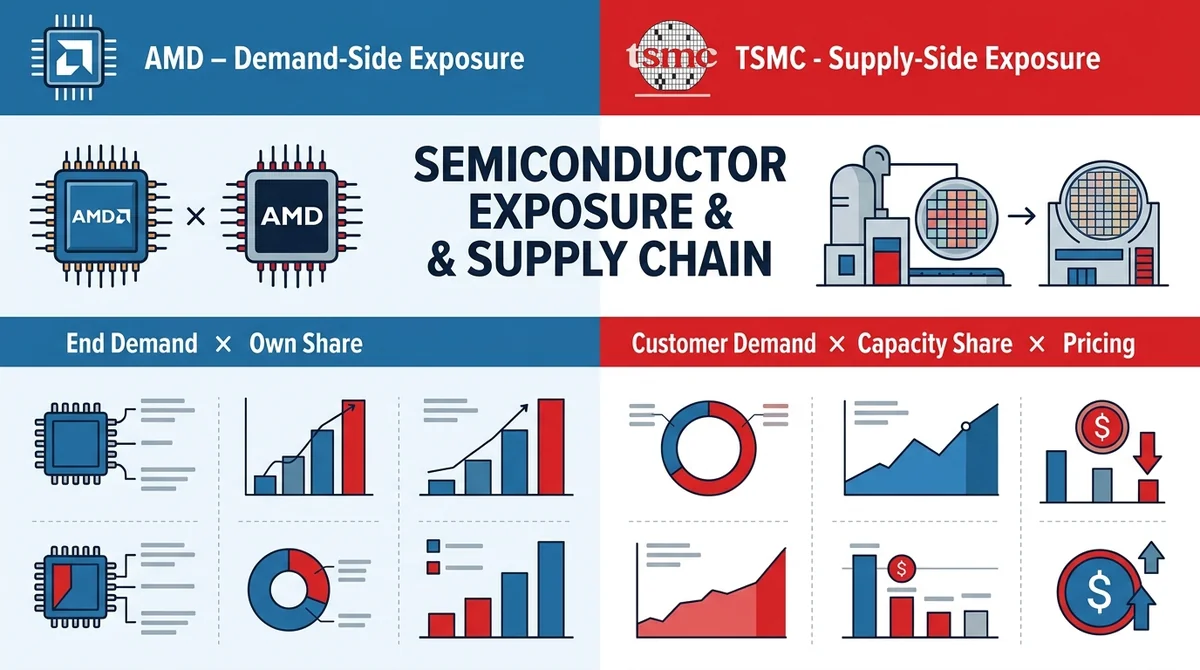
AMD offers demand-side exposure to chip design, TSMC supply-side foundry exposure. Compare revenue drivers, cycle sensitivity, risks in one table.
Conclusion: If you want elasticity from end demand and product share, AMD represents demand-side exposure; if you want capacity scarcity and supply-chain positioning, TSMC represents supply-side exposure. They are not substitutes, but two different angles on the same AI chip supply chain. This article does not provide specific financial or valuation figures for either company; related judgments should be based on company filings and official disclosures.
#What roles do AMD and TSMC play in the AI chip supply chain?
Is AMD demand-side or supply-side: AMD is a fabless chip design company, earning revenue from end customers purchasing its CPUs, GPUs, and accelerators. Its operations and stock price are therefore closer to the purchasing rhythm of end demand, and this article classifies it as demand-side exposure.
Why TSMC represents the supply side: TSMC is a wafer foundry, earning revenue by providing capacity and process services (including advanced nodes and advanced packaging) to customers. Its key operating variables are capacity utilization, process leadership, and capital expenditure, and this article classifies it as supply-side exposure.
Where does the exposure difference between "demand-side stock" and "capacity supply-side stock" come from: The difference stems from different revenue functions. Demand-side revenue can be roughly understood as "end demand × own share"; supply-side revenue as "total customer demand × capacity share × pricing." The former is more sensitive to competitive landscape and order rhythm, while the latter is more sensitive to the capacity cycle and capex rhythm. This is a structural description, not a prediction of returns in any period.
#What factors mainly drive AMD's stock price?
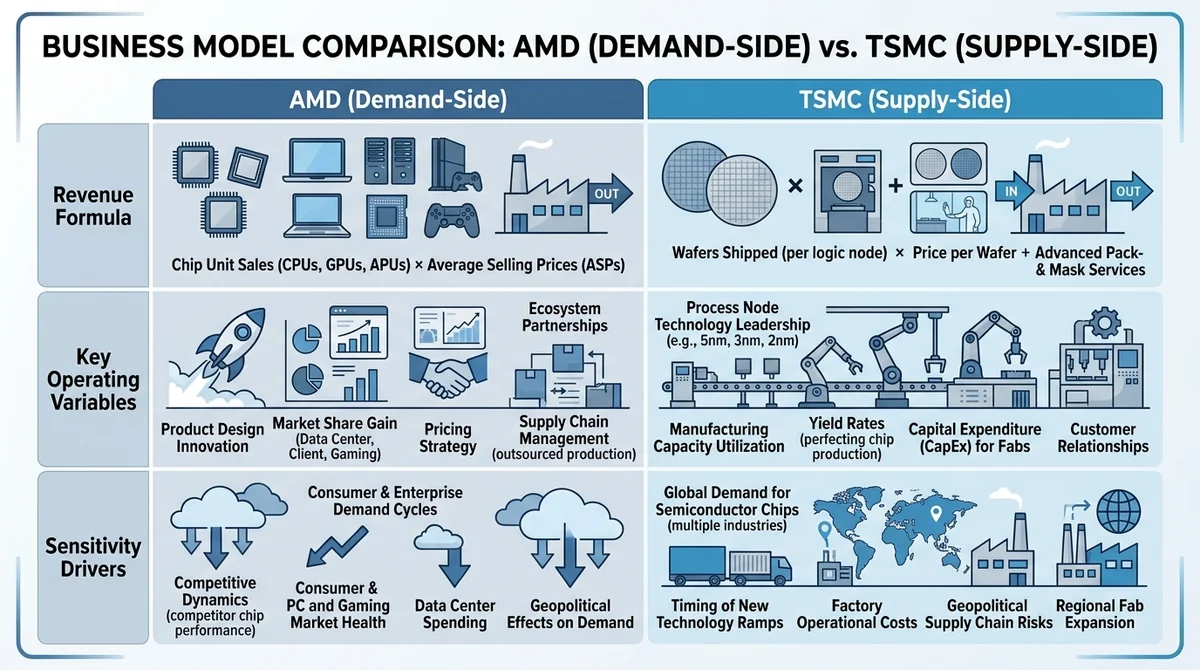
How product competitiveness and market share affect AMD's stock price: The market's valuation of AMD relies heavily on expectations for its product iteration speed and performance competitiveness; marginal changes in share can affect revenue expectations.
How important AI chip orders and customer structure are to AMD: Large customer orders and AI accelerator shipment rhythm are key variables for demand-side exposure; the higher the customer concentration, the greater the impact of a single large customer's purchasing changes on expectations. Specific customer structure should be based on company filings; this article does not provide specific figures.
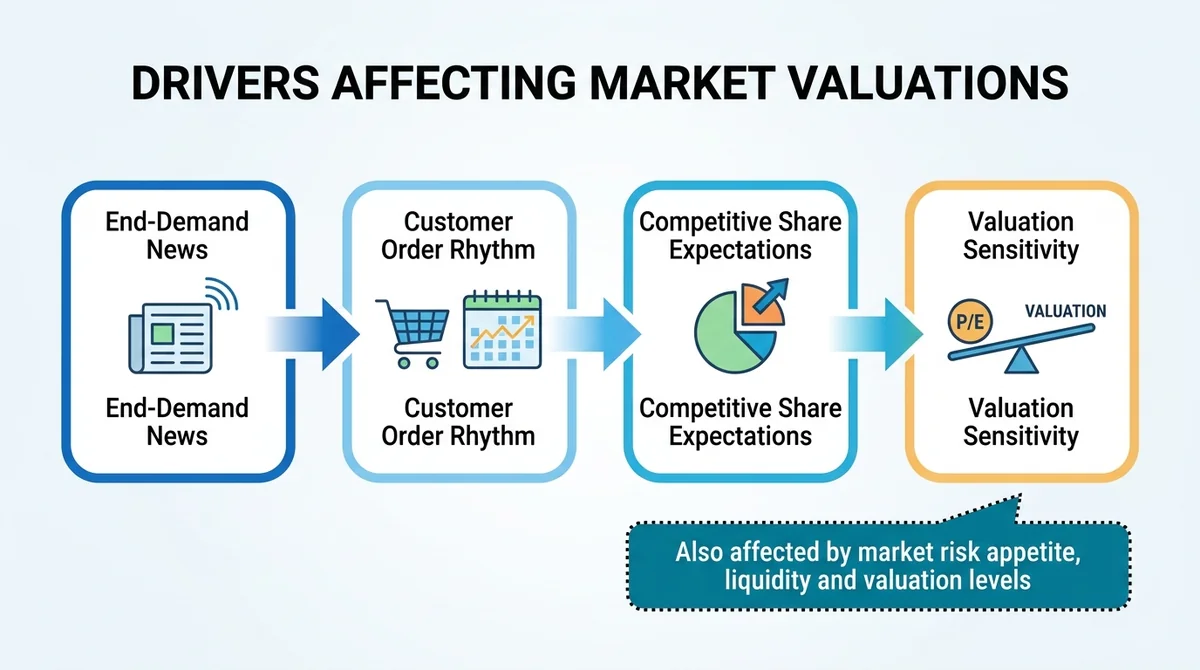
Why AMD's stock price volatility is closer to demand-side sentiment: One structural explanation is that demand-side exposure lacks the buffer of capacity barriers, so marginal news on end demand or competitive landscape may be reflected in valuation more quickly. However, stock price volatility is also affected by overall market risk appetite, liquidity, and valuation levels, and cannot be attributed solely to business attributes.
#What factors mainly drive TSMC's stock price?
How capacity utilization and process leadership affect TSMC's stock price: Capacity utilization and advanced-node share are core variables for supply-side exposure, reflecting whether "total customer demand can fill capacity."
What the capex cycle means for TSMC's stock price: Capital expenditure affects the market's expectations for future supply scarcity. A rapid expansion pace may bring expectations of looser supply, while a slower pace may reinforce the scarcity narrative. This is a market expectation mechanism, not deterministic causality.
Why TSMC's stock price is closer to the supply-side cycle: Because foundry revenue is tied to capacity, supply-side exposure is usually more sensitive to capacity expansion, process positioning, and supply-chain status than to a single customer's orders.
#Key differences between the two exposures: a clear table
| Comparison dimension | AMD (demand-side exposure) | TSMC (supply-side exposure) |
|---|---|---|
| Supply chain position | Chip design (fabless) | Wafer foundry and advanced packaging |
| Revenue source | End customers purchasing its chip products | Capacity and process services paid by customers |
| Core drivers | Product competitiveness, share, AI order rhythm | Capacity utilization, process leadership, capex |
| Cycle sensitivity | More sensitive to end demand and competitive landscape | More sensitive to capacity cycle and supply scarcity |
| Risk sources | Intensified competition, orders below expectations, lagging iteration | Overcapacity, capex slowdown, process competition |
| Elasticity characteristics | Demand-side elasticity may be greater, with more concentrated volatility | Positioning relatively more stable, tracking total supply chain volume |
| Suitable scenarios | Tactical allocation, betting on share changes | Medium- to long-term tracking of supply chain positioning |
| Common external variable | AI capex cycle | AI capex cycle |
| Data scope note | This article does not provide specific financial or valuation data | This article does not provide specific financial or valuation data |
Dimension interpretation: The supply chain position determines different revenue functions, so the same AI demand news does not transmit through the same path for both. Demand-side exposure may first reflect in order expectations, while supply-side exposure may first reflect in capacity scheduling and capex plans. The cycle sensitivity row is a structural description: demand-side exposure may reflect sentiment earlier, and supply-side exposure may reflect total volume later, but actual timing depends on market pricing at the time. Financial and valuation figures are missing from the input of this article and are marked as not provided per the rules; readers should refer to company filings and official disclosures.
#Which exposure suits you better? Scenario-based routing
If you value product iteration speed and market share elasticity and can accept a path with more concentrated expectation volatility, prioritize researching AMD's demand-side exposure.
If you value capacity scarcity and supply chain positioning and prefer tracking capacity utilization and capex rhythm, prioritize researching TSMC's supply-side exposure.
If you do not want to bet on a single segment and want to reduce the impact of single-point judgment errors, consider combining both exposures to diversify risk across the supply chain.
If you use the AI capex cycle as your main basis for judgment, you need to look at both but distinguish transmission timing: the demand side may move first, and the supply side may move later.
If you only want to track one variable (e.g., advanced-node share), the observation indicators for supply-side exposure are relatively more concentrated.
#What risks should be noted for each exposure?
Main risks for demand-side exposure: Intensified competition leading to downward revisions in share expectations, large customer orders below expectations, and product iteration lagging behind competitors.
Main risks for supply-side exposure: Industry overcapacity, slowing customer capex, and process competition putting pressure on pricing power.
How changes in the AI capex cycle affect both: Both are affected by the AI capex cycle, but the transmission paths differ—demand-side exposure may reflect more quickly through order and guidance changes, while supply-side exposure may reflect more slowly through capacity scheduling and expansion plans.
#Action checklist
- First clarify whether you want demand-side elasticity or supply-side positioning, then decide your research focus.
- Check the revenue structure and customer concentration disclosures in the latest filings of both companies (this article does not provide specific figures).
- Track changes in public guidance on the AI capex cycle as a common external variable.
- If choosing a combination, define the weighting logic and rebalancing rules for each exposure.
- Distinguish between "price exposure" and "shareholder status": if exposure is obtained through tokenized stocks, the equity attributes differ from direct shareholding and need separate verification.
- Record your judgment basis for later review against actual data.
#FAQ
Q1: Are AMD and TSMC the same type of AI chip stock? A: No. AMD is demand-side exposure in chip design, while TSMC is supply-side exposure in wafer foundry; their revenue sources and driving variables differ.
Q2: Is demand-side exposure always more elastic than supply-side exposure? A: Structurally, demand-side exposure is more sensitive to end demand and competitive landscape, but actual elasticity also depends on market pricing at the time; this article does not give a directional judgment.
Q3: Can both be held at the same time? A: A portfolio approach can be discussed to diversify single-segment risk, but weights and rebalancing rules need to be determined by yourself.
Q4: Does this article provide a specific valuation comparison? A: No. The input of this article does not provide specific financial or valuation data for the two companies, and relevant fields are marked as not provided.
Q5: Is exposure through tokenized stocks the same as direct shareholding? A: No. Tokenized stocks provide price exposure, while shareholder status and corporate action rights need separate verification.
This content is compiled from public information and does not constitute investment or open account advice. It does not contain specific financial or valuation figures for the two companies; related data should be based on company investor relations pages and official disclosures.
FAQ
Are AMD and TSMC the same type of AI chip stock?
No. AMD is a chip design company, representing demand-side exposure; TSMC is a wafer foundry, representing supply-side exposure. Their revenue sources and core driving variables differ.
Is demand-side exposure always more elastic than supply-side exposure?
Structurally, demand-side exposure is more sensitive to end demand and competitive landscape, but actual elasticity also depends on market pricing at the time; this article does not give a directional judgment.
Can both be held at the same time?
A portfolio approach can be discussed to diversify single-segment risk, but weights and rebalancing rules need to be determined by yourself.
Does this article provide a specific valuation comparison?
No. This article does not provide specific financial or valuation data for the two companies, and relevant fields are marked as not provided.
Is exposure through tokenized stocks the same as direct shareholding?
No. Tokenized stocks provide price exposure, while shareholder status and corporate action rights need separate verification.
Related Terms
Done comparing? Ready to place your first trade?
The crypto assets, tokenized US stocks and ETFs you just compared are all tradable on MSX — spot or perpetuals.
Quick Start Trading →New here? Registration takes three quick steps.