Fiat-Denominated Assets in Emerging Markets vs. USD Stablecoins: A Configuration Comparison
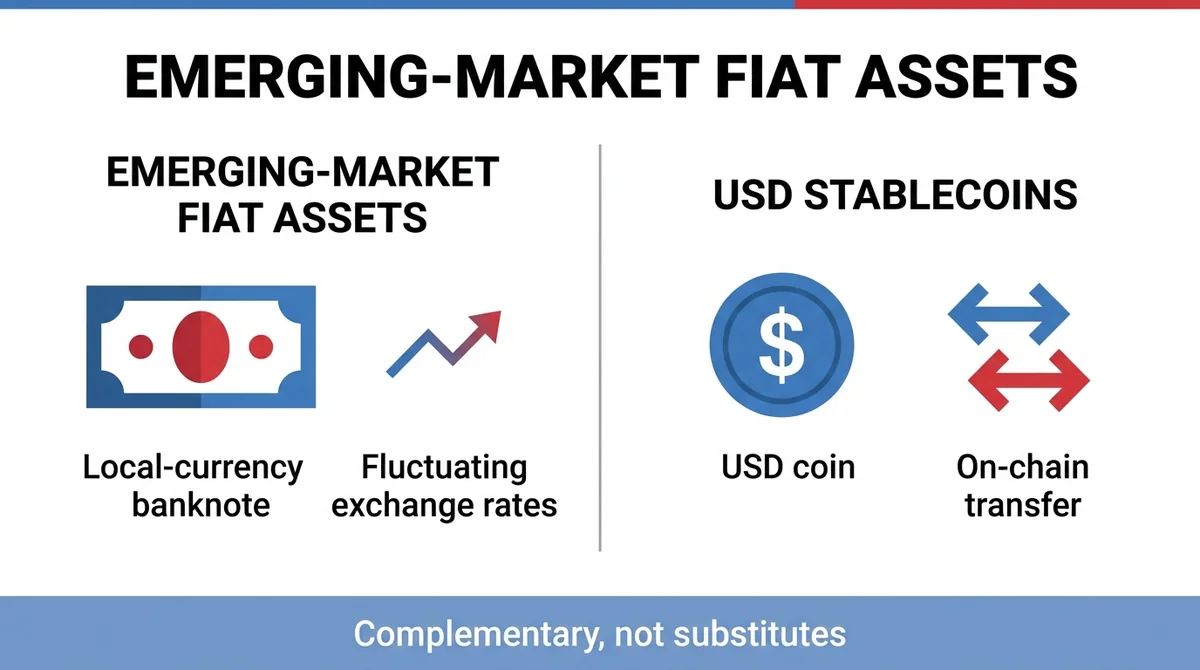
Compare emerging-market fiat assets with USD stablecoins across pricing anchor, FX exposure, liquidity, conversion costs, yield sources and compliance risk, with a layered decision path.
Conclusion: If your spending, liabilities or investment targets are denominated in local currency, prioritize fiat-denominated assets in emerging markets; if you need a USD-denominated store of value or convenient cross-border settlement, USD stablecoins are a better fit. The two are complementary, not substitutes.
#What exactly is the difference between fiat-denominated assets in emerging markets and USD stablecoins?
One-line distinction: The value anchor of fiat-denominated assets is the local currency, and their returns and risks are tied to the local interest rate and exchange rate environment; the value anchor of USD stablecoins is the US dollar, they generate no interest themselves, and their core value lies in USD denomination and cross-border transfer convenience.
#What is the pricing anchor of each?
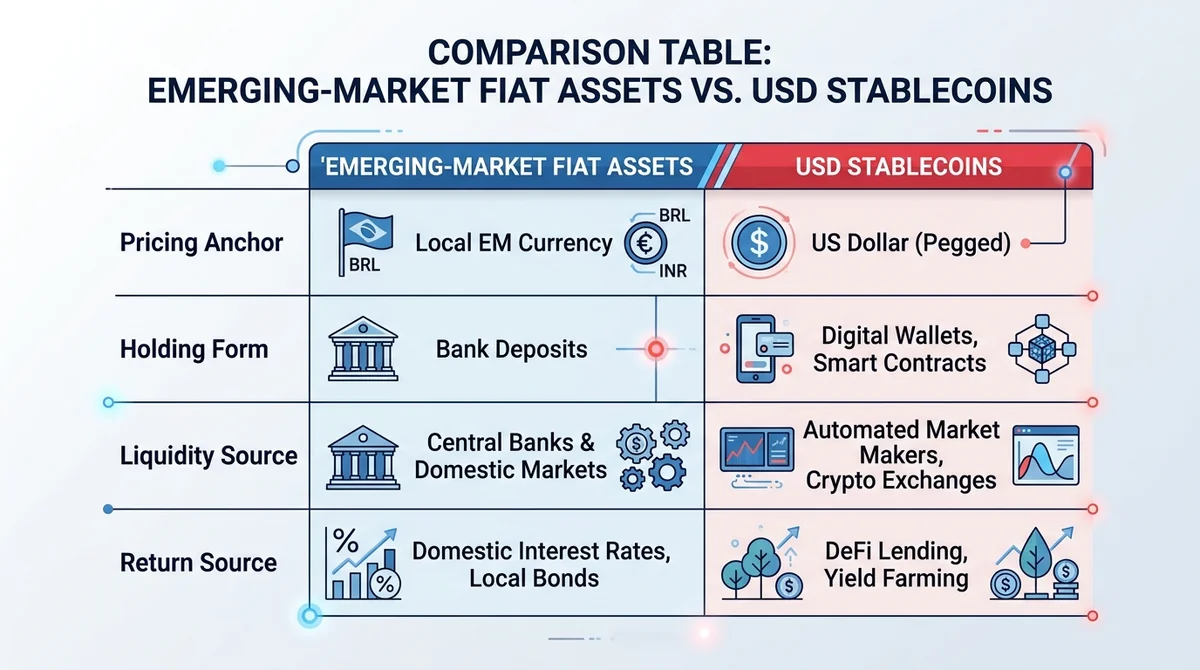
The pricing anchor of fiat-denominated assets in emerging markets is the domestic currency, whose purchasing power changes with the local exchange rate and local interest rate environment. The pricing anchor of USD stablecoins is the US dollar, and their design goal is to maintain a relatively stable exchange ratio with the dollar.
It should be noted that a stablecoin's "peg" depends on the issuer's reserve and redemption mechanism, which is a mechanism commitment rather than deposit insurance. The reserve composition and audit disclosures of specific issuers are not included in this site's current dataset and are marked as data not disclosed.
#How do the holding forms and liquidity sources differ?
Fiat-denominated assets are usually held as local currency deposits, local-currency-denominated bonds or local financial products; their liquidity comes from the local banking system and local markets, and converting them into foreign currency requires going through a foreign exchange channel and bearing spreads and fees.
USD stablecoins are held as on-chain tokens; their liquidity comes from on-chain trading and over-the-counter conversion channels. Cross-border transfer does not depend on the traditional correspondent banking chain, but it does depend on the issuer's redemption capacity and the availability of the channels used.
#Where do the returns come from?
Returns on fiat-denominated assets come from local interest rates and local asset returns. Nominal yields may be high, but actual returns should be assessed only after deducting the purchasing power loss caused by local currency depreciation.
USD stablecoins themselves generate no interest. The yield on holding stablecoins is zero (unless you separately participate in credit-risk activities such as lending), and their value lies mainly in the choice of unit of account rather than in coupon.
#How do the key difference dimensions compare?
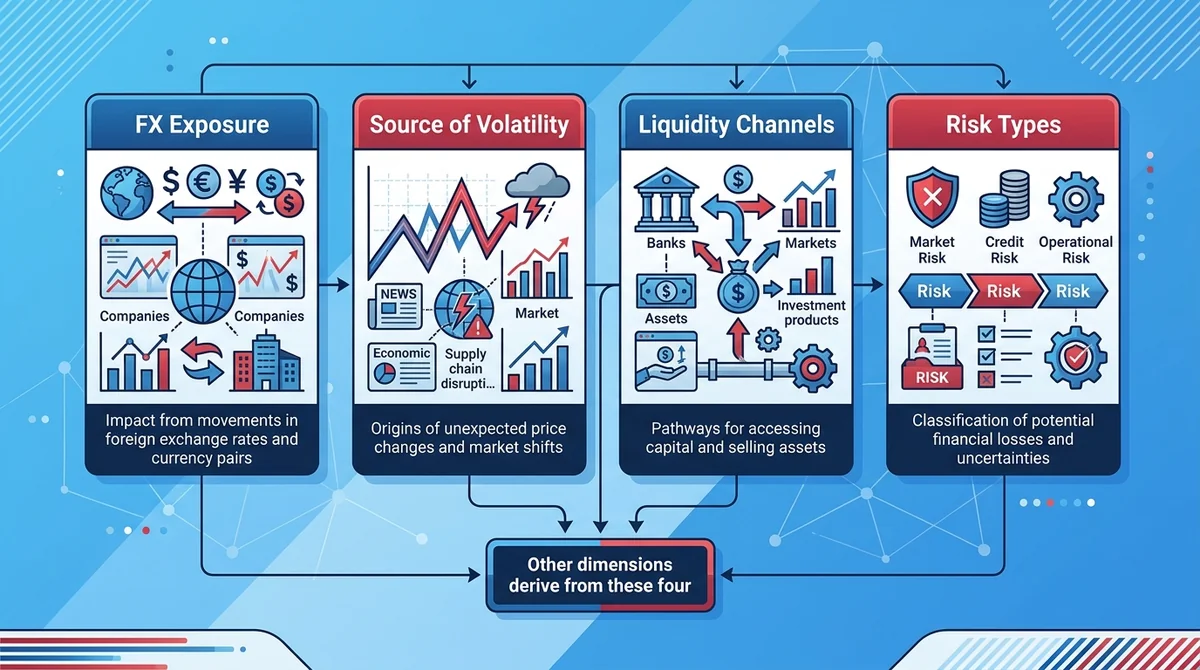
Conclusion: The differences concentrate in four areas: direction of FX exposure, source of volatility, liquidity channels and risk types; the other dimensions derive from these.
#How do FX exposure and volatility differ?
Fiat-denominated assets carry exposure to depreciation or appreciation of the local currency against foreign currencies, with volatility coming from the local exchange rate and local interest rates. USD stablecoins carry USD exposure, with relatively smaller exchange rate volatility, but they introduce issuer credit and depeg risk.
The nature of volatility differs: the former is market price volatility, while the latter is mechanism and credit risk. You cannot simply compare the two by which has higher or lower volatility.
#How do liquidity and conversion costs compare?
Fiat-denominated assets usually have good local liquidity, but cross-currency conversion incurs foreign exchange costs. USD stablecoins transfer efficiently on-chain, but converting them into local cash requires going through a conversion channel, which likewise involves spreads and channel fees.
Specific fee levels depend on the region and the channel used. This site's current dataset does not provide itemized fee data, marked as data not disclosed.
#What are the respective compliance and custody risks?
The main risks of fiat-denominated assets are local currency depreciation, the soundness of local financial institutions and changes in local regulation. The main risks of USD stablecoins are issuer credit, reserve transparency, regulatory characterization and the availability of conversion channels.
Neither option is "risk-free"; the difference lies in where the risk comes from.
#When should you choose fiat-denominated assets in emerging markets?
Conclusion: When spending, liabilities or investment opportunities are denominated in local currency, holding local-currency-denominated assets avoids unnecessary conversion costs and maturity mismatches.
Suitable for: Residents whose income and spending are both local, people with local-currency liabilities (such as a local mortgage), and people who mainly invest in local assets.
Not suitable for: People whose main spending is in foreign currency, or who lack confidence in the stability of local currency purchasing power and have no local liabilities.
Decision criteria: First look at the currency of spending, then the currency of liabilities, and finally the currency of investment targets. The higher the local-currency share of the three, the better the match with local-currency assets.
#When should you choose USD stablecoins?
Conclusion: When the goal is to reduce exposure to local currency depreciation, to have a USD-denominated store of value, or to have convenient cross-border settlement, USD stablecoins are a better fit.
Suitable for: People with cross-border payment and receipt needs, people who need a short-term USD-denominated store of value, and residents of regions with high local currency volatility.
Not suitable for: People whose spending is entirely local with no foreign currency needs; people who cannot reliably complete conversion channel operations.
#What risks do you bear when allocating to USD stablecoins?
Conclusion: USD stablecoins are not the same as risk-free USD deposits; they carry at least four types of risk: issuer credit, reserve transparency, compliance and conversion channels.
Issuer credit and reserve transparency: A stablecoin's value depends on the issuer redeeming as promised, and reserve composition and audit disclosure are core items to watch. This dataset does not include specific issuers' reserve details, marked as data not disclosed.
Compliance and regulatory uncertainty: Different jurisdictions characterize and regulate stablecoins differently, and rule changes may affect usability.
Conversion channel and liquidity risk: Holding on-chain does not mean you can convert to local cash at any time; channel congestion or temporary restrictions can affect actual usability.
#How should you layer your allocation by purpose and maturity?
Conclusion: A more common approach is to layer by purpose rather than choose one of the two.
Layer 1: Spending layer, covering 3-6 months of local-currency daily spending and liability repayments, held in highly liquid local-currency-denominated instruments.
Layer 2: Liquidity layer, covering foreseeable foreign currency spending or cross-border needs; consider USD stablecoins, but first confirm the conversion channel is available.
Layer 3: Store-of-value layer, with a longer horizon; assess both the real return on local currency and the credit risk of USD-denominated instruments.
Scenario routing:
- If your income and spending are both local, then local-currency assets dominate, with USD stablecoins only as a small backup.
- If you have local-currency liabilities, prioritize keeping local-currency assets to match the liability currency.
- If you have cross-border payment and receipt needs, USD stablecoins can play the settlement layer role.
- If your main concern is local currency purchasing power, first quantify the historical real return on the local currency, then decide the USD exposure ratio.
- If you cannot reliably complete conversion channel operations, you should not put your main liquidity in on-chain stablecoins.
Action checklist:
- List the currencies and amounts of your spending over the next 12 months.
- List the currencies and repayment schedule of your liabilities.
- Check the nominal interest rates on local-currency assets and the historical exchange rate changes of the local currency.
- Check the reserve disclosures of stablecoin issuers (not disclosed in this dataset; consult official sources yourself).
- Confirm the availability and actual costs of conversion channels.
- Allocate funds across the three layers by maturity, avoiding using short-term funds to bear long-term risk.
This content is compiled from public data and does not constitute investment or open account advice. Data as of 2026-01-01; actual conditions may change.
To verify the latest disclosures from issuers and channels, refer to the relevant official sources.
FAQ
Are USD stablecoins the same as USD deposits?
No. A stablecoin is the issuer's redemption commitment and does not carry deposit insurance; it bears issuer credit and reserve transparency risk and cannot be equated with a risk-free USD deposit.
Is a fiat-denominated asset more worthwhile if its yield is higher?
Not necessarily. Only the real return after deducting local currency depreciation is comparable; when the nominal rate is high but local currency depreciation is larger, actual purchasing power may fall.
Can you hold both at the same time?
Yes, and it is more common. Layer by purpose: put local-currency spending and liabilities in fiat-denominated assets, and consider USD stablecoins for cross-border and USD-denominated needs; the two are complementary.
Do stablecoins themselves generate interest?
Stablecoins themselves generate no interest. If you earn yield through lending or similar methods, that adds counterparty credit risk, which is different in nature from holding stablecoins.
Which metric should you look at first when choosing?
First look at the currency of your spending and liabilities, then the maturity. Currency matching determines whether you need to bear conversion costs, and maturity determines the volatility and liquidity requirements you can bear.
Done comparing? Ready to place your first trade?
The crypto assets, tokenized US stocks and ETFs you just compared are all tradable on MSX — spot or perpetuals.
Quick Start Trading →New here? Registration takes three quick steps.