Ethereum Spot vs Perpetual Contracts 2026: Spread, Arbitrage & Platform Liquidity Differences
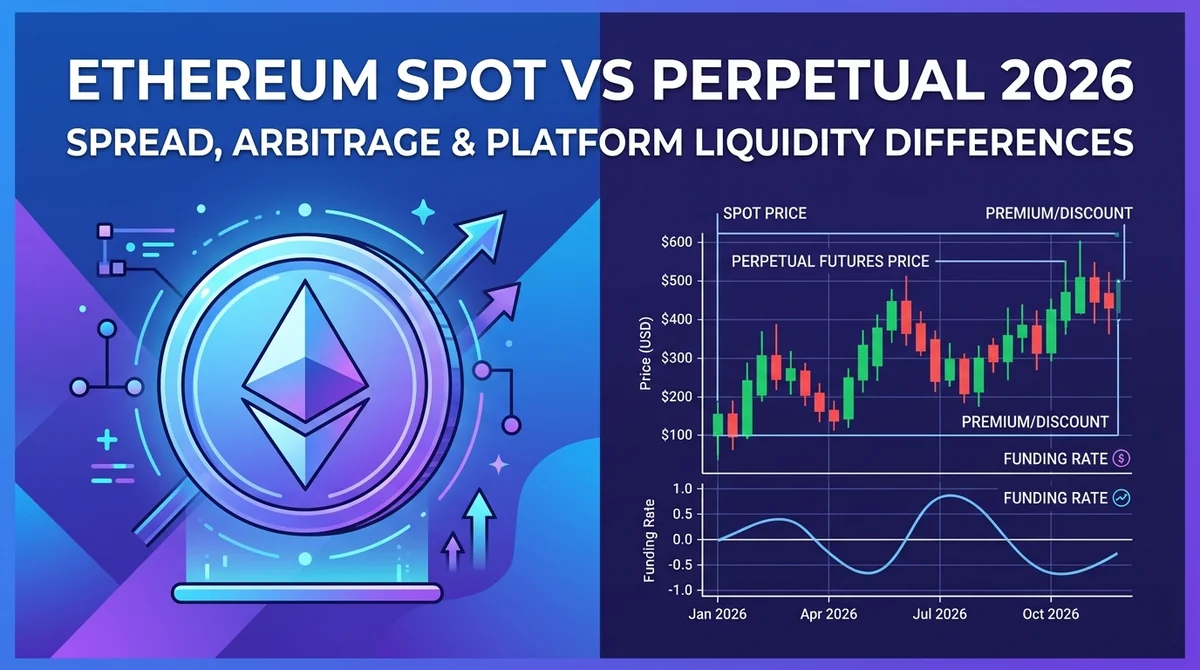
Ethereum spot holds ETH with no leverage or liquidation; perpetuals are leveraged derivatives anchored by funding rates. See spreads, arbitrage, liquidity.
Answer: As of September 7, 2026, the core difference between Ethereum spot and perpetual contracts lies in the nature of the asset held: standard spot trading involves holding ETH itself, usually without leverage or liquidation risk; perpetual contracts are leveraged derivatives that track the price of ETH, have no expiry but anchor to the spot price through funding rates, and are suitable for short-term traders with risk tolerance.
Comparison Table:
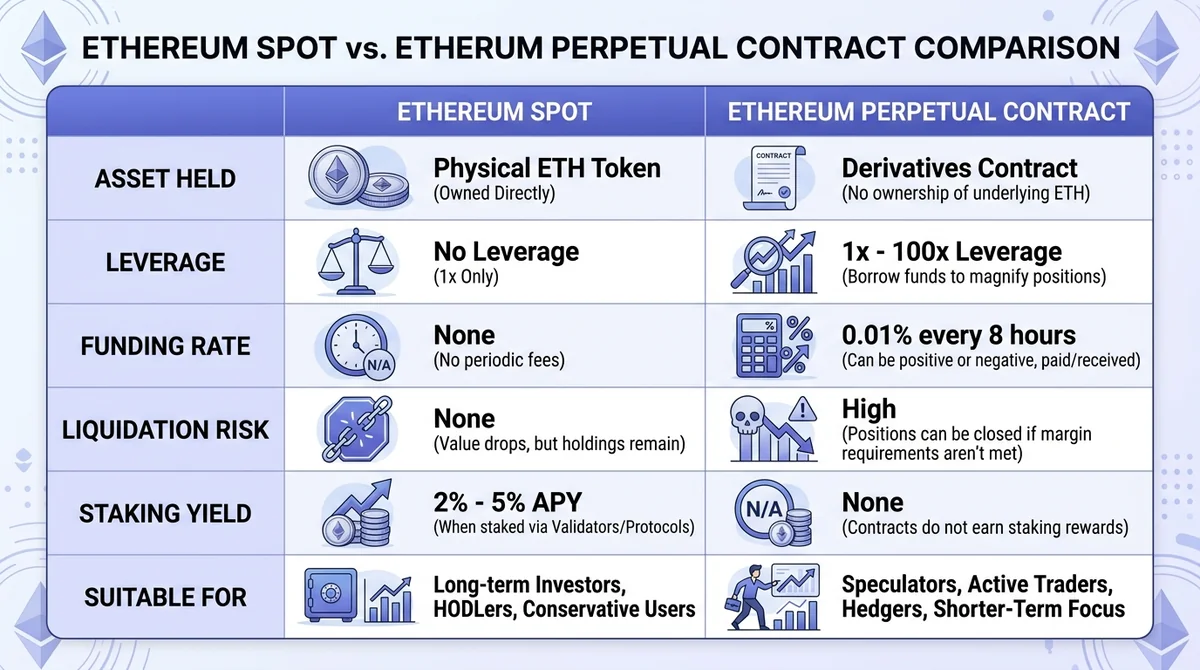
| Dimension | Ethereum Spot | Ethereum Perpetual Contract |
|---|---|---|
| Asset held | Holds ETH itself | Holds a price index contract |
| Expiry | None | None |
| Leverage | Usually no leverage (some platforms offer low leverage) | Supports leverage, multiple varies by platform |
| Funding rate | None | Typically settled every 8 hours (rate varies by platform and market conditions) |
| Liquidation risk | No liquidation risk in standard spot trading | Has liquidation risk |
| Price anchoring | Directly determined by market supply and demand | Converges to spot via funding rate |
| Trading costs | Spread and fees (varies by platform) | Fees, funding rate, and slippage (varies by platform) |
| Rights | Can participate in staking, etc. (requires platform support) | No staking or other on-chain rights |
| Suitable for | Long-term holders | Short-term traders and arbitrageurs |
Dimension Details:
Assets Held and Rights: Spot trading involves directly holding ETH, which can be transferred to a wallet or used in on-chain activities; perpetual contracts do not hold ETH but only track the price index, with no on-chain rights. Another advantage of holding spot is the ability to participate in staking. After Ethereum's transition to PoS, users can stake ETH to the network or to liquid staking protocols to earn additional yield. However, staking yields are not fixed; they depend on the total amount staked on the network and fee income, typically floating between 2% and 5% (example range; actual figures are subject to real-time data). Perpetual contract holders cannot earn any on-chain yield because their position is merely price exposure.
Perpetual Futures Funding Rate Settlement Schedule:
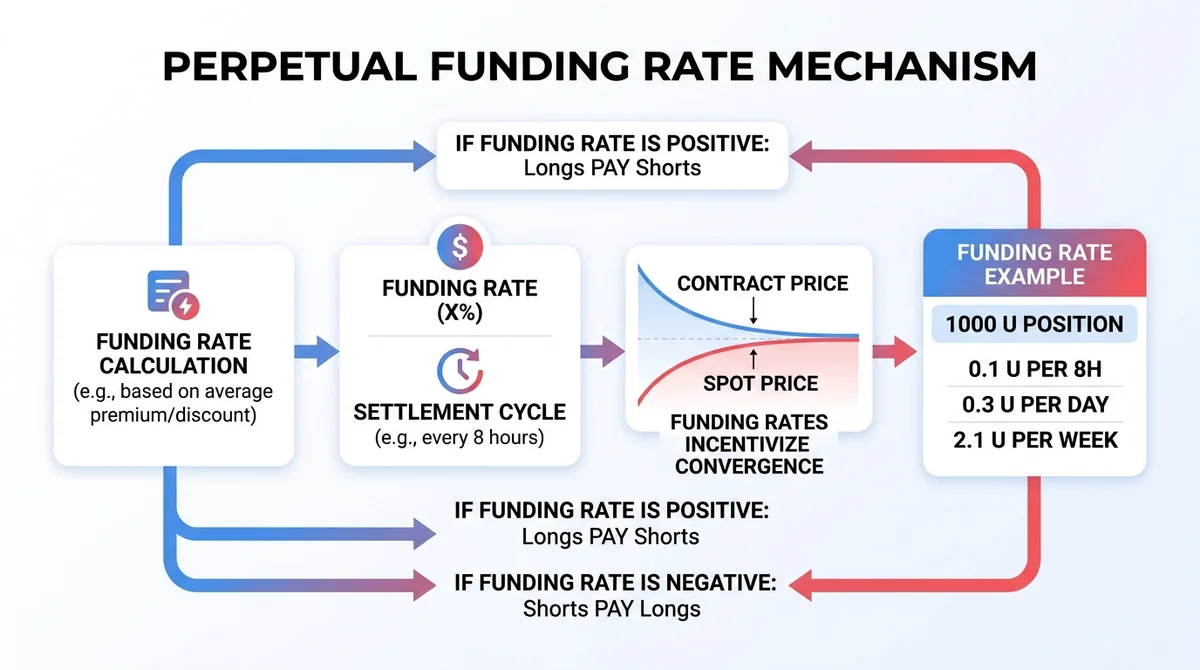
Perpetual contracts use a funding rate settled every 8 hours to converge the contract price to the spot price. When the contract price is above spot, longs pay; otherwise, shorts pay.
Specifically, the funding rate typically consists of two components: an interest rate differential and a premium index. When the perpetual contract price is significantly above spot, the premium is positive, and longs pay shorts, which suppresses bullish sentiment and pulls the contract price down; conversely, when the contract price is below spot, shorts pay, encouraging bullish positioning. The rate level updates every 8 hours, usually fluctuating around 0.01%, but may rise sharply in extreme market conditions. For example, if the funding rate is 0.01%, holding a 1000 U long position requires paying 0.1 U every 8 hours, or 0.3 U per day (three times). If held for a week, the funding cost is about 2.1 U. This is a cost short-term traders must account for.
Leverage and Liquidation:
Standard spot trading holds ETH itself, with no leverage and no liquidation risk; perpetual contracts are leveraged derivatives with liquidation risk.
Perpetual contracts offer leverage, commonly ranging from 1x to 100x depending on the platform and trading pair. Leverage amplifies both gains and losses. When losses cause the margin rate to fall below the maintenance margin rate (see TRUMPUSDT perpetual futures margin requirements explained), the platform triggers forced liquidation, i.e., liquidation. The formula for calculating the liquidation price is approximately: long liquidation price = entry price × (1 - initial margin rate + maintenance margin rate), and short liquidation price = entry price × (1 + initial margin rate - maintenance margin rate) (approximate formula; differs across platforms). Taking a 10x leveraged long on ETH as an example: if the entry price is 3000 U, initial margin rate 10%, and maintenance margin rate 0.5%, then the liquidation price is approximately 3000 × (1 - 0.1 + 0.005) = 2715 U, meaning a price drop of about 9.5% triggers liquidation. Clearly, the higher the leverage, the closer the liquidation distance and the greater the risk.
Spread Formation:
The spread between spot and perpetual contracts is driven by liquidity asymmetry, market sentiment, and funding rates; the worse the liquidity, the larger the spread.
The spread can be understood as the difference between the spot price and the perpetual contract price at the same moment. Normally, the two are very close because arbitrageurs continuously close the spread. However, during sharp market fluctuations, liquidity depletion, or extreme sentiment, the spread may widen significantly. For example, when the market is broadly bullish, the perpetual contract price may exceed spot, creating a positive premium; conversely, a negative premium appears. The size of the spread is also affected by trading costs: if trading fees and slippage exceed the spread profit, arbitrageurs will not act, and the spread will persist. Therefore, the spread reflects market efficiency and liquidity levels.
Arbitrage Strategies: A common arbitrage strategy is "cash-and-carry arbitrage": when the perpetual contract price is above spot, buy spot and short the perpetual contract, then close both positions after the spread converges to profit. Specific steps: 1) monitor the spread and enter when the spread exceeds trading costs (fees + slippage + funding rate); 2) simultaneously buy ETH in the spot market and open an equal-sized short position in the perpetual contract market; 3) wait for the spread to converge to a reasonable level; 4) close both positions to earn the spread difference. Note that arbitrage is not risk-free: if the spread does not converge or even widens, or if the funding rate remains unfavorable, losses may occur. Additionally, execution risks (such as slippage and delays) can erode profits. Therefore, arbitrage is more suitable for experienced traders.
Platform Liquidity Impact: Liquidity is key to arbitrage success. When order book depth is insufficient, large orders can significantly push the price up or down, causing slippage. For example, on a platform with poor liquidity, buying 10 ETH might push the price up 0.5%, while on a platform with good liquidity, the same amount might only affect the price by 0.05%. Slippage directly reduces arbitrage profits and can even turn a otherwise profitable spread into a loss. Therefore, users should prioritize platforms with deep order books and high trading volume, and check metrics such as 2% depth to assess liquidity.
Scenario Recommendations: If you are a long-term ETH holder and unwilling to bear liquidation risk, choose spot. Spot is suitable for dollar-cost averaging, holding, and also allows staking for additional yield. If you are a short-term trader with leverage experience and can manage funding rate costs, you may consider perpetual contracts, but be sure to set stop-losses and control position size. If you are an arbitrageur, you need to use both spot and perpetual contracts, and prioritize platforms with sufficient liquidity. Whichever you choose, start with small test orders to familiarize yourself with platform mechanics and fee structures.
Disclaimer: This content is for informational purposes only and does not constitute investment or account-opening advice. Data is as of 2026-09-07 and actual conditions may change. Specific fees, leverage multiples, and liquidity data should be based on each platform's official announcements.
FAQ:
Q: How is the funding rate calculated? A: Funding rates are typically settled every 8 hours; the exact formula varies by platform and generally consists of a premium index and an interest rate. When the perpetual contract price is above spot, longs pay shorts; otherwise, shorts pay longs. Specific rates vary by platform, so please refer to the platform's official announcements.
Q: Which is more suitable for beginners: spot or perpetual contracts? A: Spot is more suitable for beginners because standard spot trading has no leverage or liquidation risk and involves holding actual ETH. Perpetual contracts involve leverage and funding rates, requiring some trading experience and risk tolerance.
Q: How much capital is needed for an arbitrage strategy? A: The required capital depends on the spread size, fees, and slippage costs. Since specific rates vary by platform, a uniform amount cannot be given, but you generally need sufficient funds to cover both sides' trading costs and margin.
Q: How does platform liquidity affect trading? A: Poor liquidity increases slippage, and insufficient order book depth may prevent arbitrage trades from executing at expected prices. Users should pay attention to order book depth and trading volume rather than just nominal fees.
Q: What is the liquidation mechanism for perpetual contracts? A: When margin is insufficient to maintain a position, the platform triggers forced liquidation to control risk. Specific liquidation thresholds and mechanisms vary by platform, so please refer to the platform's rules.
Q: What are the typical leverage multiples for perpetual contracts? A: Different platforms offer different leverage multiples, commonly from 1x to 100x. High leverage can amplify gains but also greatly increases liquidation risk. Beginners are advised to start with low leverage and set stop-losses.
Q: How large is the spread between spot and perpetual contracts usually? A: There is no fixed range for the spread; in normal markets it is usually very small, perhaps only a few basis points; but in extreme market conditions or insufficient liquidity, the spread may widen to over 1%. It needs to be monitored in real time.
FAQ
How is the funding rate calculated?
Funding rates are typically settled every 8 hours; the exact formula varies by platform and generally consists of a premium index and an interest rate. When the perpetual contract price is above spot, longs pay shorts; otherwise, shorts pay longs. Specific rates vary by platform, so please refer to the platform's official announcements.
Which is more suitable for beginners: spot or perpetual contracts?
Spot is more suitable for beginners because standard spot trading has no leverage or liquidation risk and involves holding actual ETH. Perpetual contracts involve leverage and funding rates, requiring some trading experience and risk tolerance.
How much capital is needed for an arbitrage strategy?
The required capital depends on the spread size, fees, and slippage costs. Since specific rates vary by platform, a uniform amount cannot be given, but you generally need sufficient funds to cover both sides' trading costs and margin.
How does platform liquidity affect trading?
Poor liquidity increases slippage, and insufficient order book depth may prevent arbitrage trades from executing at expected prices. Users should pay attention to order book depth and trading volume rather than just nominal fees.
What is the liquidation mechanism for perpetual contracts?
When margin is insufficient to maintain a position, the platform triggers forced liquidation to control risk. Specific liquidation thresholds and mechanisms vary by platform, so please refer to the platform's rules.
Related Terms
Done comparing? Ready to place your first trade?
The crypto assets, tokenized US stocks and ETFs you just compared are all tradable on MSX — spot or perpetuals.
Quick Start Trading →New here? Registration takes three quick steps.