Germany vs UK Stock Market: Which Is Better for Long-Term Allocation
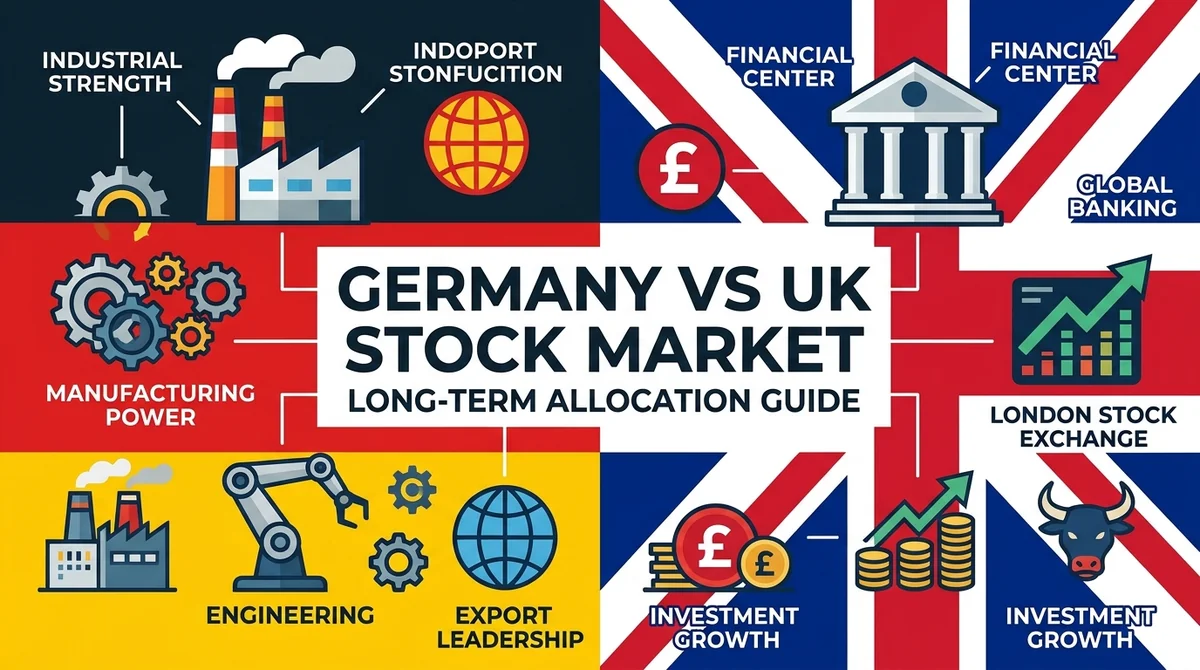
Germany vs UK stock market for long-term allocation: sector structure, median P/CF methodology, FX and tax costs, direct stocks vs ETF paths, and a 10-point checklist.
#Germany vs UK Stock Market: How to Choose for Long-Term Allocation
Conclusion: Germany and the UK are both mature developed markets. The core difference for long-term allocation is not market maturity but sector structure and revenue sources — if you value industrial and export exposure, lean toward the German market; if you value financials, energy and globally revenue-generating companies, lean toward the UK market. You can also allocate to both to reduce single-market concentration. This is a structural judgment (a speculative conclusion), not a return forecast.
First, a note: this article does not include specific quantitative data such as valuation, dividend yield or market size for the German and UK stock markets, so any place involving specific figures is marked "data not disclosed" and no speculation is made; the verifiable parts focus on structure, methodology and measurement conventions.
#What is the core difference between the German and UK stock markets for long-term allocation?
In one sentence: Both markets are mature developed markets; the differences come mainly from sector structure and the geographic distribution of revenue, not from regulatory maturity or liquidity levels.
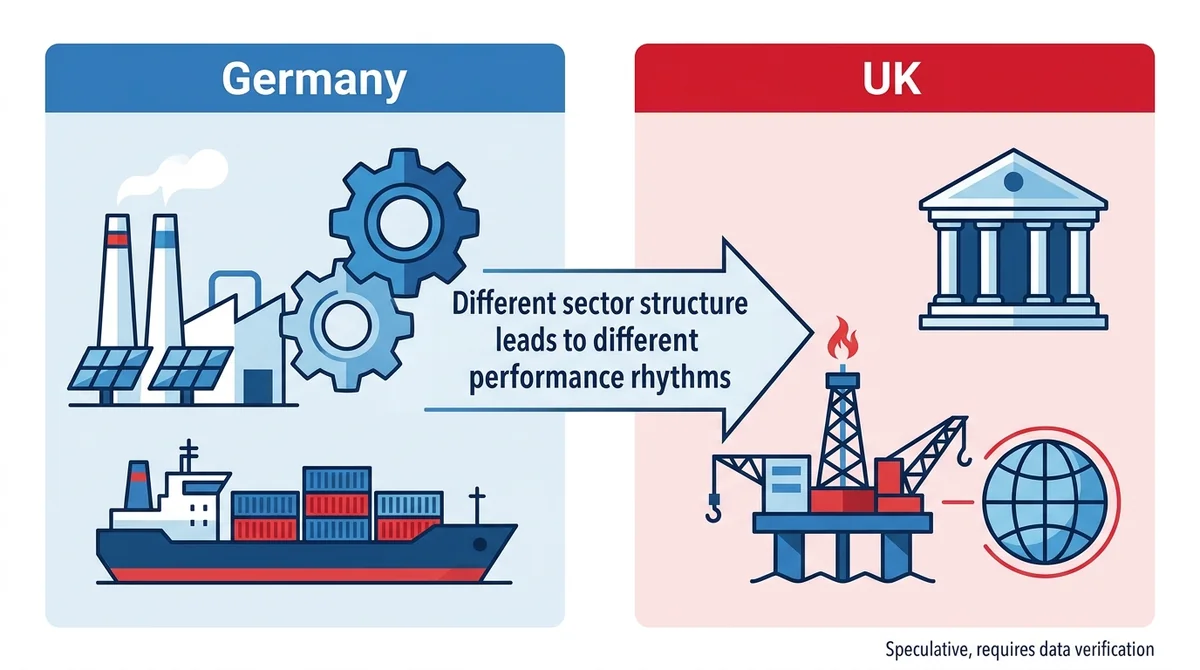
Sector structure differences (speculative, based on qualitative descriptions of common index sector weights; no specific weight data attached): The German market is often described as skewed toward industrial, manufacturing and export-oriented companies, whose earnings are more sensitive to the global capex cycle and external demand; the UK market is often described as more weighted toward financials and energy, with listed companies' revenue more globally distributed. This difference may cause the two to perform on different rhythms under different macro environments, but "different sector structure → different relative performance" requires specific weight data and historical range verification, which this article does not provide.
Index exposure vs single-stock exposure: Long-term allocation must first distinguish whether you hold "average market exposure" or "single-stock exposure." The index or ETF path gives you the sector-weighted average result, while the single-stock path adds stock-selection judgment and concentration risk. These are not the same type of decision.
FX and tax costs: Holding assets in a non-domestic currency means bearing exchange-rate fluctuations between your home currency and the target market's currency; cross-border holding also involves withholding tax, reporting and compliance costs. These costs directly erode long-term net returns; specific tax rates and applicable rules vary by investor location, and this article does not give a unified figure.
Common traits of mature markets: Both are generally considered to have relatively high liquidity, mature regulatory frameworks and robust disclosure — this part does not constitute a major selection difference (this article attaches no quantitative comparison data).
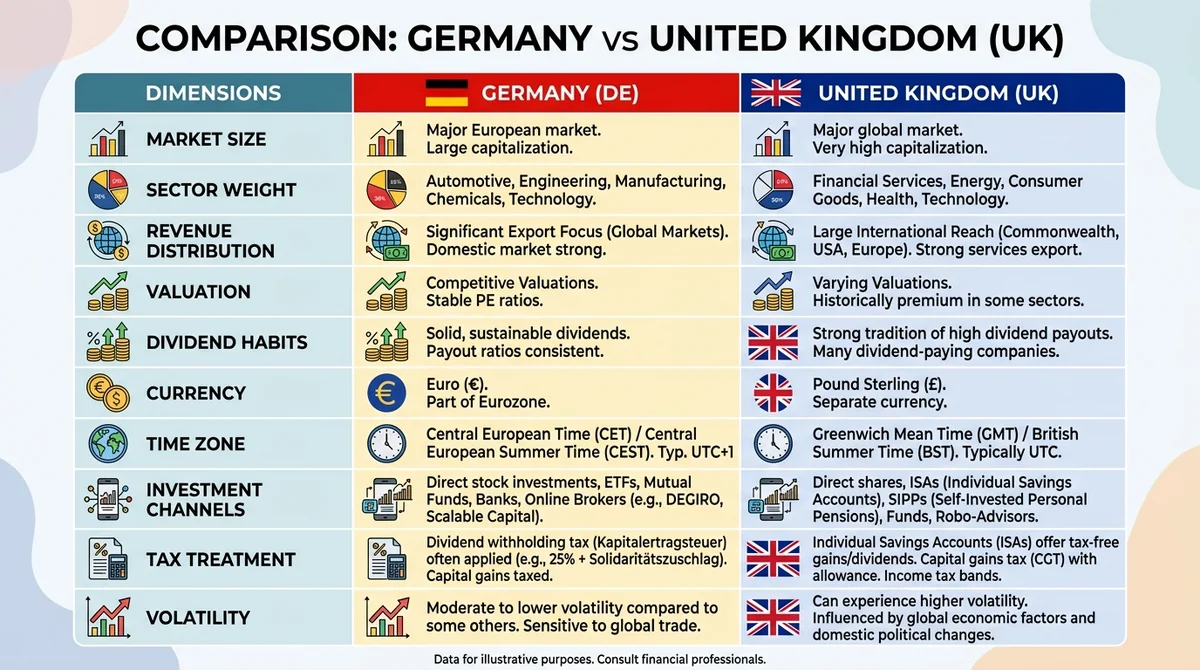
#Germany vs UK stock market comparison table: how to compare across 10 dimensions?
In one sentence: A comparison table using dimensions such as sector weights, valuation conventions, currency and investment channels can turn "Germany vs UK" from a gut feeling into a verifiable list of differences.
We recommend fixing the comparison at 10 dimensions: market size, sector weight structure, geographic revenue distribution, valuation conventions (including median P/CF), dividend habits, currency of denomination, trading time zone, investment channels and accessibility, tax treatment, and volatility characteristics. Specific quantitative values are not included in this article's data sources and are marked "data not disclosed"; the table below retains only confirmable structural differences and items to be verified.
The methodology issue with median P/CF: Median price-to-cash-flow is highly sensitive to sector structure — asset-heavy, high-depreciation industries and asset-light industries have different cash-flow profiles, so directly comparing medians can easily lead to misleading conclusions. The correct approach is: first confirm whether the two medians use the same calculation convention (whether negative values are excluded, whether trailing-twelve-month cash flow is used, whether weighted by free-float market cap), then explain the source of differences in light of sector weights. If the conventions are inconsistent, the comparison does not hold. This article does not give specific median P/CF values for the two countries.
What the comparison table should deliver: Any comparison table must ultimately answer "what kind of allocation need does this suit," rather than giving an absolute ranking of better or worse.
#Buying German stocks directly vs buying a German ETF: which is better?
In one sentence: Buying German stocks directly is active stock selection, bearing single-stock and concentration risk; buying a German ETF gives average market exposure with greater diversification, and long-term allocation usually values the diversification and cost structure the latter brings.
Extra risks of buying individual stocks: It requires stock-selection skill and exposes you to company operating risk, single-holding concentration risk, and stock-level information and research costs.
What a German ETF gives you: It gives index-rule-weighted average market exposure with greater diversification, and its cost structure is reflected in holding fees and trading costs rather than research input. Specific ETF fee rates, tracking error and share classes are not included in this article's data sources and are data not disclosed; these parameters should be based on product documents.
The long-term allocation trade-off: Long-term allocation values diversification and holding costs more than short-term stock-picking wins. This does not mean the single-stock path is invalid, but that the two paths solve different problems.
Portfolio approach: The two paths are not mutually exclusive and can be combined in a core-plus-satellite approach — use broad-market exposure for the core position to capture average market results, and use satellite positions to express specific sector or single-stock views.
#When should you choose the German market, and when the UK market?
In one sentence: If you want industrial and export exposure, lean toward the German market; if you want financials and energy exposure, lean toward the UK market; you can also allocate to both to reduce single-market concentration.
- If you value industrial, manufacturing and export leaders → German market exposure fits your needs better (provided the market is indeed dominated by such sectors, to be verified against the latest index weights).
- If you value financials, energy and globally revenue-generating companies → UK market exposure fits your needs better (likewise to be verified against the latest index weights).
- If you only want to reduce single-market concentration → You can allocate to both markets, but note that the two may overlap in some sectors, and the actual diversification effect depends on weight settings.
- If you want average market results with minimal research input → Prioritize broad-based index or ETF paths over individual stocks.
- If you have a clear sector view and are willing to bear concentration risk → The single-stock path can serve as a satellite position, but set a single-holding cap.
#What risks come with long-term allocation to these two markets?
In one sentence: Long-term allocation to the German or UK market involves sector concentration, FX volatility and cross-border tax compliance costs; long-term holding does not equal risk-free.
Sector concentration risk: Concentrated sector weights mean greater sensitivity to a single cycle; when that sector enters a downturn, overall market performance may be dragged down.
FX risk: Exchange-rate fluctuations between your home currency and the target market's currency directly affect the holding experience denominated in your home currency, and FX direction is not necessarily aligned with asset price direction.
Tax and compliance costs: Withholding tax, reporting obligations and compliance costs vary by investor location and must be verified separately according to your own tax residency status.
Rebalancing: Long-term allocation does not mean buy-and-forget; regular rebalancing is needed to maintain target weights.
Accessibility risk: Product types, trading channels and eligibility conditions available differ by region; specific availability must be verified by location, and related details are not included in this article's data sources and are data not disclosed.
#FAQ
Q1: Which is better for long-term allocation, the German or UK stock market? A: There is no one-size-fits-all answer. Both are mature developed markets, and the differences lie mainly in sector structure and revenue sources. If you value industrial and export exposure, lean toward Germany; if you value financials and energy exposure, lean toward the UK; you can also allocate to both to reduce single-market concentration.
Q2: Can median P/CF be directly compared across the German and UK markets? A: Only under the same calculation convention. First confirm whether negative values are excluded, whether cash flow is trailing twelve months, and whether it is weighted by free-float market cap, then explain differences in light of sector weights. If the conventions are inconsistent, the comparison does not hold.
Q3: What is the core difference between buying German stocks directly and buying a German ETF? A: Buying individual stocks is active stock selection, bearing single-stock and concentration risk; buying an ETF gives average market exposure with greater diversification, and the cost structure is reflected in holding fees. Long-term allocation usually values diversification and holding costs more.
Q4: Does it make sense to allocate to both the German and UK markets? A: Yes — it can reduce single-market concentration, but note that the two may overlap in some sectors, and the actual diversification effect depends on weight settings.
Q5: Does long-term holding mean no rebalancing is needed? A: No. Long-term allocation still requires regular rebalancing to maintain target weights, and periodic review of FX, tax and product-level changes.
Disclaimer: This content is compiled from public data and structural descriptions and does not constitute investment or open account advice. This article does not include specific valuation, dividend yield or market size figures for the German and UK stock markets; relevant places are marked "data not disclosed." Please refer to official sources from exchanges, index providers and product issuers.
To verify the latest conventions, check the official sources of the relevant exchanges and product issuers.
FAQ
Which is better for long-term allocation, the German or UK stock market?
There is no one-size-fits-all answer. Both are mature developed markets, and the differences lie mainly in sector structure and revenue sources. If you value industrial and export exposure, lean toward Germany; if you value financials and energy exposure, lean toward the UK; you can also allocate to both to reduce single-market concentration.
Can median P/CF be directly compared across the German and UK markets?
Only under the same calculation convention. First confirm whether negative values are excluded, whether cash flow is trailing twelve months, and whether it is weighted by free-float market cap, then explain differences in light of sector weights. If the conventions are inconsistent, the comparison does not hold.
What is the core difference between buying German stocks directly and buying a German ETF?
Buying individual stocks is active stock selection, bearing single-stock and concentration risk; buying an ETF gives average market exposure with greater diversification, and the cost structure is reflected in holding fees. Long-term allocation usually values diversification and holding costs more.
Does it make sense to allocate to both the German and UK markets?
Yes — it can reduce single-market concentration, but note that the two may overlap in some sectors, and the actual diversification effect depends on weight settings.
Does long-term holding mean no rebalancing is needed?
No. Long-term allocation still requires regular rebalancing to maintain target weights, and periodic review of FX, tax and product-level changes.
Related Terms
Done comparing? Ready to place your first trade?
The crypto assets, tokenized US stocks and ETFs you just compared are all tradable on MSX — spot or perpetuals.
Quick Start Trading →New here? Registration takes three quick steps.