Instant Multi-Asset Swap vs Traditional Broker Execution Cost
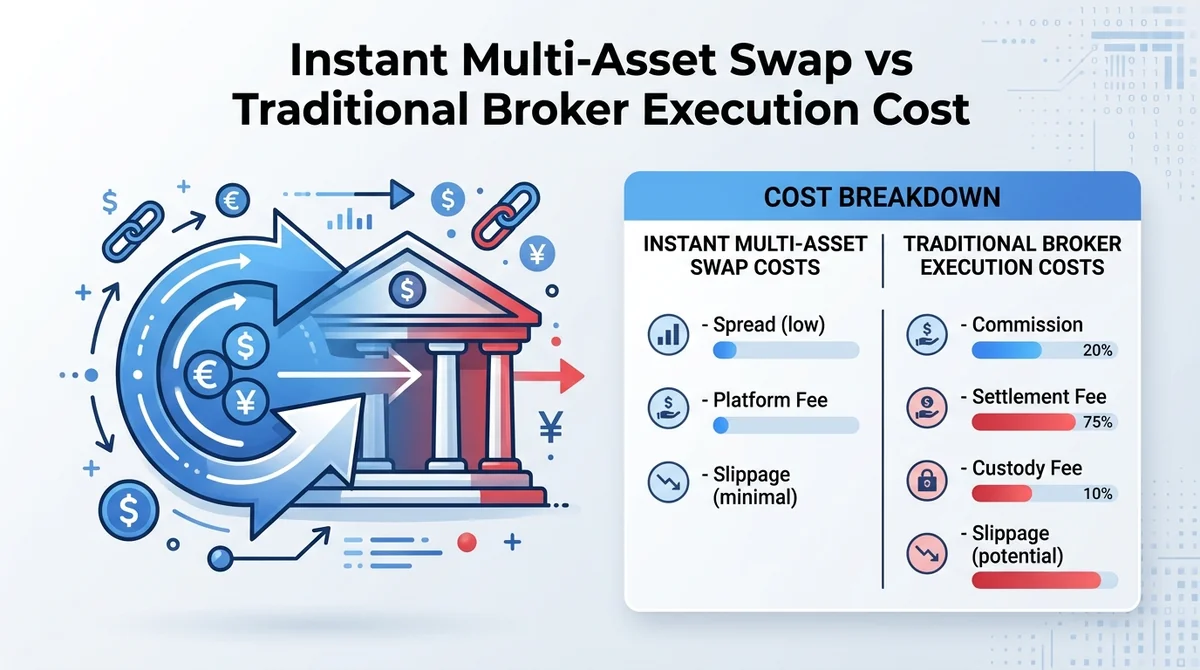
An 8-dimension breakdown of execution costs for instant multi-asset swaps vs traditional brokers—spreads, slippage, commissions, fees, settlement—and why one metric can't compare.
Conclusion: The cost of instant multi-asset swaps is concentrated in the execution price (spread and slippage), while traditional broker costs are spread across commissions, platform fees, and settlement/custody steps. Comparing commissions alone cannot reveal true execution cost; you need to route choices by order size and scenario.
#What exactly is the difference between instant multi-asset swap and traditional broker execution costs?
The cost structures of the two do not sit at the same layer, so directly comparing a single fee rate leads to misleading conclusions.
#What are the cost components of each?
The cost of instant multi-asset swaps mainly appears as spread and slippage: the quote embeds a bid-ask spread, and at execution, if the order size exceeds the currently available depth, the average fill price deviates from the quote, creating slippage. Traditional broker costs are spread across commissions, spreads, platform fees, and settlement- and custody-related charges; some fees are explicitly listed, while others are implicit in quotes or account terms.
It should be noted that specific fee rates and spread levels for both approaches vary greatly by platform, instrument, and account type. This article does not provide unified figures, nor does it rank any specific platform by cost.
#Why can't you just compare commission levels?
Because commission is only one part of traditional broker costs, while instant swaps often charge no explicit commission—the cost is fully internalized in the spread. Looking only at commission underestimates the spread cost of instant swaps and ignores the additional fees of traditional brokers. Different degrees of cost-structure dispersion make a single metric non-comparable.
#A comparison table: cost differences across 8 dimensions
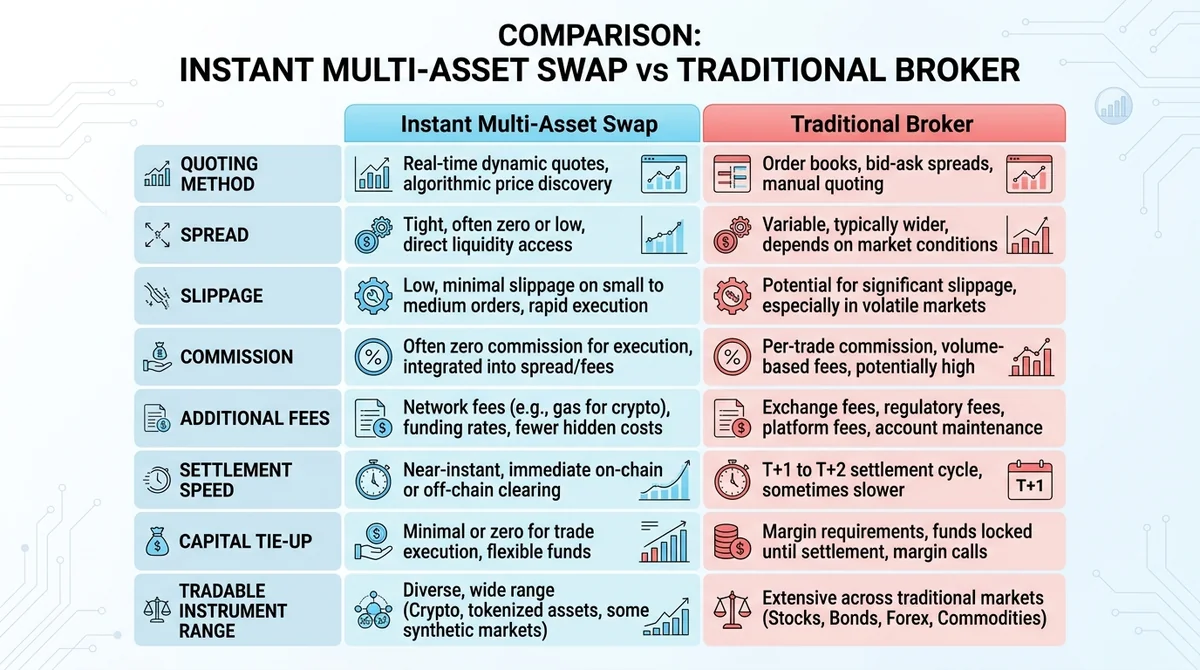
The table below provides a structural comparison across 8 dimensions: quoting method, spread, slippage, commission, additional fees, settlement speed, capital tie-up, and tradable instrument range. Specific values vary by platform and instrument; missing data is uniformly marked "data not publicly available."
| Dimension | Instant multi-asset swap | Traditional broker |
|---|---|---|
| Quoting method | Real-time quotes, price moves with depth | Matched or market-maker quotes, visible intraday |
| Spread | Internalized in quote; no unified public standard | Explicit spread on some instruments; no unified public standard |
| Slippage | Directly related to order size and depth | Also present on large orders, but matching mechanism differs |
| Commission | Usually no explicit commission | Explicit commission, per trade or percentage-based |
| Additional fees | Network/cross-chain bridge and similar fees depending on route | Platform fee, settlement fee, custody fee, and other items |
| Settlement speed | Instant or near-instant | Usually T+1 or T+2, depending on market |
| Capital tie-up | Occupied on execution, short waiting time | Longer capital tie-up during settlement cycle |
| Tradable instrument range | Multi-asset coverage, depending on platform | Limited by exchange and account permissions |
#How do spread and slippage affect the final execution price?
Spread is the difference between bid and ask in the quote and is an unavoidable cost; slippage is the deviation of the actual fill price from the expected price, amplified by order size and market volatility. Together they determine the final execution price, not commission.
#Where do commission and additional fees each appear?
Commission is deducted at the execution step, while additional fees may appear at deposit, settlement, custody, or withdrawal steps. Additional fees for instant swaps are mostly related to on-chain routes (e.g., cross-chain bridge fees), while those for traditional brokers relate to account type and settlement process.
#Do settlement speed and capital tie-up count as costs?
Yes. Slow settlement means funds are in transit longer and cannot be redeployed during that time, creating an opportunity cost. Instant swaps shorten transit time but bear the spread of instant execution.
#When is instant multi-asset swap execution cost more favorable?
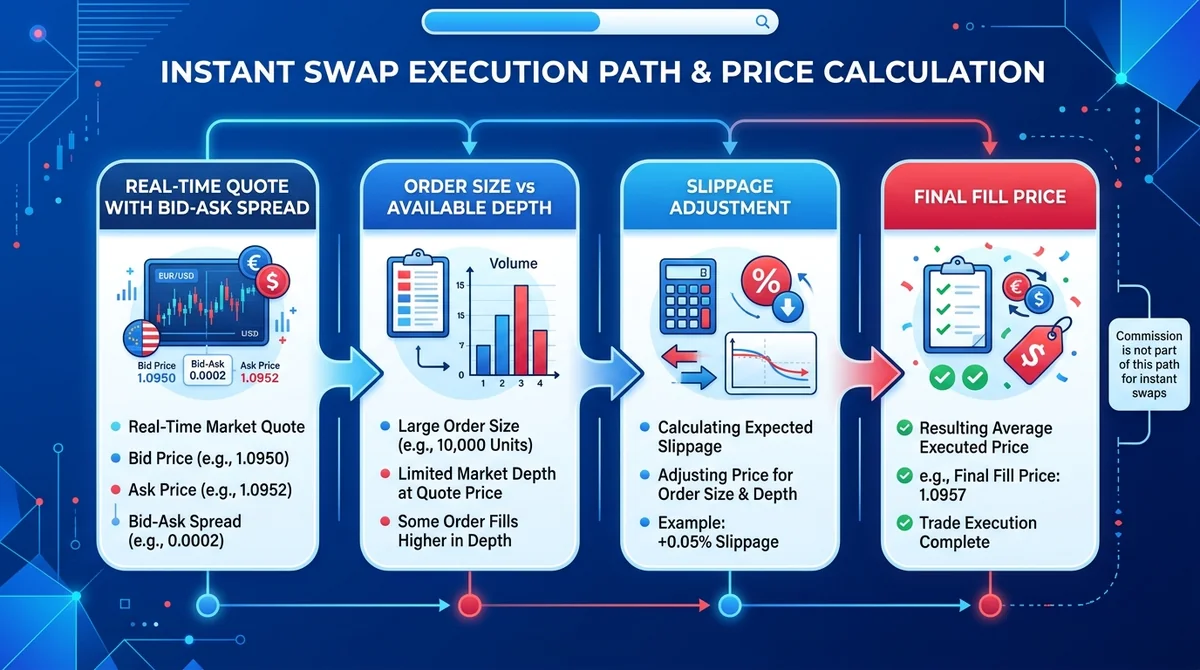
In small-amount, high-frequency scenarios requiring rapid cross-asset switching, instant multi-asset swaps reduce waiting and multi-step fees, making execution cost more controllable—but first confirm the liquidity depth of the instrument.
#At what order size does spread impact become most obvious?
When order size approaches or exceeds current quote depth, slippage amplifies significantly. For small orders, the spread cost share is relatively fixed; for large orders, splitting or seeking deeper liquidity is needed. The specific threshold depends on instrument depth, and no universal number can be given.
#What is saved when rapidly switching across assets?
What is saved is the waiting time for settlement and multi-step fees. For users who need to quickly adjust asset exposure, instant execution reduces the opportunity cost of funds in transit.
#When is traditional broker execution cost more controllable?
In large single-instrument trades or scenarios requiring compliance documentation, custody, and reconciliation, the explicit commissions and mature settlement processes of traditional brokers make execution cost more predictable.
#Why do large single-instrument orders rely more on depth?
Large orders are sensitive to liquidity and slippage; the matching mechanisms and market-maker systems of traditional brokers are usually more mature in depth, making fill-price deviation relatively controllable. However, this is a general inference; specifics still depend on the instrument and market session.
#How to choose when compliance documentation and custody are needed?
If formal statements, custody proof, or compliance documentation are required, the account systems of traditional brokers are more direct; the documentation format for instant swaps depends on the platform, with no unified public standard, so it is advisable to first verify the platform's official documentation.
#What easily overlooked costs and risks does each approach have?
Slippage in instant swaps is amplified in volatile markets, while additional fees of traditional brokers are easily underestimated; both require attention to quote transparency and execution certainty.
#How to account for slippage and ongoing costs like funding rate?
Slippage is a one-time execution cost, while funding rate-type costs are ongoing costs—the two are different in nature. If holding derivative positions, ongoing costs accumulate over time and must be calculated separately. Understanding how does perpetual futures funding rate work is essential for accurate cost estimation.
#What risk does insufficient quote transparency bring?
When quote transparency is insufficient, users find it hard to judge whether the spread is reasonable and cannot estimate slippage, reducing execution certainty. Choosing platforms with verifiable quotes and inspectable depth is more conducive to cost control.
This article is only a cost-structure explanation and does not constitute investment advice. To view specific platforms' fee rates and execution rules, refer to their official sources.
This content is compiled from public information and does not constitute investment or open account advice. Data standards and fee rates may change over time; refer to each platform's official disclosures for specifics.
FAQ
Is instant multi-asset swap cheaper than a traditional broker?
It cannot be generalized. Instant swaps usually have no explicit commission, but spread and slippage are internalized in the execution price; traditional brokers have explicit commissions but dispersed additional fees. In small-amount, high-frequency scenarios, instant swap costs are more controllable; for large single-instrument trades, depth and slippage must be compared.
Why does comparing only commissions lead to wrong conclusions?
Because commission is only one part of traditional broker costs, while instant swap costs mainly appear as spread and slippage. Looking only at commission underestimates the spread cost of instant swaps and ignores the platform and settlement fees of traditional brokers.
When does slippage have the greatest impact?
Slippage has the most obvious impact when order size approaches or exceeds current quote depth and market volatility is high. Large orders may consider split execution or choosing a route with better depth.
Does slow settlement count as a cost?
Yes. During the settlement cycle, funds are in transit and cannot be redeployed, creating an opportunity cost. Instant swaps shorten transit time but bear the spread of instant execution.
Which approach should be chosen when compliance documentation is needed?
If formal statements, custody proof, or compliance documentation are required, the account systems of traditional brokers are more direct. The documentation format for instant swaps depends on the platform; it is advisable to first verify its official documentation.
Done comparing? Ready to place your first trade?
The crypto assets, tokenized US stocks and ETFs you just compared are all tradable on MSX — spot or perpetuals.
Quick Start Trading →New here? Registration takes three quick steps.