Beyond Intel vs TSMC: A Three-Way Comparison of Advanced Packaging and Foundry Customer Competition in 2026 (Samsung Enters)
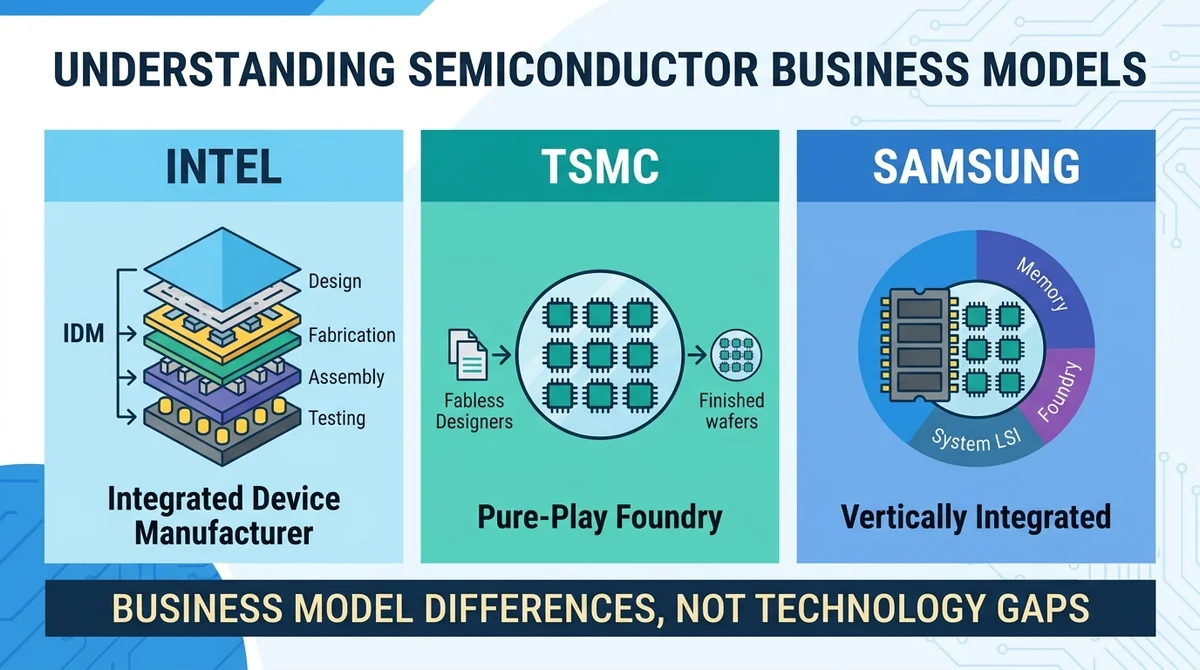
2026 three-way comparison of advanced packaging and foundry: Intel IDM 2.0, TSMC pure-play, and Samsung vertical integration, plus a decision checklist.
Conclusion: If "mass-production maturity and packaging ecosystem breadth" is the primary criterion, TSMC is currently the more predictable choice; if "customized heterogeneous integration and design–manufacturing–packaging co-optimization" is the primary criterion, Intel is worth prioritizing for evaluation; if "memory synergy and cost flexibility" is the primary criterion, Samsung offers a third path. There is no single optimal answer among the three—the differences lie mainly in business models rather than individual technologies.
Note: The descriptions in this article regarding packaging technology roadmaps and mass-production status are based on public technology announcements and general industry understanding, but no specific source links are attached. Capacity figures, customer contracts, order shares, and similar data have not been publicly disclosed in comparable form by any of the three parties, so no quantitative assertions are made in this article.
#What are the core differences among Intel, TSMC, and Samsung in advanced packaging and foundry?
The core difference lies in the business model: Intel is a vertically integrated IDM 2.0 (in-house design + foundry services + packaging), TSMC is a pure-play foundry focused on manufacturing, and Samsung is a vertically integrated player that combines its memory business with foundry and packaging. This underlying structure shapes the three companies' customer structure, packaging technology roadmaps, and capacity allocation logic, but does not by itself determine their technical merits.
#How do the three companies' foundry models differ?
Intel: The IDM 2.0 model, which retains in-house chip design, external foundry services, and packaging capabilities simultaneously; customers need to assess the parallel relationship between its design and foundry businesses when partnering.
TSMC: A pure-play foundry model that does not design chips competing with customers and focuses on manufacturing and the packaging ecosystem; this structure gives it broader customer coverage.
Samsung: A vertically integrated model that bundles memory, foundry, and packaging, appealing to customers needing storage-logic synergy, but also implying business overlap with some customers.
#What are the characteristics of each advanced packaging technology roadmap?
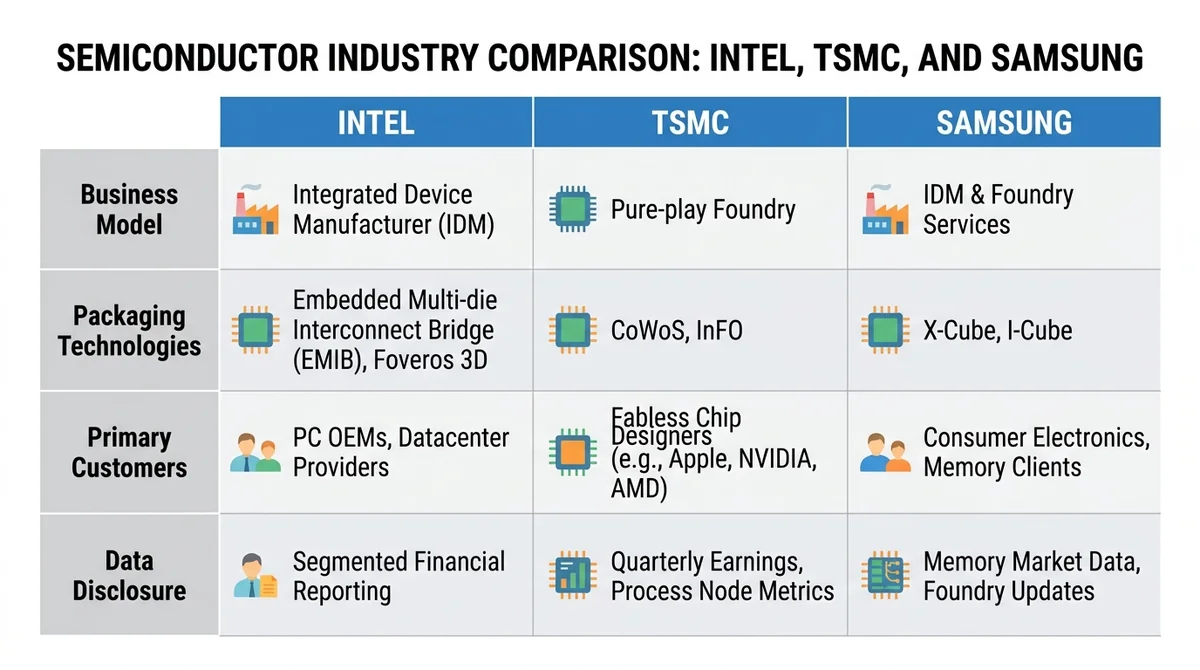
Intel: EMIB and Foveros—the former focused on flexible heterogeneous integration, the latter on 3D stacking.
TSMC: CoWoS and InFO—CoWoS targets high-performance computing packaging, InFO targets mobile packaging; both are widely regarded in the industry as having entered mass production, though specific yields and capacity are not disclosed.
Samsung: X-Cube and I-Cube, focused on 3D integration.
#Where do customer structure differences show up?
TSMC covers a broad Fabless customer base; Intel focuses on expanding external customers, with its foundry services ecosystem still under construction; Samsung binds memory customers and system-level customers, pursuing orders through bundled solutions. Details of specific customer contracts and order shares are not disclosed.
#What is the advanced packaging capacity and customer competition landscape in 2026?
The 2026 competition centers on two fronts: capacity expansion and the battle for AI/HPC customers. Public information shows TSMC advancing CoWoS capacity expansion, Intel increasing packaging-related investment, and Samsung expanding packaging lines. Specific capacity figures for the three are not disclosed, so no quantitative capacity comparison is possible.
#How do the three differ in their advanced packaging capacity layouts?
TSMC: Expanding around CoWoS with a clear direction, though capacity tightness is widely discussed in the industry and the specific timing of relief is not disclosed.
Intel: Primarily packaging plant investment, supporting its foundry services expansion.
Samsung: Expanding packaging lines, bundled with its memory business.
#In which areas is customer competition concentrated?
Mainly in three directions: AI accelerators, HPC, and mobile chips. Among these, AI accelerators have the highest demand intensity for advanced packaging and are one of the key battlegrounds for the three.
#What impact does Samsung's entry have on the landscape?
Samsung attracts customers with a "memory + packaging" combination, offering an alternative for customers needing storage-logic co-design and potentially increasing customer negotiating room; however, its foundry customer trust still needs time to build.
#Three-way comparison table
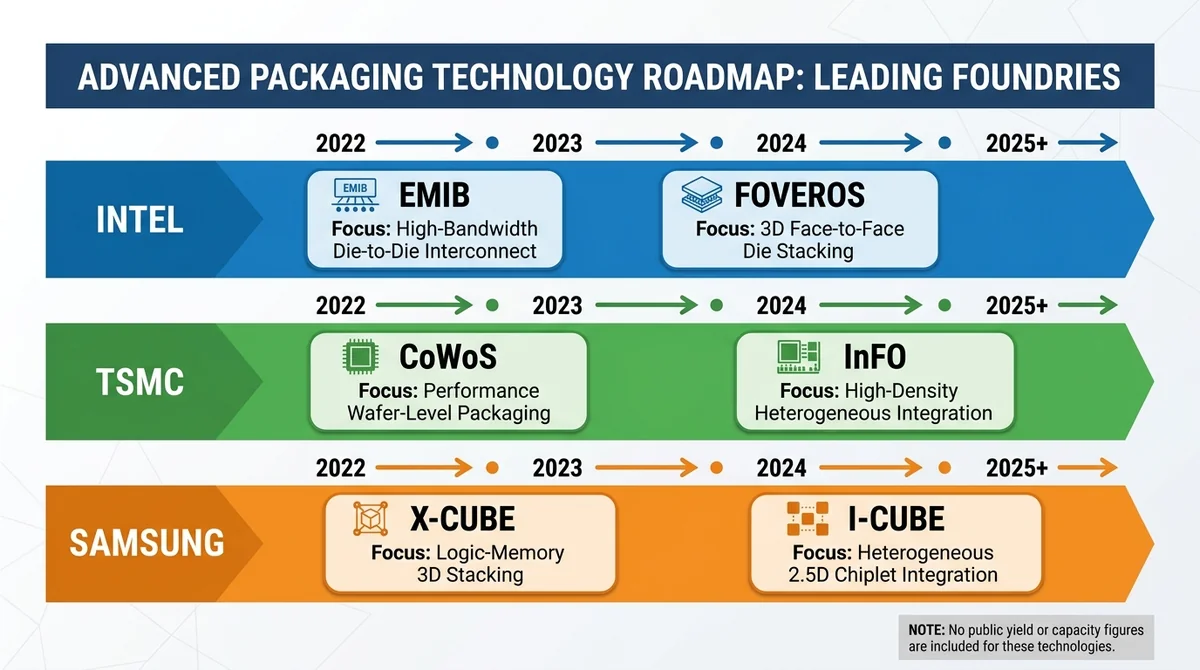
| Dimension | Intel | TSMC | Samsung |
|---|---|---|---|
| Business model | IDM 2.0 (design + foundry + packaging) | Pure-play foundry | Vertical integration (memory + foundry + packaging) |
| Packaging technology roadmap | EMIB / Foveros | CoWoS / InFO | X-Cube / I-Cube |
| Packaging mass-production maturity | Ecosystem under construction (not quantitatively verified) | Widely regarded as mass-production mature (not quantitatively verified) | Expanding (not quantitatively verified) |
| Customer structure | Mainly external customer expansion | Broad Fabless coverage | Tied to memory and system customers |
| Capacity layout | Packaging plant investment | CoWoS capacity expansion | Packaging line expansion |
| Specific capacity figures | Data not disclosed | Data not disclosed | Data not disclosed |
| Main battlegrounds | AI accelerators, HPC | AI accelerators, HPC, mobile | AI accelerators, HPC, mobile |
| Main risks | Foundry ecosystem still under construction | Capacity tightness may persist | Foundry customer trust yet to improve |
#Dimension details
Business model: Determines whether customers face overlap with the foundry's own design business when partnering—the first-layer filter when choosing a foundry.
Packaging technology roadmap: EMIB/Foveros, CoWoS/InFO, and X-Cube/I-Cube correspond to different heterogeneous integration and 3D stacking approaches and must match the actual chip architecture, rather than simply comparing technology names.
Mass-production maturity: CoWoS and InFO are widely regarded in the industry as having entered mass production, but there is a lack of publicly available quantitative metrics on a consistent basis; Intel's and Samsung's packaging roadmaps are in the ecosystem-building and expansion stages, and likewise lack comparable data.
Customer structure: The breadth of a customer structure affects the fairness of capacity allocation and queue times, but specific contract details are not disclosed.
Capacity figures: None of the three has disclosed comparable capacity data, so any quantitative ranking lacks a basis.
#Scenario recommendations
If you are a customer seeking mass-production stability and a mature packaging ecosystem: TSMC's CoWoS/InFO roadmap is the more predictable path, but you should allow for scheduling buffers due to capacity tightness.
If you need customized advanced packaging and design–manufacturing–packaging co-optimization: Intel's EMIB/Foveros combination is worth prioritizing for evaluation, while also assessing the progress of its foundry services ecosystem.
If you need memory synergy and cost flexibility: Samsung's vertically integrated combination offers a third path, but you should assess the accumulation of its foundry customer trust.
If you are in the early architecture-definition stage: It is advisable to conduct parallel technical feasibility discussions with all three rather than locking into a single packaging roadmap too early.
#Action checklist
- Clarify the core packaging requirements of your chip architecture (heterogeneous integration or 3D stacking).
- Verify whether the target packaging roadmap has entered mass production and request verifiable yield/delivery data.
- Confirm whether the foundry's business model overlaps with your own design business.
- Ask about capacity scheduling and allocation mechanisms, noting that specific capacity figures are not disclosed.
- Assess the impact of supply chain and geopolitical factors on delivery.
- Converge on a solution only after parallel technical feasibility discussions with all three.
#FAQ
Q1: Can the advanced packaging technologies of Intel, TSMC, and Samsung be directly ranked? A: Simple ranking is not appropriate. EMIB/Foveros, CoWoS/InFO, and X-Cube/I-Cube correspond to different heterogeneous integration and 3D stacking approaches and must match the actual chip architecture.
Q2: Who has the largest advanced packaging capacity in 2026? A: This cannot be determined; specific capacity figures are not disclosed, so no quantitative ranking is possible. Public information only shows TSMC advancing CoWoS expansion, Intel investing in packaging-related capacity, and Samsung expanding packaging lines.
Q3: What does Samsung's entry into advanced packaging mean for customers? A: Samsung attracts customers with a memory-plus-packaging combination, offering an alternative for customers needing storage-logic synergy and potentially increasing negotiating room, but its foundry customer trust still needs time to build.
Q4: What should you look at first when choosing a foundry? A: First, whether the business model overlaps with your own business; then, how well the packaging roadmap matches your architecture; finally, mass-production maturity and capacity scheduling.
Q5: In which areas is the three-way customer competition concentrated? A: It is concentrated in AI accelerators, HPC, and mobile chips, with AI accelerators having the highest demand intensity for advanced packaging.
This content is compiled from public information and does not constitute investment advice. The packaging technology roadmaps and mass-production status described here are qualitative; specific data such as capacity and customer contracts have not been publicly disclosed by the three parties, and actual conditions may change. To verify the latest information, check the three companies' official investor relations pages and official technology announcements.
FAQ
Can the advanced packaging technologies of Intel, TSMC, and Samsung be directly ranked?
Simple ranking is not appropriate. EMIB/Foveros, CoWoS/InFO, and X-Cube/I-Cube correspond to different heterogeneous integration and 3D stacking approaches and must match the actual chip architecture.
Who has the largest advanced packaging capacity in 2026?
This cannot be determined; specific capacity figures are not disclosed, so no quantitative ranking is possible. Public information only shows TSMC advancing CoWoS expansion, Intel investing in packaging-related capacity, and Samsung expanding packaging lines.
What does Samsung's entry into advanced packaging mean for customers?
Samsung attracts customers with a memory-plus-packaging combination, offering an alternative for customers needing storage-logic synergy and potentially increasing negotiating room, but its foundry customer trust still needs time to build.
What should you look at first when choosing a foundry?
First, whether the business model overlaps with your own business; then, how well the packaging roadmap matches your architecture; finally, mass-production maturity and capacity scheduling.
In which areas is the three-way customer competition concentrated?
It is concentrated in AI accelerators, HPC, and mobile chips, with AI accelerators having the highest demand intensity for advanced packaging.
Related Terms
Done comparing? Ready to place your first trade?
The crypto assets, tokenized US stocks and ETFs you just compared are all tradable on MSX — spot or perpetuals.
Quick Start Trading →New here? Registration takes three quick steps.