NVDA vs AMD: Which AI Chip Stock Is Better for Retirement?
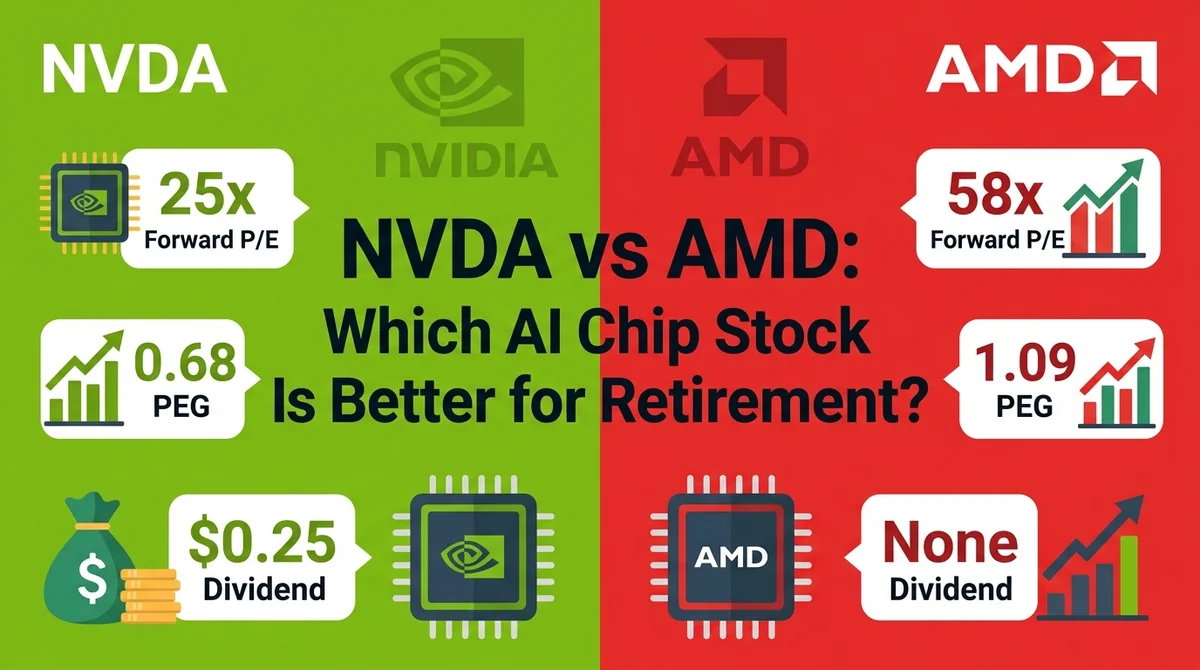
NVIDIA trades at 25x forward earnings vs AMD's 58x, plus a $0.25 dividend and $80B in authorized buybacks. See which AI chip stock aligns with retirement goals.
#NVDA vs AMD: Which AI Chip Stock Is Better for Retirement?
For retirement-focused investors, NVIDIA is the better AI chip stock than AMD. It trades at 25x forward earnings versus AMD's 58x, has a PEG ratio of 0.68 versus 1.09, and returns cash through a $0.25 quarterly dividend and an $80 billion buyback. AMD pays no dividend and carries a 192 trailing P/E.
Key Takeaways:
- NVIDIA trades at 25x forward earnings and a 0.68 PEG ratio, versus AMD's 58x and 1.09 — a clear valuation advantage for NVIDIA.
- NVIDIA raised its quarterly dividend to $0.25 and authorized $80 billion in buybacks, while AMD pays no dividend — giving NVIDIA the income edge for retirees.
- NVIDIA grew revenue 85% year over year to $82 billion last quarter and controls 85% of the GPU market — confirming its AI chip dominance.
- AMD's 58x forward earnings, 192 trailing P/E, and no dividend make it a higher-risk, growth-oriented bet that may not suit conservative retirement portfolios.
#How Do NVDA and AMD Compare on Valuation?
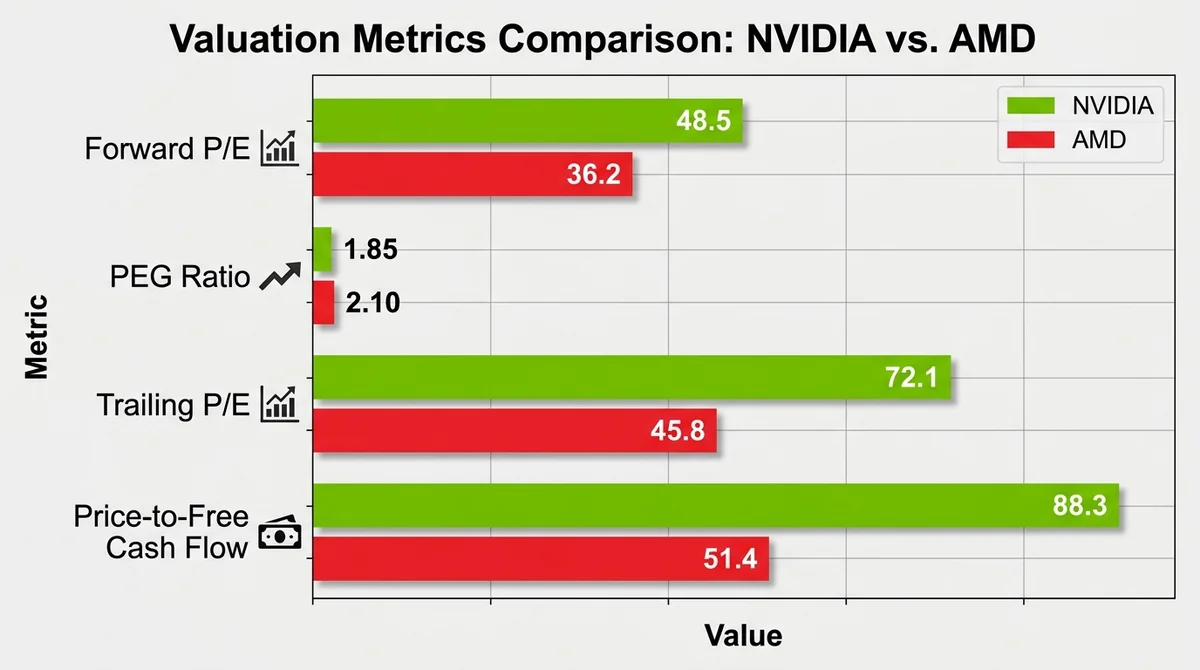
NVIDIA trades at roughly 25x forward earnings, while AMD commands 58x forward earnings. On a PEG basis, NVIDIA sits at 0.68 versus AMD's 1.09, meaning you pay materially less per unit of expected growth at NVIDIA. Trailing multiples reinforce the gap: AMD's P/E sits at 192 with price-to-free-cash-flow at 124, reflecting a stock that has rerated aggressively after a 138% year-to-date surge.
| Metric | NVIDIA (NVDA) | AMD |
|---|---|---|
| Forward P/E | 25x | 58x |
| PEG Ratio | 0.68 | 1.09 |
| Trailing P/E | — | 192 |
| Price-to-Free Cash Flow | — | 124 |
#Chip Technology and Ecosystem: What the 85% GPU Share Means
NVIDIA controls 85% of the GPU market, according to company-reported data cited by Yahoo Finance. That dominant share reflects broad adoption of its GPUs across AI training and inference workloads. AMD holds a much smaller share, which limits its ecosystem and customer adoption relative to NVIDIA. Without a comparable installed base or software stack, AMD faces an uphill battle to close the gap.
#How Do NVDA and AMD Compare on Dividends and Buybacks?
NVIDIA raised its quarterly dividend from $0.01 to $0.25, a 25-fold increase, and authorized $80 billion in fresh buybacks. AMD pays no dividend, giving NVIDIA a clear income advantage for shareholders. For retirement investors seeking income and capital preservation, NVIDIA's shareholder return policy is materially more supportive, while AMD's lack of dividend makes it less suitable for income-focused retirees.
- NVIDIA: quarterly dividend raised from $0.01 to $0.25; $80 billion buyback authorization.
- AMD: pays no dividend.
#How Do NVDA and AMD Compare on Revenue Growth and Market Share?
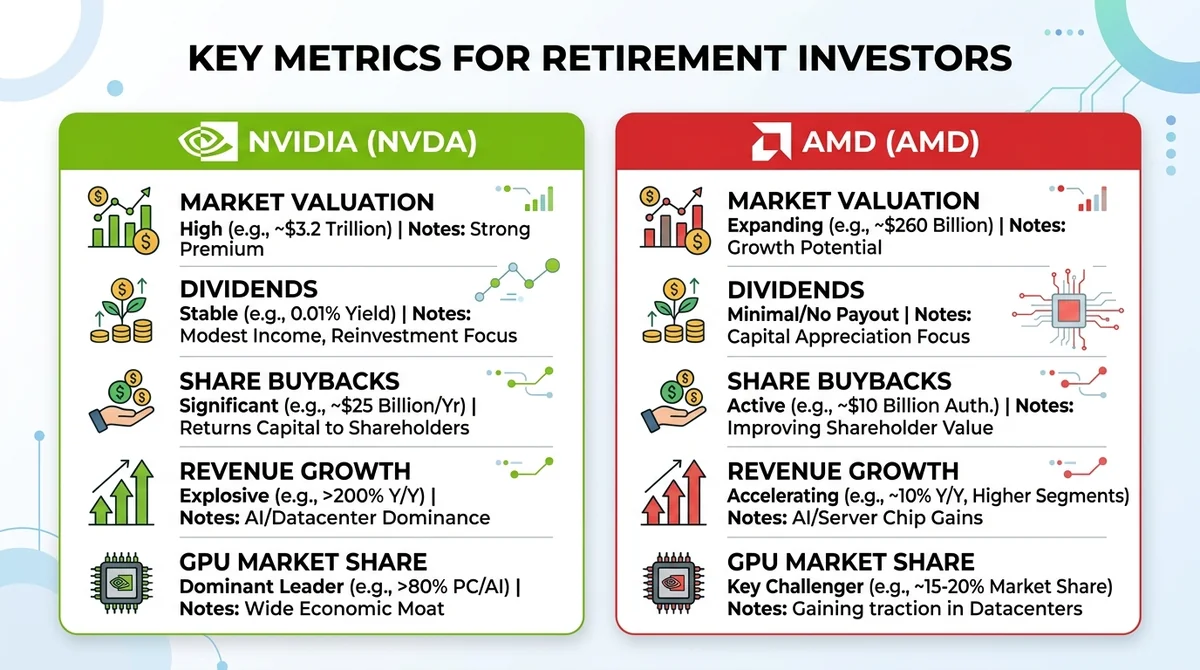
Despite its massive scale, NVIDIA grew revenue 85% year over year to $82 billion last quarter and controls 85% of the GPU market, which underpins its pricing power. AMD's stock has surged 138% year to date, reflecting an aggressive rerating despite less scale, making it a higher-risk growth bet. This scale gap explains much of NVIDIA's valuation and income advantage.
#Risk and Considerations for Retirement Investors
While NVIDIA's valuation is lower and it pays a dividend, no stock is risk-free. AI chip demand can be cyclical and sensitive to enterprise and cloud capital spending. NVIDIA's growth depends on continued AI infrastructure investment. AMD's 58x forward earnings and 192 trailing P/E embed aggressive growth expectations; if AI spending slows, both stocks could fall, but AMD's higher multiple could lead to larger drawdowns. Retirees should limit AI chip exposure, diversify, and consider total portfolio risk. For broader chip comparisons, see Nvidia vs AMD vs Broadcom or Nvidia vs Micron.
#Which AI Chip Stock Is Better for Retirement Portfolios?
- NVIDIA's lower forward P/E, 0.68 PEG, dividend, buyback authorization, and 85% GPU market share align with capital preservation and income goals.
- AMD's higher valuation and no dividend make it a higher-risk, growth-oriented position.
Bottom line: NVIDIA is the more suitable AI chip stock for most retirement investors, but it should be held as part of a diversified portfolio. For more alternatives, see our list of stocks similar to NVDA.
This article is based on data from Yahoo Finance and company disclosures; it does not constitute investment advice.
FAQ
Is NVDA cheaper than AMD on valuation?
Yes. NVIDIA trades at 25x forward earnings and a 0.68 PEG ratio, while AMD trades at 58x forward earnings and a 1.09 PEG ratio, making NVIDIA materially cheaper per unit of expected growth.
Does AMD pay a dividend?
No. AMD pays no dividend, whereas NVIDIA raised its quarterly dividend from $0.01 to $0.25 and authorized $80 billion in buybacks, giving NVIDIA a clear income advantage for shareholders.
Which AI chip stock is better for retirement portfolios, NVDA or AMD?
NVIDIA is the better choice for most retirement-focused investors. Its lower valuation, dividend and buybacks, and 85% GPU market share support capital preservation, while AMD's 58x forward earnings and no dividend make it a higher-risk, growth-oriented position.
How fast did NVIDIA revenue grow last quarter?
NVIDIA grew revenue 85% year over year to $82 billion last quarter, while controlling 85% of the GPU market. This combination of rapid growth at scale and dominant market share supports NVIDIA's pricing power and ecosystem lock-in across AI infrastructure.
Why is AMD's stock rerating risky for retirees?
AMD's stock has surged 138% year to date, leaving it with a trailing P/E of 192 and price-to-free-cash-flow of 124, which creates higher downside risk if growth slows.
What risks should retirees consider before buying NVDA or AMD?
The main risk is AI chip demand volatility. Even NVIDIA's lower valuation and dividend do not eliminate downside if AI infrastructure spending slows. AMD's high valuation embeds aggressive growth expectations, so retirees should limit AI chip exposure and diversify across sectors.
Done comparing? Ready to place your first trade?
The crypto assets, tokenized US stocks and ETFs you just compared are all tradable on MSX — spot or perpetuals.
Quick Start Trading →New here? Registration takes three quick steps.