Crypto Assets vs. US Stocks in Oceania: A Comprehensive Comparison
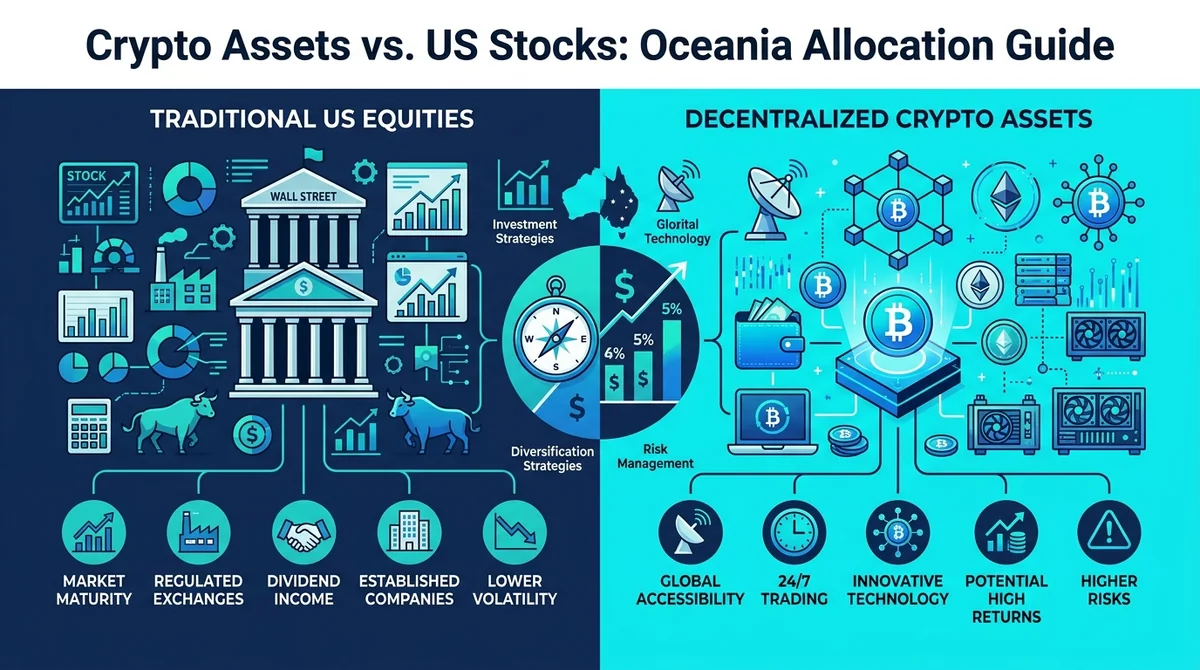
Compare US equities and crypto assets for Oceania investors, covering valuation models, 24/7 vs. T+1 trading, tokenized stocks, and regulatory risks.
In cross-border asset allocation decisions, the key takeaway is clear: Investors seeking underlying corporate profit distributions and mature regulatory protections should make traditional US equities their core holding; investors seeking 24/7 instant liquidity and high volatility elasticity are better suited for crypto assets; meanwhile, tokenized US stocks typically offer only synthetic price exposure and are not equivalent to owning underlying legal equity.
#What Are the Core Differences for Oceania Investors Allocating to Crypto vs. US Stocks?
Cross-border investors across Oceania and the broader Asia-Pacific region must first distinguish between the underlying value drivers and trading mechanisms of USD-denominated assets and on-chain assets.
#Asset Class Fundamentals and Underlying Value Drivers
- US Equities: Represent equity ownership in listed corporations. Their intrinsic value is anchored to free cash flow, revenue growth, net income, and dividend yields. Shareholders are protected by established securities frameworks (such as the US SEC) and enjoy statutory shareholder rights along with bankruptcy liquidation claims.
- Crypto Assets: Digital assets native to decentralized networks or protocols. Their value is primarily driven by network consensus, on-chain activity, supply-demand dynamics, and tokenomics (e.g., hard caps or burn mechanisms), typically without direct claims on a legal entity's corporate assets.
- Tokenized Stocks: On-chain receipts or derivatives tracking the price of US equities. Holding tokenized stocks usually provides price exposure only, without direct register shareholder status, voting rights, or statutory liquidation entitlements.
#Trading Hours, Settlement Mechanisms, and Cross-Timezone Usability
- Trading Hours: US equities adhere to fixed market hours (Monday to Friday, Eastern Time). Investors in Oceania (e.g., Australia, New Zealand) face timezone friction, often requiring late-night or early-morning order monitoring. Crypto assets operate 24/7/365 without geographic or market-opening boundaries.
- Settlement Cycles: Traditional US markets operate under a T+1 settlement cycle, with fiat deposits and withdrawals relying on international wire transfers and foreign exchange clearing. Crypto assets settle via blockchain confirmations or centralized exchange internal matching, executing in seconds to minutes.
#Core Comparison Overview
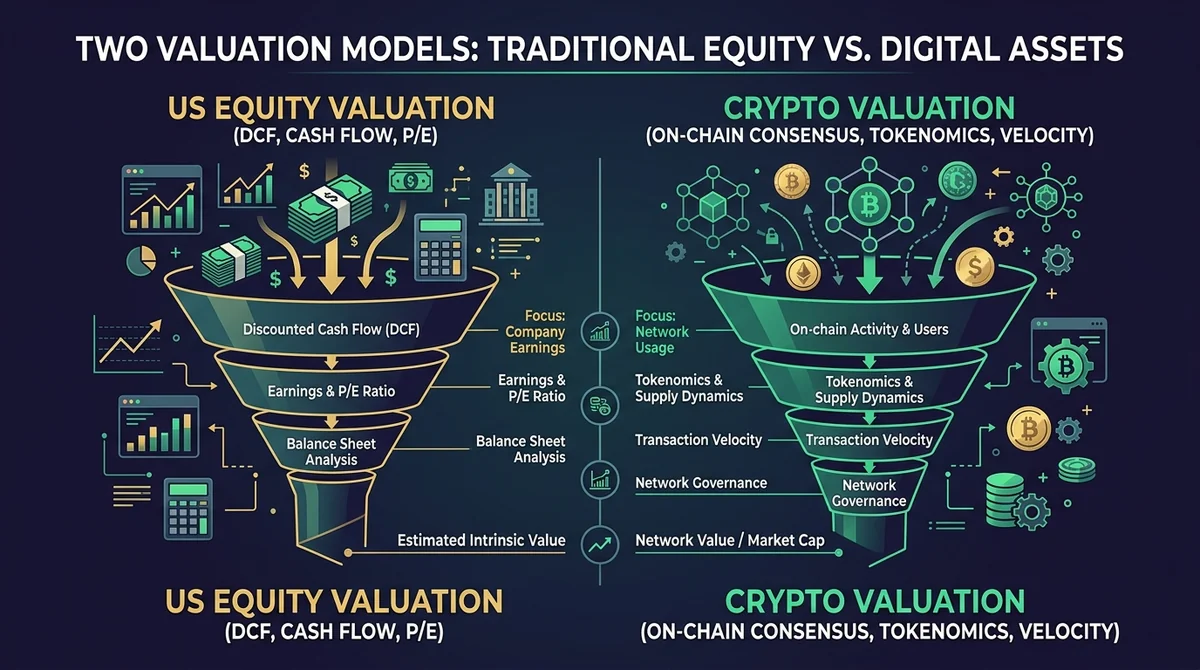
| Dimension | Traditional US Equities | Mainstream Crypto Assets |
|---|---|---|
| Underlying Backing | Corporate assets, free cash flow, and profitability | On-chain consensus, protocol value capture, and supply/demand |
| Trading Hours | 5×6.5 hours (US trading days) | 24/7/365 continuous |
| Liquidity Structure | Central limit order books (CLOB), concentrated during open market hours | Global order books and decentralized Automated Market Makers (AMM) |
| Volatility & Circuit Breakers | Relatively stable, enforced market-wide circuit breakers | High volatility, no global circuit breakers |
| Shareholder Rights | Voting rights, statutory dividends, and liquidation claims | No corporate shareholder rights; select tokens offer governance voting |
| Settlement & Custody | Central depositories (e.g., DTC) and licensed brokerages | Self-custody (private keys) or exchange/institutional custody |
| Primary Derivatives | Exchange-traded options, margin trading | Spot, perpetual contracts, on-chain lending |
| Regulatory Framework | SEC, CFTC, and mature national securities laws | Evolving multi-jurisdictional regulatory frameworks |
#How Do US Tech Stocks and Mainstream Crypto Assets Differ in Return Logic and Valuation?
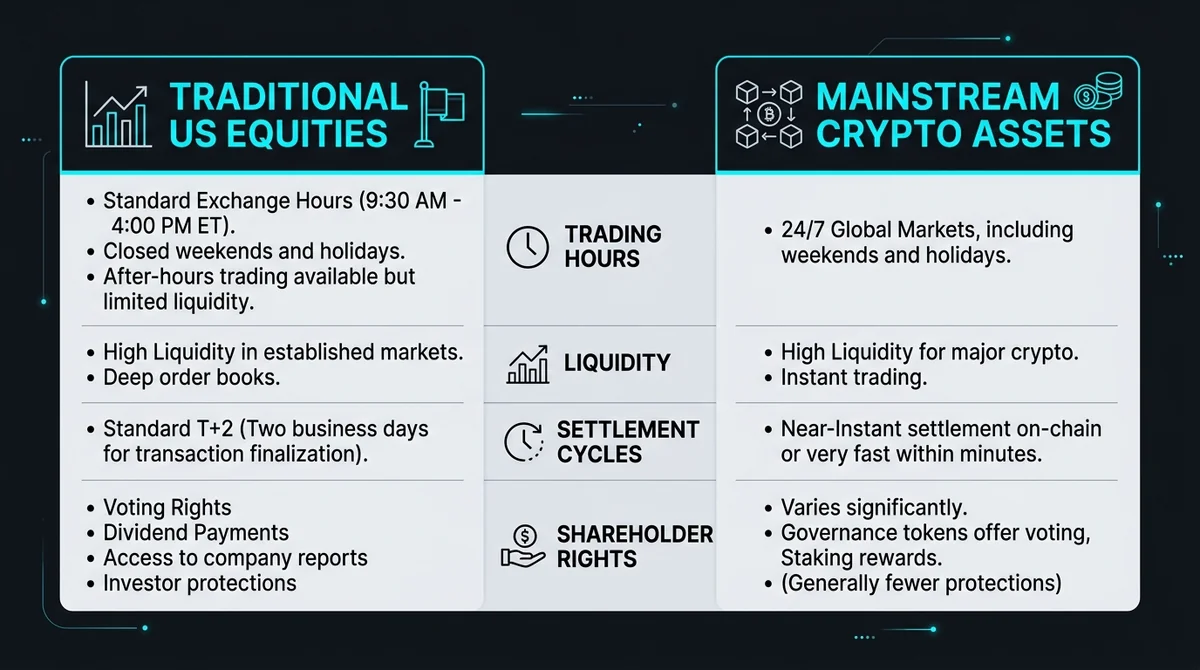
#Free Cash Flow & Valuation Multiples vs. Network Consensus & Supply-Demand
US tech stock valuations are typically calculated using discounted cash flow (DCF) models, price-to-earnings (P/E), or price-to-sales (P/S) ratios. When risk-free interest rates shift or corporate earnings miss expectations, valuation multiples undergo contraction and repricing.
Mainstream crypto assets lack a standardized discounted cash flow framework. Their valuation models rely on active on-chain addresses, network throughput, total value locked (TVL), hashrate security, and global fiat liquidity premiums.
#Pricing Dynamics of Tokenized Equities
Tokenized US stocks strictly follow the pricing of the underlying equity. The token itself does not reflect independent corporate developments; its secondary market price relies on oracle price feeds, market maker arbitrage, or collateral net asset value (NAV) to maintain its peg with traditional spot equities.
#Cycle Resilience and Value Capture in Bull/Bear Markets
- US Equities: In macroeconomic downturns, blue-chip companies with stable dividend yields and high free cash flow provide a valuation floor via share buybacks and regular dividend distributions.
- Crypto Assets: Display substantially wider market cycles, delivering asymmetric upside in bull markets while experiencing deeper drawdowns during liquidity-tightening phases.
#How to Choose Between US Stocks and Crypto Based on Investment Objectives?
#Long-Term Compound Growth and Dividend Income
Recommended Route: Prioritize traditional US equity spot positions or broad-market ETFs. Rationale: US equities offer robust legal protections, transparent corporate disclosure standards, and sustained shareholder return programs, making them ideal for conservative capital focused on principal preservation and predictable cash flow.
#24/7 Trading and Cross-Market Volatility Capture
Recommended Route: Allocate to mainstream crypto assets or tokenized instruments. Rationale: For investors looking to capitalize on Asia-Pacific daytime trading without waiting for US market openings—and who maintain strict risk management and volatility tolerance—crypto assets provide a seamless, non-stop trading environment.
#Cross-Asset Portfolio Synergy: Core-Satellite Allocation
A widely adopted portfolio framework is the core-satellite strategy:
- Core Holdings: Broad-market US equity index funds and leading tech equities to establish a stable, long-term return foundation.
- Satellite Holdings: A measured allocation to major crypto assets or compliant tokenized derivatives to capture technological sector growth and cyclical upside.
#What Cross-Border Risks and Regulatory Limitations Must Investors Consider?
#Timezone Monitoring Friction and Overnight Gaps
Major macroeconomic announcements or earnings reports released while US markets are closed can lead to significant market opening gaps. If Oceania investors are unable to monitor positions across time zones, preset stop-loss orders can experience substantial slippage.
#Funding Rate Drag and Liquidation Risks in Derivatives
When trading perpetual contracts or leveraged tokenized derivatives, ongoing funding rate payments can erode long-term position capital. Furthermore, rapid market movements can trigger margin liquidations, wiping out collateral—marking a fundamental risk divergence from holding unleveraged spot assets.
#De-Pegging and Regulatory Boundaries for Tokenized Assets
Tokenized synthetic assets carry risks of smart contract vulnerabilities, liquidity pool imbalances, or de-pegging caused by insufficient reserve backing. In addition, national licensing regimes and tax treatments for synthetic securities remain dynamic; investors must verify their regional compliance obligations prior to deployment.
This content is for objective informational comparison only and does not constitute investment or account-opening advice. Data and regulatory frameworks are current as of 2026; investors should consult official regulatory filings and disclosures.
FAQ
What is the primary difference between allocating to US stocks vs. crypto for Oceania investors?
US stocks are protected by mature securities regulations and backed by corporate cash flows within fixed market hours; crypto assets offer 24/7 global liquidity and higher volatility elasticity, but lack standardized cash-flow valuation models and global circuit breakers.
Are tokenized stocks equivalent to holding actual US equities?
No. Tokenized stocks are on-chain instruments or synthetic derivatives tracking underlying stock prices; they generally do not grant registered shareholder status, direct voting rights, or statutory liquidation claims.
How can Oceania investors mitigate timezone and monitoring risks?
Investors can use broad-market US ETFs for passive, low-maintenance long-term holdings, or trade 24/7 on-chain assets during Asia-Pacific daytime hours to manage liquidity without overnight gaps.
Related Terms
Done comparing? Ready to place your first trade?
The crypto assets, tokenized US stocks and ETFs you just compared are all tradable on MSX — spot or perpetuals.
Quick Start Trading →New here? Registration takes three quick steps.