RToken vs Real US Stocks: Price Formation Mechanisms and Spread Arbitrage Compared (2026)
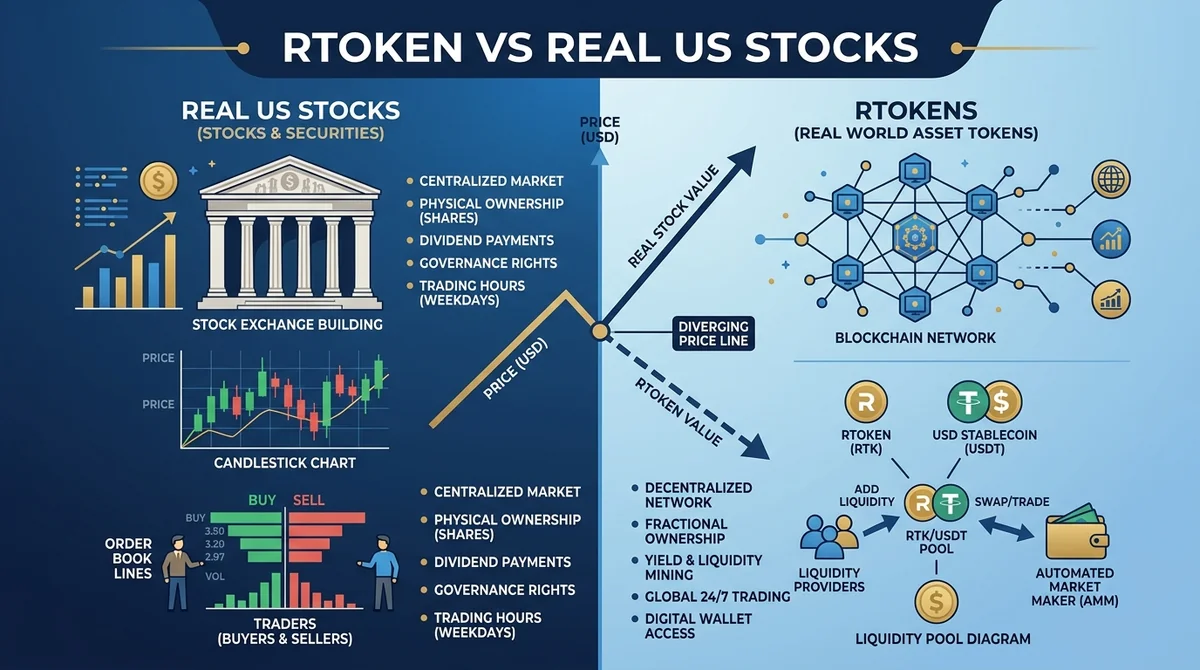
RToken and real US stocks differ in price formation; spreads arise from liquidity, trading hours, and compliance limits. Explore arbitrage paths, costs, risks, and use cases.
Conclusion: RToken is not suitable as a direct substitute for real US stocks. Its price is jointly determined by on-chain liquidity pools and oracles, structurally different from the order-book matching of real US stocks. Spread arbitrage opportunities are limited and come with compliance and smart contract risks.
#What Determines the Prices of RToken and Real US Stocks?
#What is the price formation mechanism of real US stocks?
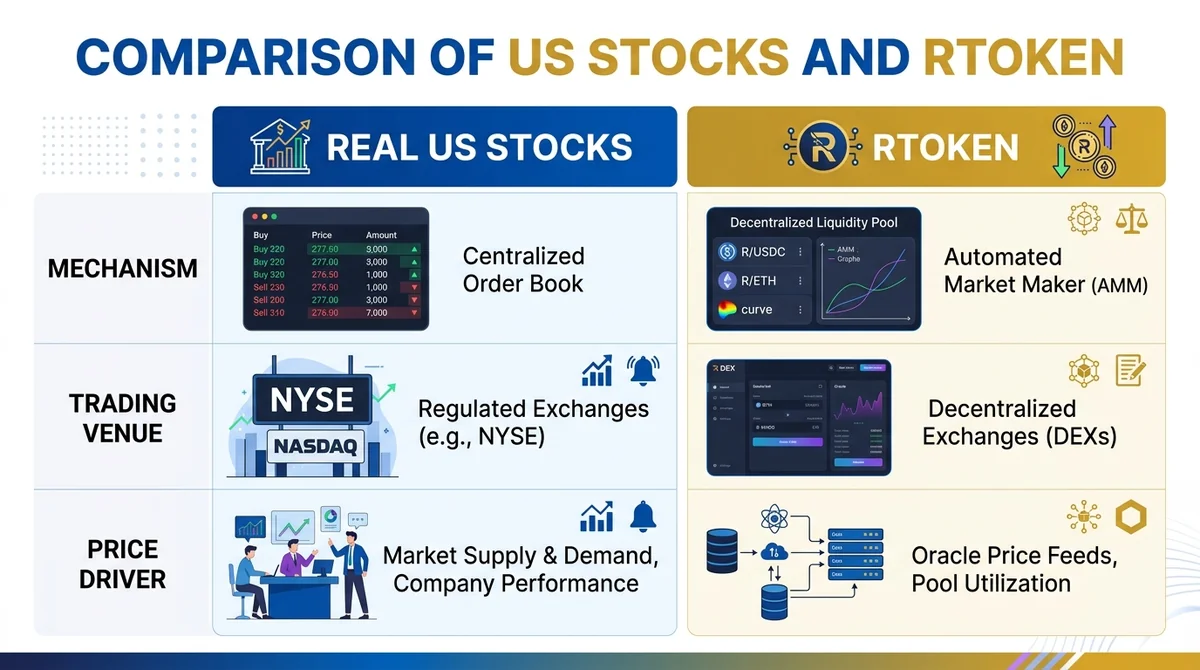
Real US stocks are traded on centralized exchanges (e.g., NYSE, NASDAQ) through order-book matching, with prices determined by real-time supply and demand from buyers and sellers. The exchange conducts continuous bidding, and the price reflects the market consensus on the stock's value.
#What is the price formation mechanism of RToken?
RToken (tokenized stocks) are traded on-chain through liquidity pools (e.g., Uniswap V3), with prices determined by the asset ratio in the pool and trading volume. In addition, oracles provide external price references, but the final transaction price depends on actual trades within the pool.
#What role do oracles play in RToken pricing?
Oracles bring real US stock prices on-chain as an anchor reference for RToken. However, oracle feeds and on-chain market prices may diverge, causing RToken to deviate from the real US stock price.
#Why Do Spreads Occur Between RToken and Real US Stocks?
#How does liquidity difference affect the spread?
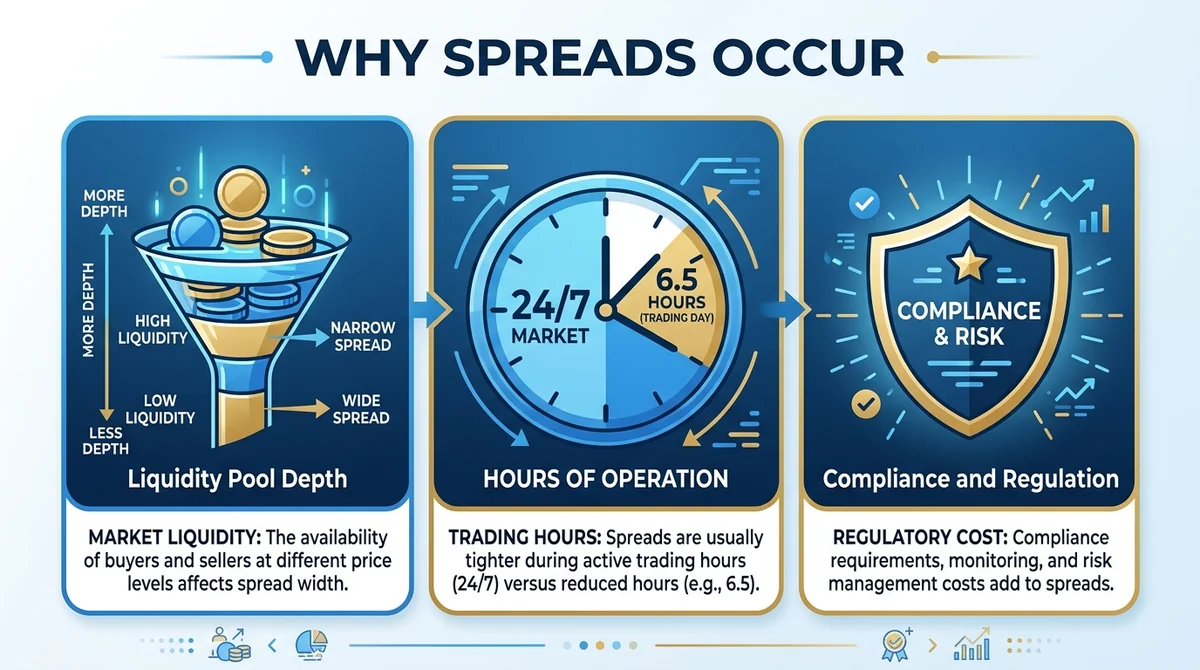
RToken liquidity pool depth is usually far lower than the real US stock market. Large trades can easily cause slippage, leading to price deviation. For example, Uniswap V3 (Base) 24-hour trading volume is about 3,079 BTC (data as of 2026-09-17), while the daily trading volume of a single real US stock can be several orders of magnitude higher.
#Do different trading hours create spreads?
Real US stock trading is limited by exchange hours (typically Monday to Friday, 6.5 hours per day), while RToken can be traded 24/7. During US stock market closures, RToken prices may deviate due to on-chain news or sentiment fluctuations, creating spreads.
#How do compliance restrictions lead to premiums or discounts?
Some RTokens require KYC or are subject to geographic restrictions, allowing only compliant users to trade. If compliant channels are not smooth, it may cause a premium (demand exceeds supply) or a discount (insufficient liquidity).
#How to Arbitrage the Spread Between RToken and Real US Stocks?
#What is the basic arbitrage path?
When the RToken price is higher than the real US stock, one can buy the stock in the real market and simultaneously sell RToken on-chain; and vice versa. Arbitrage requires holding assets on both sides or having the ability to transfer quickly.
#What costs and risks are involved in arbitrage?
- Trading fees: On-chain gas fees, DEX fees, real market commissions.
- Slippage: Insufficient liquidity pool depth causes execution prices worse than expected.
- Fund transfer time: Fiat-to-crypto conversion, cross-market settlement delays.
- Compliance risk: Some RTokens are limited to specific regions, and arbitrageurs may not be legally allowed to participate.
#Can ordinary investors participate in arbitrage?
Ordinary investors face high barriers: they need both a stock account and an on-chain wallet, and bear cross-market operational risks. Arbitrage opportunities are usually quickly eliminated by professional market makers, making it difficult for retail investors to profit.
#Is RToken Suitable as a Substitute for Real US Stocks?
#How do the rights of RToken differ from real US stocks?
Real US stock holders have shareholder rights such as voting rights and dividend distribution. RToken typically only represents price exposure, without voting rights, and dividend handling varies by project (data not disclosed).
#In what scenarios would users choose RToken?
- Want 24/7 trading of US stock price exposure.
- Seek on-chain composability (e.g., as DeFi collateral).
- Users in regions unable to open a US stock account directly.
#What additional risks are involved in holding RToken?
- Smart contract risk: Contract vulnerabilities may lead to asset loss.
- Depegging risk: Oracle failure or manipulation may cause RToken price to deviate significantly from the real US stock.
- Liquidity risk: In extreme market conditions, it may be impossible to exit at a reasonable price.
#Comparison Table
| Dimension | RToken | Real US Stocks |
|---|---|---|
| Price formation | On-chain liquidity pool + oracle | Exchange order-book matching |
| Trading hours | 24/7 | Exchange hours (~6.5 hours/day) |
| Liquidity | Depends on pool depth, usually lower | High, deep market |
| Shareholder rights | Usually no voting rights, dividend handling opaque | Voting rights, dividend distribution |
| Compliance requirements | May require KYC, geographic restrictions | Brokerage account, regulated by securities laws |
| Smart contract risk | Yes | No |
| Depegging risk | Yes (oracle/market deviation) | No (price is the market) |
| Composability | High (DeFi programmable) | Low |
| Settlement speed | On-chain confirmation (minutes) | T+2 (US) |
| Custody | Non-custodial (user holds private keys) | Brokerage custody |
#Scenario Recommendations
Suitable for choosing RToken:
- Need 24/7 trading of US stock price exposure and can tolerate smart contract and depegging risks.
- Want to use US stock exposure in DeFi lending, collateral, and other on-chain scenarios.
- Located in regions where opening a US stock account directly is not possible, but can access on-chain protocols.
Suitable for choosing real US stocks:
- Seek shareholder rights (voting, dividends) and regulatory protection.
- Trade infrequently and are not sensitive to trading hours.
- Have lower risk tolerance and are unwilling to bear smart contract and liquidity risks.
#FAQ
Will the price of RToken exactly equal the real US stock? No. Due to differences in liquidity, trading hours, and compliance, RToken prices usually fluctuate around the real US stock price, with possible premiums or discounts.
How much capital is needed for arbitrage? There is no fixed threshold, but you need to cover trading costs on both sides, slippage, and fund transfer time, so the practical threshold is high.
Does RToken pay dividends? Data not disclosed. Most tokenized stocks do not directly distribute dividends, or handle them through other mechanisms.
Is holding RToken safe? There are smart contract risks, depegging risks, and liquidity risks; safety is lower than holding real US stocks.
Which platforms can trade RToken? Some decentralized exchanges (e.g., Uniswap V3) may provide relevant liquidity pools, but specific support needs to be verified by yourself.
This content is compiled from public data and does not constitute investment or account opening advice. Data as of 2026-09-17, actual conditions may change. For the latest information, please refer to official sources.
FAQ
Will the price of RToken exactly equal the real US stock?
No. Due to differences in liquidity, trading hours, and compliance, RToken prices usually fluctuate around the real US stock price, with possible premiums or discounts.
How much capital is needed for arbitrage?
There is no fixed threshold, but you need to cover trading costs on both sides, slippage, and fund transfer time, so the practical threshold is high.
Does RToken pay dividends?
Data not disclosed. Most tokenized stocks do not directly distribute dividends, or handle them through other mechanisms.
Is holding RToken safe?
There are smart contract risks, depegging risks, and liquidity risks; safety is lower than holding real US stocks.
Which platforms can trade RToken?
Some decentralized exchanges (e.g., Uniswap V3) may provide relevant liquidity pools, but specific support needs to be verified by yourself.
Related Terms
Done comparing? Ready to place your first trade?
The crypto assets, tokenized US stocks and ETFs you just compared are all tradable on MSX — spot or perpetuals.
Quick Start Trading →New here? Registration takes three quick steps.