rtoken vs. Real US Stock Lending & Staking 2026: DeFi Yield Protocols vs. Traditional Brokerage Securities Lending (SLB)
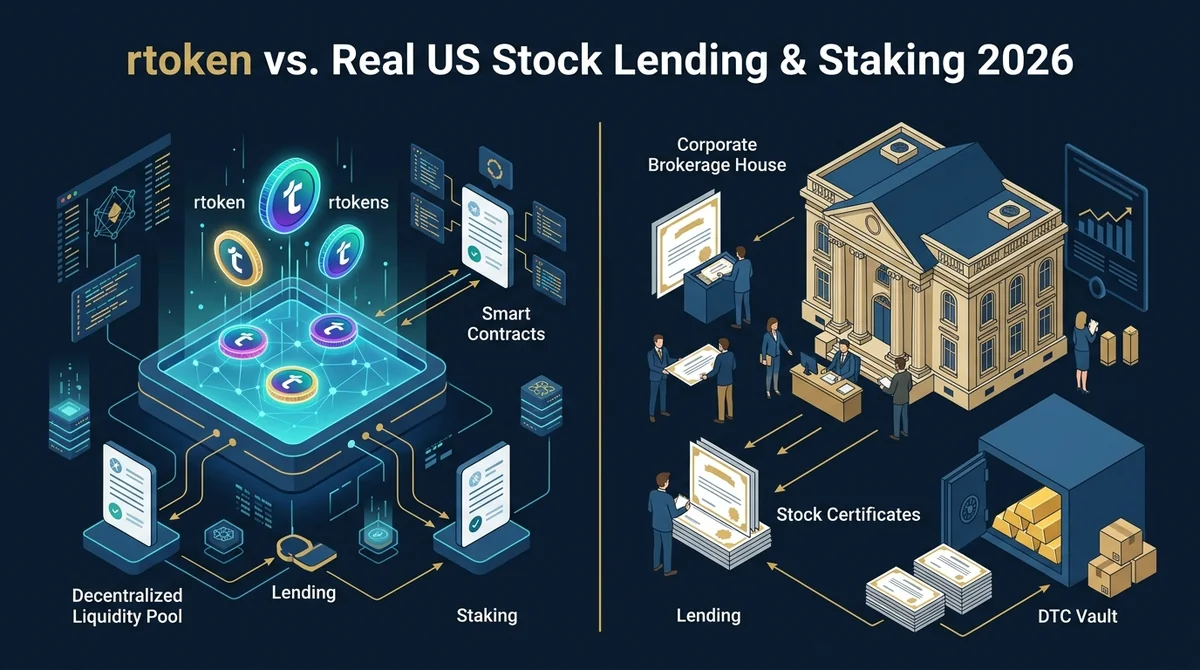
Compare rtoken DeFi yield with traditional US stock securities lending (SLB) across legal rights, settlement cycles, collateral, and liquidation risks.
Key Takeaway: Long-term holders seeking statutory shareholder ownership, mature regulatory protections, and stable securities lending income should prioritize traditional brokerage Securities Lending and Borrowing (SLB). Users requiring 24/7 real-time settlement, permissionless interaction, and cross-DeFi composability are better suited for tokenized US stock (such as rtoken) lending and staking mechanisms.
#How Do the Underlying Mechanisms Differ Between rtoken On-Chain Yield and Traditional Broker SLB?
#How Do DeFi Liquidity Pools and Over-Collateralized Lending Mechanisms Work?
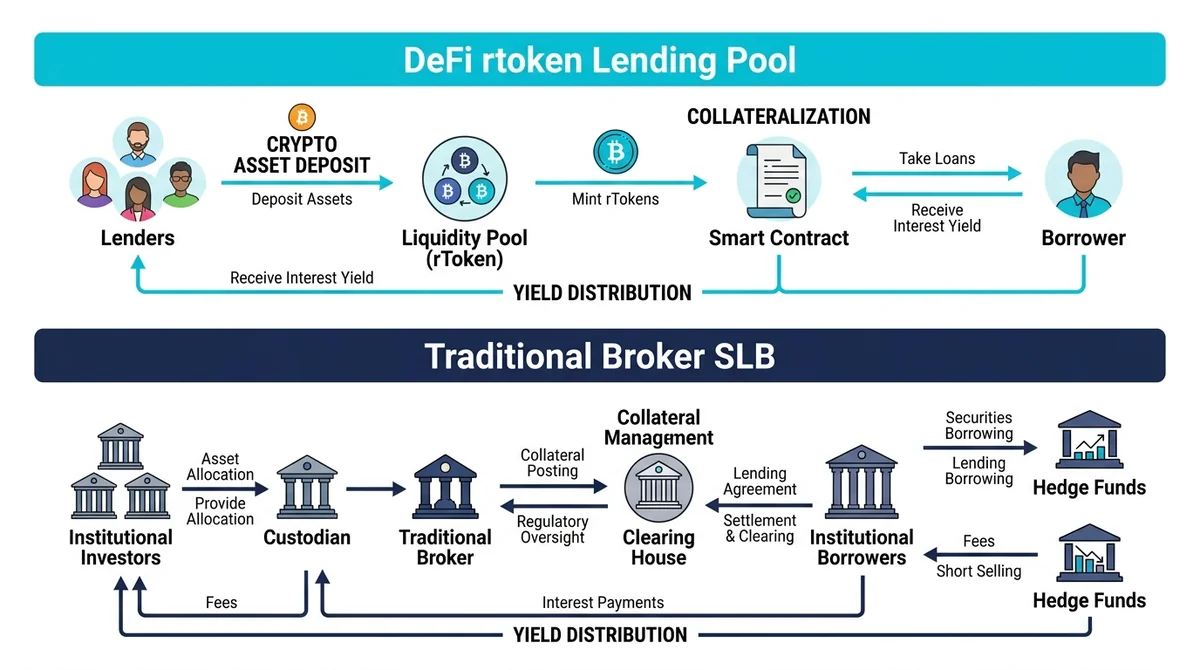
In decentralized finance (DeFi) protocols, yield generation and lending for tokenized US stocks (e.g., rtoken) operate via pre-configured smart contract liquidity pools:
- Lender: Deposits rtoken into lending pools as a liquidity provider and receives interest-bearing receipt tokens (e.g., aToken/cToken), with interest dynamically adjusting based on pool utilization rates.
- Borrower: Must deposit sufficient or over-collateralized on-chain assets (such as USDT, USDC, or major crypto assets) to borrow.
- Automated Settlement: Interest rate calculation, yield distribution, and collateral transfers are executed automatically by smart contracts, eliminating the need for custodial intermediaries or central counterparties.
#What Is the Counterparty and Securities Lending/Recall Process in Traditional Broker SLB?
In traditional US equity markets, Securities Lending and Borrowing (SLB) typically operates through Fully Paid Lending Programs:
- Intermediaries & Counterparties: Regulated brokerages act as intermediaries, lending idle real US shares in client accounts to institutional borrowers (e.g., market makers, hedge funds for short selling, hedging, or arbitrage).
- Collateral Protection: Institutional borrowers must provide cash or high-grade US Treasuries as collateral to the broker (typically 100%–102% of mark-to-market value).
- Yield Settlement: Brokers accrue lending interest daily and distribute it to investor accounts monthly or periodically after deducting their commission split.
#What Are the Core Differences in Underlying Asset Ownership vs. On-Chain Token Rights?
- Ownership Nature: The underlying assets in traditional US stock lending are registered shares held at the Depository Trust Company (DTC), where investors retain statutory legal claims over the base assets. Conversely, rtokens are on-chain tokenized receipts tracking the price performance of underlying stocks—essentially price-exposure derivatives or custodial collateral tokens without direct registered shareholder status. For legal property details, see Direct Stock Ownership vs. Tokenized Stocks: Ownership, Tax, and Platform Risk 2026.
- Settlement Cycles: DeFi lending achieves real-time settlement within seconds to minutes based on blockchain block confirmations. Traditional US equity clearing networks universally operate on a T+1 settlement cycle.
#rtoken vs. Traditional US Stock Lending: Core 8-Dimension Comparison Table
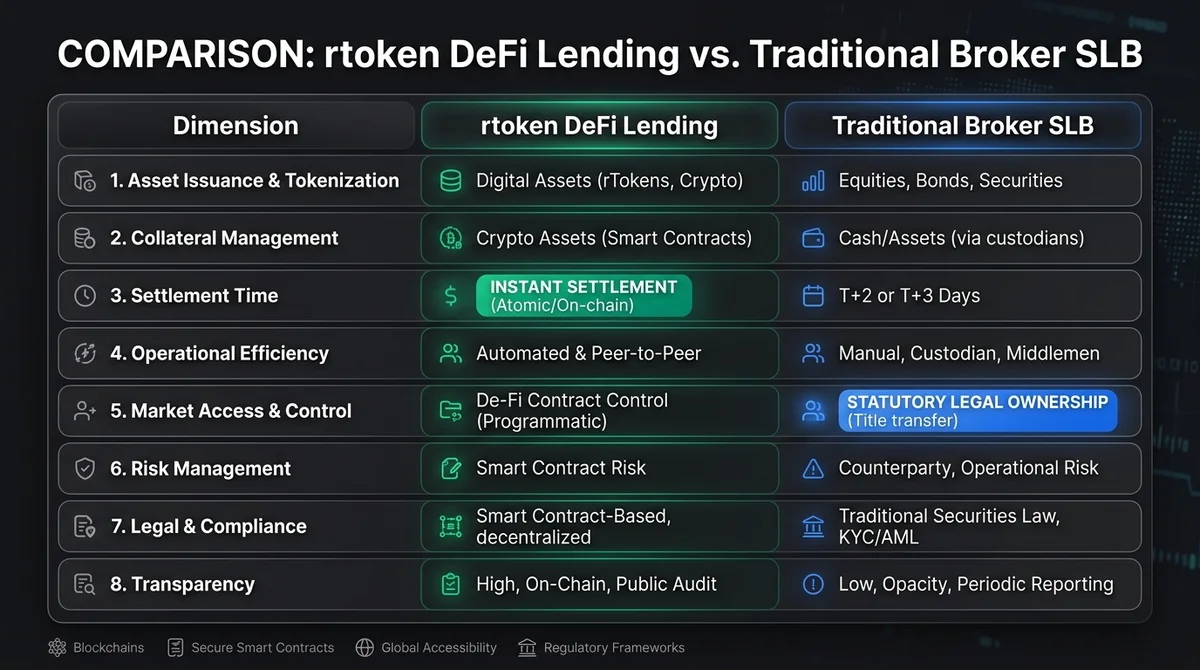
The following table compares the core mechanisms of tokenized US stock (rtoken) DeFi lending with traditional broker securities lending (SLB):
| Dimension | rtoken DeFi Lending / Staking | Traditional Broker Securities Lending (SLB) |
|---|---|---|
| Underlying Nature | On-chain tokenized receipt / Price exposure contract | Legally registered real US equity spot |
| Yield Generation Model | Pool utilization floating rate + Protocol governance rewards | Share of borrowing fees paid by institutions for short selling/arbitrage |
| Collateral Mechanism | On-chain over-collateralization (Crypto assets / Stablecoins) | Institutions provide cash collateral or high-liquidity Treasuries |
| Settlement & Receipt Speed | Real-time on-chain settlement (Seconds / Minutes) | Traditional clearing networks (Mainly T+1 settlement) |
| Liquidation Trigger | Oracle price breaches liquidation threshold, triggering auto-liquidation/auction | Broker mark-to-market margin calls and forced liquidations |
| Core Counterparty Risk | Smart contract exploits, oracle failure, pool bad debt | Broker credit risk and institutional default risk |
| Compliance & Protection | Code execution; no traditional statutory deposit/securities insurance backstop | Covered by securities regulations (Protected via segregated collateral accounts during lending) |
| Access Threshold | Permissionless direct on-chain wallet interaction | Requires regulated broker account, eligibility checks, and KYC verification |
#Comparison of Yield Sources, Settlement Speed, and Liquidity
rtoken lending protocol yields are driven by on-chain supply and demand, and borrowing rates can surge during periods of high market volatility. Capital can be withdrawn instantly as long as it is not 100% utilized. Traditional SLB yield depends on the short-borrowing demand for specific stocks (hard-to-borrow stocks offer significantly higher annualized yields), with proceeds settled periodically by broker systems.
#Collateral Requirements vs. Liquidation Triggers
DeFi lending relies on price oracles. When the value of a borrower's collateral falls below the liquidation threshold, liquidation bots automatically execute liquidations on-chain. In brokerage SLB systems, individual lenders do not manage liquidations directly; collateral risk control is handled by the broker on the backend via daily mark-to-market monitoring.
#Regulatory Coverage and Investor Protection Mechanisms
Traditional brokerage accounts are bound by regulatory frameworks. Notably, while US shares are lent out, in certain brokerage systems they may no longer be directly covered by SIPC insurance, but are instead protected by segregated full-cash or Treasury collateral accounts. In contrast, rtoken relies entirely on code execution and smart contract security architecture, lacking statutory legal safety nets.
#How Should Investors Choose Based on Different Capital Needs?
#If Holding US Stocks Long-Term for Low-Risk Passive Yield, Which to Choose?
Recommendation: Prioritize traditional broker securities lending (SLB). Rationale: For compliant investors aiming for long-term spot holding, enabling brokerage SLB allows generating incremental yield without altering underlying asset statutory custody. Furthermore, brokers provide compliant tax reporting and standard clearing support. For dividend handling and shareholder rights differences, see Direct Stock Ownership vs. Tokenized Stocks: Corporate Actions and Dividend Reinvestment Differences 2026.
#If Requiring 24/7 Cross-Asset Collateralized Borrowing and Flexible Liquidity, Which to Choose?
Recommendation: Choose rtoken DeFi lending protocols. Rationale: If an investor's assets are primarily deployed in Web3 and require 24/7 collateralization of US stock exposure to borrow stablecoins, execute arbitrage, or aggregate cross-protocol liquidity, rtoken provides high capital turnover unaffected by banking hours. For derivative and leverage structures, refer to Tokenized Stock Contracts vs. Tokenized Stock Perpetuals: Settlement, Dividend, and Leverage Funding Cost Differences.
#What Are the Core Risks and Disclaimers for rtoken vs. US Stock Lending?
#Smart Contract Vulnerabilities, Oracle Price Deviations, and Bad Debt Liquidation Risks
- Code Security & Protocol Black Swans: If lending contracts contain reentrancy vulnerabilities or logical flaws, staked pool funds may be lost.
- Oracle Latency & Price Manipulation: If on-chain oracle feeds experience latency or manipulation during extreme volatility, it may lead to abnormal liquidations or uncollected bad debts.
- Liquidity Squeeze: When borrowing utilization reaches 100%, lenders may face temporary liquidity lockups and cannot withdraw immediately.
#Broker Counterparty Default, Cash-in-Lieu Dividends, and Rights Adjustments
- Tax Impact of Substitute Dividends: When shares are on loan, cash dividends are typically paid as "Cash-in-Lieu of Dividends," which in certain jurisdictions may be taxed as ordinary income rather than qualified dividend tax rates.
- Suspension of Voting Rights: While shares are lent out, shareholder voting rights are temporarily transferred to the actual borrower.
- Institutional Counterparty Extreme Risk: In rare systemic crises, if an institutional borrower defaults and collateral values collapse rapidly, the broker must cover the loss using its own risk reserves.
Disclaimer: This content is compiled based on publicly available mechanisms and industry standard practices for mechanism research and educational reference only. It does not constitute account opening advice, investment advice, or tax planning guidance. Markets carry risks; exercise caution when making decisions.
FAQ
Can investors still sell their US stock spot positions at any time after enrolling in traditional broker SLB lending?
Yes. In mainstream broker fully paid lending programs, when an investor places a sell order, the system automatically triggers a recall or terminates the lending agreement in the backend, without impacting normal trade execution and T+1 settlement.
In what form are yields distributed when participating in rtoken DeFi lending?
Yields are typically distributed via the accumulation of the underlying asset in the pool (reflected as an increase in the net asset value or quantity of receipt tokens). Some protocols also distribute platform governance tokens as liquidity incentives.
Are US stocks on loan and rtoken staking/lending protected by SIPC compensation?
rtoken does not have any SIPC protection. For traditional US stocks, while shares are on loan, they are typically backed by segregated accounts holding full cash or Treasury collateral provided by the broker, rather than standard SIPC securities insurance.
Related Terms
Done comparing? Ready to place your first trade?
The crypto assets, tokenized US stocks and ETFs you just compared are all tradable on MSX — spot or perpetuals.
Quick Start Trading →New here? Registration takes three quick steps.