Taiwan Semiconductor vs Intel: Which Semiconductor Stock Is the Better Buy for 2026?
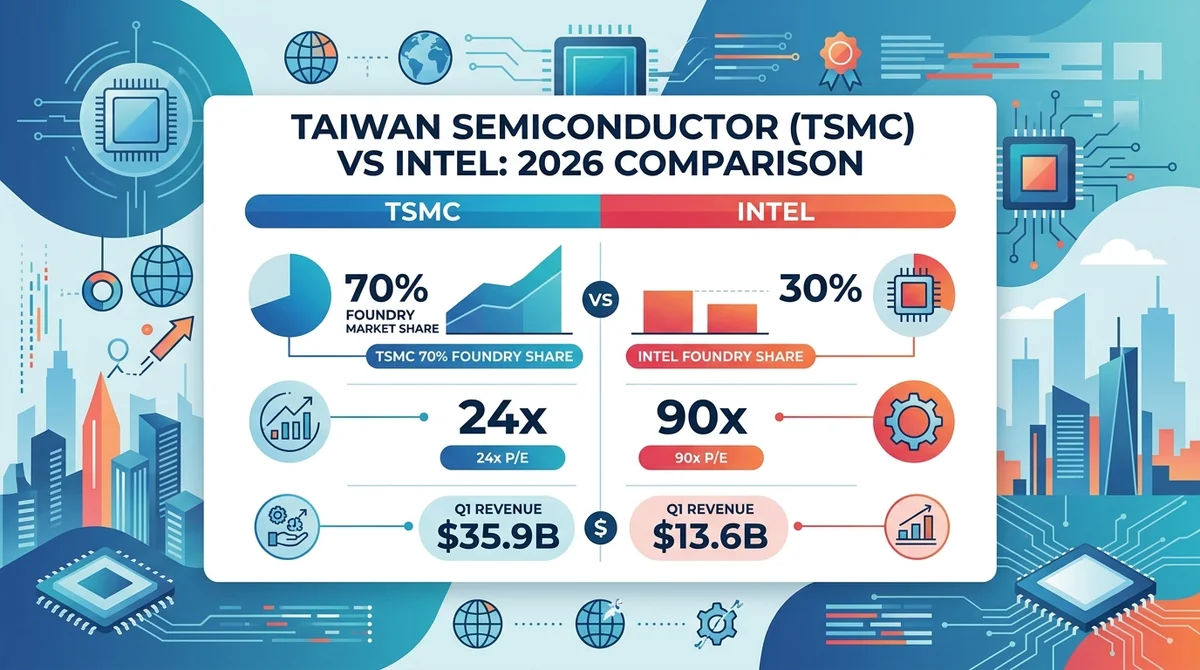
Compare Taiwan Semiconductor vs Intel foundry share, 2025 revenue, margins, forward P/E, and 2026 guidance. See which stock is the better buy for 2026.
#Taiwan Semiconductor vs Intel: Which Semiconductor Stock Is the Better Buy for 2026?
Taiwan Semiconductor (TSMC) is the better semiconductor stock for 2026. It holds roughly 70–72% of global foundry revenue, delivered $121.3 billion in 2025 revenue with a 58.98% gross margin, and guided Q3 2026 revenue above $44 billion. Intel remains a turnaround bet with a recent net loss and 18A yield risk.
Key Takeaways
- TSMC controls approximately 70.4% to 72% of global foundry revenue; Intel sits in the low single-digit “other” group.
- TSMC’s Q1 2026 revenue reached $35.9 billion with a 66.2% gross margin, while Intel reported $13.6 billion and a net loss.
- Intel trades at about 90x forward earnings versus TSMC at 24x; over 12 months, Intel returned +270% versus TSMC +83%.
- TSMC’s main risk is Taiwan geopolitical concentration; Intel’s Apple foundry deal and government backing are catalysts, but 18A yields remain unproven until late 2026.
#How Do Taiwan Semiconductor and Intel Compare on Market Share and Business Model?
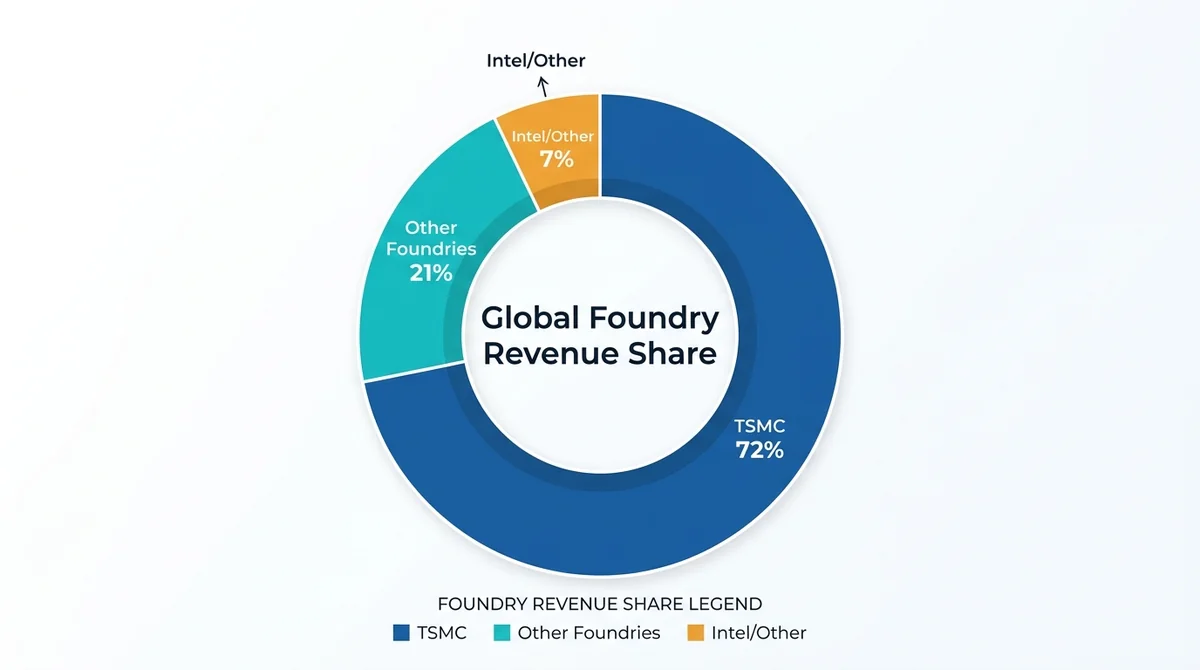
TSMC dominates the foundry market, while Intel is a minor player in fabrication scale. According to TrendForce data cited by TradingKey, TSMC held 70.4% of global foundry revenue in March 2026; Motley Fool research puts TSMC at about 72%, with Intel grouped into the low single-digit “other” category around 7%.
TSMC holds about 70.4% to 72% of global foundry revenue share, while Intel falls into the low single-digit 'other' group around 7%. TSMC operates a pure-play foundry model and serves nearly all leading chip design companies; Intel is an integrated device manufacturer now opening foundry services to external customers. TSMC dominates the foundry market, while Intel remains a minor player.
#What is TSMC's foundry market share in 2026?
TSMC held about 70.4% to 72% of global foundry revenue in 2026, according to TrendForce and Motley Fool research.
#Where does Intel fit in the foundry market?
Intel's foundry share is so small that it is grouped into the "other" category, which collectively accounts for about 7% of foundry revenue.
#How do the pure-play foundry and IDM models differ?
TSMC is a pure-play foundry that manufactures chips for nearly all leading chip designers, while Intel is an integrated device manufacturer (IDM) that designs and makes its own chips and is now opening foundry services to external customers.
#Which Company Has Stronger Financials: TSMC or Intel?
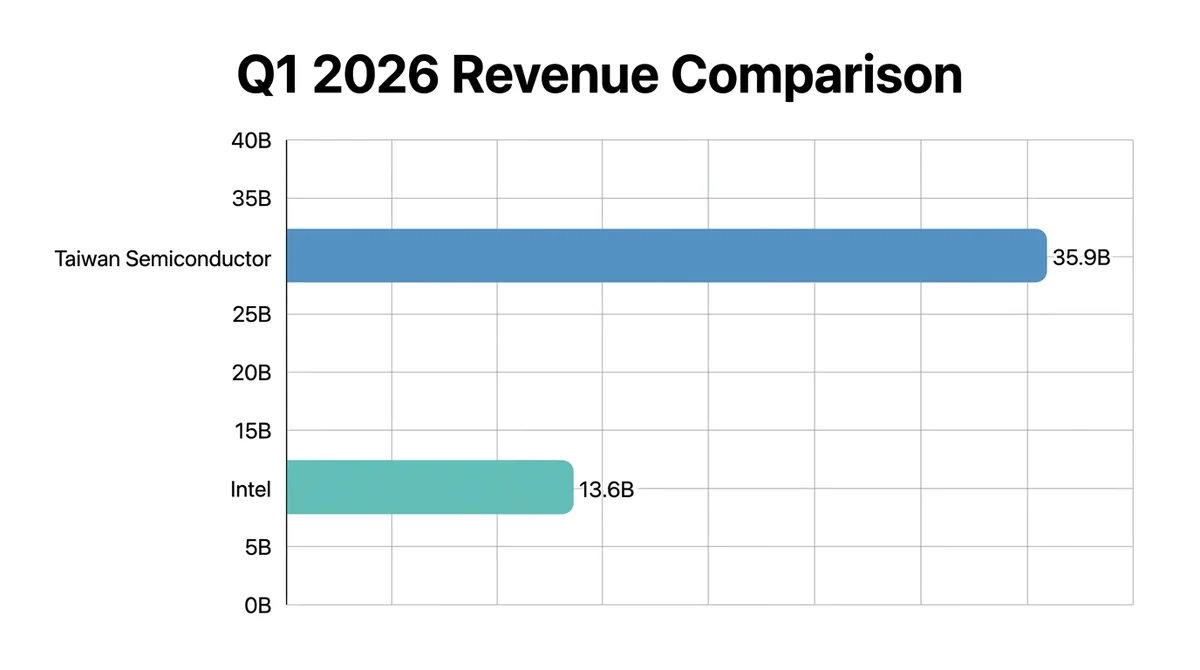
TSMC beats Intel on virtually every core financial metric. The table below compares the latest reported figures.
TSMC's 2025 revenue was $121.3 billion, up 37% year over year, with gross margin of 58.98% and net income margin of 43.29%. In Q1 2026, TSMC revenue reached $35.9 billion with 66.2% gross margin, while Intel reported $13.6 billion revenue but incurred a net loss. TSMC beats Intel on virtually every core financial metric.
| Metric | Taiwan Semiconductor (TSMC) | Intel (INTC) |
|---|---|---|
| Q1 2026 revenue | $35.9 billion | $13.6 billion |
| Forward P/E | ~24x | ~90x |
| 12-month return | +83% | +270% |
#What were TSMC's latest revenue, margins, and profitability?
TSMC generated $121.3 billion in 2025 revenue, up 37% YoY, with a 58.98% gross margin and a 43.29% net income margin. In Q1 2026, revenue was $35.9 billion with 66.2% gross margin.
#How did Intel's latest quarterly results compare?
Intel reported Q1 2026 revenue of $13.6 billion but still posted a net loss, overshadowed by a $4 billion restructuring charge.
#What do dividend and balance sheet trends show?
TSMC pays a dividend yielding about 0.99%; Intel's results were weighed down by restructuring charges and a GAAP loss.
#What Do Latest Earnings and Forward Guidance Reveal for Taiwan Semiconductor vs Intel?
TSMC is compounding record revenue and margin growth, while Intel's turnaround remains unproven through the end of 2026. TSMC posted a record $40 billion quarter with 68% gross margins and guided Q3 2026 revenue above $44 billion, raising full-year growth above 40%. Intel beat earnings expectations, but a $4 billion restructuring charge produced a GAAP loss, and Intel stock dropped 22% in a month.
#How did TSMC's recent quarter and Q3 guidance come in?
TSMC's latest quarter set a record at $40 billion with 68% gross margins. It guided Q3 2026 revenue above $44 billion and raised full-year growth above 40%.
#What is Intel's turnaround progress and restructuring charge?
Intel beat earnings expectations, but a $4 billion restructuring charge produced a GAAP loss, and its stock fell 22% in a month.
#Why is Intel's 18A node timeline important?
Intel's 18A node won't reach profitable yields until late 2026 at the earliest, while TSMC is already commercially shipping 2nm.
#How Does Valuation Compare Between TSMC and Intel Stock?
Intel trades at a much higher forward multiple than TSMC despite current losses. According to TradingKey, Intel trades at 90x forward earnings versus TSMC at 24x. Over the past 12 months, TSMC returned +83% while Intel returned +270%, per AlphaSpread. Intel's higher multiple reflects turnaround optionality and larger stock price movements, but it adds downside risk if milestones slip.
#What are the forward P/E multiples for TSMC and Intel?
Intel trades at about 90x forward earnings, while TSMC trades at about 24x, according to TradingKey.
#Why does Intel trade at a higher multiple despite losses?
Intel's premium multiple reflects turnaround optionality and larger price movements, but it adds downside risk if execution slips.
#How did 12-month stock performance diverge?
Over the past 12 months, Intel returned +270% versus TSMC's +83%, according to AlphaSpread, even though TSMC has stronger fundamentals.
#What Are the Key Risks and Catalysts for Each Semiconductor Stock?
TSMC's main risk is geopolitical concentration in Taiwan, while Intel's catalysts remain speculative against high execution risk.
TSMC tailwinds:
- Major clients include Apple and nearly all leading chip designers.
- Strong AI-driven demand and high profitability.
TSMC risks:
- Geopolitical concentration in Taiwan, where most advanced chips are produced.
Intel catalysts:
- Apple agreement to use some Intel foundry services.
- Involvement from Nvidia and the U.S. government.
Intel risks:
- High restructuring charges and prolonged 18A yield ramp.
- Dependence on turnaround execution rather than stable free cash flow.
#What tailwinds support Taiwan Semiconductor stock?
TSMC benefits from major clients including Apple and nearly all leading chip designers, with strong AI-driven demand and high profitability.
#What risks does Taiwan Semiconductor face?
TSMC's main risk is geopolitical concentration in Taiwan, where the majority of advanced chips are produced.
#What catalysts could lift Intel?
Intel's catalysts include an Apple agreement to use some Intel foundry services, plus involvement from Nvidia and the U.S. government.
#What risks could derail Intel's turnaround?
Intel's risks include high restructuring charges, prolonged 18A yield ramp, and dependence on turnaround execution rather than stable free cash flow.
#Should You Buy Taiwan Semiconductor or Intel Stock for 2026?
Taiwan Semiconductor is the better buy for 2026 for most investors. Conservative investors may prefer TSMC for its dominant foundry share, stable profitability, and more reasonable 24x forward P/E. Risk-tolerant investors may consider Intel for optionality, but its 90x forward P/E and current net losses make it speculative. Based on market share, financials, and forward guidance, Taiwan Semiconductor is the better buy for 2026, consistent with source conclusions. For another side-by-side, see our Intel vs TSMC analysis. If you want tokenized exposure, see the TSMC tokenized stock platform guide.
FAQ
Who has more foundry market share: TSMC or Intel?
TSMC dominates with about 70.4% to 72% of global foundry revenue, while Intel sits in the low single-digit “other” group around 7%.
Is Taiwan Semiconductor more profitable than Intel?
Yes. TSMC delivered $121.3 billion in 2025 revenue with a 58.98% gross margin, while Intel reported a net loss in Q1 2026 despite $13.6 billion in revenue.
Why does Intel trade at a higher forward P/E than TSMC?
Intel trades at about 90x forward earnings versus TSMC at 24x because investors are pricing in turnaround optionality, but that also adds downside risk if milestones slip.
What is Intel's 18A timeline and why does it matter?
Intel's 18A node won't reach profitable yields until late 2026 at the earliest, while TSMC is already commercially shipping 2nm, giving TSMC a clear leading-edge manufacturing advantage.
Which semiconductor stock is a better buy for 2026?
Taiwan Semiconductor is the better buy for most investors based on dominant foundry share, stronger margins, and a more reasonable 24x forward P/E, while Intel remains a speculative turnaround bet.
Done comparing? Ready to place your first trade?
The crypto assets, tokenized US stocks and ETFs you just compared are all tradable on MSX — spot or perpetuals.
Quick Start Trading →New here? Registration takes three quick steps.