TSMC vs Intel Foundry: Which Should Fabless Companies Choose in 2026 (Process, Packaging and Capacity Comparison)
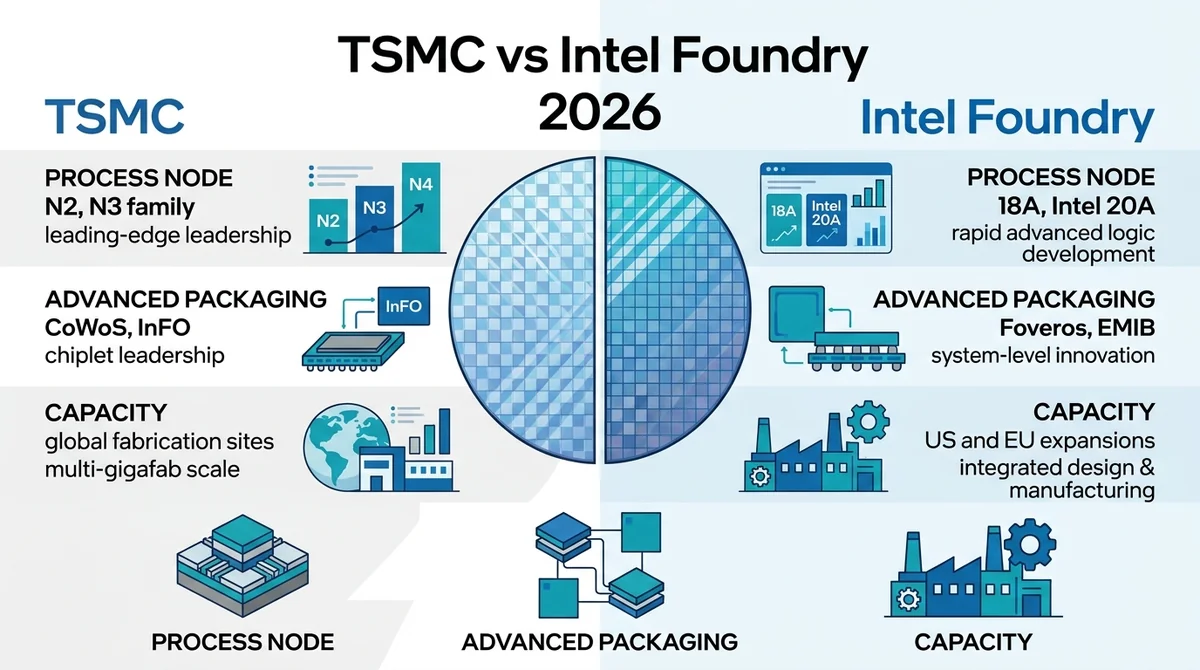
Compare TSMC and Intel Foundry across model, process, advanced packaging and capacity, with scenario routing and a dual-sourcing checklist for fabless companies.
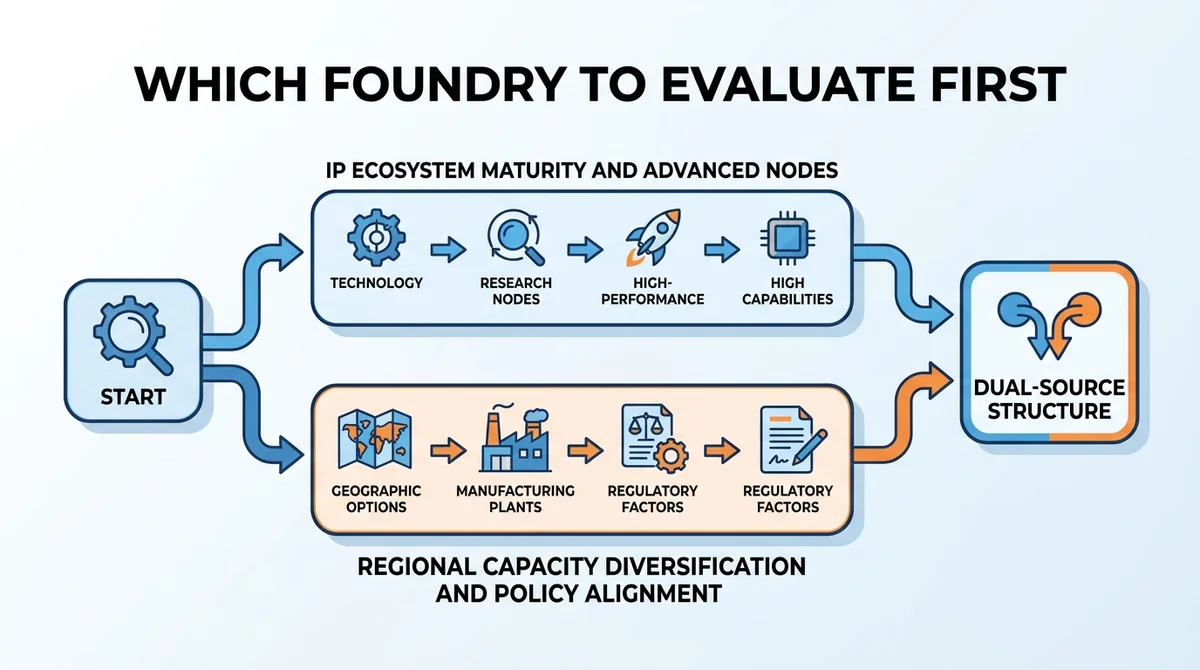
Conclusion: For fabless companies whose primary criteria are IP ecosystem maturity and availability of advanced process nodes, TSMC should come first in the evaluation order; companies whose primary criteria are regional capacity diversification and policy alignment should include Intel Foundry in a formal comparison, and in most cases the outcome will be a dual-source structure. This article only provides dimension comparisons and scenario routing; specific process parameters, capacity and lead times are subject to each company's official PDK and commercial terms.
#What are the essential differences between TSMC and Intel Foundry?
Model difference: TSMC is a pure-play foundry that does not operate its own branded chip product line, so there is no direct product competition between it and its customers; Intel Foundry evolved from an IDM business, so customers need to additionally confirm the boundary between its own product lines and its foundry business during evaluation.
Three implications for customers:
- Basis of trust: Under a pure-play model, customer design information and product roadmaps do not come into direct comparison with the foundry's own products; IDM transitioning to foundry requires contractual and information-isolation arrangements to answer the same question.
- Capacity priority: A pure-play foundry's scheduling logic takes customer orders as its only input; how an IDM-turned-foundry allocates capacity during peaks in its own product demand needs to be clarified in commercial terms.
- IP protection expectations: Public data does not provide complete, comparable details on the two companies' specific information-isolation mechanisms and IP protection clauses, so confidentiality agreements and contract texts should govern.
Why this affects selection: Model differences do not directly determine process strength, but they do determine different due-diligence checklists. With a pure-play foundry, the focus is on capacity and nodes; with an IDM-turned-foundry, beyond capacity and nodes you also need to discuss boundaries and isolation.
#How should process nodes be compared without looking only at names?
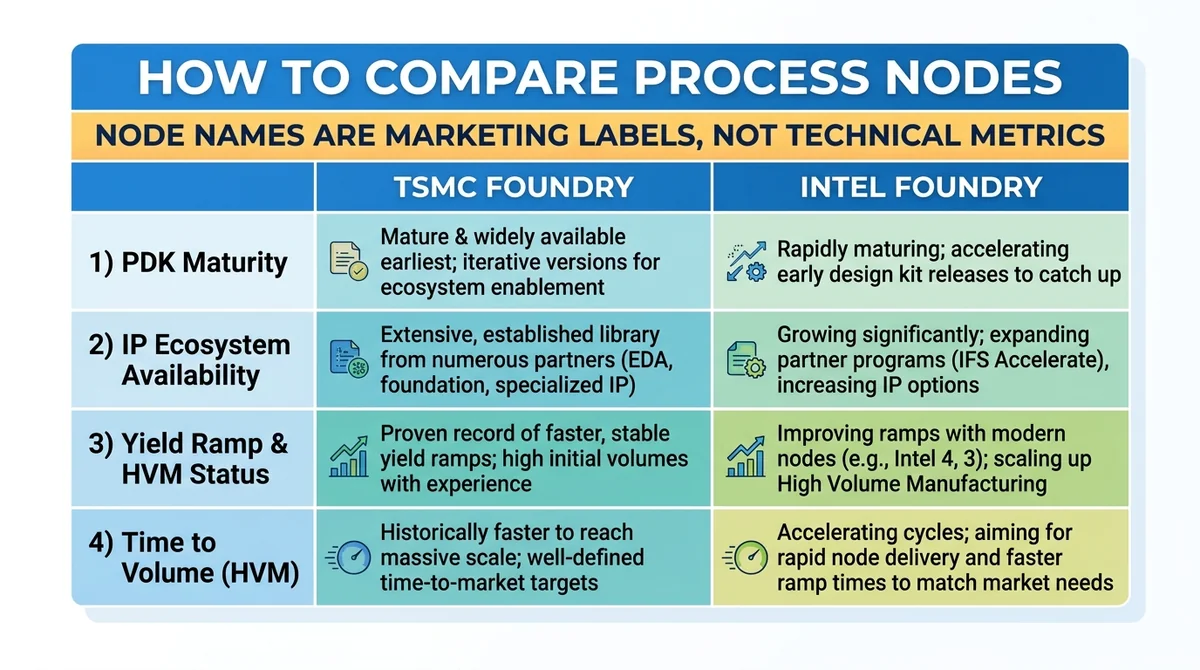
Naming conventions: Advanced process node names are marketing and generational labels and cannot be equated with actual transistor density, performance or power consumption; directly comparing node numbers between the two companies has no technical meaning.
Actual metrics to examine:
- PDK maturity: Design kit version stability, documentation completeness, and known-issue lists.
- IP ecosystem availability: Whether the required interface IP, PHY and analog IP have been silicon-verified on the target node.
- Yield ramp: The pace of yield ramp from risk production to mass production on a new node.
- Time to volume: The time window from design freeze to deliverable volume.
Roadmap delivery cadence: Historical delivery records directly affect tape-out risk. Roadmap delays can cause product windows to be missed, and this hurts small and mid-sized fabless companies more than large ones. Public data does not provide complete, comparable figures on the two companies' specific node parameters and yield data, so this article does not make numerical comparisons.
#Advanced packaging and capacity: which affects delivery more?
Advanced packaging is tied to process: High-performance products often require both process and advanced packaging capability to be available at the same time; getting wafers but not packaging slots means delivery is not complete. Packaging should therefore be an evaluation item on par with process, not an appendage.
Capacity certainty and regional distribution: Regional distribution of capacity affects policy alignment and supply chain resilience. For companies shipping to specific markets, production location and policy treatment may matter as much as price and performance.
How to ask about lead times and scheduling priority: Scheduling priority, capacity reservation ratios, lead-time commitments and remedies for breach should be written into commercial terms rather than left to verbal communication. Public data does not provide the two companies' specific capacity scale and lead-time data, so this article does not estimate them.
#Which fabless companies should choose TSMC, and when should they choose Intel Foundry?
Scenario routing:
- If you are a company pursuing the most advanced process and a mature IP ecosystem, prioritize evaluating TSMC, focusing on the PDK version for the target node and the silicon-verification status of the required IP.
- If you value regional capacity diversification and local policy alignment, include Intel Foundry in a formal comparison, focusing on capacity regions, policy treatment and boundary clauses.
- If you are a small or mid-sized fabless company, first confirm minimum order quantities, engineering support resources and mask cost-sharing arrangements before deciding whether to start a second evaluation.
- If you already have products in mass production at TSMC with stable lead times, position Intel Foundry as a backup option and first conduct an IP portability assessment rather than going straight to tape-out.
- If you ship to policy-sensitive markets, make production location and compliance treatment your first screening criteria, then compare process and packaging.
Who this applies to: Chip design companies and product and supply chain leaders currently doing foundry selection or dual-source planning. Not applicable: Readers who need specific quotes, specific yield figures or procurement decision conclusions; this article does not provide such data.
#What should you watch for in dual-sourcing strategy and switching costs?
Engineering cost: Bringing in two foundries at once means two PDKs, two verification flows, two documentation systems and extra manpower; design porting and verification costs are the main price of dual sourcing.
Cross-foundry IP availability: Whether IP can be reused at the second foundry determines porting difficulty. If key IP is only available on a single platform, the practical value of dual sourcing drops significantly.
Predefined trigger conditions: The conditions for activating the backup supplier should be specified in advance, such as capacity crunches, lead times exceeding thresholds or policy changes, to avoid ad hoc decisions.
Action checklist:
- List the key IP required by the product and check the silicon-verification status on the target node item by item.
- Request PDK version notes and known-issue lists to assess design risk.
- Confirm whether advanced packaging capability is available in sync with the target process.
- Confirm scheduling priority, capacity reservation and lead-time commitments in writing.
- Check the regional distribution of capacity and policy alignment with target markets.
- Assess IP cross-foundry portability and quantify the engineering cost of dual sourcing.
- Predefine the trigger conditions and decision owners for activating the backup supplier.
#Selection risks and the boundaries of the conclusion
The most easily overlooked risks: Roadmap delays and capacity crunches. Neither shows up in node names, but both directly change time to market.
Boundaries of the conclusion: This article only provides dimension comparisons and scenario routing and does not constitute procurement advice or any price forecast. All technical parameters and commercial conditions are subject to the two companies' official PDKs, public technical documentation and contract terms.
To check official statements, see the official technology announcements and customer documentation pages of the two foundry businesses.
This content is compiled from public data and does not constitute investment or open account advice. Data is as of 2026-01-01 and actual conditions may change.
FAQ
What is the most practical difference between a pure-play foundry model and an IDM-turned-foundry for fabless companies?
The most practical difference is in the due-diligence checklist. A pure-play foundry has no competing product line of its own, so evaluation focuses on process, IP and capacity; an IDM-turned-foundry requires additional confirmation of the boundary between its own product lines and its foundry business, capacity priority arrangements and information-isolation mechanisms, usually confirmed through contract clauses.
Can process node numbers be compared directly?
Not recommended. Node names are generational and marketing labels and do not equal actual density, performance or power consumption. You should compare PDK maturity, the silicon-verification status of required IP, yield ramp cadence and time-to-volume windows, as these are the variables that affect tape-out risk and delivery.
Why must advanced packaging be evaluated together with process?
High-performance products usually require both process and advanced packaging capability to be available at the same time. If you get wafers but cannot get packaging capacity, delivery is not complete. Packaging should therefore be an evaluation item on par with process and confirmed in parallel during commercial negotiations.
Is dual sourcing suitable for small and mid-sized fabless companies right away?
Not necessarily. Dual sourcing brings two PDKs, two verification flows and extra manpower costs. Constrained by minimum order quantities and engineering resources, smaller companies are usually better off stabilizing a single primary source first, completing an IP portability assessment, and then activating a second foundry according to predefined trigger conditions.
How should scheduling priority and lead times be confirmed?
They should be confirmed in written commercial terms, including capacity reservation ratios, scheduling priority, lead-time commitments and remedies for breach. Verbal communication is not sufficient as a basis for supply chain planning. Public data does not provide the two companies' specific capacity and lead-time figures.
Related Terms
Done comparing? Ready to place your first trade?
The crypto assets, tokenized US stocks and ETFs you just compared are all tradable on MSX — spot or perpetuals.
Quick Start Trading →New here? Registration takes three quick steps.