TSMC vs Intel Stock: 2026 Comparison, Financials, and Recommendation
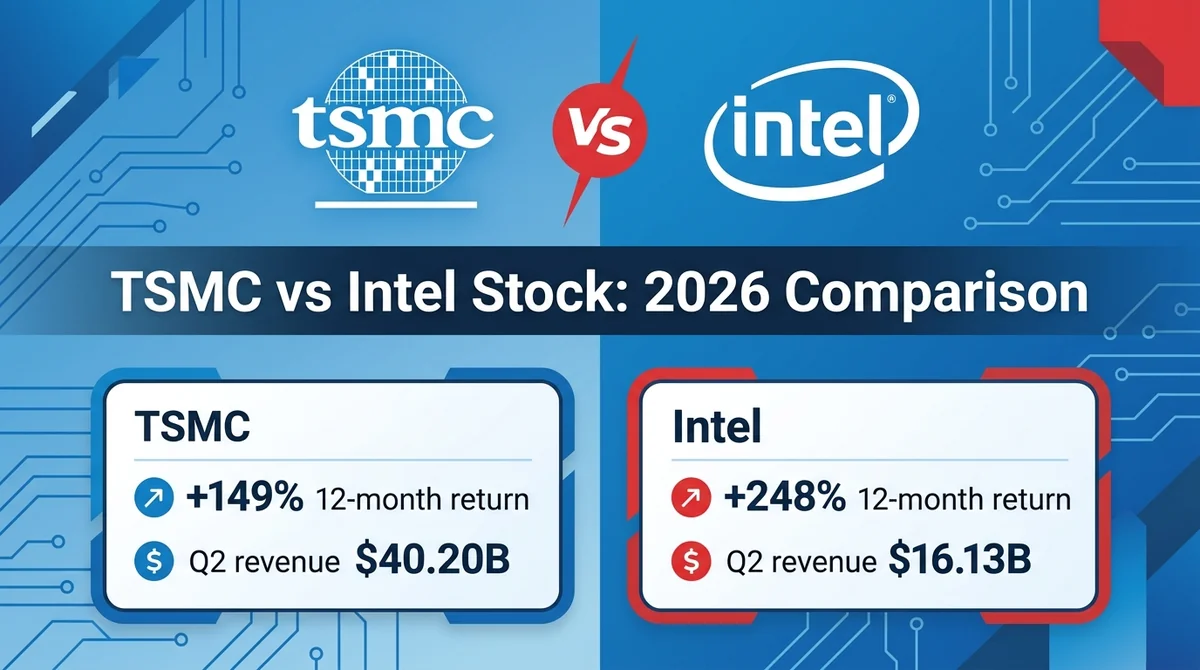
See how TSMC vs Intel stock compare on 2026 revenue, 18A vs 2nm progress, valuation, and Q3 guidance to judge Intel's turnaround against TSMC's dominance.
#TSMC vs Intel Stock: 2026 Comparison, Financials, and Recommendation
The TSMC vs Intel stock comparison is not just about past returns. Intel offers a high-risk turnaround optionality after a 248% 12-month gain, while TSMC provides proven scale, 36% revenue growth, and 67.7% gross margins. The better buy depends on whether you prioritize upside optionality or fortress-like execution.
Key Takeaways
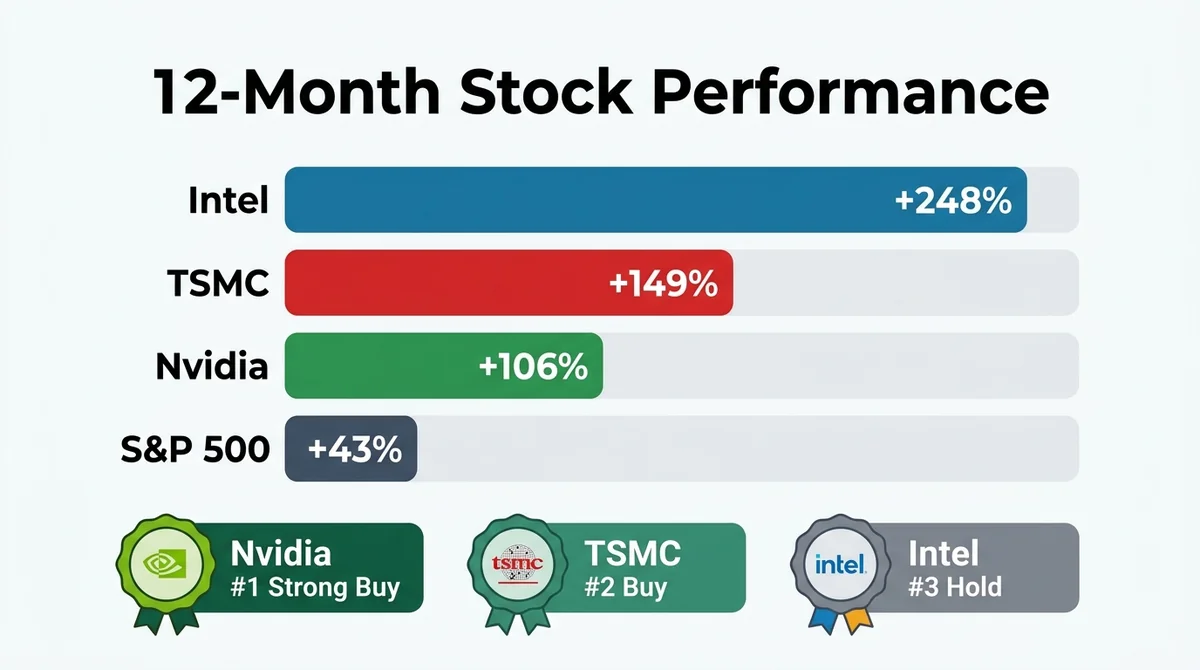
- Intel stock rose roughly 248% over the last 12 months versus TSMC's 149% and Nvidia's 106% gain, but Zacks ranks Intel #3 (Hold) and TSMC #2 (Buy).
- TSMC wins 20 of 26 MarketGenius metrics, including valuation, profitability, growth, dividends, risk, and performance.
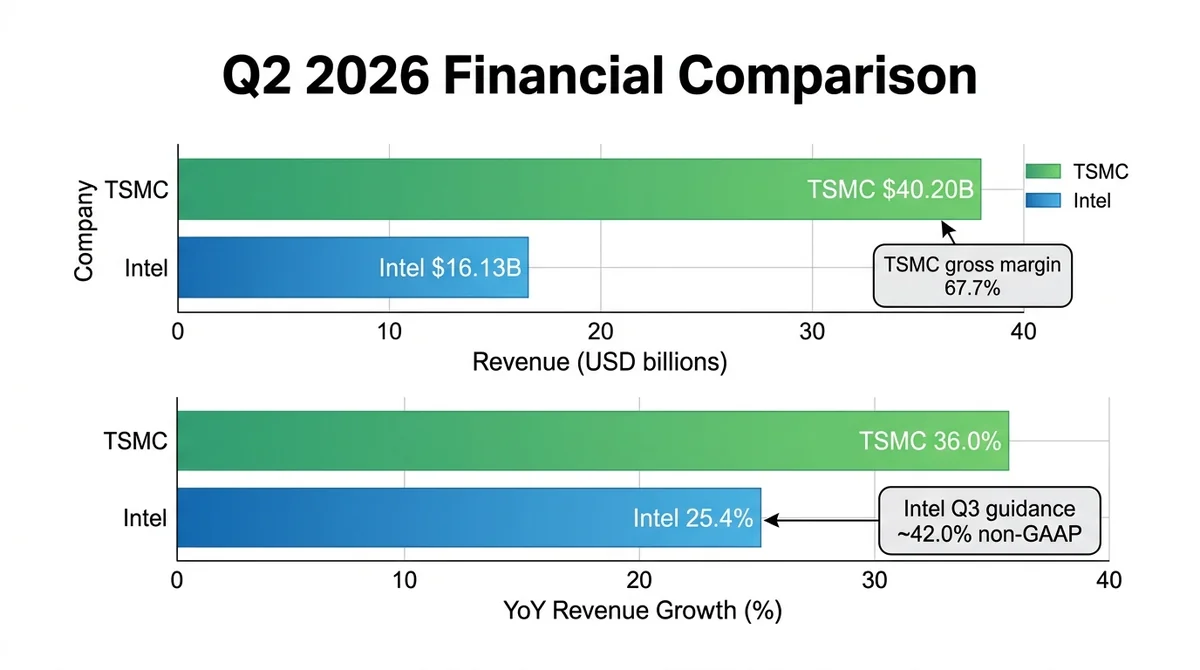
- Intel Q2 2026 revenue reached $16.128 billion, up 25.4% YoY, with Data Center & AI up 59%; TSMC posted $40.20 billion, up 36.0%, with 67.7% gross margin.
- Intel's 18A node entered high-volume manufacturing at around 10,000 wafer starts per week, while TSMC's 2nm already contributes 3% of wafer revenue.
- Intel guided Q3 2026 to $15.80–16.80 billion and ~42.0% non-GAAP gross margin, versus TSMC's $44.6–45.8 billion and 65–67% margin.
#How TSMC and Intel Business Models Differ
TSMC is a pure-play foundry that manufactures chips for fabless customers like Nvidia and Apple, while Intel is transitioning from an integrated device manufacturer (IDM) to a foundry model with its 18A and 14A nodes. This structural difference is central to any TSMC vs Intel stock analysis: TSMC’s foundry-only model delivers massive scale and margins today, while Intel’s IDM 2.0 strategy adds U.S.-based manufacturing capacity and a potential sovereign hedge.
#TSMC vs Intel Stock: Which Has Outperformed Over the Past Year?
Intel has outperformed by a wide margin. Over the last 12 months, Intel shares surged roughly 248%, compared with TSMC's 149% and Nvidia's 106% gain; the S&P 500 rose 43%. Despite this, Zacks ranks Nvidia #1 (Strong Buy), Taiwan Semiconductor #2 (Buy), and Intel #3 (Hold), reflecting execution certainty versus turnaround potential. The divergence raises questions about AI chip leadership, but the companies are becoming complementary pillars rather than direct competitors.
#TSMC vs Intel Stock: Financial Metrics and Q2 2026 Results
TSMC dominates on most traditional financial metrics. According to MarketGenius, TSM wins 20 of 26 metrics and leads in Company, Valuation, Profitability, Growth, Dividends, Risk & Health, and Performance.
Intel Q2 2026 revenue reached $16.128 billion, up 25.4% YoY, with Data Center and AI growing 59% and Foundry growing 31%. Intel's GAAP net loss of $11.033 billion was driven by a $12.53 billion non-cash charge tied to CHIPS Act escrow, not an operational shortfall. TSMC posted revenue of $40.20 billion, up 36.0% YoY, with EPS of $4.31 and gross margin of 67.7%, demonstrating a clear scale and profitability gap.
This contrast shows why TSMC is considered a fortress: double the revenue growth rate on a much larger base, with gross margins more than 25 percentage points higher than Intel's Q2 non-GAAP gross margin.
#Is Intel's Foundry Turnaround Credible Enough to Challenge TSMC?
Intel's foundry momentum is improving, but TSMC still leads in advanced-node scale. Intel's chipmaking equipment orders ramped by more than 50% year-over-year to start 2026, and its 18A node entered high-volume manufacturing at around 10,000 wafer starts per week. Meanwhile, TSMC's 2nm node made its commercial debut at 3% of wafer revenue, with advanced nodes at 7nm and below accounting for 77% of wafer revenue in Q2 2026—underscoring a narrowing but still significant gap.
The upcoming 14A node is designed from the ground up for external customers and incorporates RibbonFET and High-NA EUV lithography, signaling Intel's strategic shift toward a true foundry business.
#The American AI Ecosystem: Complementary, Not Direct Competitors
Nvidia, Intel, and TSMC are evolving into complementary pillars of the American AI ecosystem rather than direct competitors. Nvidia designs the AI chips, TSMC manufactures the leading-edge silicon, and Intel offers a sovereign hedge that TSMC structurally cannot, with heavy U.S. government support and strategic domestic manufacturing commitments. Intel's 18A-P entered risk production on schedule, Panther Lake is in high-volume manufacturing on ASML High NA EUV, and Xeon 6+ became the first server product on 18A.
#Should Investors Buy Intel Stock Instead of Taiwan Semiconductor?
The answer depends on your risk tolerance and time horizon. The table below compares the key Q3 2026 guidance and valuation:
| Metric | Intel (INTC) | TSMC (TSM) |
|---|---|---|
| Market cap | ~$465.66 billion | ~$2.07 trillion |
| Q3 2026 revenue guidance | $15.80–16.80 billion | $44.6–45.8 billion |
| Q3 non-GAAP gross margin | ~42.0% | 65–67% |
Intel offers turnaround optionality: if 18A converts defense and hyperscaler tape-outs into paying external volume, the stock could re-rate higher. TSMC offers proven fortress dominance with superior scale and margins. For most long-term AI investors, TSMC remains the lower-risk compounder, but Intel is a credible high-beta alternative for those willing to bet on the U.S. foundry turnaround. If you want to trade TSMC or Intel as tokenized stocks, use MSX Compare to screen platform fees and compliance.
FAQ
Is TSMC a better stock than Intel in 2026?
For most investors, yes. TSMC wins 20 of 26 MarketGenius metrics, posts 36% revenue growth with 67.7% gross margin, and carries a Zacks #2 (Buy), while Intel is a Zacks #3 (Hold) turnaround with higher risk and potential reward.
Why did Intel stock outperform TSMC over the past year?
Intel surged roughly 248% versus TSMC's 149% because investors began pricing in a credible foundry turnaround, including a 50%+ jump in chipmaking equipment orders and 18A high-volume manufacturing, even though TSMC remains more profitable.
What were Intel's Q2 2026 results?
Intel posted Q2 2026 revenue of $16.128 billion, up 25.4% YoY, with Data Center & AI growing 59% and Foundry up 31%. Its GAAP net loss of $11.033 billion was driven by a $12.53 billion non-cash CHIPS Act escrow charge, not an operational shortfall.
How does Intel's 18A node compare to TSMC's 2nm?
Intel's 18A node is in high-volume manufacturing at about 10,000 wafer starts per week with improving yields, while TSMC's 2nm has already reached 3% of wafer revenue. The gap is narrowing, but TSMC still leads in advanced-node scale.
Should I buy INTC or TSM stock for AI exposure?
TSMC is the lower-risk way to own leading-edge AI chip manufacturing, while Intel offers a high-beta sovereign-hedge bet on U.S. foundry revival. Choose based on your risk tolerance and time horizon.
Related Terms
Done comparing? Ready to place your first trade?
The crypto assets, tokenized US stocks and ETFs you just compared are all tradable on MSX — spot or perpetuals.
Quick Start Trading →New here? Registration takes three quick steps.