Which Is Better?
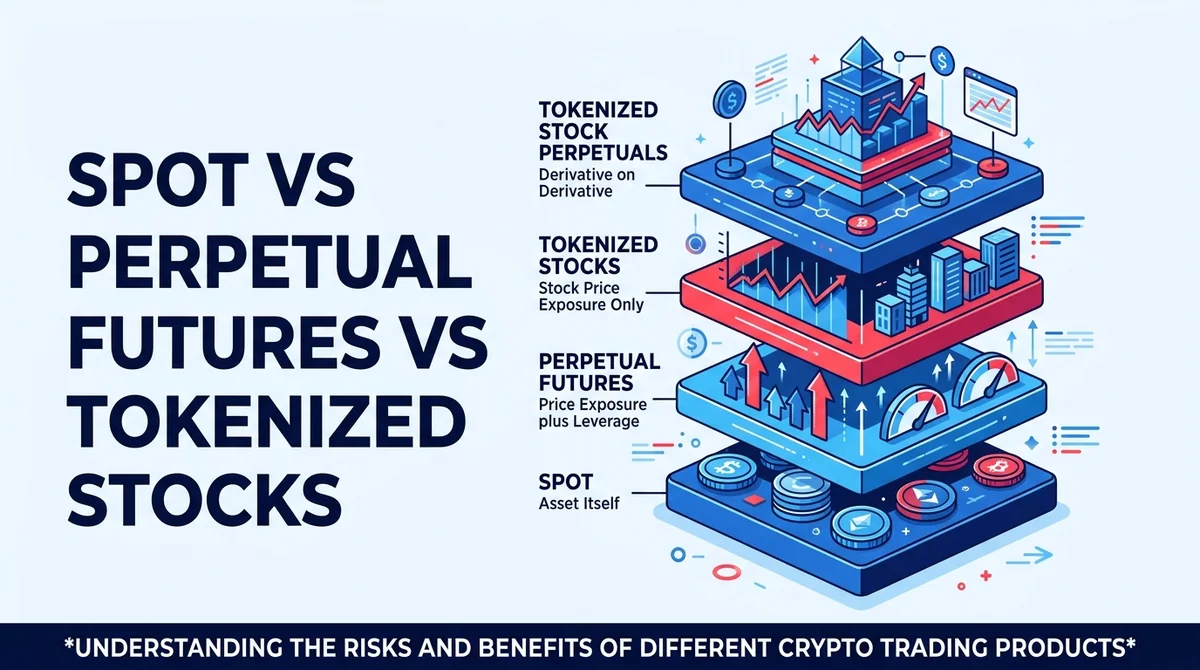
A five-dimension comparison of spot, perpetuals, tokenized stocks, and tokenized stock perpetuals—covering asset ownership, liquidation risk, exposure, costs, and holding period.
Conclusion: First distinguish the four categories before asking "which is better"—if you want to hold the asset itself long-term, look at spot; only look at perpetual futures if you just want to trade price movements and can bear liquidation risk; if you want US stock price exposure, recognize that tokenized stocks are not the same as real US stocks; tokenized stock perpetuals are derivatives even further removed from real stocks.
#What Is "Which Is Better" Actually Comparing? First Distinguish the Four Categories
The question "which is better" itself lacks a premise. Spot, perpetual futures, tokenized stocks, and tokenized stock perpetuals are four different kinds of things; comparing "good or bad" in the same table will lead to wrong conclusions. The right approach is to first confirm what each category actually makes you hold and what risks you bear.
#What Is the Essential Difference Between Spot and Perpetual Futures?
Spot is real buying and selling—you hold the asset itself, price movements correspond to changes in the market value of your holdings, and there is no forced liquidation mechanism. Perpetual futures only trade price movements, do not deliver the asset itself, usually come with perpetual futures leverage, adverse price movements may trigger forced liquidation or even total loss, and there are ongoing costs such as how does perpetual futures funding rate work during the holding period. The core difference between the two is not "which has higher returns," but "whether you hold the asset or a contract position."
#Are Tokenized Stocks the Same as Real US Stocks?
No. Tokenized stocks provide price exposure to the underlying stock, not real US stocks shareholder status. Real US stocks involve a whole set of arrangements such as shareholder rights and corporate actions (e.g., dividends, stock splits, voting); how tokenized forms handle these aspects depends on the specific product design, and when data is not public it should be explicitly marked as "data not public," not assumed to be equivalent. In terms of price, real US stocks are the cause and token prices are the effect—token prices follow real US stock movements, not the other way around.
#Why Are Tokenized Stock Perpetuals Further from Real Stocks?
Tokenized stock perpetuals add another layer of derivative structure on top of tokenized stock price exposure: they do not hold the tokenized stock itself, only trade its price movements, usually come with perpetual futures leverage and have how does perpetual futures funding rate work and forced liquidation mechanisms. The more layers, the weaker the connection to real stock shareholder status and corporate actions, and the longer the risk transmission chain.
#Which Market to Choose: What Comparison Dimensions Should You Look At?
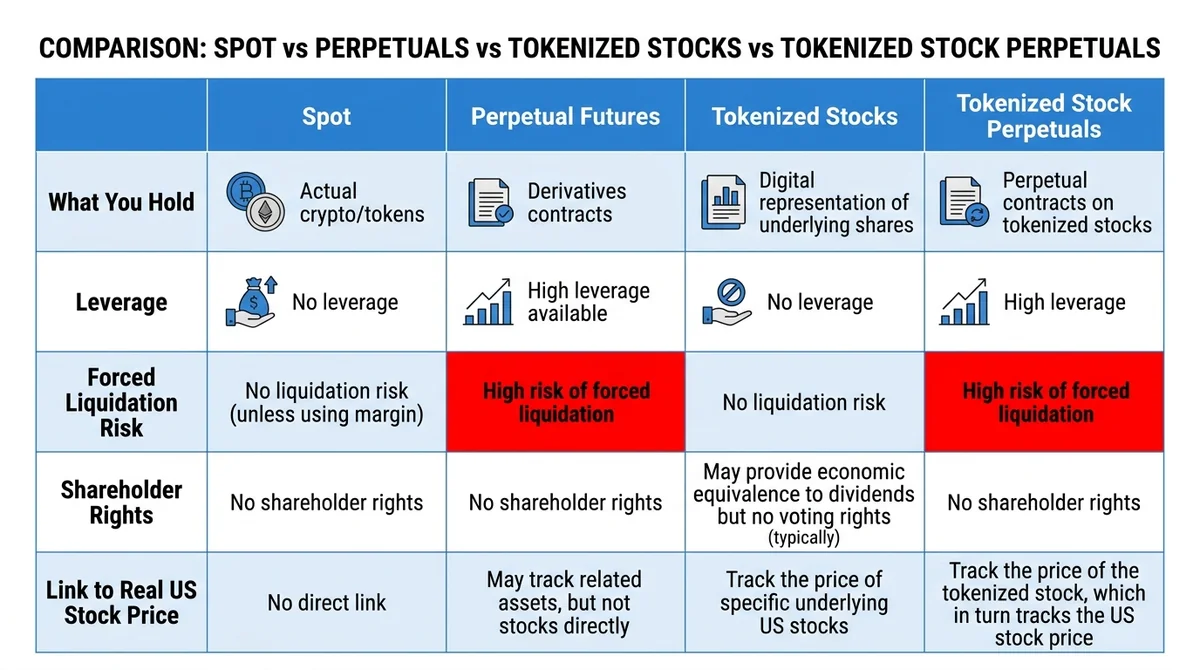
Using five dimensions to check item by item can turn the vague "which is better" into a comparable structure.
#Do You Hold the Asset Itself or Price Exposure?
Spot holds the asset itself; perpetual futures and tokenized stock perpetuals hold price exposure; tokenized stocks sit in between, holding price exposure to the underlying stock rather than shareholder status. This determines whether you can claim rights related to the asset.
#Is There perpetual futures leverage and Liquidation Risk?
Whether spot and tokenized stocks involve perpetual futures leverage and margin arrangements depends on the specific product and platform terms; when undisclosed, mark as "data not public"; perpetual futures and tokenized stock perpetuals usually come with perpetual futures leverage and carry the possibility of forced liquidation and total loss. perpetual futures leverage amplifies both profits and losses simultaneously—this is a structural feature, not something trading skills can eliminate.
#How to Balance Costs and Holding Period?
Spot costs are mainly one-time trading fees and the opportunity cost of holding; perpetual-type products, in addition to trading fees, have ongoing costs such as how does perpetual futures funding rate work, and the longer the holding period, the more obvious the cumulative impact. When the holding period is short and the purpose is trading price movements, the weight of ongoing costs relatively decreases; when the holding period is long and the purpose is holding the asset, ongoing costs will erode results. Specific fee levels should be based on platform disclosure; if undisclosed, mark as "data not public."
#Source of Exposure and Liquidity Needs
The source of exposure determines the reliability of price signals: real asset prices are the source, tokenized and derivative prices are transmission results. Liquidity needs determine exit difficulty; when depth is insufficient, slippage will amplify actual costs. When specific liquidity data is not public, mark as "data not public" rather than estimating.
#Which Is More Suitable for You in Different Scenarios?
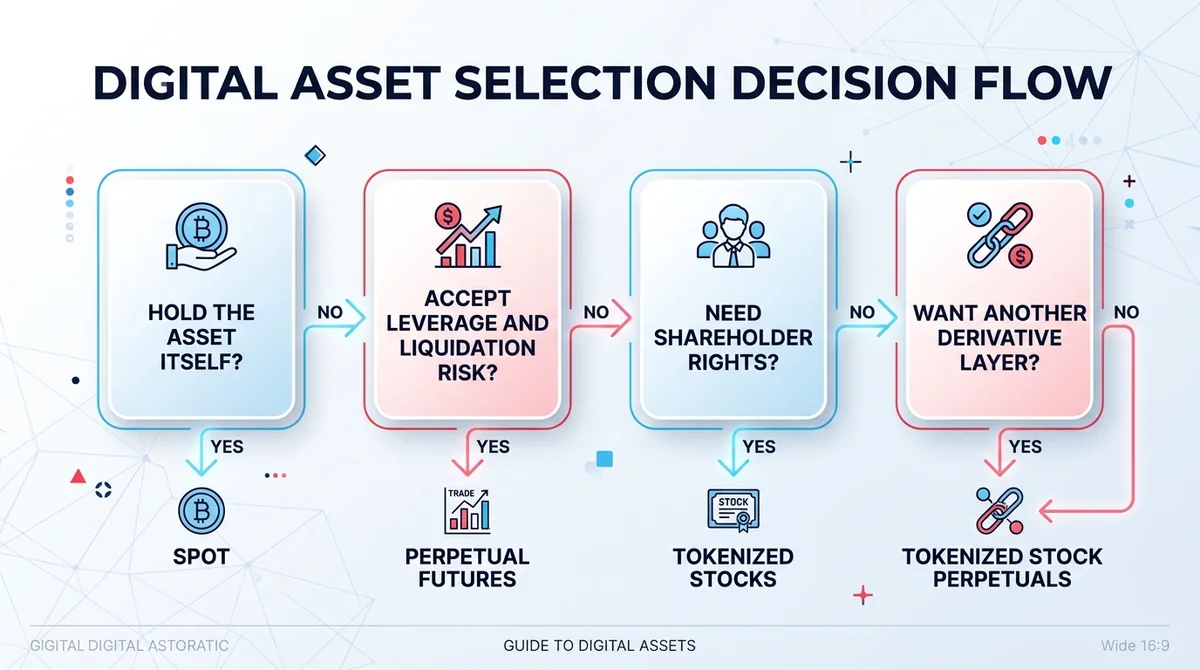
#If You Want to Hold the Asset Itself Long-Term, Which Category Should You Choose?
If you are aiming to hold the asset itself, with a holding period measured in months or years, and do not want to be passively liquidated due to short-term fluctuations, then lean toward spot. Spot has no forced liquidation mechanism and will not force you out due to adverse price movements.
#If You Only Want to Trade Price Movements, What Should You Watch Out For?
If you are aiming to go long or short on price movements, can bear liquidation risk, and understand that how does perpetual futures funding rate work will continuously affect holding costs, only then consider perpetual futures. You need to first confirm the maximum drawdown you can accept and the relationship between perpetual futures leverage multiples and liquidation price.
#If You Want US Stock Exposure but Do Not Want to open account a Real US Stock Account, How to Understand It?
If you are wanting US stock price exposure but do not plan to open account a real US stock account, you can understand tokenized stocks as a price exposure tool, while clarifying that it is not equivalent to shareholder status; how rights related to corporate actions are handled depends on product disclosure, and if undisclosed, mark as "data not public."
#Pursuing Further-End Derivative Structures
If you are already understand the price exposure nature of tokenized stocks and further want to trade their price movements and can bear perpetual futures leverage and forced liquidation risk, only then enter the tokenized stock perpetuals layer. The order cannot be reversed: first understand the difference between spot and price exposure, then enter derivatives.
#What Risks Must You Know Before Making a Choice?
#Why Does perpetual futures leverage Amplify Losses?
perpetual futures leverage proportionally amplifies both profits and losses. For the same adverse price movement, the higher the perpetual futures leverage, the larger the proportion of loss to margin, and the shorter the distance to the liquidation price.
#How Do Forced Liquidation and Total Loss Happen?
When adverse price movements make margin insufficient to maintain the position, forced liquidation is triggered; when liquidity is insufficient or volatility is severe, forced liquidation may be executed at worse prices, resulting in total loss. This is a mechanistic result, unrelated to whether your judgment is right or wrong.
#Why Do Tokenized Stock Prices Follow Real US Stocks Up and Down?
Because the price exposure of tokenized stocks is anchored to real US stocks; real US stock prices are the cause, token prices are the effect. Understanding this directionality helps avoid misreading short-term deviations in token prices as independent market movements.
#How to Turn "Which Is Better" into Your Own Decision Checklist?
Step 1: Clarify whether the goal is to hold the asset itself or trade price movements. Step 2: Assess risk tolerance and acceptable maximum drawdown, and judge whether you can bear perpetual futures leverage and forced liquidation risk. Step 3: Check the cost structure, especially ongoing costs such as how does perpetual futures funding rate work for perpetual-type products. Step 4: Confirm whether the holding period matches liquidity needs. Step 5: Record all "data not public" items to avoid filling data gaps with feelings. Step 6: For tokenized stock products, separately confirm the disclosure of rights related to corporate actions.
#FAQ
Q1: Is spot always better than perpetual futures? A: No. The two are different in nature: spot holds the asset itself with no forced liquidation; perpetuals only trade price movements with perpetual futures leverage and ongoing costs. Whether it is suitable depends on whether the goal is holding the asset or trading price movements, and whether you can bear liquidation risk.
Q2: Can tokenized stocks receive dividends and voting rights? A: Tokenized stocks provide price exposure, not equivalent to real US stock shareholder status. How rights related to corporate actions are handled depends on the specific product design; when undisclosed, mark as "data not public" and do not assume equivalence to real shareholding.
Q3: What is the difference between tokenized stock perpetuals and tokenized stocks? A: Tokenized stocks are price exposure; tokenized stock perpetuals add a derivative structure on top, only trading price movements, usually with perpetual futures leverage, how does perpetual futures funding rate work, and forced liquidation mechanisms, further from real stocks.
Q4: Does how does perpetual futures funding rate work count as a cost? A: Yes. how does perpetual futures funding rate work is an ongoing cost during the holding period, and the longer the holding period, the more obvious the cumulative impact. Specific fee levels should be based on platform disclosure; if undisclosed, mark as "data not public."
Q5: How to quickly judge which category you should choose? A: First answer one question: do you want to hold the asset itself or trade price movements? The former points to spot; the latter leads to perpetual-type products; if the goal is US stock exposure, first understand that tokenized stocks are only price exposure.
This content is a conceptual comparison based on public information, does not constitute investment or open account advice, and does not include any specific platform's fee rates or return promises. Actual conditions may change; for specific terms, please refer to the official disclosure of the relevant platform.
FAQ
Is spot always better than perpetual futures?
No. The two are different in nature: spot holds the asset itself with no forced liquidation; perpetuals only trade price movements with perpetual futures leverage and ongoing costs. Whether it is suitable depends on whether the goal is holding the asset or trading price movements, and whether you can bear liquidation risk.
Can tokenized stocks receive dividends and voting rights?
Tokenized stocks provide price exposure, not equivalent to real US stock shareholder status. How rights related to corporate actions are handled depends on the specific product design; when undisclosed, mark as "data not public" and do not assume equivalence to real shareholding.
What is the difference between tokenized stock perpetuals and tokenized stocks?
Tokenized stocks are price exposure; tokenized stock perpetuals add a derivative structure on top, only trading price movements, usually with perpetual futures leverage, how does perpetual futures funding rate work, and forced liquidation mechanisms, further from real stocks.
Does how does perpetual futures funding rate work count as a cost?
Yes. how does perpetual futures funding rate work is an ongoing cost during the holding period, and the longer the holding period, the more obvious the cumulative impact. Specific fee levels should be based on platform disclosure; if undisclosed, mark as "data not public."
How to quickly judge which category you should choose?
First answer one question: do you want to hold the asset itself or trade price movements? The former points to spot; the latter leads to perpetual-type products; if the goal is US stock exposure, first understand that tokenized stocks are only price exposure.
Related Terms
Done comparing? Ready to place your first trade?
The crypto assets, tokenized US stocks and ETFs you just compared are all tradable on MSX — spot or perpetuals.
Quick Start Trading →New here? Registration takes three quick steps.