Beyond AMD vs Nvidia Comparison Pages: Ranking AI Chip Exposure in 2026 (TSMC and Broadcom Enter the Frame)
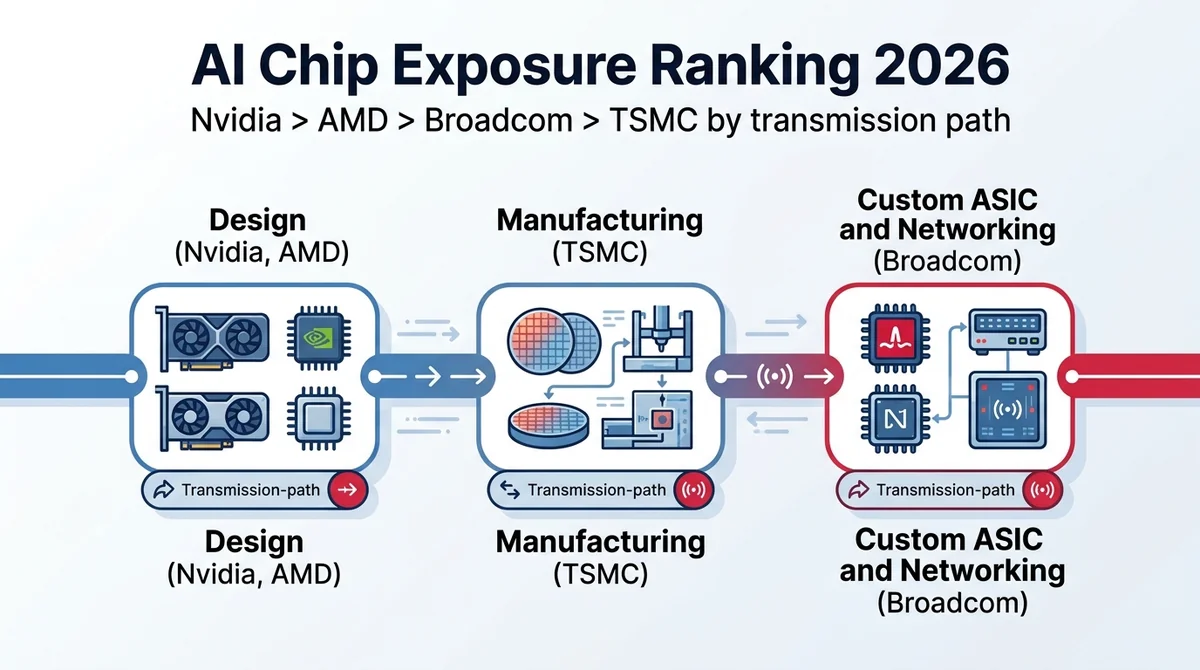
How Nvidia, AMD, TSMC and Broadcom differ in AI chip exposure by supply chain position and AI revenue relevance, plus tokenized stock risks.
Ranked by supply chain position and AI revenue relevance, Nvidia has the most direct AI chip exposure, followed by AMD; Broadcom's custom ASIC and networking exposure has a mid-length transmission path, while TSMC's manufacturing-side exposure has the longest transmission path. The four are driven by different factors, so there is no single best choice. This article does not forecast prices and is not a buy or sell recommendation.
#Where do AMD, Nvidia, TSMC and Broadcom each sit in the AI chip supply chain?
Design side: Nvidia and AMD are both in the GPU/AI accelerator design race, facing AI compute demand directly.
Manufacturing side: TSMC handles wafer foundry work and is a key upstream node in the supply chain. Advanced-process orders from AI chip design companies must be realized through its capacity.
Custom and networking: Broadcom has exposure on the custom ASIC and networking chip side, and its demand is tied more to the capex rhythm of hyperscale customers.
Scope note: Tokenized stocks are price exposure, not actual shareholding, and carry no shareholder rights.
In the AI chip supply chain, Nvidia and AMD sit on the design side, TSMC on the manufacturing side, and Broadcom on the custom ASIC and networking side; the four are driven by different factors.
#How should the four exposures be ranked? A comparison table shows the key differences
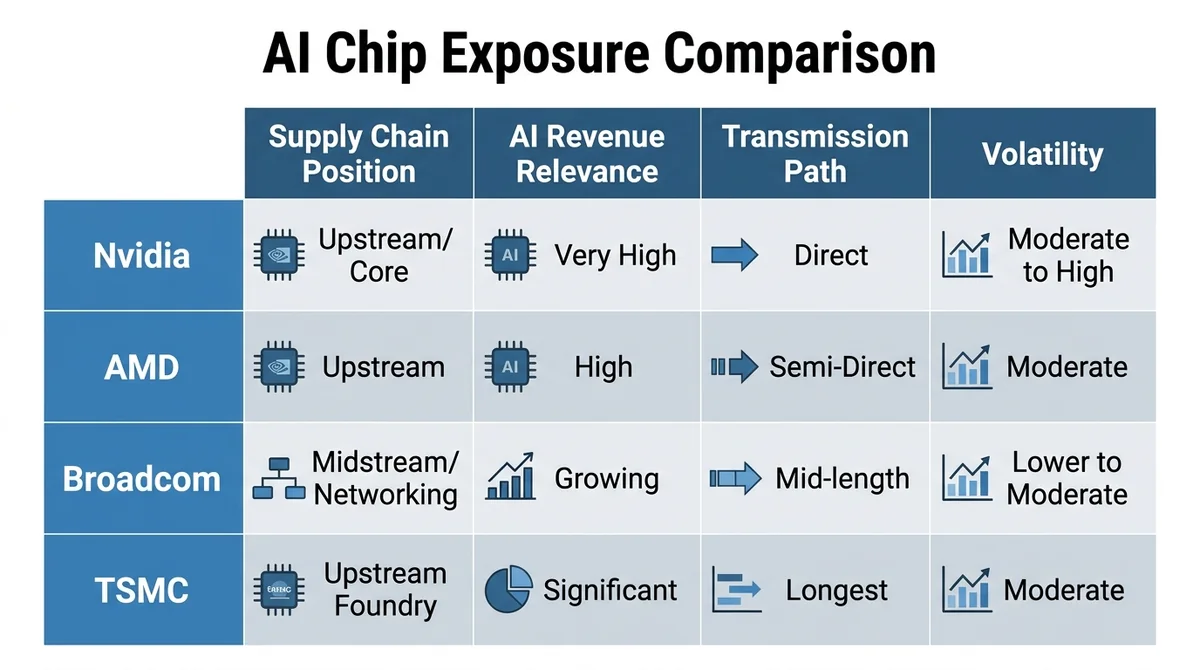
Comparing by supply chain position, AI revenue relevance, customer structure and volatility characteristics, design-side exposure is more direct to AI demand, while manufacturing and custom ASIC exposure have longer transmission paths.
Comparison dimension notes: Supply chain position determines the driving factors; AI revenue relevance reflects how sensitive results are to AI demand; customer structure affects order stability; competitive landscape determines pricing power; volatility characteristics affect the holding experience; tokenized availability affects how exposure can be expressed.
Data scope: Specific financial ratios, market share and AI revenue share data are not provided in this article's inputs, so they are marked "data not disclosed" and not estimated. The ranking in this article is a qualitative judgment based on supply chain structure, not a quantitative scoring result.
#AMD stock vs Nvidia stock: why does exposure in the same segment perform differently?
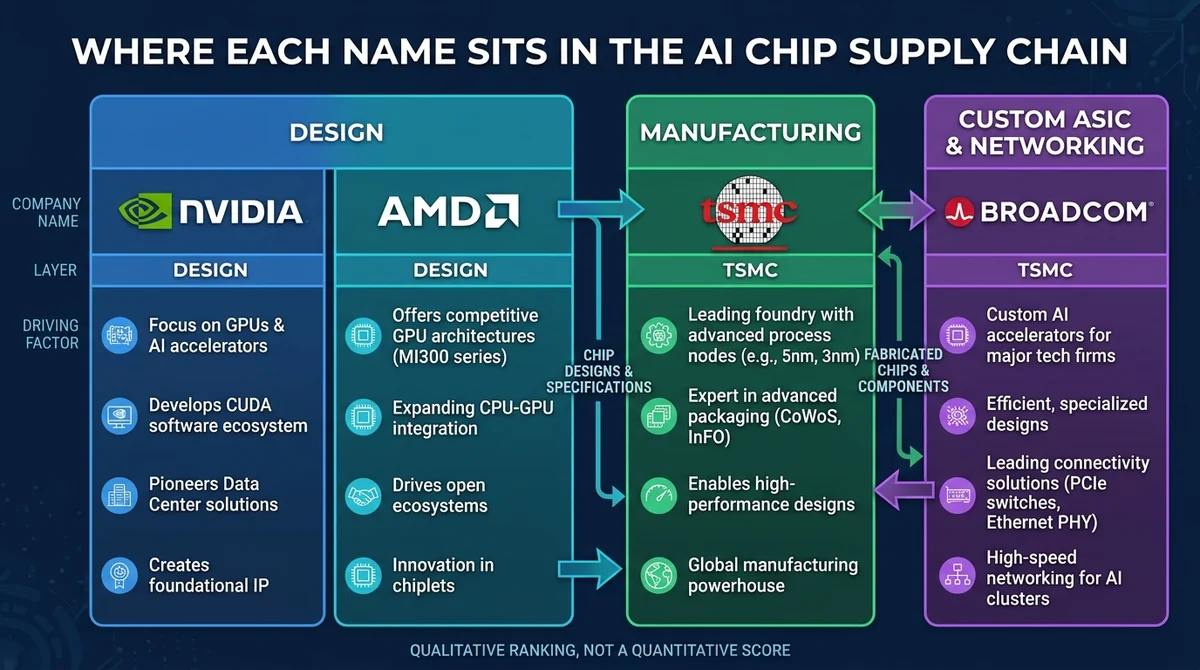
AMD and Nvidia both sit on the AI chip design side, but they differ in market share, ecosystem and business structure, so their exposure attributes and volatility characteristics differ.
Scale and ecosystem differences: Nvidia laid out its AI accelerator ecosystem and software stack earlier, while AMD is in a catch-up position, so their earnings sensitivity to the same demand change differs. This is a qualitative inference based on business structure; specific sensitivity differences need to be verified against each company's financial reports.
Tokenized stock scope: Tokenized stock prices track US equities but carry tracking deviation and liquidity differences, and cannot be equated with direct shareholding.
No price forecasts: This article makes no buy or sell recommendation and only describes exposure attributes.
#With TSMC and Broadcom in the frame, how should AI chip exposure be split by scenario?
Split by scenario: design-side views map to Nvidia/AMD, the manufacturing link maps to TSMC, custom and networking map to Broadcom, and overall supply chain exposure requires a multi-name portfolio.
- If you focus on AI accelerator design and ecosystem, see Nvidia/AMD exposure.
- If you focus on manufacturing capacity and foundry orders, see TSMC exposure.
- If you focus on custom ASIC and networking, see Broadcom exposure.
- If you want only overall supply chain coverage, you need a combination of exposures rather than a single name.
- If you use tokenized stocks to express a view, you need to check tracking deviation and platform liquidity separately.
#What are the risks of expressing AI chip exposure with tokenized stocks?
Tokenized stocks are only price exposure rather than actual shareholding; tokenized stock perpetual futures carry perpetual futures leverage and liquidation risk, plus tracking deviation and liquidity differences.
Tokenized stocks vs real US equities: Tokenized stocks carry no shareholder status or voting rights, and corporate actions and dividend handling differ from direct shareholding; specific rules depend on the issuing platform's disclosures.
Tokenized stocks vs tokenized stock perpetual futures: The former is spot exposure, the latter is a derivative with perpetual futures leverage and possible liquidation, and a different cost-of-funds structure.
Tracking deviation and liquidity: US equity prices are the cause and token prices are the effect; token prices may deviate due to platform liquidity differences.
Platform risk: Custody fee and settlement depend on platform mechanisms; check the platform's disclosed reserve, custody fee and audit information.
#Ranking list
The following ranking is a qualitative comparison based on supply chain structure, not a quantitative score, and does not constitute investment advice.
- Nvidia: The most direct AI chip design-side exposure with relatively mature ecosystem; large scale and diversified business make its volatility characteristics relatively moderate.
- AMD: Also on the design side, in a catch-up position, with potentially higher earnings sensitivity but also higher volatility and execution risk.
- Broadcom: Custom ASIC and networking-side exposure tied to hyperscale customer capex, with a mid-length transmission path; relatively high customer concentration.
- TSMC: An unavoidable manufacturing-side link that benefits from AI chip capacity demand, but has the longest transmission path and is constrained by cycles and capacity.
#Scoring methodology
This comparison makes a qualitative ranking based on supply chain position, AI revenue relevance, customer structure, competitive landscape, volatility characteristics and tokenized availability, without reproducible quantitative weights or specific financial data. Missing fields are uniformly marked "data not disclosed". This ranking is only for horizontal comparison of exposure attributes and does not constitute investment advice.
#Rank-by-rank details
Nvidia: Located on the AI chip design side, directly facing AI accelerator demand, with an earlier ecosystem and software stack layout, so its exposure is sensitive to changes in AI demand. Larger scale and a diversified business structure make its volatility characteristics relatively moderate. Tokenized stock availability is relatively high, but tracking deviation should be noted. Suitable for users who want to express a direct design-side view on AI compute.
AMD: Also on the design side and in a catch-up position, with potentially higher earnings sensitivity but also greater execution risk and volatility. Its business structure includes other product lines, so its AI revenue relevance is less pure than Nvidia's. Suitable for users who can tolerate higher volatility and want to express a design-side catch-up thesis.
Broadcom: Exposure comes from custom ASIC and networking chips, with demand tied to the capex rhythm of hyperscale customers and a mid-length transmission path. Customer concentration is relatively high, and order fluctuations may affect the earnings rhythm. Suitable for users focused on custom chips and the data center networking side.
TSMC: An unavoidable manufacturing-side link; advanced-process orders from AI chip design companies must be realized through its capacity, so it benefits from overall AI chip demand. It has the longest transmission path and is constrained by capacity cycles and capex. Suitable for users who want to express manufacturing-link exposure and accept a longer transmission path.
#FAQ
Q1: AMD and Nvidia are both on the design side, so why do their exposure attributes differ? A: Because they differ in market share, ecosystem maturity and business structure, their earnings sensitivity and volatility characteristics in response to the same AI demand change differ; specific sensitivity needs to be verified against financial report data.
Q2: Why does TSMC's AI exposure have a longer transmission path? A: TSMC sits on the manufacturing side and must transmit through design company orders and capacity realization, and is constrained by cycles and capacity, so the path is longer.
Q3: Where does Broadcom's AI exposure come from? A: From the custom ASIC and networking chip side, with demand tied to the capex rhythm of hyperscale customers.
Q4: What is the difference between tokenized stocks and real US equities? A: Tokenized stocks are price exposure, not actual shareholding, carry no shareholder rights, and have tracking deviation and liquidity differences.
Q5: What additional risks do tokenized stock perpetual futures carry? A: Perpetual futures are derivatives with perpetual futures leverage and possible liquidation, and a cost-of-funds structure different from spot.
This content is compiled from public information and supply chain structure and does not constitute investment or open account advice. Parts without specific financial data are marked "data not disclosed", and actual conditions may change. To verify the latest information, please check the official disclosures of the relevant companies.
FAQ
AMD and Nvidia are both on the design side, so why do their exposure attributes differ?
Because they differ in market share, ecosystem maturity and business structure, their earnings sensitivity and volatility characteristics in response to the same AI demand change differ; specific sensitivity needs to be verified against financial report data.
Why does TSMC's AI exposure have a longer transmission path?
TSMC sits on the manufacturing side and must transmit through design company orders and capacity realization, and is constrained by cycles and capacity, so the path is longer.
Where does Broadcom's AI exposure come from?
From the custom ASIC and networking chip side, with demand tied to the capex rhythm of hyperscale customers.
What is the difference between tokenized stocks and real US equities?
Tokenized stocks are price exposure, not actual shareholding, carry no shareholder rights, and have tracking deviation and liquidity differences.
What additional risks do tokenized stock perpetual futures carry?
Perpetual futures are derivatives with perpetual futures leverage and possible liquidation, and a cost-of-funds structure different from spot.
Related Terms
Found your pick? Ready to buy in?
Your chosen asset — crypto spot, tokenized US stocks/ETFs or perpetuals — you can trade it on MSX.
Quick Start Trading →New here? Registration takes three quick steps.