US Stock Dividends vs RToken Dividends: 2026 Net-of-Tax Yield Ranking for Cash Dividends, On-Chain Payouts, and Reinvestment Paths
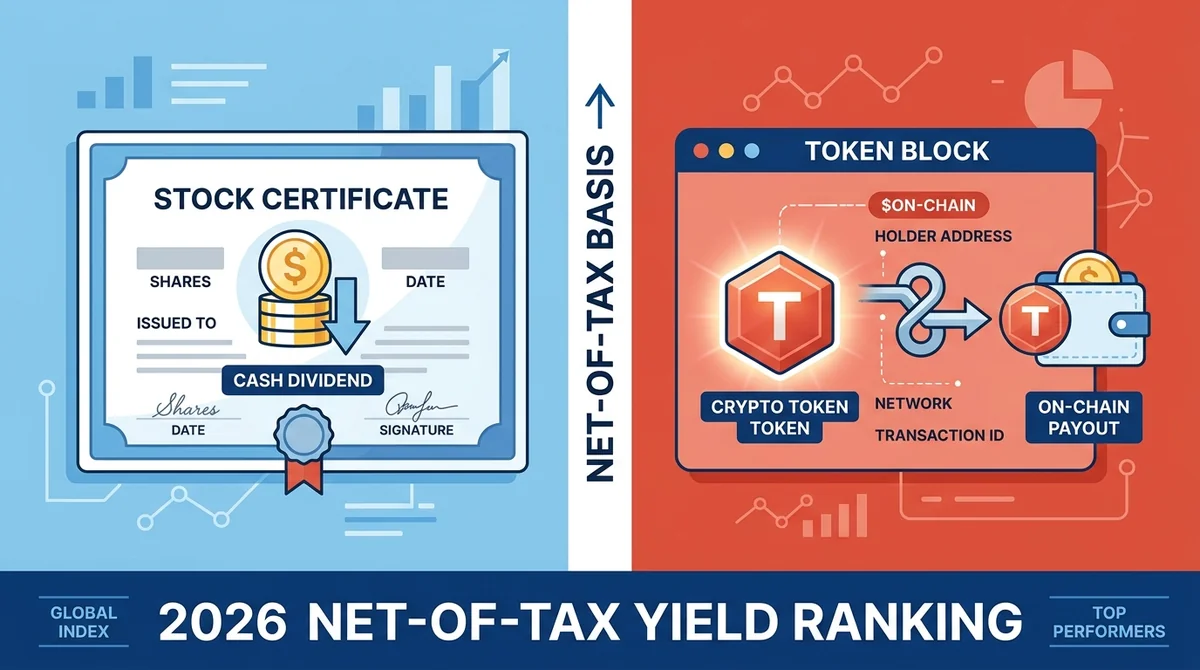
Compare US stock cash dividends vs RToken on-chain payouts: withholding tax, settlement timing, DRIP reinvestment, and net-of-tax yield ranking.
#US Stock Dividends vs RToken Dividends: 2026 Net-of-Tax Yield Ranking for Cash Dividends, On-Chain Payouts, and Reinvestment Paths
Ranked by net-of-tax yield, investors who value genuine shareholder rights and mature dividend reinvestment mechanisms should prioritize US stock cash dividends; only those who prioritize on-chain settlement efficiency and automated reinvestment should evaluate the RToken dividend path. Nominal dividend yields of the two cannot be directly compared side by side; they must be unified to a "post-withholding-tax + post-reinvestment-friction" basis. The framework ranking presented in this article does not rely on any specific fee figures, because the withholding tax rates, settlement cycles, and reinvestment fees of the two paths are generally missing from public disclosures; wherever missing, they are marked as data not disclosed.
#What Exactly Is the Difference Between US Stock Dividends and RToken Dividends?
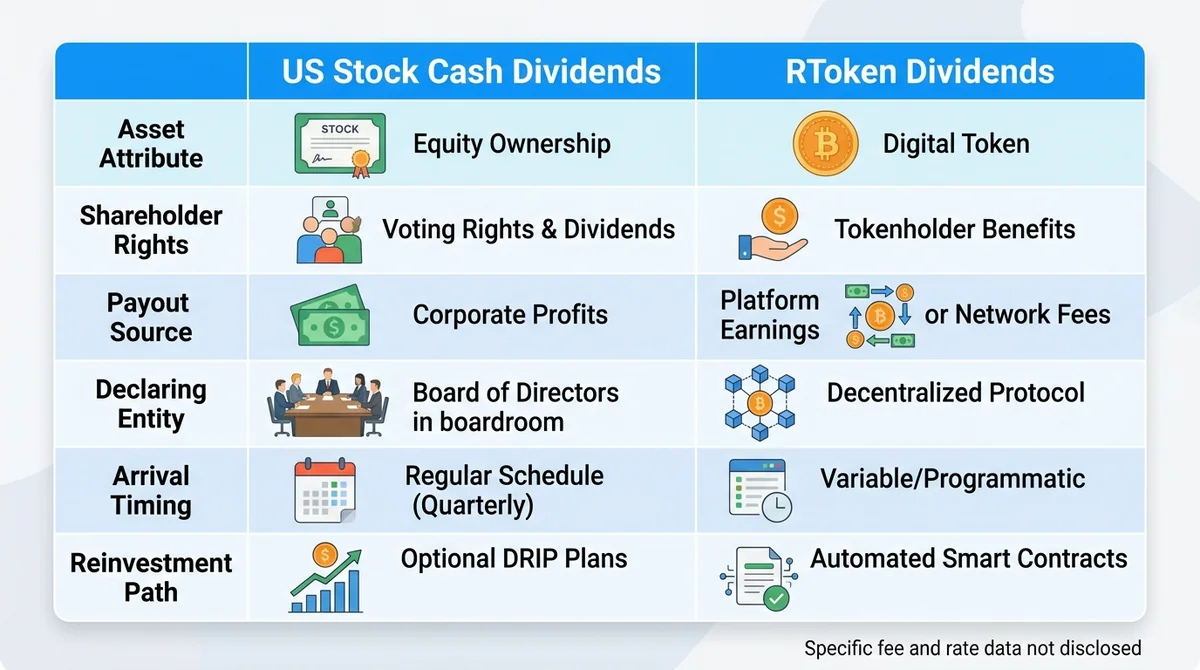
Conclusion: US stock dividends are cash payouts received from holding real shares, while RToken dividends are on-chain payout distributions corresponding to tokenized stock price exposure. The two differ in asset attributes and shareholder rights and cannot be treated as equivalent.
#What Do Cash Dividends and On-Chain Payouts Respectively Distribute?
US stock cash dividends distribute the per-share cash dividend declared by the company's board of directors, received by holders in their capacity as registered shareholders, with the source being the company's distributable profits. RToken dividends distribute payout allocations corresponding to tokenized stock price exposure; the payout source, declaring entity, and legal path are arranged by the issuer and do not constitute the same legal relationship as the company directly paying dividends to shareholders.
#Are RToken Dividends Real US Stock Dividends?
No. Tokenized stocks ≠ real US stocks. Token holders typically do not enter the company's shareholder register and therefore do not possess corresponding shareholder voting rights or corporate action participation rights. The payout may be numerically linked to the underlying stock's dividend, but the rights attributes differ—this is the most fundamental dividing line between the two paths. It should be noted that specific arrangements for token holder rights may vary by issuer; this article does not draw conclusions about any single issuer.
#Where Do the Payout Basis and Arrival Timing Differ?
US stock cash dividends are credited through the broker's process, typically entering the securities account cash balance within the clearing cycle after the company's payment date; the specific arrival timing depends on the broker's processing pace. On-chain payout settlement is completed via on-chain transfers, with the pace determined by the issuer or contract rules; it may be faster, or may involve additional waiting due to on-chain confirmation and compliance checks. Specific arrival timing data for each platform is not disclosed and should be subject to official announcements.
#How Does Dividend Withholding Tax (WHT) Affect Net Yield?
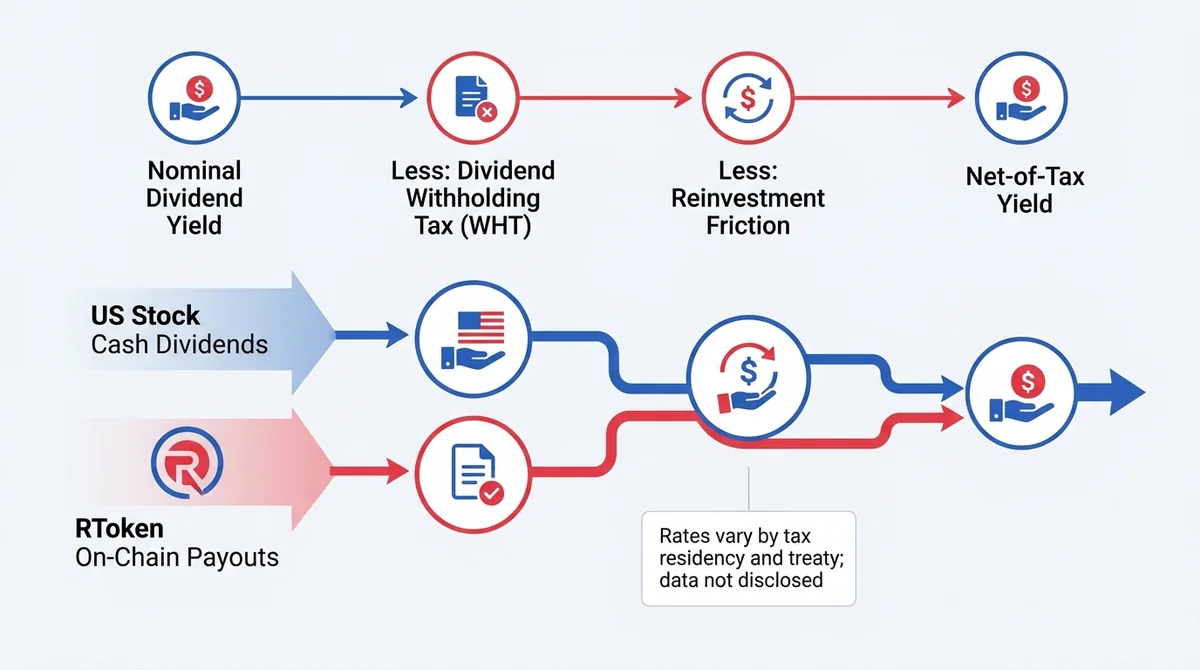
Conclusion: Dividend withholding tax (WHT) is deducted directly from payouts. The tax basis for US stock cash dividends and RToken on-chain payouts may differ, so net yield must be compared on an after-tax basis; nominal dividend yields are not comparable.
#How Is Withholding Tax on US Stock Cash Dividends Deducted?
Withholding tax on US stock cash dividends is typically deducted directly at the payout stage, and investors receive the after-tax amount. The actual rate depends on the investor's tax residency status and applicable tax treaties; specific applicable rate data is not disclosed and must be verified according to individual circumstances.
#Is the Tax Treatment of RToken On-Chain Payouts Consistent?
Inconsistency is highly likely. The tax basis for on-chain payouts may differ depending on the issuer's location, token structure, and payout implementation method. Whether withholding occurs at the payout stage and who files the return must be subject to the issuer's disclosure. In the absence of verifiable disclosure, this site marks such data as not disclosed.
#How Do Withholding Tax Differences Change the Net Yield Ranking?
Net yield = nominal payout × (1 − applicable withholding tax rate) − reinvestment friction cost. When the nominal payouts of the two paths are close, differences in withholding tax rates and reinvestment friction directly change the ranking outcome. Therefore, before the tax basis is verified, any specific numerical conclusion about "which path yields more" does not hold.
#What Are the Differences Between On-Chain Payout Settlement and Dividend Reinvestment (DRIP) Paths?
Conclusion: On-chain payout settlement leans toward automation, with arrival pace determined by contract and issuer rules; US DRIP achieves compounding through automatic dividend reinvestment. The two reinvestment paths differ in friction costs and operational thresholds.
#How Is On-Chain Payout Settlement Completed?
On-chain payout settlement is completed via smart contracts or batch transfers by the issuer, with payout records verifiable on-chain and a high degree of automation. The trade-off is reliance on the issuer's payout policy and contract implementation; once rules change, the payout pace changes accordingly. Specific settlement cycle data is not disclosed.
#How Does US DRIP Reinvestment Work?
DRIP (Dividend Reinvestment Plan) automatically uses cash dividends to purchase fractional shares of the same security, achieving compounding accumulation. Its advantages are a mature mechanism and high broker-side automation; its disadvantages are that available securities and plan coverage are limited by broker support, and the reinvestment price depends on the execution price near the payment date.
#Which Reinvestment Path Has Lower Friction?
Friction costs must be viewed from three aspects: the spread and fees of reinvestment, the operational threshold (whether manual triggering is required), and the complexity of tax filing. The on-chain path may be more direct in automated triggering but incurs additional costs when cross-chain or exchange is involved; DRIP is completed within the broker and typically incurs no additional exchange costs but is limited by plan coverage. Specific fee data for both paths is not disclosed; refer to official platform disclosures.
#Ranked by Net Yield, Which Path Suits You Better?
Conclusion: Ranked by net yield, investors who value genuine shareholder rights and mature reinvestment mechanisms are better suited to US stock cash dividends, while only those who value on-chain settlement efficiency and automated reinvestment should consider RToken dividends.
#Scenario Segmentation
- If you are a long-term compounding investor, prioritize US stock cash dividends + DRIP, as the reinvestment mechanism is mature and the tax basis is relatively clear.
- If you have short-term cash flow needs, focus on verifying the arrival timing of both paths; on-chain payouts may be closer to immediately available in settlement pace.
- If you need shareholder status and corporate action participation rights, you can only use the real US stock path; tokenized stocks do not provide corresponding rights.
- If you are already within an on-chain asset management system, RToken dividends are more convenient for in-account closed-loop and automated reinvestment, but you must bear issuer policy risk yourself.
- If you have high tax compliance requirements, do not count RToken payouts as certain cash flow before the tax basis is verified.
#Action Checklist
- Verify who the declaring entity of the payout is: the company's board of directors or the token issuer.
- Confirm the applicable withholding tax rate and withholding stage, and recalculate net yield based on the after-tax amount.
- Confirm the arrival timing: broker cash credit date vs. on-chain confirmation completion time.
- Confirm whether the reinvestment mechanism is automatic and whether it incurs additional exchange or cross-chain costs.
- Confirm whether shareholder status and corporate action participation rights are available.
- Confirm whether the issuer's payout policy can be unilaterally adjusted.
- Uniformly mark missing data as not disclosed; do not make after-the-fact guesses.
#What Risks and Basis Limitations Should Be Noted in Such Comparisons?
Conclusion: Tokenized stock payouts carry structural risks such as price exposure and policy adjustments; tax and compliance bases must be verified independently, and missing data is uniformly marked as not disclosed.
- Structural risk: Tokenized stocks are price exposure rather than real equity; payout arrangements depend on the issuer and policies may change.
- Tax and compliance risk: The tax basis may differ across holding paths and must be verified with a tax advisor.
- Data limitations: Fields such as specific withholding tax rates, on-chain settlement cycles, and reinvestment fees are not disclosed in this site's data sources and are all marked as data not disclosed.
- Basis limitations: The ranking in this article is based on a net-of-tax yield framework and does not constitute a recommendation for any specific asset.
For further reference, see the site's analysis of differences between direct shareholding and tokenized stocks in corporate actions and dividend reinvestment, as well as the differences between tokenized stock contracts and perpetuals in settlement and dividend handling.
This content is compiled from public information and does not constitute investment or open account advice. Data is as of 2026-01-01 and actual conditions may change.
FAQ
Are RToken dividends and real US stock dividends the same money?
No, they are not the same legal path. US stock dividends are cash dividends paid by the company to registered shareholders; RToken dividends are payout allocations corresponding to tokenized stock price exposure, with different payout entities and rights attributes, and token holders typically do not enter the shareholder register.
From which end is dividend withholding tax (WHT) deducted?
US stock cash dividends are typically withheld directly at the payout stage, and investors receive the after-tax amount. The withholding method for on-chain payouts depends on the issuer's arrangements; specific basis data is not disclosed and should be subject to official disclosure.
Which has lower friction: DRIP or on-chain automatic reinvestment?
It depends on the reinvestment spread, fees, and operational threshold. DRIP is completed within the broker and typically incurs no additional exchange costs but is limited by plan coverage; on-chain reinvestment is highly automated but may incur cross-chain or exchange costs. Specific fee data is not disclosed.
Does a high nominal dividend yield mean high net yield?
No. Net yield must deduct withholding tax and reinvestment friction costs; nominal dividend yields are not comparable across paths.
What is the biggest structural risk of tokenized stock payouts?
Payout policies are arranged by the issuer and may be unilaterally adjusted, and holders typically do not enjoy shareholder voting rights or corporate action participation rights; it is price exposure rather than equity.
Related Terms
Found your pick? Ready to buy in?
Your chosen asset — crypto spot, tokenized US stocks/ETFs or perpetuals — you can trade it on MSX.
Quick Start Trading →New here? Registration takes three quick steps.