AMZN Japan Shares vs AMZN US Shares: Which Valuation Is More Reasonable in 2026
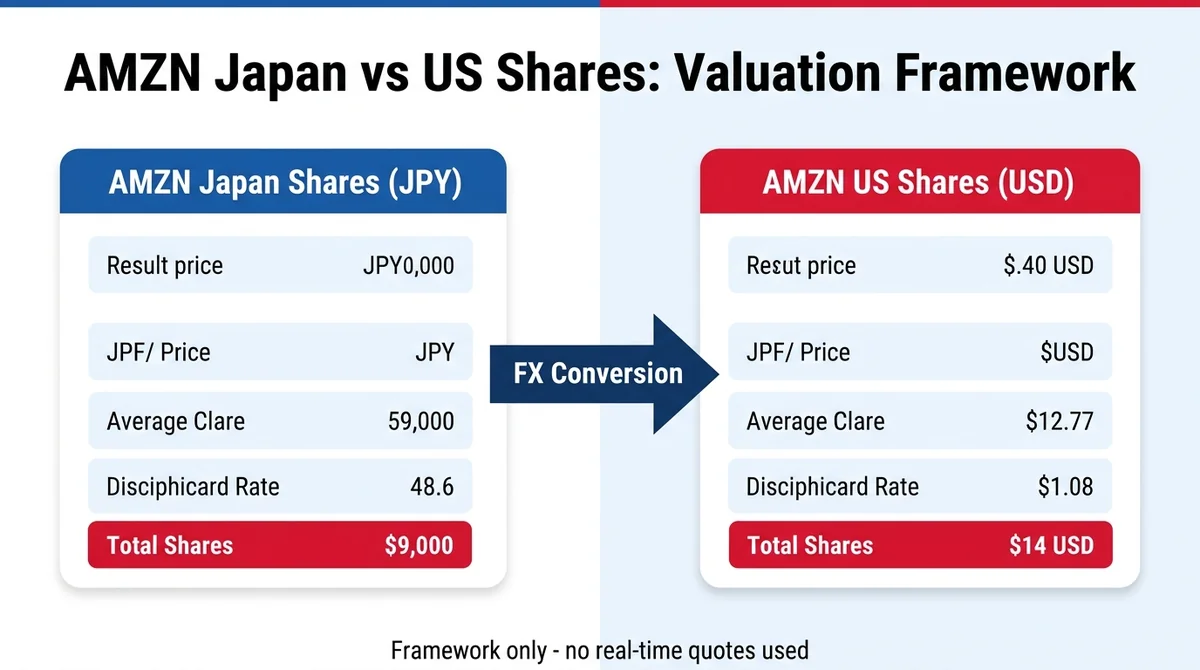
AMZN Japan and US shares are the same company; compare valuation only after adjusting for FX and trading costs. We break down currency, sessions, liquidity and tokenized exposure.
Conclusion: AMZN Japan shares and AMZN US shares correspond to the same company, so there is no independent "two sets of valuation"; the question of which is more reasonable is essentially about first normalizing for FX and trading costs, then checking whether the remaining price gap can be explained by differences in trading sessions and liquidity. This article has not obtained verifiable real-time quotes, FX rates, or spread data, so it makes no judgment on which price is higher or lower and only provides a decision framework.
#Are AMZN Japan shares and AMZN US shares the same asset?
Conclusion: They are the same underlying, but not the same trading channel. Japan shares and US shares point to equity in the same company; the differences lie in the trading venue, the pricing currency, and the trading sessions. Tokenized AMZN, by contrast, is price exposure, not actual share ownership.
#What do Japan shares and US shares each refer to?
Japan shares refer to the relevant instrument priced in yen and matched during Japanese trading hours in the Japanese market; US shares refer to the underlying stock priced in US dollars and matched during US trading hours in the US market. The company fundamentals behind both are identical, and financial reports, guidance, and corporate actions come from the same source.
#Why does the same company have two prices?
Because the pricing currencies differ, the matching sessions do not overlap, and each market has a different depth of liquidity. A yen-denominated quote must be multiplied by the FX rate to align with the USD quote, and only the remaining difference after alignment may be a deviation caused by liquidity, sessions, and costs.
#What is the relationship between tokenized AMZN exposure and real shares?
Tokenized stocks provide price exposure; holders do not obtain shareholder status, voting rights, or direct rights to corporate actions. Their price follows the real US shares and is the "effect" rather than the "cause." Therefore, token prices cannot be used in reverse to infer the reasonable valuation of the real US shares.
#Which valuation is more reasonable, AMZN Japan shares or AMZN US shares?
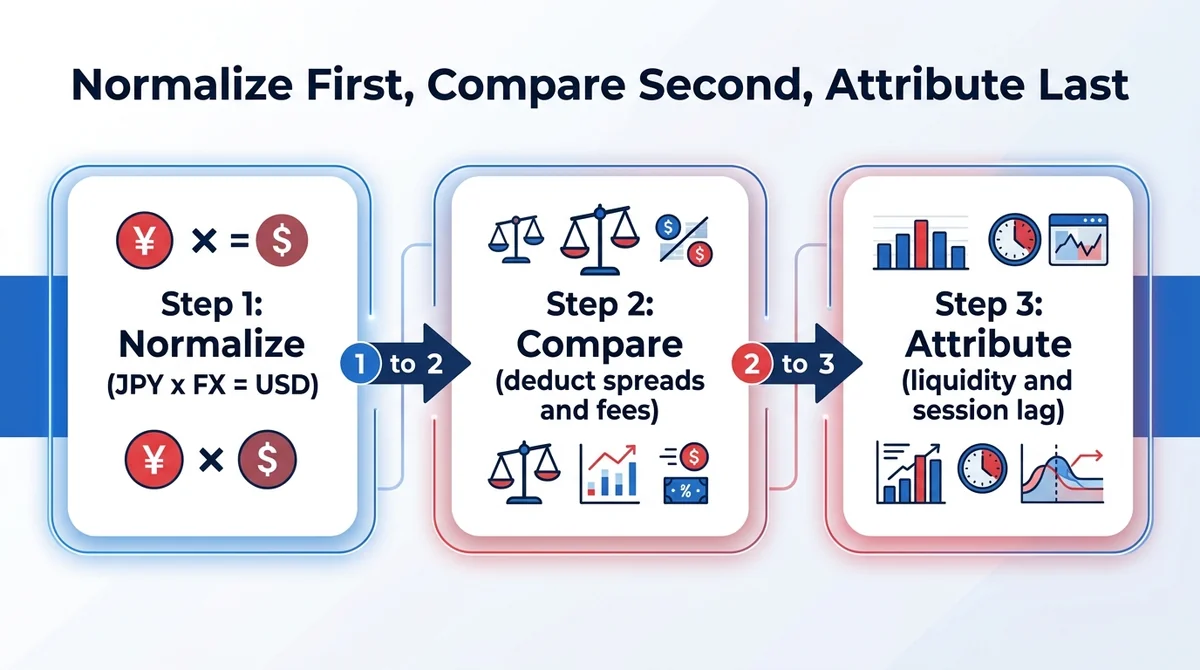
Conclusion: The order of judgment is "normalize first, compare second, attribute last"—first convert the yen quote into USD at the FX rate, then deduct the trading costs of both markets, and finally check whether the remaining price gap falls within a range explainable by liquidity and session differences.
#Which dimensions should be examined for valuation differences?
Verifiable comparison dimensions include: pricing currency, FX rate, trading sessions, liquidity depth, and trading costs (including spreads and fees). If any item is missing, the conclusion should be labeled as data not disclosed rather than filled in with speculation.
#How does the FX rate affect the quotes in the two markets?
Yen quote × FX rate = USD-equivalent quote. The FX rate itself is a volatile variable; even if the underlying stock prices in the two markets move in perfect sync, the yen quote will deviate due to FX movements. Therefore, the first layer of explanation for a cross-market price gap is always the FX rate, not a valuation disagreement.
#At what level does a premium or discount count as abnormal?
A reasonable approach is to set an "explainable range": add up the bid-ask spread, two-way trading costs, and the information lag caused by session mismatch to obtain a theoretically tolerable deviation. Only the portion beyond that range is worth further attribution. The specific threshold depends on real-time data, and this article does not provide a numerical judgment.
#What impact do differences in trading sessions and liquidity between the two markets have?
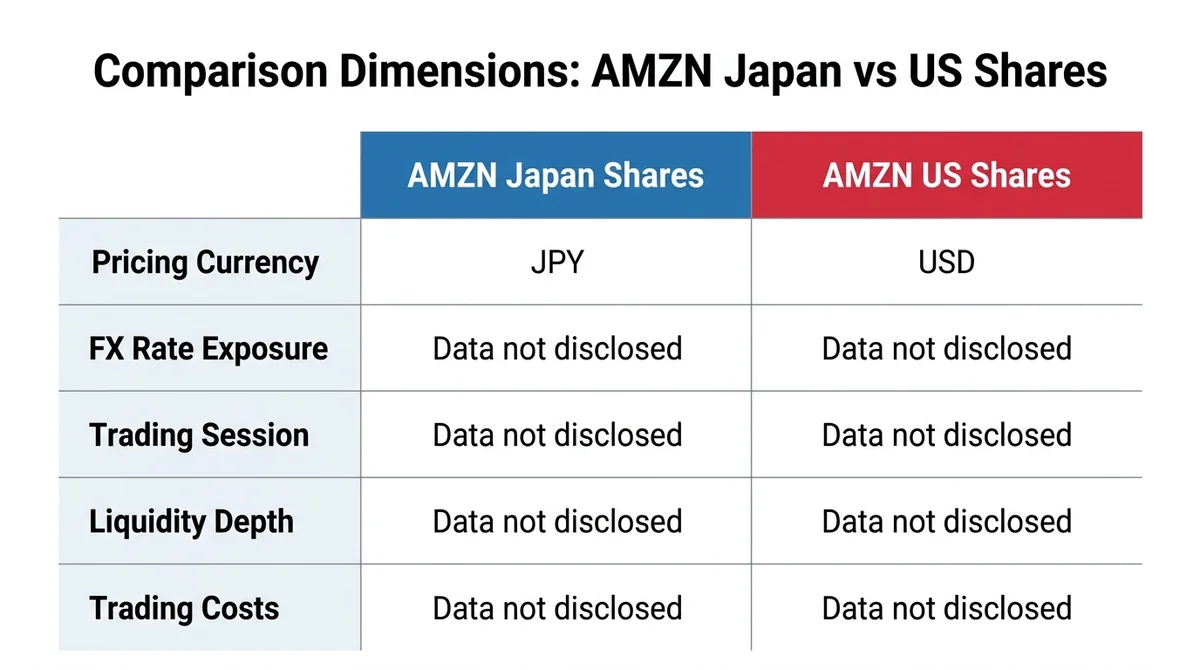
Conclusion: Non-overlapping sessions cause information to be reflected at different times, and liquidity differences affect actual execution prices through bid-ask spreads; together, the two create an apparent "valuation gap."
#What does non-overlapping trading sessions bring?
When the US market is closed and the Japanese market is open, the Japanese market quote reflects the latest available information plus local supply and demand, not the real-time US share price. Information is digested in segments across the two sessions, so the price gap carries a time attribute.
#How do liquidity differences show up in the spread?
The thinner the liquidity, the wider the bid-ask spread usually is. A wide spread means a larger gap between the buy price and the sell price at the same moment; comparing mid prices will underestimate actual execution costs, while comparing execution prices may misread the spread as a valuation deviation.
#How is overnight information reflected in prices?
News that appears overnight is concentrated into the next opening session, creating an opening gap. When comparing across markets, if the two markets are at different stages of information digestion, any point-in-time snapshot may be distorted.
#How much reference value does tokenized AMZN exposure have for valuation?
Conclusion: Limited reference value. Tokenized stocks are price exposure rather than shareholder equity; tokenized stock perpetuals further add perpetual futures leverage and funding rates, and token prices can only serve as a following indicator, not be used to reverse-engineer the valuation of real US shares.
#How do tokenized stocks differ from real US shares?
Real US shares correspond to shareholder status, voting rights, and rights to corporate actions; tokenized stocks correspond to price exposure. The two are highly correlated in price direction but completely different in rights, tax treatment, and platform dependence.
#What additional risks do tokenized stock perpetuals add?
Perpetual futures are derivatives and add perpetual futures leverage and a funding rate mechanism. The funding rate continuously generates holding costs over time, while leverage introduces forced liquidation risk. Neither exists in spot exposure.
#Is it feasible to use token prices to infer US share valuation?
No. The causal direction is that US share prices are the cause and token prices are the effect. The token market's own liquidity, funding rate, and leverage structure introduce additional deviations; using it to infer the underlying stock valuation would mistake derivative noise for fundamental signals.
#How to choose under different needs: scenario breakdown
Conclusion: Long-term holders should prioritize the channel closest to real shares; only short-term traders should consider derivatives; users who cannot bear liquidation risk should directly exclude perpetual products.
- If you are a long-term holder: Prioritize the channel closest to real share equity, focusing on shareholder rights, corporate action treatment, and tax arrangements rather than chasing short-term price gaps.
- If you are a short-term spread trader: You may evaluate derivative channels, but you must first factor the funding rate and leverage costs into your break-even point.
- If you cannot bear liquidation risk: Avoid perpetual products and consider only unleveraged spot or tokenized spot exposure.
- If you only want price exposure: Tokenized products are usable, but you must understand that they do not include shareholder rights and depend on continued platform operation.
- If you are comparing prices across markets: First unify the currency, then unify the time point, and finally unify the cost basis; otherwise the comparison is invalid.
#Action checklist
- Confirm whether the two quotes are taken at the same time point; if not, align the time points first.
- Convert the yen quote into a USD equivalent using the FX rate at the same time point.
- Record the bid-ask spread and two-way trading costs of each market separately.
- Calculate the remaining price gap after deducting costs and judge whether it falls within the explainable range.
- Verify the equity attributes of the instrument: is it the underlying stock, tokenized spot, or a perpetual derivative.
- If derivatives are involved, calculate the annualized holding cost of the funding rate.
- Label any missing field as "data not disclosed" rather than substituting an estimate.
#FAQ
Q1: Are AMZN Japan shares and US shares the same company? A: Yes, the same company and the same fundamentals; the differences lie in the trading venue, pricing currency, and trading sessions.
Q2: Why can't the two quote numbers be compared directly? A: Because the pricing currencies differ. A yen quote must first be converted into a USD equivalent at the FX rate before it is comparable.
Q3: Can tokenized AMZN replace real US shares? A: No. Tokenized stocks provide price exposure and do not include shareholder status or direct rights to corporate actions.
Q4: How large a price gap counts as abnormal? A: The FX rate, bid-ask spread, and two-way costs must first be deducted, and only the remainder can be discussed. This article has not obtained verifiable real-time data and does not provide a specific threshold.
Q5: Are perpetual futures suitable for long-term holding? A: No. Perpetuals add perpetual futures leverage and how does perpetual futures funding rate work, so long-term holding continuously accumulates costs and carries liquidation risk.
This content is compiled from public information and does not constitute investment or open account advice. No verifiable real-time quotes or fee data are cited in this article; to check the latest quotes and fees, please refer to the relevant platforms' official sources.
FAQ
Are AMZN Japan shares and US shares the same company?
Yes, the same company and the same fundamentals; the differences lie in the trading venue, pricing currency, and trading sessions.
Why can't the two quote numbers be compared directly?
Because the pricing currencies differ. A yen quote must first be converted into a USD equivalent at the FX rate before it is comparable.
Can tokenized AMZN replace real US shares?
No. Tokenized stocks provide price exposure and do not include shareholder status or direct rights to corporate actions.
How large a price gap counts as abnormal?
The FX rate, bid-ask spread, and two-way costs must first be deducted, and only the remainder can be discussed. This article has not obtained verifiable real-time data and does not provide a specific threshold.
Are perpetual futures suitable for long-term holding?
No. Perpetuals add perpetual futures leverage and how does perpetual futures funding rate work, so long-term holding continuously accumulates costs and carries liquidation risk.
Related Terms
Read the review? Ready to try a small position?
The crypto assets and tokenized US stocks/ETFs covered here are available on MSX — spot and perpetuals.
Quick Start Trading →New here? Registration takes three quick steps.