Corporate Bonds
Corporate bonds are debt obligations of a company issuer; holders are creditors. Learn repayment mechanics, differences vs stocks and treasury bonds, 5-dimension risk assessment, and a checklist.
Conclusion: A corporate bond is a debt obligation through which a company issuer borrows from investors and promises to repay principal plus interest; holders are creditors, not shareholders. A high coupon is not the only criterion — the key question is whether the coupon and credit spread adequately compensate for the default risk and liquidity risk assumed.
Data cutoff date: 2026-06-30 (this article is general information only and contains no real-time market data; please refer to the offering documents and official disclosures for specific terms and figures).
Disclaimer: This content is general information only. It does not constitute investment advice or advice to open account, nor does it recommend any specific security. To verify terms, please consult the offering documents and official disclosure sources.
#What exactly is a corporate bond? How does it differ from stocks and interest rate bonds?
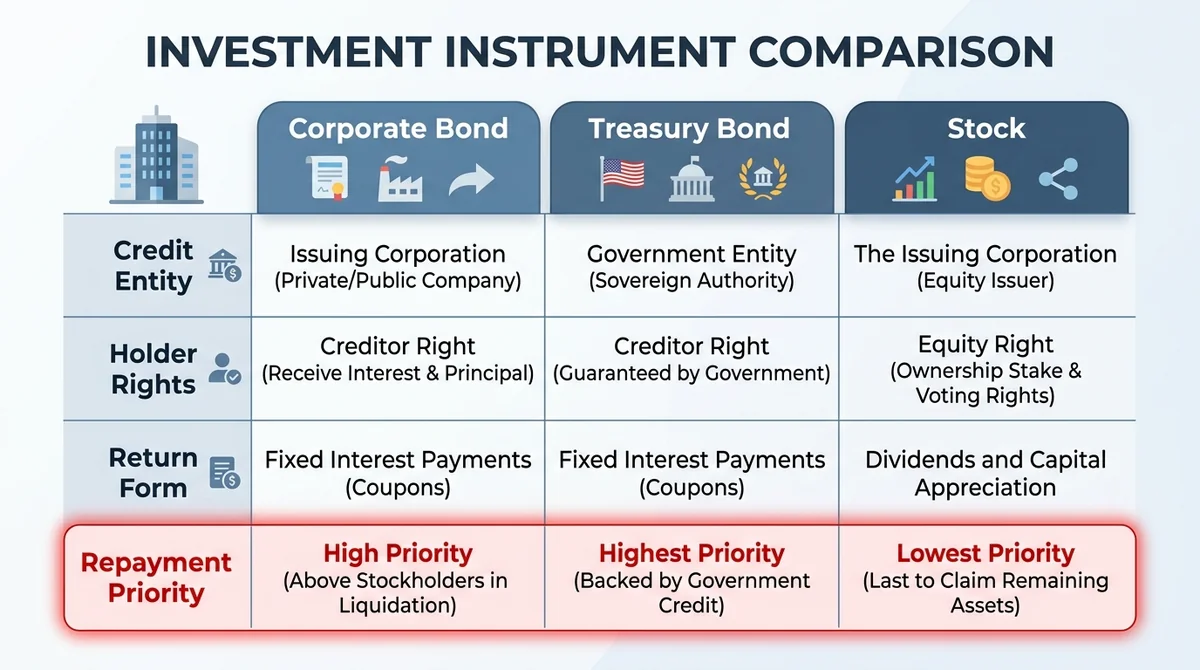
A corporate bond is a debt obligation through which a company issuer borrows from investors and promises to repay principal and interest as agreed. Holders are creditors; they have no residual claim or management participation rights, but they rank ahead of shareholders in the repayment order. The credit entity is a company, so credit risk is typically higher than for sovereign or quasi-sovereign bonds (a qualitative judgment based on general financial principles, not a conclusion from specific data).
Note: This article does not cover specific issuers, specific securities, or real-time spread figures; market data references are qualitative only, and specific figures should be based on offering documents and authoritative market data.
#How does the principal and interest repayment mechanism of a corporate bond work?
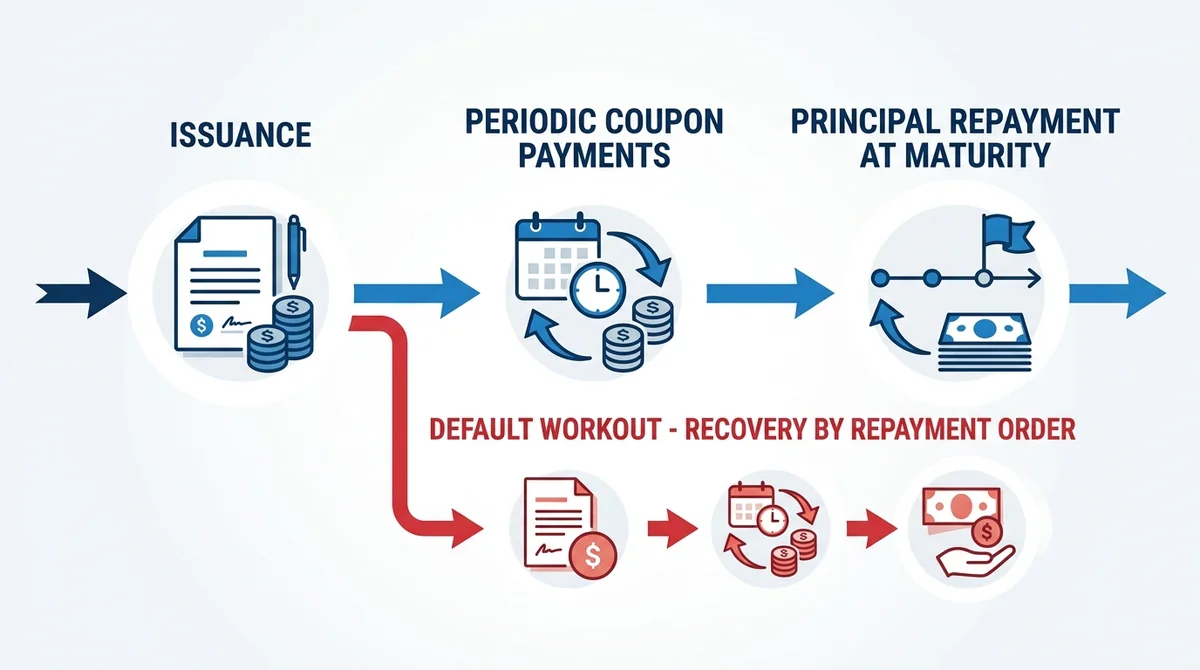
Under the terms of the offering, the issuer pays coupons periodically during the life of the bond and repays principal at maturity. The coupon level, payment frequency, maturity structure, and whether put or call provisions apply are all governed by the offering documents. If the issuer cannot meet its obligations, a default workout process begins, and holders participate in recovery according to the repayment order.
#How do the rights of corporate bonds differ from those of stocks?
Stocks represent ownership; holders have a residual claim and management participation rights (such as voting), and dividends are not fixed or promised. Corporate bonds represent a creditor's claim; returns are agreed in the form of coupons, holders do not participate in management decisions, but they rank ahead of shareholders in bankruptcy liquidation. The sources of risk differ: stocks bear operating and valuation fluctuations, while corporate bonds mainly bear the issuer's debt-servicing capacity and interest rate changes.
#What are the core differences between corporate bonds, treasury bonds, and financial bonds?
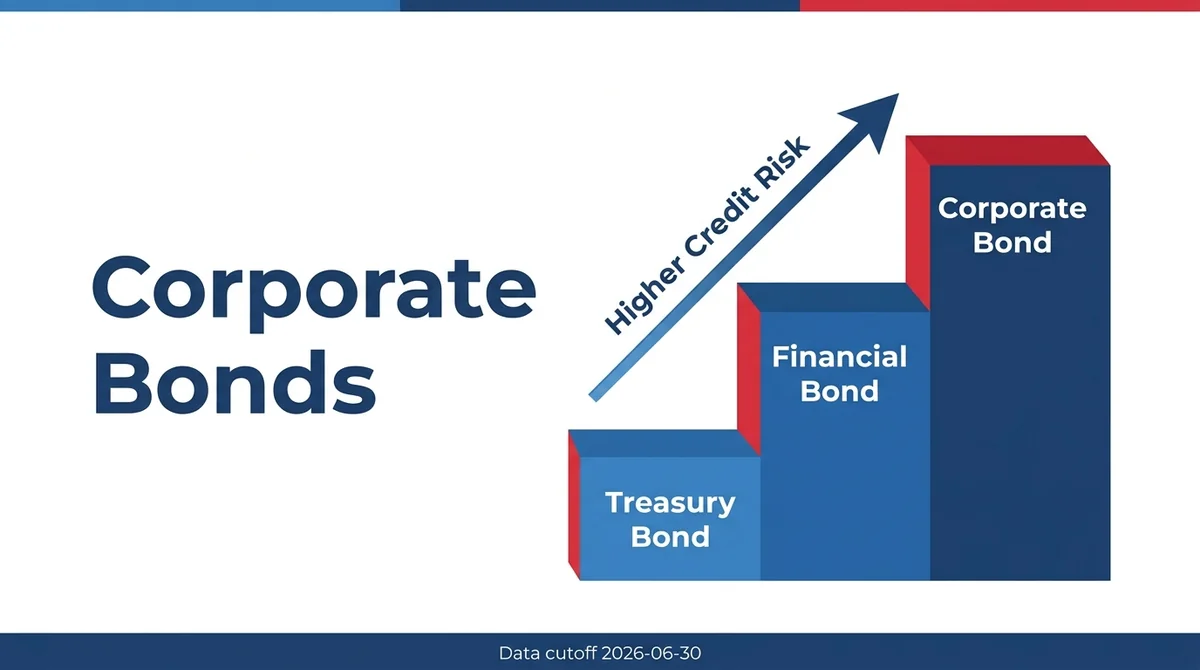
The core difference lies in the credit entity: treasury bonds rely on sovereign credit, financial bonds rely on financial institution credit, and corporate bonds rely on general corporate credit. Differences in the credit entity's tier generally correspond to a ranking of credit risk; corporate bonds typically carry higher credit risk than treasury bonds and financial bonds, so they require a higher coupon or credit spread as compensation. Specific spread levels vary with the market and individual securities; this article does not provide unverified specific figures.
The credit entity tier determines the risk ranking: treasury bonds use the sovereign as credit entity, financial bonds use financial institutions, and corporate bonds use general companies, with credit risk generally rising in that order.
| Comparison dimension | Corporate bond | Treasury bond | Stock |
|---|---|---|---|
| Credit entity | General company | Sovereign | Issuing company |
| Holder rights | Creditor's claim, coupon as agreed | Creditor's claim, coupon as agreed | Ownership, including residual claim and management participation |
| Repayment order | Ahead of shareholders | Usually highest priority | Subordinate to creditors |
| Main risk sources | Issuer's debt-servicing capacity, interest rates, liquidity | Mainly interest rates | Operating and valuation fluctuations |
| Return form | Agreed coupon | Agreed coupon | Dividends not fixed, includes capital gains |
#How should the risk-return characteristics of corporate bonds be assessed? Scoring on five dimensions
Corporate bonds can be assessed by scoring five dimensions: credit risk, interest rate risk, liquidity risk, return compensation, and covenant complexity. The core is judging whether the coupon adequately compensates for the credit and liquidity risks assumed.
Five-dimension assessment checklist:
- Credit risk: examine the issuer's qualifications and debt-servicing capacity;
- Interest rate risk: examine how duration amplifies price volatility;
- Liquidity risk: examine trading activity and liquidation costs;
- Return compensation: examine whether the coupon and credit spread cover default losses and liquidity discounts;
- Covenant complexity: examine put, call, cross-default, guarantee, and subordination arrangements.
#How should credit risk be judged?
Credit risk takes priority over the coupon: for corporate bonds, first look at the issuer's debt-servicing capacity, then at whether the coupon compensates for the spread and liquidity discount.
Examine the issuer's qualifications and debt-servicing capacity, including operating stability, cash flow coverage of interest, asset-liability structure, guarantee arrangements, and repayment order. Credit ratings can serve as a reference but cannot replace independent judgment on debt-servicing capacity.
#What is the relationship between interest rate risk and duration?
Duration is the core measure of interest rate risk: the longer the duration, the more sensitive the bond price is to interest rate changes, and when rates rise, the valuation of long-duration corporate bonds typically falls more.
The longer the duration, the more sensitive the bond price is to interest rate changes. When rates rise, the valuation of long-duration bonds typically falls more; the reverse applies when rates fall. Therefore, under expectations of rising rates, long-duration corporate bonds carry higher price volatility risk.
#Where does liquidity risk show up?
In trading activity and liquidation costs. For thinly traded securities, selling may involve wider bid-ask spreads or failure to execute in time, and the actual liquidation price may be below the carrying valuation.
#Is the yield compensation sufficient?
The coupon and credit spread must be viewed together: does the coupon match the issuer's credit risk, the maturity length, and the liquidity discount? If the coupon does not cover potential default losses and liquidity costs, the risk compensation is insufficient.
#Covenant complexity
Provisions such as put, call, cross-default, guarantee, and subordination arrangements change the actual risk exposure. The more complex the covenants, the more each clause must be checked individually rather than looking only at the coupon.
#What are the advantages and disadvantages of corporate bonds?
Advantages: Coupons are relatively certain, and cash flow predictability is higher than stock dividends; the repayment order ranks ahead of shareholders, giving a higher priority in liquidation scenarios.
Disadvantages: Bearing the issuer's default risk, which may cause partial or total loss of principal; relatively weak liquidity, with potentially high liquidation costs for individual securities; valuation comes under pressure when interest rates rise.
#What are the advantages of corporate bonds over stocks?
The return source is mainly the agreed coupon, not dependent on the company's profit growth and valuation expansion; the repayment order ranks ahead of shareholders. The trade-off is not sharing in the company's upside.
#What extra risk do corporate bonds bear compared with interest rate bonds?
They bear the credit risk of the issuing entity and typically weaker liquidity. This additional risk needs to be compensated by a higher coupon or credit spread.
#How much can creditors recover in a default?
Recovery rates depend on guarantee arrangements, repayment order, and workout outcomes, and are uncertain. This article does not provide specific recovery rate figures: such data vary greatly by case and lack publicly available statistics on a consistent basis.
#What kind of investors are suited to allocating corporate bonds?
Corporate bonds are generally suited to investors seeking relatively stable coupons, able to bear credit and liquidity risk, and able to diversify their allocations. They are not suited to people who need to cash out at any time or cannot bear principal loss.
#Are they suitable for people seeking stable coupons?
A relatively certain coupon is their core feature, but "certain" refers to the contractual terms, not to being risk-free. Those seeking coupons must also accept the possibility of default and price volatility.
#How can people who can bear credit risk judge for themselves?
Self-check on three points: whether you can accept principal loss from a single issuer's default; whether you are able to read offering documents and financial information; whether your holdings are already diversified across multiple issuers.
#What proportion should they make up of a portfolio?
The allocation should be based on the overall risk budget, avoiding excessive concentration in a single issuer. This article does not give specific percentage recommendations; judgment should be based on individual risk tolerance and portfolio structure.
#When should you not buy corporate bonds?
When you need to cash out at any time, cannot bear principal loss, or cannot verify the offering documents, corporate bonds are not appropriate.
If the funds may be needed in the short term, you cannot bear principal loss, or you lack the ability to read offering documents and track the issuer's debt-servicing capacity, then corporate bonds are not suitable.
#What risks should be watched when investing in corporate bonds?
Credit default: Default may cause partial or total loss of principal, and the workout period may be long.
Interest rate risk: Rising rates bring valuation declines, with greater sensitivity the longer the duration.
Concentration risk: Concentrated holdings in a single issuer amplify the impact of a single entity; diversifying issuers reduces the impact of individual events.
Liquidity risk: Thinly traded securities are difficult to liquidate under stress and may be forced to accept discounts.
Trading costs and taxes: Bid-ask spreads, commissions, and interest income taxes erode actual take-home returns, and must be considered together when assessing the coupon.
Three-step action checklist:
- Assess risk tolerance: confirm whether you can accept a single issuer's default and price volatility;
- Diversify issuers: avoid excessive concentration in a single entity, and allocate according to the risk budget;
- Verify offering documents: check coupon, maturity, put/call, guarantee, and repayment order clauses one by one.
#FAQ
See the structured Q&A below.
This content is general information only. It does not constitute investment advice or advice to open account, nor does it recommend any specific security. It contains no real-time market data; to verify terms, please consult the offering documents and official disclosure sources.
FAQ
Are corporate bonds principal-protected?
No. Corporate bonds are debt obligations of the issuer; if the issuer defaults, holders may lose part or all of their principal, and recovery rates depend on guarantees and repayment order and are uncertain.
What is the biggest difference between corporate bonds and stocks?
The nature of the rights differs. Stocks are ownership, including residual claims and management participation rights, with non-fixed dividends; corporate bonds are creditor's claims, paying coupons as agreed, not participating in management, but ranking ahead of shareholders in repayment order.
What does long duration mean for corporate bonds?
It means the price is more sensitive to interest rate changes. When rates rise, the valuation of long-duration bonds typically falls more, and the reverse applies when rates fall, so duration is the core measure of interest rate risk.
Is a higher coupon always better for corporate bonds?
No. A high coupon often corresponds to higher credit risk or weaker liquidity; you need to judge whether the coupon and credit spread adequately compensate for the risks assumed.
What should ordinary investors watch when allocating corporate bonds?
Diversify issuers, verify offering documents and covenants, assess your own tolerance for default and liquidity risk, and factor bid-ask spreads and taxes into return calculations, avoiding excessive concentration in a single entity.
Read the review? Ready to try a small position?
The crypto assets and tokenized US stocks/ETFs covered here are available on MSX — spot and perpetuals.
Quick Start Trading →New here? Registration takes three quick steps.