Crude Oil
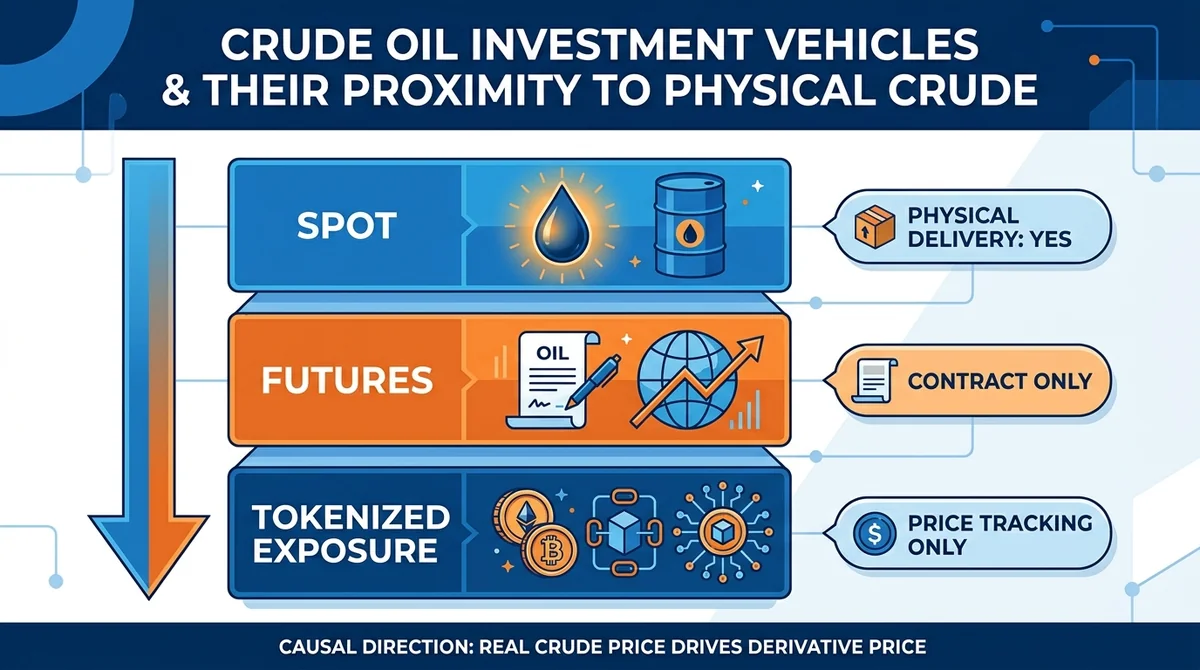
Spot, futures, and tokenized exposure differ in what you hold, perpetual futures leverage, liquidity, and cost. Compare all three paths without predicting prices.
Conclusion: The essential difference between crude oil trading paths comes down to "what you actually hold" — spot means holding physical crude or rights to it, futures means holding standardized contracts with perpetual futures leverage and expiry constraints, and tokenized exposure means holding only a derivative that tracks the price. First decide whether you want the physical asset, a contract, or price exposure, then talk about costs and risks.
#What crude oil trading methods exist, and what does each one actually trade?
Crude oil trading falls into three categories: spot, futures contracts, and tokenized price exposure. Each sits at a different level of the underlying asset: spot is closest to real crude oil, futures come next, and tokenized exposure is furthest away. Key point: do not conflate the three, because they do not trade the same thing.
#What does spot crude oil trading involve?
Spot crude oil trading involves physical crude oil or rights to physical crude, and includes real buying and selling, storage, and delivery. Characteristics: no perpetual futures leverage, no expiry date — you hold the asset itself rather than a price contract. Data not disclosed: specific delivery locations, storage costs, and quality premiums vary by market and must be confirmed with the counterparty's disclosures.
#What does a crude oil futures contract trade?
Crude oil futures trade standardized contracts that agree to deliver at an agreed price at a future point in time. Characteristics: perpetual futures leverage, an expiry date, and the need to roll over or take delivery. Leverage magnifies gains and losses, and expiry constraints bring rolling costs. Data not disclosed: specific contract specifications, margin ratios, and rollover costs vary by exchange and contract month.
#How does tokenized commodities exposure relate to real crude oil?
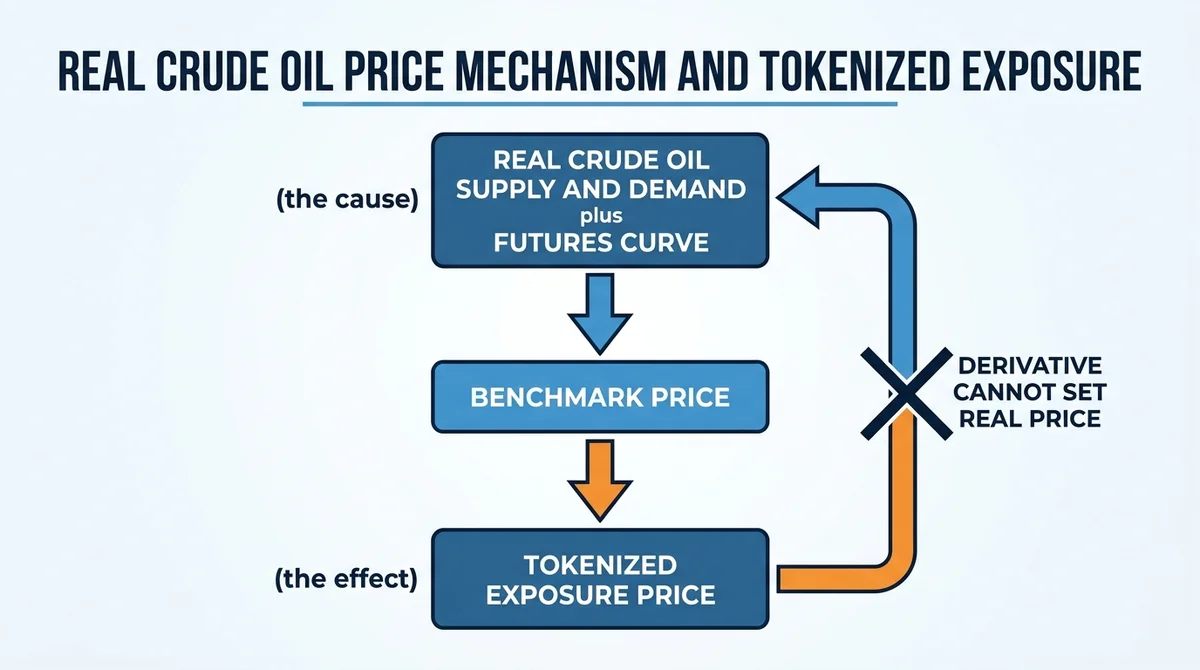
Tokenized commodities exposure is a price derivative: the real crude oil price is the cause, and the token price is the effect. Key point: it tracks price movements and carries no physical ownership or delivery rights, while also adding issuer credit risk and secondary-market liquidity risk. Data not disclosed: issuer reserve mechanisms, redemption terms, and on-chain liquidity must be confirmed through the issuer's public disclosures.
#What are the key differences between spot, futures, and tokenized exposure?
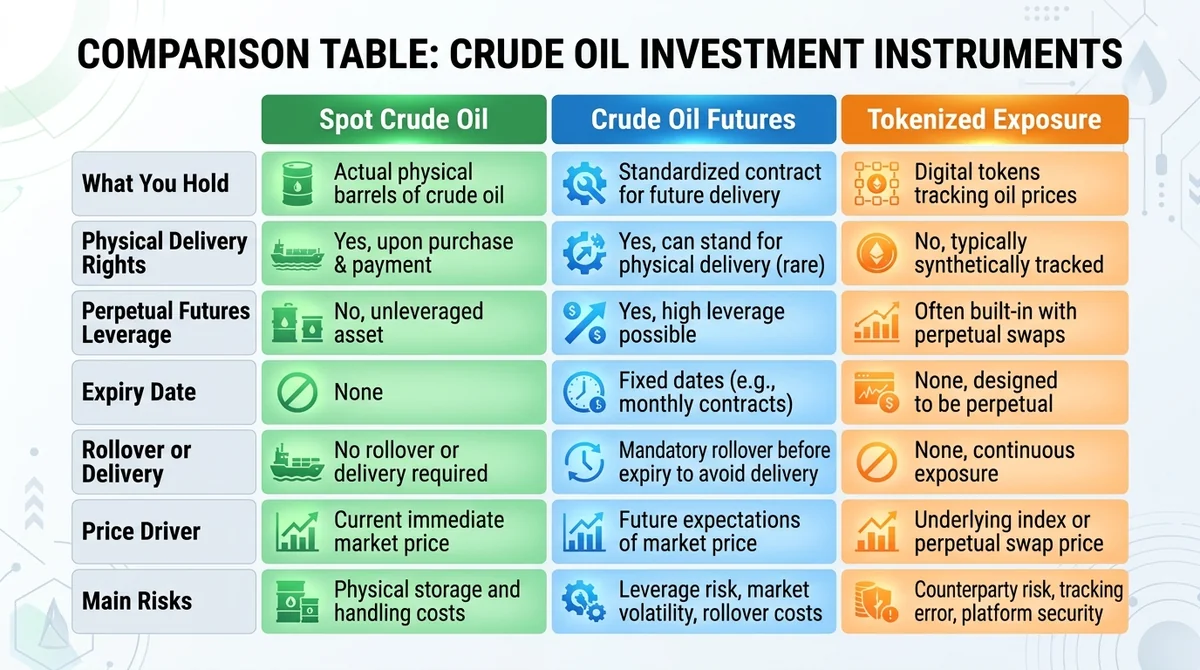
The three differ structurally in what is held, in perpetual futures leverage and expiry constraints, and in how prices are determined. Core point: the real crude oil price is the cause and the derivative exposure price is the effect; the direction cannot be reversed.
#Do you hold the physical asset or rights to it?
Spot holds the physical asset or rights to it; futures holds contractual rights that can be delivered or closed out at expiry; tokenized exposure holds no physical asset, only a price-tracking certificate. Test: ask yourself "can I demand physical delivery?" The answer tells you which layer you are in.
#How do perpetual futures leverage and expiry constraints differ?
Spot has no perpetual futures leverage and no expiry; futures have perpetual futures leverage and an expiry date, requiring rollover or delivery; the perpetual futures leverage of tokenized exposure depends on product design — some products have none, some do. Key point: the presence of perpetual futures leverage and expiry constraints is the core marker separating spot from futures.
#Who determines the price, and who follows whom?
Supply and demand in the real crude oil market and the futures curve determine the benchmark price, and tokenized exposure follows that price. Key point: derivative exposure cannot in turn determine the real crude oil price; understanding this causal direction is a prerequisite for evaluating any tokenized product.
#Differences in settlement and delivery mechanisms
Spot involves physical delivery and storage logistics; futures are settled through exchange clearinghouses, with physical delivery or cash close-out; tokenized exposure settles on-chain or within a platform, with redemption mechanisms set by the issuer. Data not disclosed: specific settlement cycles and redemption thresholds must follow each platform's rules.
#Five-dimension evaluation of crude oil trading paths: how should they be scored?
Evaluating along five dimensions — holding method, perpetual futures leverage risk, liquidity, cost structure, and suitable audience — lets you compare structural pros and cons without predicting prices. Scoring method: score each dimension by structural characteristics, mark missing data as not disclosed, and keep scoring transparent and reproducible.
#What does the holding method dimension look at?
Whether you hold the physical asset or rights to it, and whether ownership is attached. Scoring logic: holding physical rights scores highest, holding contracts comes next, and holding only a price-tracking certificate scores lowest.
#What does the perpetual futures leverage and risk dimension look at?
Whether there is perpetual futures leverage, whether there are expiry constraints, and whether forced liquidation is possible. Scoring logic: no perpetual futures leverage and no expiry scores highest, with deductions for perpetual futures leverage or expiry constraints.
#What does the liquidity and cost dimension look at?
Market depth, bid-ask spreads, rollover costs, and storage fees. Scoring logic: the deeper the liquidity and the lower the explicit and implicit costs, the higher the score. Data not disclosed: specific fee rates and spreads for each path must follow the trading venue's disclosures.
#How is the suitable audience dimension judged?
By the capital threshold, knowledge threshold, and risk tolerance the path requires. Scoring logic: the lower the threshold and the more suitable for ordinary researchers, the higher the score; high-perpetual futures leverage paths score lower for ordinary users.
#Which crude oil trading path should you choose for different needs?
Route by need, with no buy or sell advice. Next step: first clarify whether your goal is allocation, hedging, or pure price exposure, then match it against the paths below.
- If you are a long-term allocator: lean toward paths without perpetual futures leverage that you can hold, and prioritize understanding the holding costs of spot and physical rights.
- If you need to hedge price volatility: look at futures contract tools and expiry management capability, and clarify rollover costs and margin requirements.
- If you only want price exposure and can bear perpetual futures leverage: only then consider derivative paths, and recognize that their risk level is higher than spot.
- If you cannot bear forced-liquidation risk: avoid contracts with perpetual futures leverage and some tokenized leveraged products.
- If you need physical delivery: only the spot path can satisfy this, and you must verify delivery and storage arrangements.
#What risks must you know about crude oil derivatives trading?
Risk in derivative paths comes from three layers: perpetual futures leverage, expiry, and the issuer. Key point: price movements are unpredictable; the following is only a structural risk description and constitutes no advice.
#Why does perpetual futures leverage magnify losses?
Perpetual futures leverage magnifies gains and losses proportionally, and losses can exceed the initial margin and trigger forced liquidation. Key point: perpetual futures leverage does not change price direction, it only magnifies the outcome.
#What costs do expiry and rollover bring?
Contracts must be closed or rolled at expiry, and rollover generates rolling costs when the term structure is unfavorable, potentially eroding returns over long holding periods. Key point: expiry constraints are the structural difference between futures and spot.
#Why does tokenized exposure carry an extra layer of risk?
Tokenized exposure adds issuer credit risk, redemption mechanism risk, and secondary-market liquidity risk. Key point: beyond price tracking, you must assess whether the issuer is reliable and whether redemption is smooth. Data not disclosed: specific issuer reserves and audit status must follow their public disclosures.
#FAQ
Q: What is the core difference between spot crude oil and futures? A: Spot holds the physical asset or rights to it, with no perpetual futures leverage and no expiry; futures are standardized contracts with perpetual futures leverage and expiry constraints, requiring rollover or delivery.
Q: Can you get physical crude oil from tokenized commodities exposure? A: Usually not. Tokenized exposure is a price derivative that tracks price movements and carries no physical ownership or delivery rights, subject to the issuer's terms.
Q: How do you evaluate the pros and cons of crude oil trading paths? A: Use a five-dimension evaluation of holding method, perpetual futures leverage risk, liquidity, cost structure, and suitable audience, scoring by structural characteristics rather than predicting prices.
Q: Who are leveraged crude oil products suitable for? A: Only participants who clearly understand forced-liquidation mechanisms and can bear magnified losses; those who cannot bear forced-liquidation risk should avoid them.
Q: What should you do when data is missing? A: Mark missing fields as not disclosed, rely on the public disclosures of trading venues or issuers, and do not speculate.
This content is compiled from public data and does not constitute investment or open account advice. Data is as of 2026-01-01 and actual conditions may change. To verify specific rules, check the official sources of the relevant trading venues and issuers.
FAQ
What is the core difference between spot crude oil and futures?
Spot holds the physical asset or rights to it, with no perpetual futures leverage and no expiry; futures are standardized contracts with perpetual futures leverage and expiry constraints, requiring rollover or delivery.
Can you get physical crude oil from tokenized commodities exposure?
Usually not. Tokenized exposure is a price derivative that tracks price movements and carries no physical ownership or delivery rights, subject to the issuer's terms.
How do you evaluate the pros and cons of crude oil trading paths?
Use a five-dimension evaluation of holding method, perpetual futures leverage risk, liquidity, cost structure, and suitable audience, scoring by structural characteristics rather than predicting prices.
Who are leveraged crude oil products suitable for?
Only participants who clearly understand forced-liquidation mechanisms and can bear magnified losses; those who cannot bear forced-liquidation risk should avoid them.
What should you do when data is missing?
Mark missing fields as not disclosed, rely on the public disclosures of trading venues or issuers, and do not speculate.
Related Terms
Read the review? Ready to try a small position?
The crypto assets and tokenized US stocks/ETFs covered here are available on MSX — spot and perpetuals.
Quick Start Trading →New here? Registration takes three quick steps.