Databricks Pre-IPO Token: Risk and Return
Databricks pre-IPO tokens are price exposure, not equity. We break down return drivers, liquidity and exit paths, with a 5-factor qualitative risk view.
Bottom line: A Databricks pre-IPO token offers price exposure to the company's pre-listing stage, not equity. It is not a standardized investment product you can freely buy and sell. It only suits people who can tolerate a long lock-up and participate with a small position using money they can afford to lose. Anyone who needs liquidity, or who treats the token as real equity, should stay away.
#What exactly is a Databricks pre-IPO token?
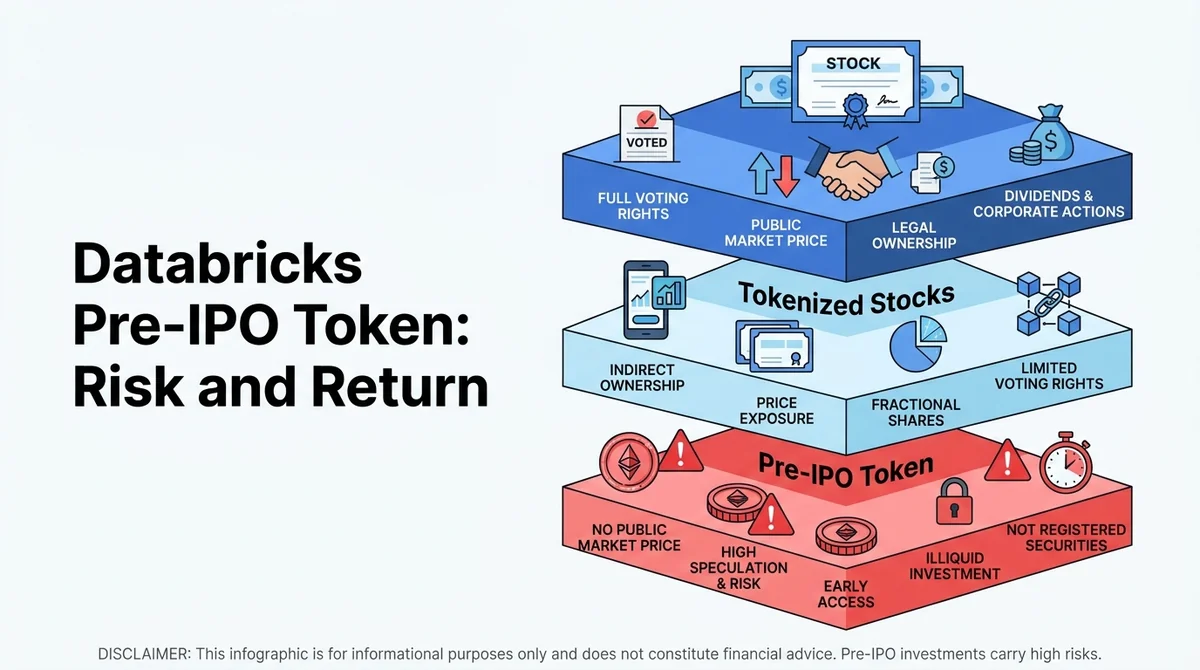
A Databricks pre-IPO token is a price exposure instrument that tracks the company's pre-listing valuation. Holding it does not mean holding equity, and it carries no shareholder rights.
#How does it differ from real equity and tokenized stocks?
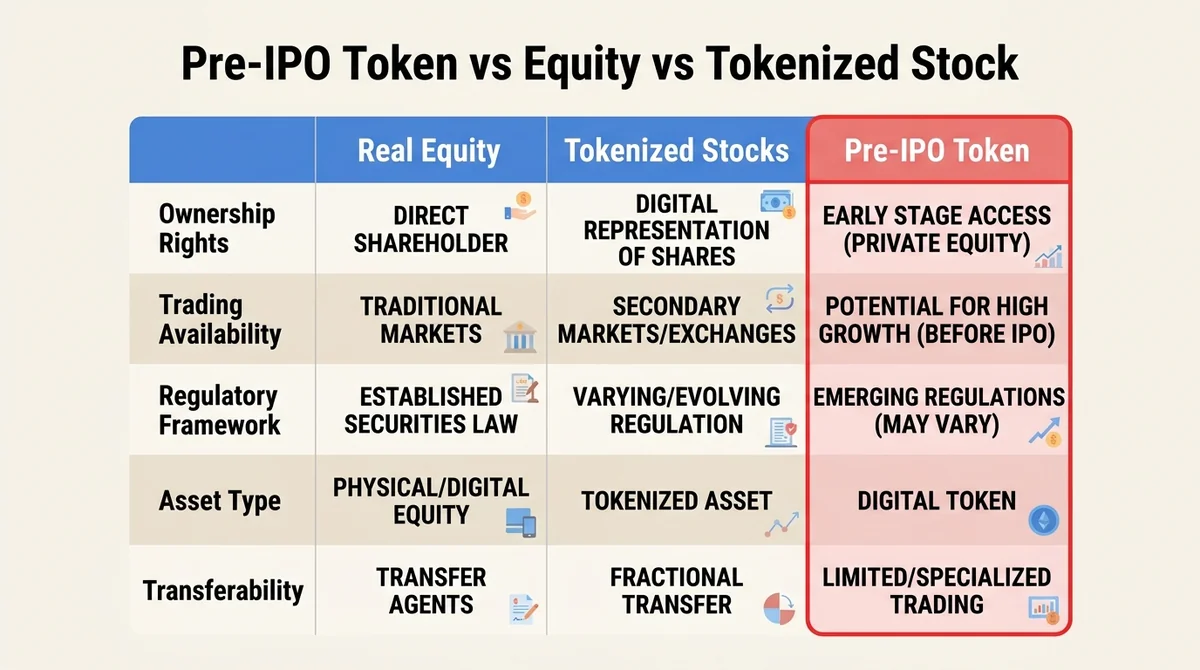
Real equity: Represents an ownership stake in the company, with voting rights, dividend rights and shareholder information rights, and is recorded on the register.
Tokenized stocks: Also just price exposure, usually tracking the share price of an already-listed company, without shareholder status.
Pre-IPO tokens: One step further removed from tokenized stocks. The underlying company is not yet listed, there is no public market share price, and the token price can only anchor to primary-market valuation conventions, making it even further from real equity.
What all three share: holding the token is not the same as holding the stock. The difference lies in whether the underlying is listed and whether there is public, continuous pricing.
#Why does the token price follow primary-market valuation?
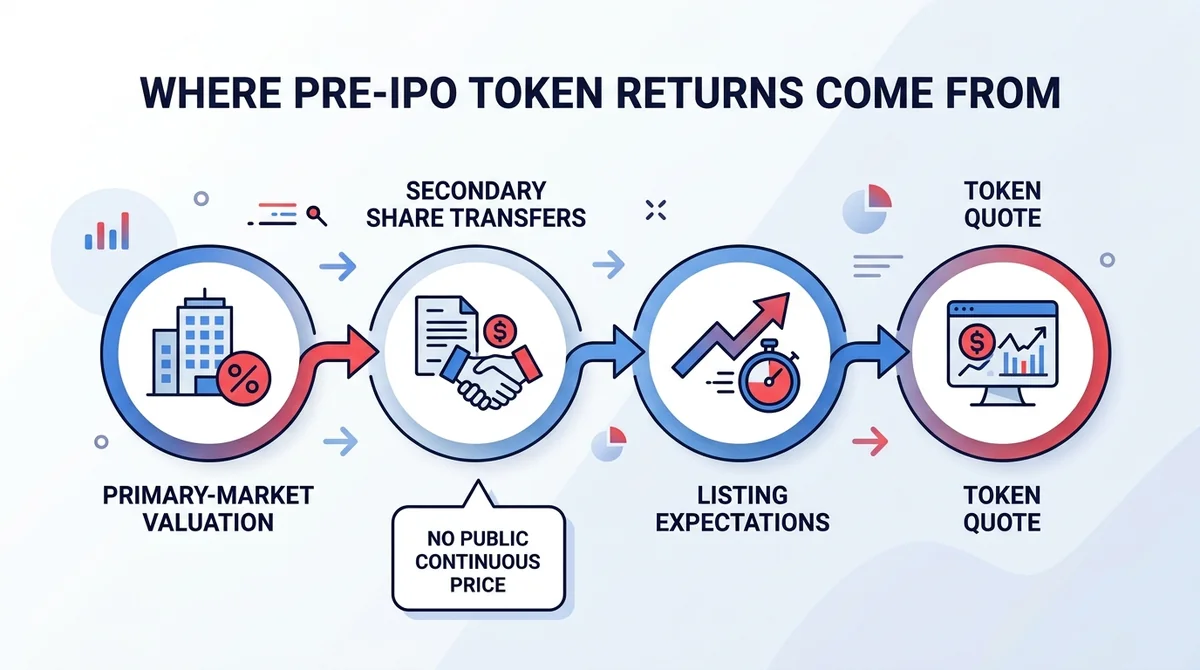
Primary-market valuation is the cause; the token price is the effect. Databricks' primary-market funding valuation, secondary share transfer prices and changes in listing expectations feed through to the token quote. Because the underlying has no public continuous traded price, the token price lacks a high-frequency external anchor, and quotes reflect the valuation consensus of the matching parties rather than a public market clearing price. Note: the transmission mechanism above is an inference about pricing logic. This article has no public disclosure of this token's specific issuer, contract structure or pricing parameters.
#Where do returns on a Databricks pre-IPO token come from?
The return logic rests on expectations of a future Databricks listing or valuation re-rating. The upside depends on changes in the valuation convention; the specific data is not publicly disclosed.
#How do listing expectations affect the token price?
When listing expectations heat up, the token quote may move toward higher expected listing valuations; when expectations cool or the timing is delayed, the quote may fall back. This is an expectation-driven pricing structure, not a cash-flow-driven one.
#How should the upside from valuation re-rating be understood?
The upside equals the difference between the valuation convention implied at purchase and the future valuation convention. However, this article provides no specific return or valuation figures, because that data is not publicly disclosed, and nothing here constitutes a return promise. To be clear: valuation re-rating can also go downward.
#What are the main risks of a Databricks pre-IPO token?
The core risks of a Databricks pre-IPO token are insufficient liquidity, uncertain exit timing and an opaque valuation convention. Holders may be unable to cash out for a long time.
#Why liquidity and exit paths are uncertain
Pre-IPO tokens have no public continuous auction market, and bid-ask spread and trading depth data are not publicly disclosed. Exit depends on a listing or other liquidity event, and the timing is uncertain. This means you may not find a counterparty when you need funds.
#How to judge valuation convention and pricing transparency
Key checks: which funding round's valuation the quote anchors to, whether preferred-share terms are converted, and whether secondary share transfer discounts are reflected. If this information is not public, pricing transparency is limited and quote comparability declines.
#What does a long inability to exit mean?
It means capital is locked up and opportunity cost keeps accumulating. If the listing is delayed by several years, the holding period could be far longer than expected, and you cannot use that capital for other opportunities in the meantime.
#Assessing a Databricks pre-IPO token across five dimensions
A qualitative assessment across five dimensions — exposure clarity, liquidity, exit path, valuation transparency, and costs and fees — structures the risk-return comparison. Note: the following are qualitative judgments, not quantitative scores, and do not constitute a rating conclusion.
Exposure clarity: The token tracks primary-market valuation, which is a clear logic, but it lacks a public continuous price anchor, so the exposure boundary is blurry.
Liquidity: Bid-ask spread and trading depth data are not publicly disclosed, there is no public continuous auction market, and liquidity is on the weak side.
Exit path: Exit depends on a listing or other liquidity event, the timing is uncertain, and the holding period may be far longer than expected.
Valuation transparency: Transparency of the valuation convention and pricing mechanism is limited, and quote comparability is weak.
Costs and fees: Data on the transaction-related fee structure is not publicly disclosed, and cross-platform friction costs are hard to quantify.
Assessment method: Each of the five dimensions gets a qualitative tier (weak / neutral / relatively clear). Missing data is uniformly labeled "data not publicly disclosed" and read in a more conservative direction. No hindsight speculation and no weighted score.
#Who it suits and who it does not
Only people who can tolerate a long lock-up and are using money they can afford to lose to gain exposure should participate with a small position. Those who need liquidity, or who mistake it for real equity, should avoid it.
Suits: People with long-horizon capital who can bear a total loss and treat the position as a high-risk satellite allocation.
Does not suit: People who need to cash out short-term; people who treat the token as real equity and expect voting or dividend rights; people who use perpetual futures leverage or money meant for living expenses.
Position sizing matters more than return expectations.
#FAQ
Q1: Does a Databricks pre-IPO token equal holding Databricks equity?
A: No. It is a price exposure instrument with no voting rights, dividend rights or shareholder information rights.
Q2: Why is there no public continuous quote for the token price?
A: The underlying company is not yet listed and has no public market share price, so the quote can only anchor to primary-market valuation conventions and lacks a high-frequency external anchor.
Q3: Where do returns mainly come from?
A: From listing expectations and valuation re-rating. Specific return and valuation data is not publicly disclosed, and nothing here is a return promise.
Q4: What is the biggest risk?
A: Insufficient liquidity and uncertain exit timing. Holders may be unable to cash out for a long time.
Q5: How can I independently verify the risks?
A: Check the valuation round the quote anchors to, the exit mechanism terms and the fee structure, and compare the liquidity arrangements of other pre-IPO platforms.
#Risk warning and disclaimer
This article only provides a structured breakdown of risk and return. It offers no price forecasts or buy/sell advice, makes no speculation where data is not publicly disclosed, and notes that the token is a derivative exposure. Decisions and risks are borne by the user.
This content is compiled from public data and does not constitute investment or open account advice. Actual conditions may change.
FAQ
Does a Databricks pre-IPO token equal holding Databricks equity?
No. It is a price exposure instrument with no voting rights, dividend rights or shareholder information rights.
Why is there no public continuous quote for the token price?
The underlying company is not yet listed and has no public market share price, so the quote can only anchor to primary-market valuation conventions and lacks a high-frequency external anchor.
Where do returns mainly come from?
From listing expectations and valuation re-rating. Specific return and valuation data is not publicly disclosed, and nothing here is a return promise.
What is the biggest risk?
Insufficient liquidity and uncertain exit timing. Holders may be unable to cash out for a long time.
How can I independently verify the risks?
Check the valuation round the quote anchors to, the exit mechanism terms and the fee structure, and compare the liquidity arrangements of other pre-IPO platforms.
Read the review? Ready to try a small position?
The crypto assets and tokenized US stocks/ETFs covered here are available on MSX — spot and perpetuals.
Quick Start Trading →New here? Registration takes three quick steps.