Databricks
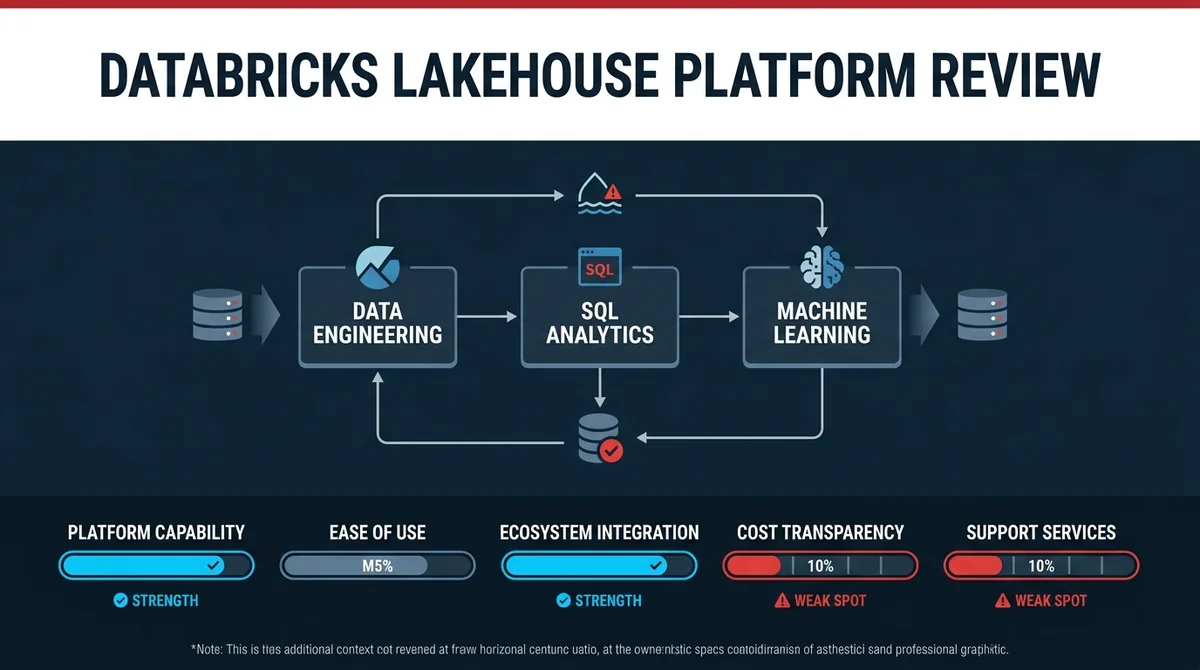
What Databricks is, which workflows it covers, its five-dimension scores, pros and cons, and which teams it fits. Qualitative, with a checklist and FAQ.
Verdict: Databricks is a lakehouse platform that unifies data engineering, analytics, and machine learning workflows in one place. Scored across five dimensions — platform capability, ease of use, ecosystem integration, cost transparency, and support services — it stands out on platform capability and ecosystem integration, while ease of use and cost transparency are relative weak spots. It best suits mid-to-large teams that already have data engineering skills and need lakehouse and ML collaboration. The scores in this article are editorial judgments (opinions) based on public information and product positioning, not third-party benchmark results.
#What is Databricks, and what problem does it solve in the data stack?
Databricks is a lakehouse platform that unifies data engineering, analytics, and machine learning workflows in one place, primarily addressing repeated data movement across multiple systems and fragmented collaboration.
Platform positioning: A unified vehicle for data engineering, analytics, and machine learning. It is not a point tool; it consolidates work that would otherwise be scattered across data warehouses, ETL tools, notebook environments, and ML platforms.
#How does its positioning differ from a traditional data warehouse?
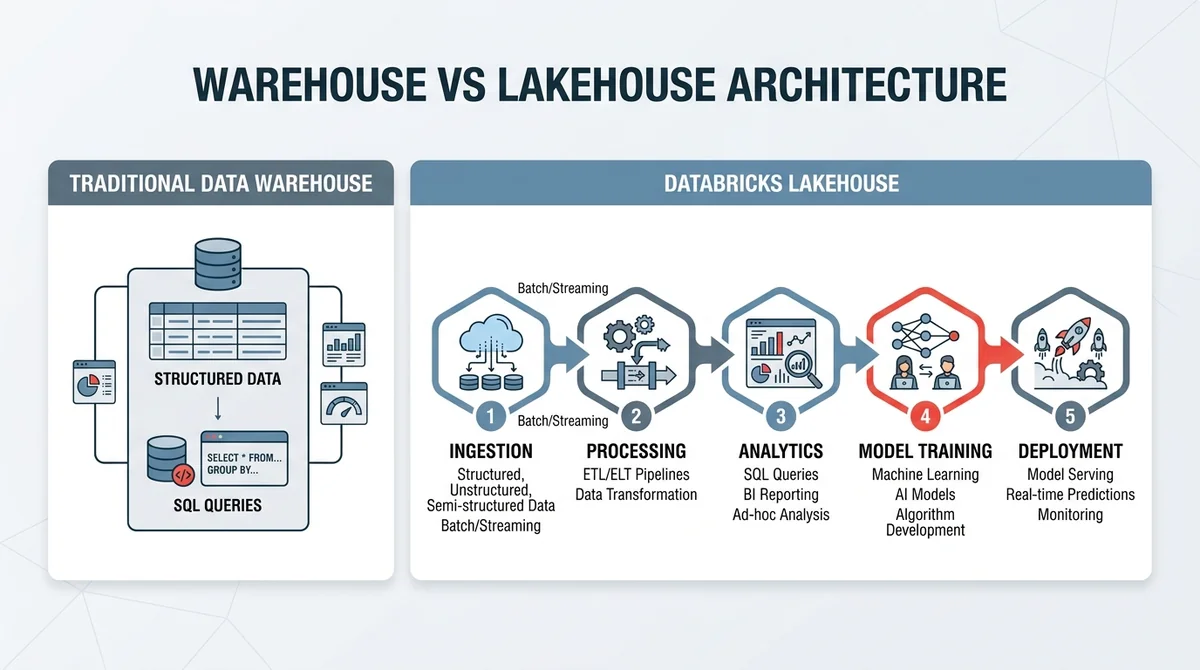
A traditional data warehouse centers on storing structured data and running SQL queries, positioning it toward the "analytics endpoint." Databricks sits further upstream, covering the chain from data ingestion and processing to analytics, model training, and deployment. The difference is not the strength of any single feature but how the stages connect: data does not need to be repeatedly exported and imported across multiple systems.
#What practical benefits does the lakehouse architecture bring?
The direct benefit of the lakehouse is less repeated data movement across multiple systems and a lower chance of the same data being defined inconsistently between the warehouse and the data lake. For teams with both BI analytics needs and machine learning needs, the value of this unified vehicle shows up mainly in collaboration efficiency and pipeline maintenance cost, not in absolute leadership on any single query performance metric. Note that these benefits are inferences at the mechanism level; the actual magnitude depends on how fragmented the team's existing systems are and on its engineering capability, and no public quantitative benchmarks are available.
#Which teams would adopt it as a core data platform?
Teams with medium or larger data volumes and existing data engineering capability are more likely to adopt it as a core platform. The test is whether they have ongoing data pipeline maintenance needs and whether ML workflows need to share the same data as the analytics pipeline. For lightweight reporting needs only, the complexity of a unified platform may outweigh the benefits.
#Which stages does Databricks' core capability cover?
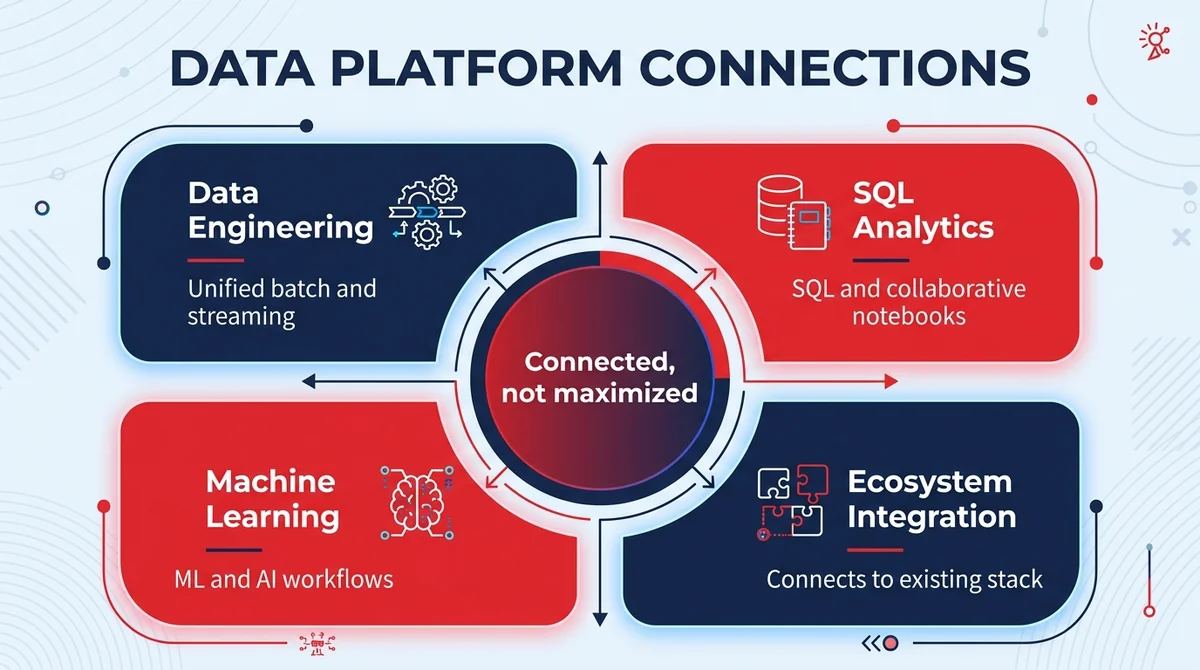
Databricks' capabilities cover four areas — data engineering, SQL analytics, machine learning, and ecosystem integration — and its strength lies in how these areas connect rather than in maximizing any single feature.
#How good are its data engineering and ETL capabilities?
On the data engineering side, the core is unified batch and streaming processing, suited to scenarios that handle offline batch jobs and streaming data at the same time. Specific performance metrics such as throughput and latency are not public; refer to official documentation and your own load testing.
#What is the analytics and SQL query experience like?
The analytics layer offers two entry points — SQL and collaborative notebooks — suited to analysts and engineers collaborating in the same workspace. Query performance and concurrency limits are not public; the actual experience depends on cluster configuration and data organization.
#How far does machine learning and AI workflow support go?
On the ML/AI side, it covers the connection between training, experimentation, and deployment. The value is that the data used for model training and the data used for analytics sit on the same platform, reducing inconsistent feature definitions and data movement costs. Specific supported frameworks and deployment forms are not public; refer to official sources.
#How about ecosystem integration and extensibility?
On the ecosystem side, it integrates with mainstream cloud and open-source components, which is a relative strength. Extensibility means connecting external tools as needed rather than building everything in-house, but integration depth and the specific component list are not public, so verify each item during selection.
#Databricks five-dimension scores: how does each perform?
Evaluated across platform capability, ease of use, ecosystem integration, cost transparency, and support services, Databricks stands out on platform capability and ecosystem integration, while ease of use and cost transparency are relative weak spots. The scores are based on public information and product positioning and are editorial judgments (opinions); missing data is marked as not public, with no after-the-fact speculation.
#What score does platform capability and feature completeness get?
The platform capability dimension scores relatively high, based on covering four areas — data engineering, SQL analytics, ML, and ecosystem integration — with complete connections between them. Whether any single feature is the industry's strongest lacks a verifiable cross-vendor benchmark, so it does not get a full score.
#How is ease of use and the learning curve evaluated?
The ease of use dimension scores moderately low. The lakehouse involves multiple layers of concepts such as data engineering, cluster configuration, and permission management, making the learning curve steep for teams without an engineering background. Specific time-to-proficiency data is not public.
#What score does ecosystem integration and extensibility get?
The ecosystem integration dimension scores relatively high, based on its positioning of integrating with mainstream cloud and open-source components. The specific number of integrations and the certification list are not public; verify each item against your own toolchain during selection.
#How about cost transparency and support services?
The cost transparency dimension scores relatively low. Costs vary with usage and there is no fixed pricing structure, so you need to build your own monitoring and quota mechanisms. Data on support response tiers and SLAs is not public; refer to official sources.
#What are Databricks' pros and cons?
Databricks' main advantages are a unified platform and ecosystem integration; its main costs are a steep learning curve and extra effort required for cost management.
#Where do the main advantages concentrate?
Unified platform: Data engineering, analytics, and ML on the same vehicle, reducing cross-system movement and inconsistent definitions. Ecosystem integration: Integrates with mainstream cloud and open-source components, lowering the cost of building and stitching things together yourself. ML collaboration: Training and experimentation can directly reuse data from the analytics pipeline, shortening the path from analytics to modeling.
#What are the common limitations and costs?
Learning curve: Involves multiple layers of concepts and configuration, and the team needs data engineering capability. Cost management complexity: Costs vary with usage and there is no fixed pricing structure, so additional monitoring and quotas are required. Engineering capability required: The platform's value depends heavily on the team's own skill level; with insufficient capability, a unified platform instead adds maintenance burden.
#Who should use Databricks, and who should consider alternatives?
Teams that already have data engineering capability and need lakehouse and machine learning collaboration are a better fit for Databricks; small teams with lightweight analytics needs or limited staffing budgets should evaluate alternatives first.
#What size and type of team fits best?
Teams with medium or larger data volumes that need to maintain both data pipelines and ML workflows. Typical traits are a dedicated data engineering role and analytics needs that share the same data sources as modeling needs.
#In which scenarios is it not worthwhile?
For lightweight reporting and ad-hoc analytics scenarios, the configuration and maintenance cost of a unified platform may outweigh the benefits. Small teams with limited staffing budgets and no dedicated data engineering role may stay stuck at the basic feature level long after adoption.
#What should be verified before adoption?
Verify two things first: the cost model and compatibility with your existing toolchain. The cost model determines long-term sustainability, and toolchain compatibility determines migration cost. Both need to be tested with your own data; public data is not a substitute.
#What risks and limitations should you watch for when using Databricks?
The main risks of using Databricks are costs spiraling out of control as usage grows, and platform value depending heavily on the team's own data engineering capability.
#What are common cost management pitfalls?
Costs vary with usage; without monitoring and quota mechanisms, long-running clusters or repeatedly scheduled jobs can lead to unexpected spending. Set up a usage dashboard and budget alerts early in adoption. Specific pricing and quota data is not public; refer to official sources.
#What implicit requirements does it place on team capability?
Platform capability depends on the team's engineering level. The lakehouse's benefits come from connecting stages, and that connection requires someone to maintain pipelines, manage permissions, and optimize jobs. Without a dedicated role, a unified platform may degrade into a lightweight tool used only for notebooks.
#FAQ
Q1: What is the core difference between Databricks and a traditional data warehouse? A: A traditional data warehouse sits toward the analytics endpoint, centered on structured data storage and SQL queries; Databricks covers the full chain of data engineering, analytics, ML, and ecosystem integration. The difference is in how stages connect, not in any single feature.
Q2: Is Databricks suitable for small teams? A: Small teams with lightweight analytics needs or limited staffing budgets should evaluate alternatives first. The configuration and maintenance cost of a unified platform requires a dedicated data engineering role to absorb; otherwise, the team may stay stuck at the basic feature level.
Q3: Is Databricks' cost structure transparent? A: Cost transparency is a relative weak spot. Costs vary with usage and there is no fixed pricing structure, so you need to build your own monitoring and quota mechanisms. Specific pricing data is not public; refer to official sources.
Q4: Where does Databricks' machine learning capability show up? A: In the connection between training, experimentation, and deployment: model training can directly reuse data from the analytics pipeline, reducing inconsistent feature definitions and data movement. Specific supported frameworks and deployment forms are not public.
Q5: What should be verified first before adoption? A: The cost model and compatibility with your existing toolchain. The cost model determines long-term sustainability, and toolchain compatibility determines migration cost; both need to be tested with your own data.
This content is a qualitative summary based on public information and represents editorial judgment; it does not constitute investment or procurement advice. No specific pricing, performance, or SLA figures are cited; refer to official Databricks sources for such data.
FAQ
What is the core difference between Databricks and a traditional data warehouse?
A traditional data warehouse sits toward the analytics endpoint, centered on structured data storage and SQL queries; Databricks covers the full chain of data engineering, analytics, ML, and ecosystem integration. The difference is in how stages connect, not in any single feature.
Is Databricks suitable for small teams?
Small teams with lightweight analytics needs or limited staffing budgets should evaluate alternatives first. The configuration and maintenance cost of a unified platform requires a dedicated data engineering role to absorb; otherwise, the team may stay stuck at the basic feature level.
Is Databricks' cost structure transparent?
Cost transparency is a relative weak spot. Costs vary with usage and there is no fixed pricing structure, so you need to build your own monitoring and quota mechanisms. Specific pricing data is not public; refer to official sources.
Where does Databricks' machine learning capability show up?
In the connection between training, experimentation, and deployment: model training can directly reuse data from the analytics pipeline, reducing inconsistent feature definitions and data movement. Specific supported frameworks and deployment forms are not public.
What should be verified first before adoption?
The cost model and compatibility with your existing toolchain. The cost model determines long-term sustainability, and toolchain compatibility determines migration cost; both need to be tested with your own data.
Read the review? Ready to try a small position?
The crypto assets and tokenized US stocks/ETFs covered here are available on MSX — spot and perpetuals.
Quick Start Trading →New here? Registration takes three quick steps.