Options
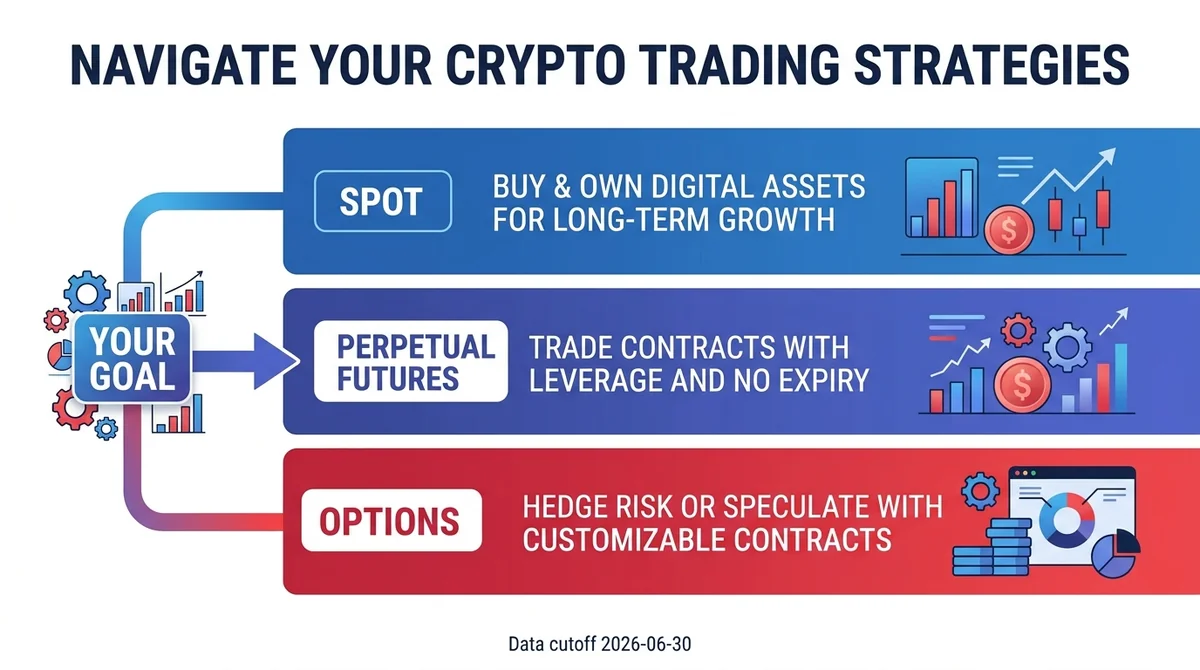
How to choose an options trading platform: a five-factor framework covering product coverage, fees, margin and risk controls, liquidity, and usability vs spot and perpetual futures.
Conclusion: Options trading platforms suit users who need to express both directional and volatility views and can tolerate premium going to zero; users who only want to hold assets long-term or who don't want to bear time-value decay will find spot or perpetual futures a more direct path. Scenario routing in one sentence: long-term holding only → spot; direction only → perpetual futures; need to express volatility or hedge → options. When evaluating any options platform, check five things first: product coverage, fee structure, risk controls and margin, liquidity, and usability.
Data cutoff: 2026-06-30. Platform parameters without specific figures in this article are marked as data not disclosed; please refer to the latest content on the platform's official fee page, contract specifications page, and risk disclosure documents.
#Options, Spot, or Perpetual Futures: Which Should You Choose?
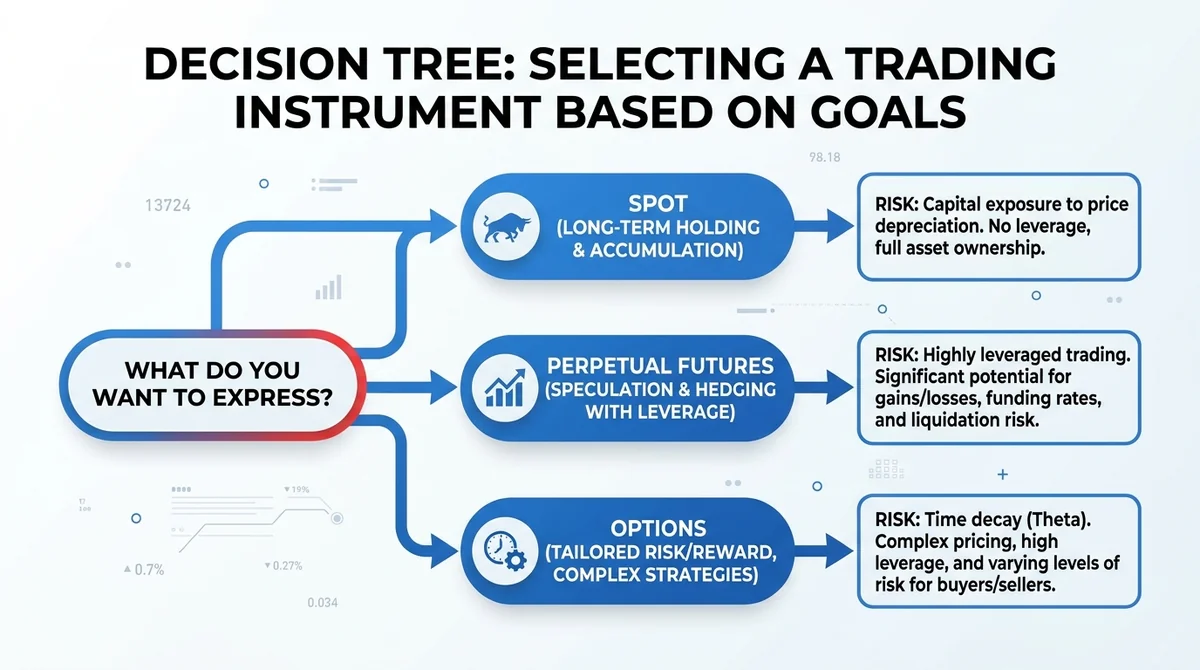
Conclusion: Choose spot if you only want to hold assets long-term; choose perpetual futures if you only trade price direction; choose options only if you need to express three variables—direction, volatility, and time—or need to hedge existing positions. The three are not substitutes but correspond to different needs for expressing views.
One-line memory aid: spot earns price, perpetuals bet on direction, and options buy a combined view of "direction + volatility + time."
#What Are the Core Differences Between Options, Spot, and Perpetual Futures?
Conclusion: Spot is holding an asset, perpetuals trade direction, and options trade a combination of three variables: direction + volatility + time. This single distinction determines the applicable scenarios and risk structures of the three.
- Spot: Real buying and selling; after execution you hold the asset itself. Price exposure comes from the position, there is no expiry date, and there is no concept of premium.
- Perpetual futures: Leveraged contracts with no expiry, anchored to the spot price through the perpetual futures funding rate settlement schedule; they trade price direction and do not involve strike price or expiry selection.
- Options: Have expiry dates and strike prices; the price (premium) is market-priced, and the rights of buyers and obligations of sellers are asymmetric.
#Three-Dimensional Comparison: Key Differences Between Spot, Perpetual Futures, and Options
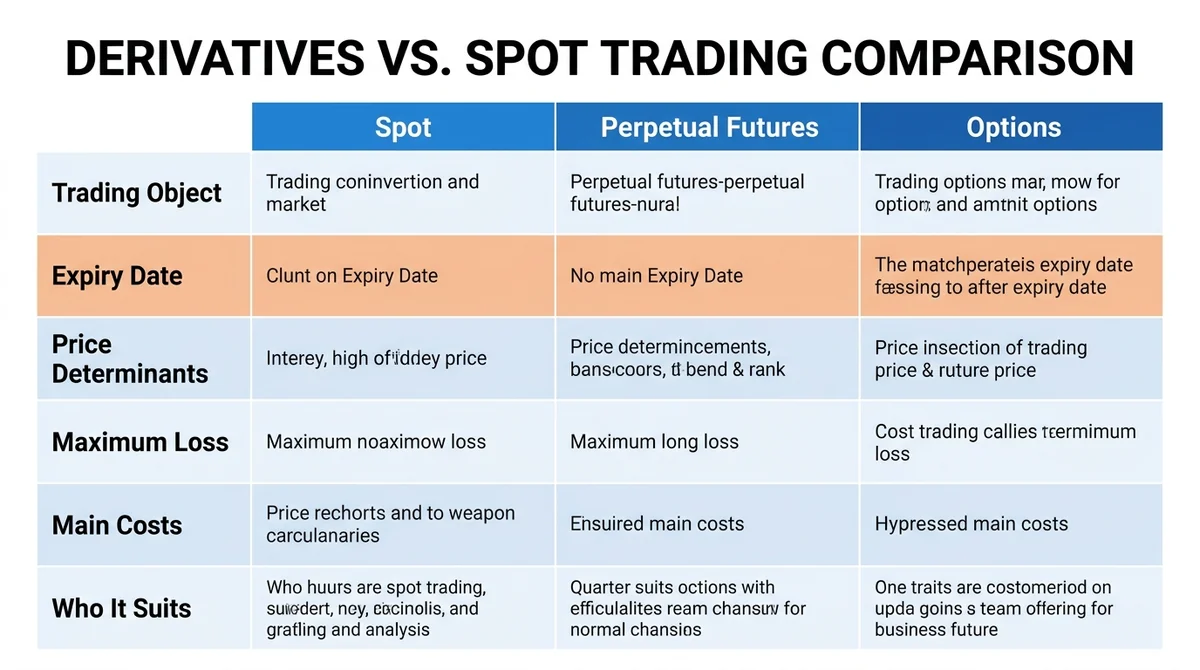
| Dimension | Spot | Perpetual Futures | Options |
|---|---|---|---|
| Trading object | The asset itself | Leveraged contract with no expiry | Right with expiry date and strike price |
| Expiry date | None | None | Yes (weekly/monthly/quarterly, etc.) |
| Price determinants | Underlying spot price | Underlying spot price + how does perpetual futures funding rate work | Underlying price + implied volatility + time remaining |
| Maximum loss | Position value | Depends on perpetual futures leverage and liquidation rules | Buyers capped at premium; sellers have no equivalent cap |
| Main costs | Trading fees | Trading fees + how does perpetual futures funding rate work | Premium + trading fees + exercise fees + margin occupation |
| Who it suits | Long-term holding | Direction only | Expressing volatility or hedging |
#What Contract Types and Expiry Structures Do Options Platforms Usually Offer?
Standard structures include call and put contracts, combined with multiple strike prices and multiple expiry dates to form a two-dimensional matrix. Expiry structures are usually divided into weekly, monthly, and quarterly cycles. How many contract types a specific platform offers and which expiry dates and strike levels it covers are platform-level parameters; this article has not obtained verifiable public data and marks them as data not disclosed; please refer to the official contract list page.
#Why Is Options Pricing More Complex Than Perpetual Futures?
Perpetual futures prices mainly follow the underlying spot price, with funding rate adjustments. Options premiums are determined jointly by at least three variables: underlying price, implied volatility, and time remaining. This means that even if the underlying moves sideways, options prices will change due to declining volatility or time passing. The direct consequence for traders is that you can be right on direction and still lose money—something that does not happen in perpetual futures.
#What Five Dimensions Should You Use to Evaluate an Options Trading Platform?
Conclusion: Use a consistent five-dimension scorecard: product coverage, fee structure, risk controls and margin, liquidity, and usability. Among these, seller margin and liquidation rules are the most easily overlooked risk items.
#Five-Dimension Evaluation Framework at a Glance
| Dimension | Core Checkpoints | Judging Criteria |
|---|---|---|
| Product coverage | Whether calls/puts are complete, expiry cycles, strike intervals | Whether your target strategy can be implemented |
| Fee structure | Trading fees, exercise/settlement fees, opportunity cost of margin | Look at total cost, not a single fee rate |
| Risk controls and margin | Margin calculation method, maintenance ratio, liquidation trigger and execution | Whether rules are public and predictable |
| Liquidity | Order book depth for a single contract, slippage on far-month and out-of-the-money contracts | Measure on the platform; watch for structural discounts |
| Usability | Order interface complexity, support for combination strategies, learning cost | Whether it matches your proficiency |
#Selection Criteria Scorecard: Five-Dimension Self-Check List
Conclusion: Check each of the five dimensions against three criteria—verifiable, predictable, and tolerable. Only include dimensions that are fully verifiable in your decision; if any item is in doubt, seek confirmation from the platform's official documents.
| Dimension | Verifiable Items to Check | Data Source | Obtained in This Article |
|---|---|---|---|
| Product coverage | Call/put contract lists, expiry cycles, strike interval levels | Official contract specifications page | Data not disclosed |
| Fee structure | Trading fee rates, exercise/settlement fees, margin occupation rules | Official fee page | Data not disclosed |
| Risk controls and margin | Margin calculation formula, maintenance ratio, liquidation trigger and execution method | Official risk disclosure documents | Data not disclosed |
| Liquidity | Order book depth for a single contract, slippage on far-month and out-of-the-money contracts | Platform measurement | Data not disclosed |
| Usability | Order interface, support for combination strategies, learning materials | Actual platform experience | Qualitative judgment |
#Product Coverage: Are Contract Types, Expiry Dates, and Strike Prices Complete?
Conclusion: Coverage determines whether a strategy can be implemented. Sparse strike levels make it impossible to construct precise spread combinations, and insufficient expiry dates make it impossible to match holding periods. When evaluating, check whether calls/puts are complete, whether expiry cycles cover your holding habits, and whether strike intervals are granular enough. This article could not obtain public data on specific platforms' contract counts and expiry structures, marked as data not disclosed.
#Fee Structure: What Are the Trading Fees, Exercise Fees, and Funding Costs Beyond the Premium?
Conclusion: Total options cost is more than the commission; it should include opening and closing trading fees, exercise/settlement fees, and the opportunity cost of margin occupied by sellers. Many users only compare fee rates and ignore the capital efficiency of margin occupation, underestimating the actual total cost. Specific fee figures in this article have not been obtained from verifiable public data and are marked as data not disclosed; please refer to the official fee page.
#Risk Controls and Margin: Are Seller Margin and Liquidation Rules Clear?
Conclusion: Whether the seller margin calculation method, maintenance margin ratio, and liquidation trigger and execution rules are public is the core test of a platform's risk-control transparency. This is the biggest divide between options and perpetual futures risk structures: buyers' maximum loss is capped at the premium paid; sellers receive premium but potential losses may far exceed it. On platforms with unclear rules, the treatment of seller positions in extreme markets is unpredictable.
#Liquidity and Usability: How Are Order Book Depth and Operational Complexity?
Conclusion: Order book depth for a single options contract is usually lower than for spot or perpetual futures on the same underlying, especially for far-month and out-of-the-money contracts—this is a structural feature, not a problem specific to individual platforms. Liquidity determines slippage; the specific discount must be measured on the platform. Usability is reflected in order interface complexity, whether combination strategies are supported, and learning cost. Both directly affect actual execution quality.
#What Are the Pros and Cons of This Options Trading Platform?
Conclusion: Pros and cons should be presented by the five-dimension framework; undisclosed fee and margin parameters are uniformly marked as data not disclosed, and users should refer to official pages. This article does not make horizontal comparisons with other third-party exchanges, nor does it rank any platform.
#What Dimensions Do the Pros Reflect?
- Richer expression dimensions: Compared with spot and perpetual futures, which can only go long or short, options can express three variables simultaneously: direction, volatility, and time.
- Clear risk boundary for buyers: The buyer's maximum loss is the premium paid; the risk cap is determined at opening.
- Combinable strategies: Structures with multiple strike prices and multiple expiry dates support spreads, hedges, and other combination ideas that are difficult to achieve with a single spot or perpetual position.
#Where Are the Cons and Limitations Concentrated?
- High learning cost: Strike price, expiry date, and implied volatility jointly determine the outcome; operational complexity is significantly higher than spot buying and selling.
- Continuous time-value decay: Even if the direction is correct, buyers may lose money as time passes.
- Tail risk for sellers: Sellers' maximum gain is the premium, but losses have no equivalent cap; poor margin management may trigger liquidation.
- Fragmented contract-level liquidity: Depth for a single contract is usually weaker than spot and perpetual futures on the same underlying; slippage is greater for far-month and out-of-the-money contracts.
#Which Data Are Not Disclosed by the Platform and Require Users to Verify Themselves?
This article has not obtained verifiable data on the following parameters: specific trading and exercise fee rates, margin ratios and liquidation rule details, contract counts and expiry structures, and order book depth data. All are marked as data not disclosed. Users are advised to consult the official fee page, contract specifications page, and risk disclosure documents directly, and to check the data cutoff date.
#Who Is an Options Trading Platform For, and Who Is It Not For?
Conclusion: Options suit users who need to express direction and volatility and can tolerate premium going to zero; users who only want to hold assets long-term or do not want to bear time-value decay should prioritize spot or perpetual futures.
#Scenario Routing Table: Which Tool to Choose for Different Needs
| Your Need | Suggested Choice | Reason |
|---|---|---|
| Long-term holding of assets | Spot | No expiry date or time-value loss |
| Only long/short, no volatility | Perpetual futures | Simpler structure; no need to choose strike price or expiry |
| Hedging existing positions | Options | Premium can lock in hedging cost |
| A clear view on timing | Options | You can pay for a time window |
| Not yet understanding implied volatility | Start with spot/perpetuals | Build foundational knowledge before entering options |
#What Type of Users Are Suited to Options?
- Users who need to hedge existing positions rather than simply amplify directional exposure.
- Users with a clear view on timing who are willing to pay for a time window.
- Users who can accept the total loss of a single premium and have incorporated it into position planning.
#When Should You Start with Spot or Perpetual Futures?
- If the goal is long-term asset holding: spot is more direct, with no time-value loss.
- If you only want to go long or short and do not need the volatility dimension: perpetual futures have a simpler structure.
- If you do not yet understand implied volatility and time value: build foundational knowledge with spot and perpetuals before entering options.
#How Do Capital Size and Risk Tolerance Affect the Choice?
Conclusion: The smaller the capital, the narrower the margin for error in seller strategies; buyer strategies are better suited to deriving position limits from the premium. Buyers use premium as the cost cap, from which position limits can be derived; sellers must occupy margin, capital efficiency is constrained by margin ratios, and a buffer for extreme markets should be reserved. Specific margin ratios in this article have not been obtained from public data and are marked as data not disclosed.
#What Risks Do You Bear When Using an Options Trading Platform?
Conclusion: Options buyers' maximum loss is the premium; sellers' risk may far exceed the premium. Meanwhile, time-value decay and volatility changes continuously affect position outcomes, and insufficient margin may lead to liquidation.
#Why Are Buyer and Seller Risks Asymmetric?
Buyers pay premium and receive rights; the worst case is the premium going to zero. Sellers receive premium and assume obligations; potential losses have no cap equivalent to the premium. This asymmetry is an inherent property of the options structure, not a platform design issue.
#How Do Time-Value Decay and Volatility Changes Affect Outcomes?
The less time remaining, the lower the time value, and the decay accelerates as expiry approaches. A decline in implied volatility suppresses options prices. Combined, this means: even with a correct directional call, you may still lose due to volatility pullback or time passing.
#What Happens When Margin Is Insufficient?
When a seller's margin falls below the maintenance requirement, the position may be forcibly liquidated. The timing and price of liquidation are determined by platform rules, and in extreme markets execution may occur at unfavorable prices. Specific liquidation rules in this article have not been obtained from verifiable public data and are marked as data not disclosed; please consult the official risk disclosure documents.
#FAQ
Q1: What is the core difference between options and perpetual futures? A: Perpetual futures have no expiry date and only trade direction, anchored to spot through how does perpetual futures funding rate work; options have expiry dates and strike prices, and the premium is affected by the underlying price, implied volatility, and time remaining, with asymmetric buyer rights and seller obligations.
Q2: How much can an options buyer lose at most? A: The buyer's maximum loss is the premium paid; the risk cap is determined at opening.
Q3: Why can options still lose money when the direction is right? A: Because the premium includes time value and volatility premium. Less time remaining lowers time value, and a decline in implied volatility also suppresses options prices; both can offset directional gains.
Q4: What is the most easily overlooked dimension when evaluating an options platform? A: Seller margin and liquidation rules. Most users only compare commissions, but the capital cost and liquidation risk from margin occupation have a greater impact on seller strategies.
Q5: Should I use options if I only want to hold assets long-term? A: No need. Spot holding has no expiry date or time-value loss and is more direct in structure.
Q6: How do I choose an options trading platform? A: Check item by item across the five dimensions of product coverage, fee structure, risk controls and margin, liquidity, and usability. Among these, seller margin and liquidation rules are most easily overlooked. Platform-level parameters such as fee rates and margin ratios are marked in this article as data not disclosed; refer to the official fee page and risk disclosure documents.
Q7: Options, spot, or perpetual futures—which should I choose? A: Choose spot if you only want to hold assets long-term; choose perpetual futures if you only trade price direction; choose options only if you need to express volatility or timing views or hedge existing positions. The three correspond to different needs for expressing views and are not substitutes.
Q8: What data should I verify myself when evaluating an options platform? A: Specific trading and exercise fee rates, margin ratios and liquidation rule details, contract counts and expiry structures, and order book depth data are all marked in this article as data not disclosed. It is recommended to consult the official fee page, contract specifications page, and risk disclosure documents directly.
Q9: What should I look at in an options platform's product coverage? A: Whether calls/puts are complete, whether expiry cycles cover your holding habits, and whether strike interval levels are granular enough; these three determine whether your target strategy can be implemented. Specific contract counts are subject to the official contract specifications page.
Q10: Can I still be an options seller with small capital? A: Be cautious. Sellers must occupy margin, and the smaller the capital, the narrower the margin for error; buyer strategies are better suited to deriving positions from the premium as the cost cap. Specific margin ratios are subject to the official risk disclosure documents.
This content is general educational material and an evaluation framework summary; it does not constitute investment or open account advice. Platform parameters without specific figures in this article are marked as data not disclosed; actual conditions may change. Please refer to the platform's official fee page, contract specifications page, and risk disclosure documents. Data cutoff: 2026-06-30.
FAQ
What is the core difference between options and perpetual futures?
Perpetual futures have no expiry date and only trade direction, anchored to spot through how does perpetual futures funding rate work; options have expiry dates and strike prices, and the premium is affected by the underlying price, implied volatility, and time remaining, with asymmetric buyer rights and seller obligations.
How much can an options buyer lose at most?
The buyer's maximum loss is the premium paid; the risk cap is determined at opening.
Why can options still lose money when the direction is right?
Because the premium includes time value and volatility premium. Less time remaining lowers time value, and a decline in implied volatility also suppresses options prices; both can offset directional gains.
What is the most easily overlooked dimension when evaluating an options platform?
Seller margin and liquidation rules. Most users only compare commissions, but the capital cost and liquidation risk from margin occupation have a greater impact on seller strategies.
Should I use options if I only want to hold assets long-term?
No need. Spot holding has no expiry date or time-value loss and is more direct in structure.
Read the review? Ready to try a small position?
The crypto assets and tokenized US stocks/ETFs covered here are available on MSX — spot and perpetuals.
Quick Start Trading →New here? Registration takes three quick steps.