Pre-IPO Equity
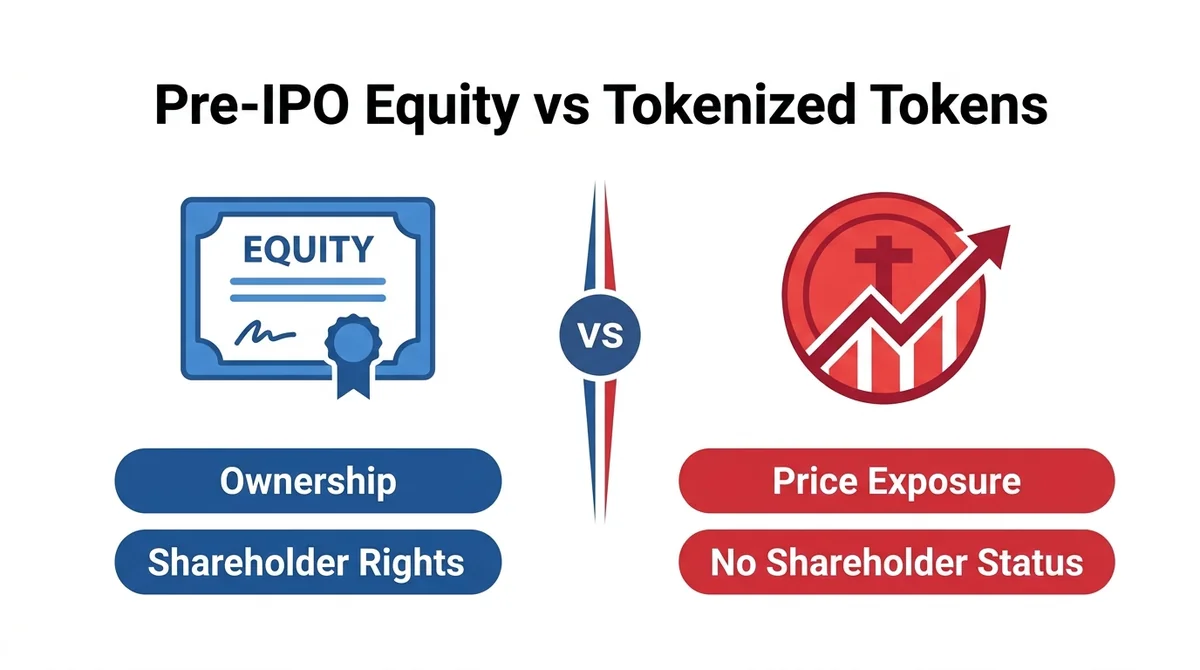
Pre-IPO equity vs tokenized pre-IPO tokens: key differences, five comparison dimensions for 2026, who each suits, and risk checklist. Not investment advice.
Conclusion: Pre-IPO equity is real ownership in a company before it goes public, while tokenized pre-IPO tokens typically offer only price exposure rather than equity — the former corresponds to company ownership and legal rights, the latter is a derivative-style bet on the company's valuation. If you need shareholder rights and long-term fundamental exposure, you should first understand the real equity route and its thresholds and limitations; only if you just need price exposure and trading convenience should you consider tokenized products, accepting the distance between them and real shares.
#What exactly is the difference between pre-IPO equity and tokenized pre-IPO tokens?
One-line distinction: Real equity corresponds to company ownership and legal rights, while tokenized tokens correspond to price movements and usually do not constitute shareholder status.
#Are you holding equity or price exposure?
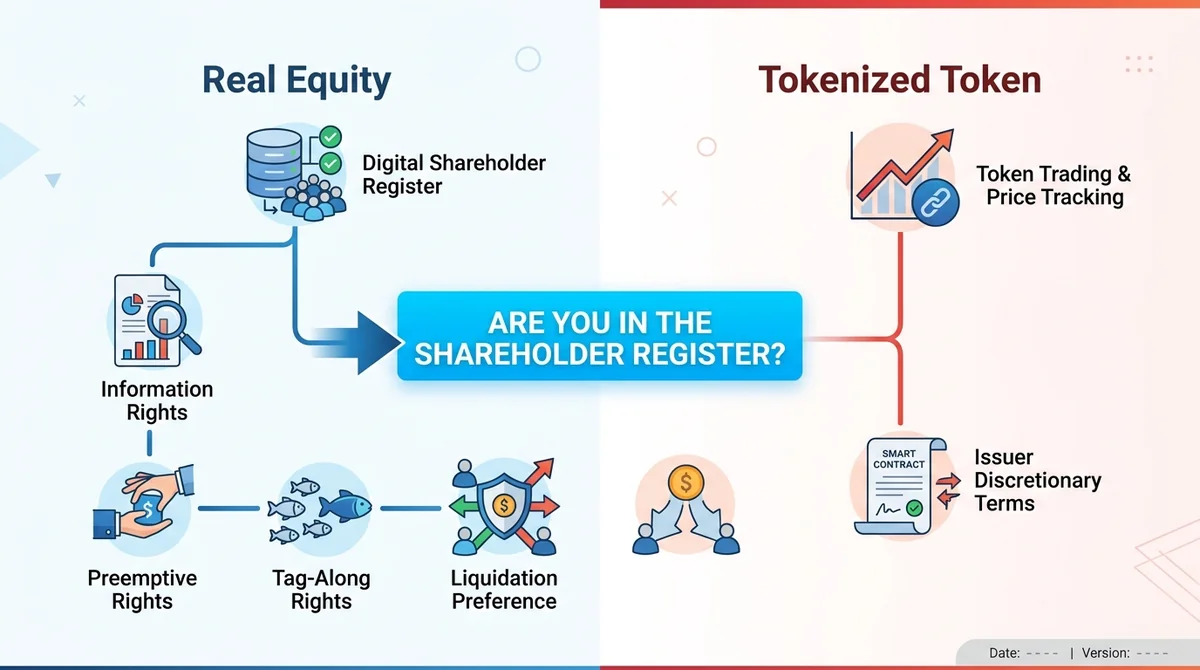
Pre-IPO equity (including pre-IPO shares) refers to equity or equivalent ownership certificates issued by a company before its public listing, with holders being part of the company's shareholder register. Tokenized pre-IPO tokens express exposure to a target company's valuation in token form, and holders typically do not enter the target company's shareholder register. The test is straightforward: check whether the product grants you registered equity or merely a tradable price certificate.
#How do the two differ on shareholder rights?
Real equity usually involves information rights, preemptive rights, tag-along rights, liquidation preference and other terms (subject to the target company's articles of association and transaction documents; public information may not disclose them). Tokenized tokens generally do not carry these rights; their terms are set by the issuer, and holders face issuer credit and product terms rather than the company's articles. Anything not disclosed in public information should be treated as uncertain rather than assumed to exist.
#Why is the US stock price the cause and the token price the effect?
Tokenized stock pricing is anchored to the underlying stock price, which is determined by company fundamentals, financial reports and market supply and demand; the token price is a re-expression of that result. The analysis order should therefore be: first the underlying (real US stocks/company fundamentals), then the token structure (premium, liquidity, redemption mechanism). Treating the token price as an independent signal source mistakes the effect for the cause.
#Which dimensions should a 2026 pre-IPO project comparison cover?
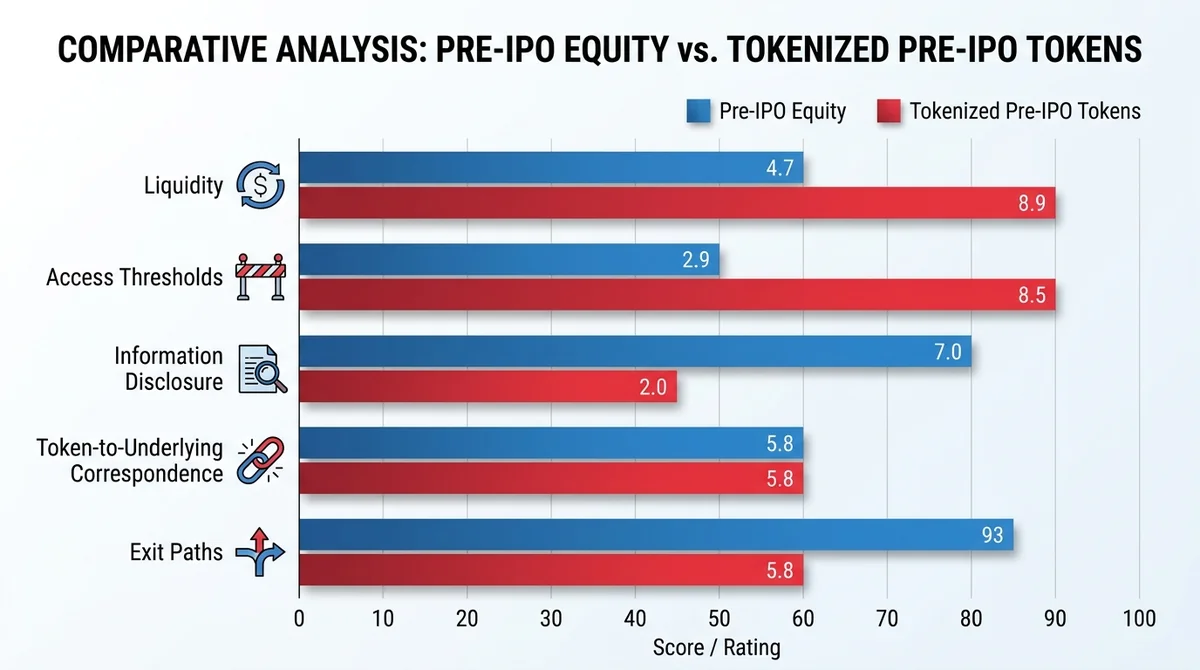
Conclusion: A 2026 pre-IPO project comparison should focus on five dimensions — liquidity, access thresholds, information disclosure, the token-to-underlying correspondence, and exit paths — with price being the last step.
#How to compare liquidity and exit methods?
Real pre-IPO equity has low liquidity; exits depend on an IPO, M&A or secondary transfers, and are often subject to lock-up periods and transfer approval restrictions. Tokenized products are nominally tradable 24/7, but actual liquidity depends on that token's depth, and quotes in thin order books may deviate significantly. When comparing, ask: what are the exit trigger conditions, what is the average matching depth, and can trades still fill under extreme market conditions.
#How to compare access thresholds and information disclosure?
Real equity routes usually have accredited investor thresholds, minimum subscription amounts and identity checks; tokenized routes may have lower thresholds but also coarser disclosure granularity. When comparing, verify: whether the target company's financials, valuation basis, issuer reserves and custody fee arrangements are disclosed. Missing items should be recorded as "data not disclosed."
#How to verify the token structure and its correspondence to the underlying?
Confirm: how much underlying equity one token represents, whether reserves are 1:1, whether there is a redemption window, and the issuance and unlock rules. If the correspondence is vague or can be unilaterally adjusted by the issuer, the exposure is closer to a derivative than to spot.
#Who are pre-IPO shares for, and who is tokenized exposure for?
Conclusion: Investors who need shareholder rights and can accept low liquidity and long holding periods are better suited to real pre-IPO shares; only users seeking price exposure and trading flexibility should consider tokenized products.
#Which should long-term believers in company fundamentals choose?
If your thesis rests on the company's 3-5 year fundamentals and a listing event, and you want rights aligned with equity, the real equity route fits better — at the cost of a liquidity discount and information acquisition costs.
#Which should those seeking only short-term price exposure choose?
If the goal is to express a short-term view on the valuation, tokenized tokens are more direct in trading convenience, but you must accept that they are not equity and that the price may deviate from the underlying.
#How does risk tolerance affect the choice?
Tokenized exposure typically stacks multiple layers of risk — issuer credit, smart contracts, liquidity and regulation — and those with insufficient risk budgets should not treat it as an equity substitute.
#What risks should you watch when participating in tokenized pre-IPO exposure?
Conclusion: Tokenized pre-IPO exposure is a derivative-style exposure further from real stocks; the core risks are underlying correspondence, liquidity, price deviation and information asymmetry.
#Why does the correspondence between underlying and token matter?
The correspondence determines whether the token truly has underlying support. If reserves are opaque or redemption paths are missing, the token price may move independently of the underlying.
#How to understand liquidity and price deviation risk?
In thin markets under stress, bid-ask spreads widen, execution prices may deviate significantly from the underlying's fair value, and stop-loss orders may fail across gap ranges.
#What problems does information asymmetry cause?
The issuer holds an information advantage over terms, reserves and unlock schedules, while ordinary holders are at an information disadvantage and may be forced to accept unfavorable pricing at event-driven moments.
#Action checklist
- First confirm whether you are buying equity or price exposure, and write down the supporting terms.
- Verify the token-to-underlying ratio, proof of reserves and redemption window.
- Check the token's actual trading depth and bid-ask spread, not just the nominal number of trading pairs.
- Clarify the exit path: IPO, M&A, secondary transfer or redemption, along with the timing and conditions of each.
- Factor issuer credit risk into your position limit.
- Treat projects with "data not disclosed" as maximum uncertainty.
#FAQ
Q1: Does holding a tokenized pre-IPO token count as holding pre-IPO shares? A: No. It typically provides price exposure, does not enter the target company's shareholder register, and carries no shareholder rights such as information rights or preemptive rights.
Q2: Is pre-IPO equity liquidity necessarily worse than tokens? A: Real equity is subject to lock-up periods and transfer approval restrictions, so exits are slower; tokens are nominally continuously tradable, but actual order book depth may be very thin. These are different forms of risk, and you cannot simply say one is better.
Q3: Why emphasize that "the US stock price is the cause and the token price is the effect"? A: Token prices are anchored to the underlying stock price, which is determined by company fundamentals and market supply and demand, so the analysis order should be underlying first, token second.
Q4: What is the minimum number of dimensions for a 2026 pre-IPO project comparison? A: At least five: liquidity, access thresholds, disclosure transparency, the token-to-underlying correspondence, and exit paths.
Q5: What is the biggest hidden risk of tokenized pre-IPO exposure? A: Issuer credit and information asymmetry — terms, reserves and unlock schedules are controlled by the issuer, leaving holders at an information disadvantage.
To verify a specific platform's terms and fee structure, refer to the platform's official source documentation.
This content is compiled from public information and does not constitute investment or open account advice. Data as of 2026-01-01; actual conditions may change.
FAQ
Does holding a tokenized pre-IPO token count as holding pre-IPO shares?
No. It typically provides price exposure, does not enter the target company's shareholder register, and carries no shareholder rights such as information rights or preemptive rights.
Is pre-IPO equity liquidity necessarily worse than tokens?
Real equity is subject to lock-up periods and transfer approval restrictions, so exits are slower; tokens are nominally continuously tradable, but actual order book depth may be very thin. These are different forms of risk, and you cannot simply say one is better.
Why emphasize that "the US stock price is the cause and the token price is the effect"?
Token prices are anchored to the underlying stock price, which is determined by company fundamentals and market supply and demand, so the analysis order should be underlying first, token second.
What is the minimum number of dimensions for a 2026 pre-IPO project comparison?
At least five: liquidity, access thresholds, disclosure transparency, the token-to-underlying correspondence, and exit paths.
What is the biggest hidden risk of tokenized pre-IPO exposure?
Issuer credit and information asymmetry — terms, reserves and unlock schedules are controlled by the issuer, leaving holders at an information disadvantage.
Related Terms
Read the review? Ready to try a small position?
The crypto assets and tokenized US stocks/ETFs covered here are available on MSX — spot and perpetuals.
Quick Start Trading →New here? Registration takes three quick steps.