S&P 500
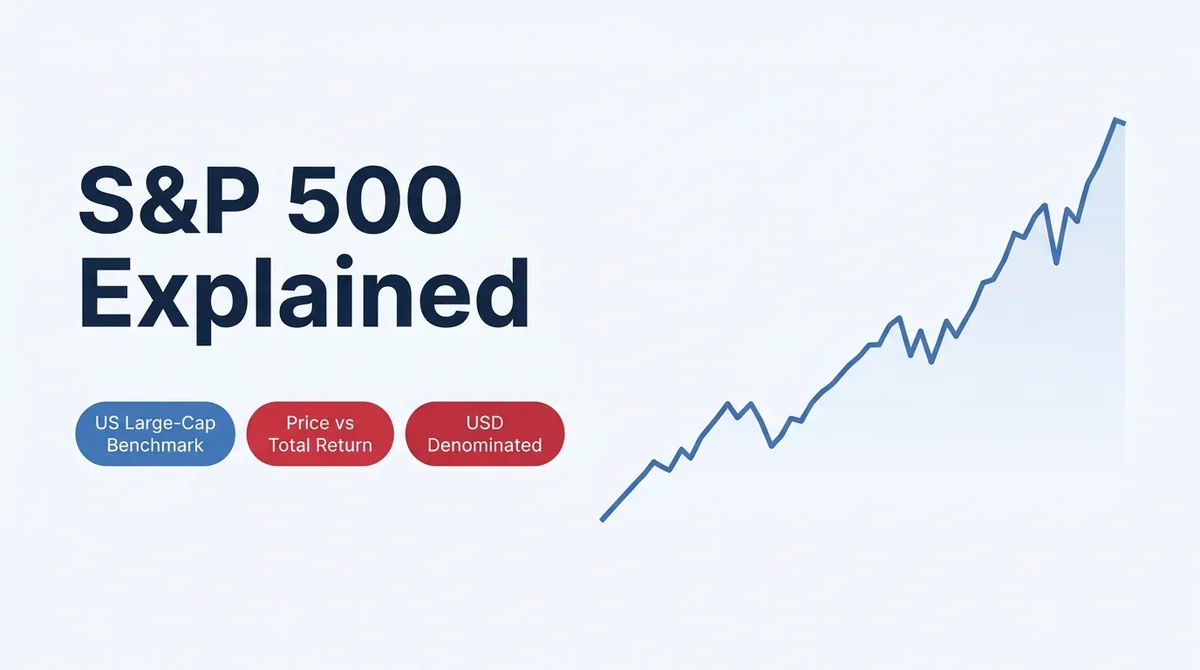
What the S&P 500 is, how it differs from Japan, UK and China A-shares, and four exposure routes: index funds, ETFs, derivatives and tokenized products.
Conclusion: The S&P 500 is a market-cap-weighted stock index covering large US listed companies, widely used as the benchmark for overall us stock market performance. For most individual investors, the first step is not asking "what to buy" but clarifying whether they need "asset ownership" or "price exposure."
#What kind of index is the S&P 500 and what does it measure?
The S&P 500 is a market-cap-weighted stock index covering large US listed companies, widely used as the representative benchmark for overall us stock market performance.
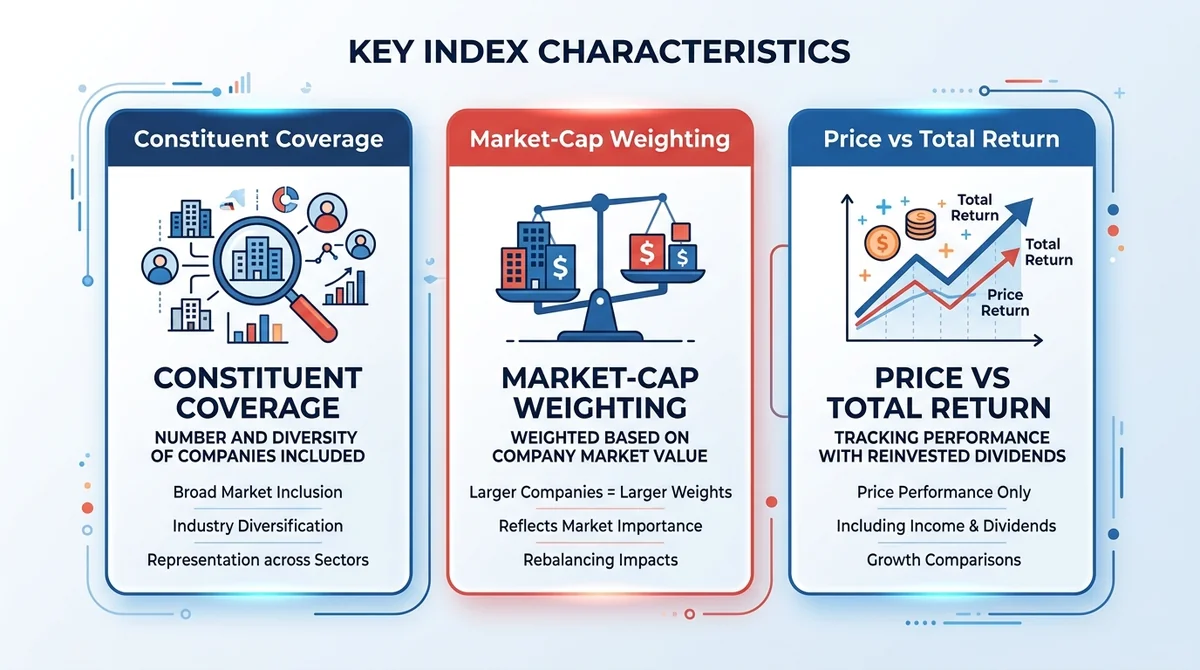
Constituent coverage: The index includes the large US listed company universe, not all listed companies, so it reflects the overall trend of the large-cap segment rather than the full picture of small and mid-sized businesses in the US economy. The specific constituent list and adjustment rules are published by the index provider; this article does not name them individually to avoid citing an outdated list.
Weighting method: Market-cap weighting means the larger a company's market cap, the greater its influence on the index level. The direct consequence is that index performance is more sensitive to top companies, and volatility in top-weighted stocks noticeably amplifies index volatility.
Price index vs. total return index: This is a commonly confused point. The widely quoted S&P 500 level usually refers to the price index, which excludes dividend reinvestment; constituent dividends create a gap versus the total return measure. So when comparing "index gains" with "the fund return you actually receive," a dividend and fee gap naturally exists. Specific dividend yield data could not be publicly verified for this article and is marked as data not disclosed.
Why it is seen as representative of the us stock market: Because it covers the large-cap US company universe and is used by many funds, ETFs and derivatives as a performance benchmark and tracking target, forming a complete "benchmark—product—derivative" ecosystem with the highest citation rate.
#How does the S&P 500 differ from Japanese, UK and China A-share markets?
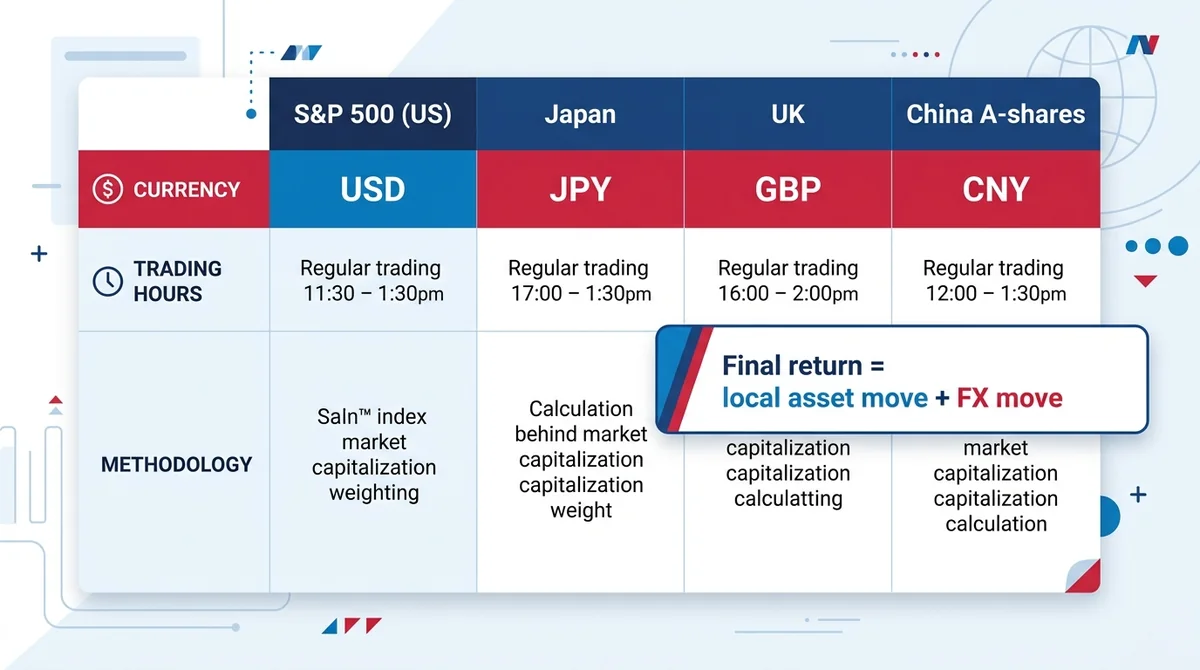
The S&P 500 corresponds to the US market and differs from Japanese, UK and China A-share markets in constituent structure, trading hours,计价 currency and regulatory environment. Cross-market allocation introduces additional currency and time-zone risks.
Constituents and sector structure: The listed company composition, sector distribution and market-cap concentration differ across the four markets, and index methodologies differ too (some are cap-weighted, some apply free-float adjustments or differ in constituent count). This means that "large-cap indices" are not equivalent in sector exposure and cannot be compared simply by index point gains.
Trading hours: The US, Japanese, UK and China A-share markets trade in different time zones with limited overlap. For cross-market investors this creates two practical issues: first, the same news is priced in at different times across markets; second, tokenized or OTC products may still quote while the underlying market is closed, creating price discovery gaps.
Denomination currency and FX exposure: The S&P 500 is denominated in USD, Japanese stocks in yen, UK stocks in pounds and A-shares in RMB. For non-USD investors holding US assets, the final return = local-currency asset move + FX move, which may align or offset each other. This is often underestimated in cross-market allocation.
Liquidity and regulatory differences: Trading mechanisms, price limits, settlement cycles, disclosure requirements and investor suitability rules differ across markets. Cross-market allocation means bearing the rule risks of two markets, not one.
#How can ordinary investors gain S&P 500 exposure?
Ways to gain S&P 500 exposure include index funds, ETFs, derivatives and tokenized products. Funds and ETFs are closer to asset ownership, while derivatives and tokenized products provide only price exposure.
Index funds and ETFs: indirect ownership. Investors subscribe to fund shares, and the fund holds the constituents. Advantages are low barriers, diversification and no need to handle constituent changes yourself; costs are management fees, tracking error, and the fact that fund shares are not equivalent to stock shareholder status. Specific fee and tracking error figures vary by product and could not be verified for this article, marked as data not disclosed.
Derivatives: betting only on direction. Futures, options and CFDs provide price exposure without ownership of the underlying asset. Holding derivatives involves margin, rollover, how does perpetual futures funding rate work, or time-value decay costs, and the long-term cost structure is completely different from holding spot.
Tokenized products: price exposure, not real US stocks. Tokenized stock products quote and settle on-chain and provide exposure to the underlying stock price, usually without shareholder status or voting rights; treatment of corporate actions (splits, dividends, mergers) depends on the issuer's rules. For differences between direct ownership and tokenized stocks on corporate actions and dividend reinvestment, see MSX Compare's dedicated comparison.
Cost and risk overview: Fund/ETF costs are mainly explicit management fees and implicit tracking error; derivative costs are funding costs and rollover decay; tokenized product costs include platform fees, on-chain costs and issuer credit risk. The three routes have different risk sources and cannot be judged by headline fee levels alone.
#Which investors should focus on the S&P 500, and which should not?
Investors seeking to diversify single-market risk, able to tolerate FX volatility and holding for longer periods are better suited to the S&P 500; short-term traders or those unable to tolerate FX volatility should be cautious.
Suitable groups: Investors already concentrated in a single market who want different market exposure; those with longer holding periods who can tolerate interim volatility; those who accept FX as a component of returns rather than a distraction.
Groups needing caution: Investors unable to tolerate FX volatility and not planning to hedge; short-term traders focused on session continuity and perpetual futures leverage tools; and investors who mistake "tokenized stocks" for "real share ownership."
Decision routing:
- If you are a long-term allocator who just wants low-cost market average: prioritize broad-based index funds or ETFs, focusing on fees, tracking error and scale.
- If you already hold substantial US assets and want to reduce single-market concentration: focus on cross-market diversification rather than adding more to the same market.
- If you only want directional trading and do not plan to hold long-term: derivatives or perpetual-style instruments better fit the need, but first understand how does perpetual futures funding rate work and liquidation rules.
- If you operate in an on-chain environment and need 7×24 quotes: tokenized products are an option, but first confirm the issuer, redemption mechanism and corporate action rules.
- If you cannot tolerate FX volatility: include hedging costs in comparisons or reduce the market weight.
Action checklist:
- Clarify whether the goal is long-term holding or directional trading, which determines the instrument category.
- If choosing funds/ETFs, check fees, tracking error, scale and premium/discount.
- If choosing derivatives, check margin rules, how does perpetual futures funding rate work and liquidation mechanisms.
- If choosing tokenized products, check issuer qualifications, redemption paths and corporate action treatment.
- Calculate the FX exposure share and judge whether hedging is needed and its cost.
- Confirm trading hours and quote risk when the underlying market is closed.
- Record the data cutoff date to avoid decisions based on outdated data.
#What risks should you watch when following the S&P 500?
Risks include constituent concentration, FX volatility and trading-hour mismatch, and tokenized stock products are only price exposure, different from holding real US stocks.
Concentration risk: Cap weighting gives top companies high weight, making index performance sensitive to a few large caps. When top sectors de-rate, index-level drawdowns may exceed the median constituent drawdown.
FX risk: Non-USD investors' actual returns include FX moves. A weaker dollar may erode local-currency returns, while a stronger dollar may amplify them; direction cannot be assumed.
Session mismatch and liquidity risk: Cross-market or on-chain products may lack quote depth while the underlying market is closed, raising slippage and spread risk.
Risks specific to tokenized products: Including issuer credit risk, smart contract risk, redemption restrictions, and treatment of corporate actions (dividends, splits) on-chain that differs from direct ownership.
Valuation basis risk: When citing index levels, confirm whether it is the price index or total return index, otherwise actual holding returns may be overstated or understated.
#FAQ
Q1: Is the S&P 500 a price index or a total return index? A: The widely quoted level is usually the price index basis, excluding dividend reinvestment; the total return basis includes constituent dividends. When comparing actual fund returns, use the total return basis or look directly at fund NAV.
Q2: Does buying an S&P 500 ETF equal holding US stocks? A: Not equivalent. ETF shares represent an interest in fund assets, and the fund holds the constituents; investors are not directly registered as constituent shareholders and do not directly exercise voting rights.
Q3: What is the core difference between tokenized stocks and real US stocks? A: The core difference lies in equity attributes and corporate action treatment. Tokenized products usually provide only price exposure; shareholder status, voting rights and dividend treatment depend on issuer rules, with additional platform and contract risks.
Q4: What extra risks does cross-market S&P 500 allocation carry? A: Mainly FX exposure, trading-hour mismatch, and operational risks from different market regulation and settlement rules.
Q5: What are the data sources for this article? A: This article is based only on public index definitions and market structure information; specific fees, dividend yields, valuation multiples and other figures lacked verifiable sources and are marked as data not disclosed.
This content is compiled from public data and does not constitute investment or open account advice. Data as of 2026-01-01; actual conditions may change. To verify the latest rules, check the index provider and official sources for the relevant products.
FAQ
Is the S&P 500 a price index or a total return index?
The widely quoted level is usually the price index basis, excluding dividend reinvestment; the total return basis includes constituent dividends. When comparing actual fund returns, use the total return basis or look directly at fund NAV.
Does buying an S&P 500 ETF equal holding US stocks?
Not equivalent. ETF shares represent an interest in fund assets, and the fund holds the constituents; investors are not directly registered as constituent shareholders and do not directly exercise voting rights.
What is the core difference between tokenized stocks and real US stocks?
The core difference lies in equity attributes and corporate action treatment. Tokenized products usually provide only price exposure; shareholder status, voting rights and dividend treatment depend on issuer rules, with additional platform and contract risks.
What extra risks does cross-market S&P 500 allocation carry?
Mainly FX exposure, trading-hour mismatch, and operational risks from different market regulation and settlement rules.
What are the data sources for this article?
This article is based only on public index definitions and market structure information; specific fees, dividend yields, valuation multiples and other figures lacked verifiable sources and are marked as data not disclosed.
Related Terms
Read the review? Ready to try a small position?
The crypto assets and tokenized US stocks/ETFs covered here are available on MSX — spot and perpetuals.
Quick Start Trading →New here? Registration takes three quick steps.