Students Allocating Small Amounts: Tokenized US Stocks vs RWA — How to Choose
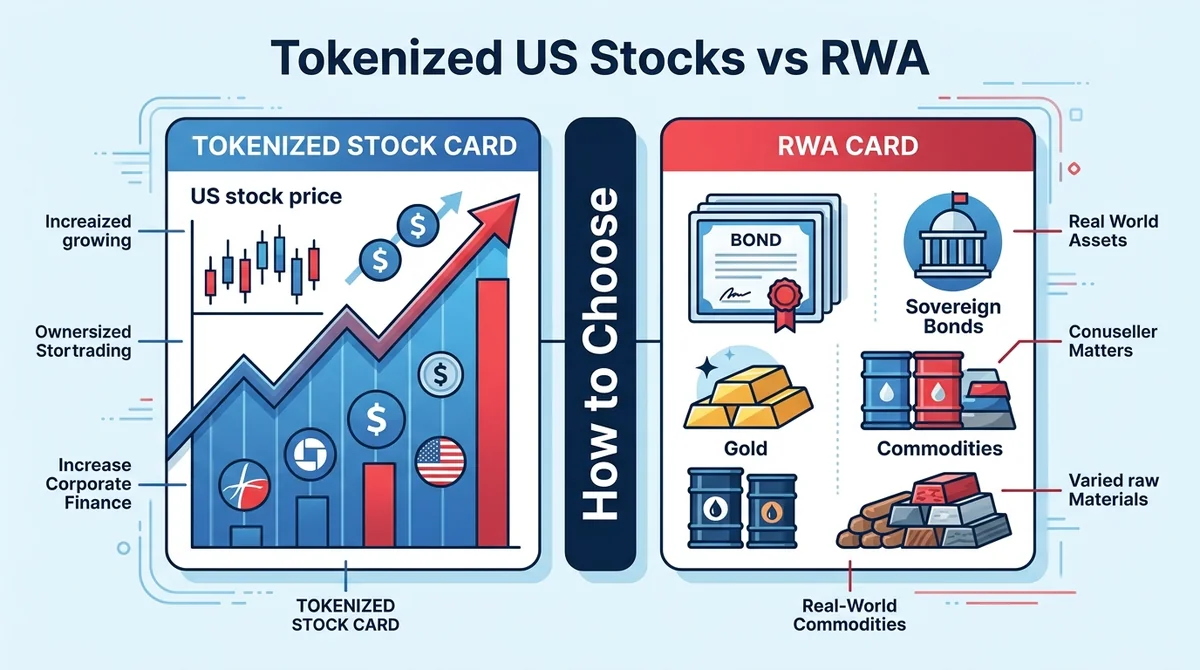
How students with small capital can tell tokenized US stocks apart from RWA across underlying assets, price sources, liquidity, costs and disclosure.
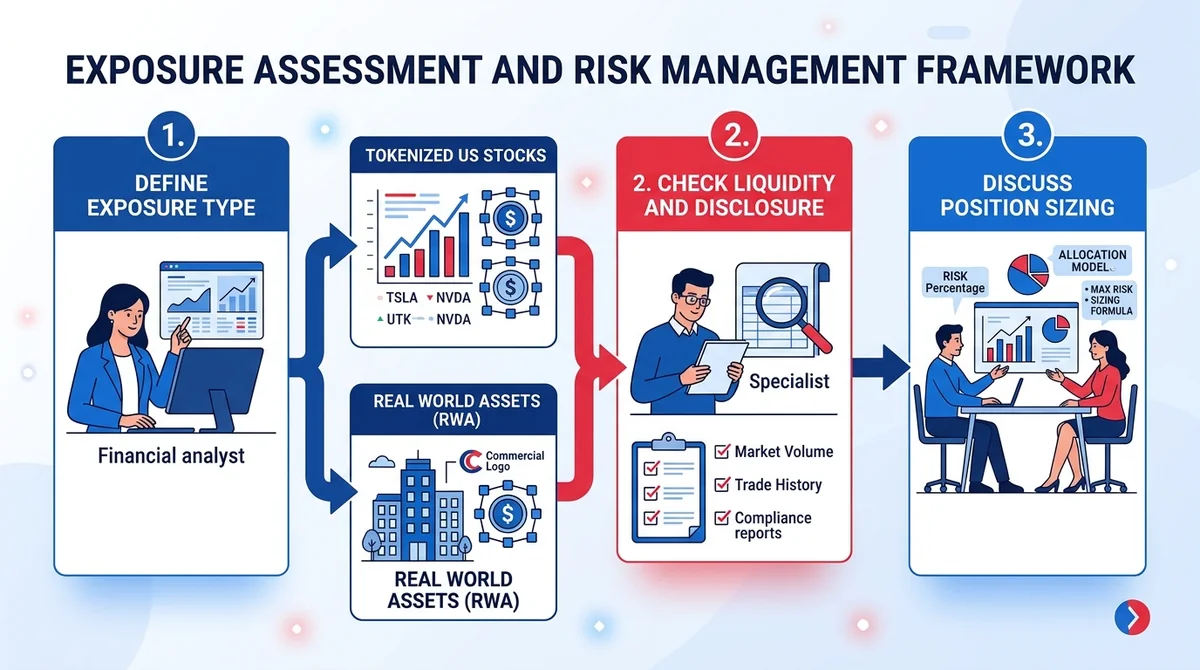
Conclusion: If your goal is exposure to US stock prices, look at tokenized stocks first; only if your goal is exposure to non-equity real-world assets should you look at RWA. Neither gives you direct ownership of the underlying asset. When students allocate small amounts, they should first define the type of exposure, then check liquidity and issuer disclosure, and only then discuss position sizing.
#What exactly is the difference between tokenized stocks and RWA?
Tokenized stocks provide US stock price exposure, while RWA provides on-chain real-world asset exposure. Neither gives you direct ownership of the underlying asset itself.
#What asset exposure does each represent?
Tokenized stocks correspond to the price movement of a single US stock or a basket of US stocks; they track US market quotes and usually carry no shareholder status, voting rights, or similar entitlements. The underlying assets of RWA vary widely and may be bonds, funds, commodities, or receivables-type assets, depending on the issuer's design, so each RWA product requires separate verification of its underlying asset composition.
#What is the relationship between the token price and the underlying asset price?
The US stock price is the cause; the token price is the effect. In theory the token price is pegged to the underlying asset price, but in actual trading it may deviate due to insufficient liquidity, restricted redemption channels, or issuer mechanism design; when public data on the deviation is lacking, it cannot be quantified. The price source for RWA depends more on the underlying asset's valuation method and the issuer's disclosure frequency, and transparency varies by product.
#How do the two compare on key dimensions for student small-amount allocation?
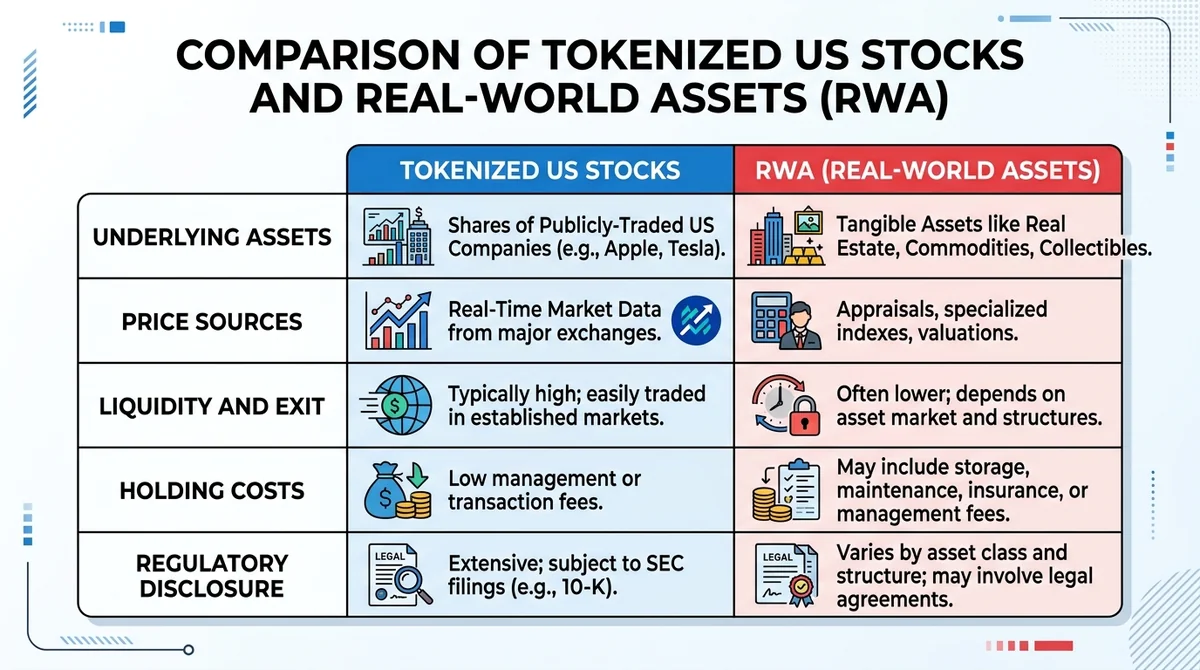
Comparing tokenized stocks with RWA should look at five dimensions: underlying assets, price sources, liquidity, holding costs, and regulatory disclosure — not just names or marketing language.
#How do underlying assets and price sources differ?
The underlying assets of tokenized stocks point to US stock targets, and the price source is public US market quotes, which can be cross-verified; RWA's underlying asset types vary, and the price source is the underlying asset valuation plus issuer disclosure, making verification harder.
#How should liquidity and exit methods be compared?
The liquidity of tokenized stocks depends on the trading platform's order depth and trading-hour coverage, and the exit path is usually selling on the secondary market; RWA liquidity varies more widely, and some products have redemption windows or lock-up periods, so the exit path may be redemption rather than immediate sale. For products whose depth and redemption cycle are not public, assess them under the most conservative scenario.
#Where do holding costs and settlement methods differ?
The costs of tokenized stocks usually include trading fees and possible on-chain settlement costs; RWA costs may include management fees, redemption fees, and issuer fees. The fee structures differ, so verify each product item by item, and do not assume unpublished fee items are zero-cost.
#What is the level of regulatory and compliance disclosure?
Tokenized stock information disclosure mainly centers on the underlying US stock targets and platform mechanisms; RWA disclosure centers on underlying assets, custody arrangements, and redemption terms. Disclosure granularity varies by issuer, so students allocating small amounts should prioritize products with readable disclosure documents and clear terms.
#With small capital, what kind of student is suited to tokenized stocks?
If the goal is to gain US stock price exposure with a small amount, tokenized stocks are the more direct choice, but they are not equivalent to real shareholding and usually carry no shareholder rights.
#How should you allocate if you want to track US stock trends?
First clarify whether you are tracking a single target or a broad-based direction, then check the platform's tradable targets and minimum order size. With small capital, single-target concentration can easily be amplified passively, so set a cap on the share of funds per target in advance. Price volatility comes from US stocks, and the token price is the result; do not treat short-term token price deviations as an independent signal.
#Why can't it replace real shareholding?
Tokenized stocks usually carry no shareholder rights, and corporate actions and dividend handling may differ from direct shareholding, depending on the issuer and platform terms. If the purpose of allocation is to obtain shareholder status or participate in corporate governance, tokenized stocks are not suitable.
#What kind of student small-amount allocation needs is RWA suited to?
Only when the allocation goal is non-equity real-world asset exposure rather than stock price exposure should you prioritize RWA, and you must first understand the underlying assets and redemption mechanism.
#When should you prioritize RWA?
When the goal is clearly non-equity asset exposure and you can accept differences in redemption cycles and disclosure frequency, RWA enters the candidate list. If the goal itself is US stock price exposure, using RWA as a substitute is a goal mismatch.
#How do you judge whether an RWA's underlying assets are understandable?
Check three things: what the underlying asset is, who provides custody, and how the redemption terms are triggered. If any of the three cannot be confirmed from public disclosure, treat it as not understandable and do not allocate.
#What risks should students avoid in small-amount allocation?
The core risks of student small-amount allocation in tokenized stocks or RWA are concentration, price decoupling, liquidity, and issuer credit, all of which must be assessed before allocating.
#Why are concentration and position sizing most critical?
With small capital, the share of a single allocation is easily amplified, and the impact of a single target's volatility on overall funds is more direct. Use a position cap to constrain first, then consider the number of targets.
#What extra risks do tokenized products carry?
These include possible decoupling of token price from the underlying asset price, liquidity and exit-channel risk, and issuer and custodian credit risk. These risks do not disappear because the amount is small; they simply surface concentrated at exit.
Action checklist:
- First write down the allocation goal: US stock price exposure or non-equity asset exposure.
- Screen product types by goal; do not compare yields across types.
- Verify whether the underlying assets, price sources, and disclosure documents are readable.
- Verify the exit path: secondary market sale or redemption, and whether there is a lock-up period.
- Verify all fee items; estimate unpublished ones conservatively.
- Set a cap on the share of funds per target.
- Record the allocation rationale and review date.
FAQ
Q: Does a tokenized stock equal holding real US stocks? A: No. It provides US stock price exposure and usually carries no shareholder rights; corporate actions and dividend handling may differ from direct shareholding.
Q: Which type should small capital choose first? A: Look at the goal first. If the goal is US stock price exposure, look at tokenized stocks first; only if the goal is non-equity real-world asset exposure should you look at RWA.
Q: Is RWA yield higher than tokenized stocks? A: They cannot be compared that way. The two have different underlying asset types and different return structures, and should be evaluated separately; historical data does not represent the future.
Q: Can the token price decouple from the underlying asset price? A: It is possible, mainly due to insufficient liquidity, restricted redemption channels, or differences in mechanism design; when public data on the specific deviation is lacking, it cannot be quantified.
This content is compiled from public information and does not constitute investment or account-opening advice. No specific fee rates, yields, or platform data are cited; please refer to the platform's official disclosure for product mechanisms and fees, and note that information may change over time.
FAQ
Does a tokenized stock equal holding real US stocks?
No. It provides US stock price exposure and usually carries no shareholder rights; corporate actions and dividend handling may differ from direct shareholding.
Which type should small capital choose first?
Look at the goal first. If the goal is US stock price exposure, look at tokenized stocks first; only if the goal is non-equity real-world asset exposure should you look at RWA.
Is RWA yield higher than tokenized stocks?
They cannot be compared that way. The two have different underlying asset types and different return structures, and should be evaluated separately; historical data does not represent the future.
Can the token price decouple from the underlying asset price?
It is possible, mainly due to insufficient liquidity, restricted redemption channels, or differences in mechanism design; when public data on the specific deviation is lacking, it cannot be quantified.
Related Terms
Read the review? Ready to try a small position?
The crypto assets and tokenized US stocks/ETFs covered here are available on MSX — spot and perpetuals.
Quick Start Trading →New here? Registration takes three quick steps.