tokenized U.S. Treasuries
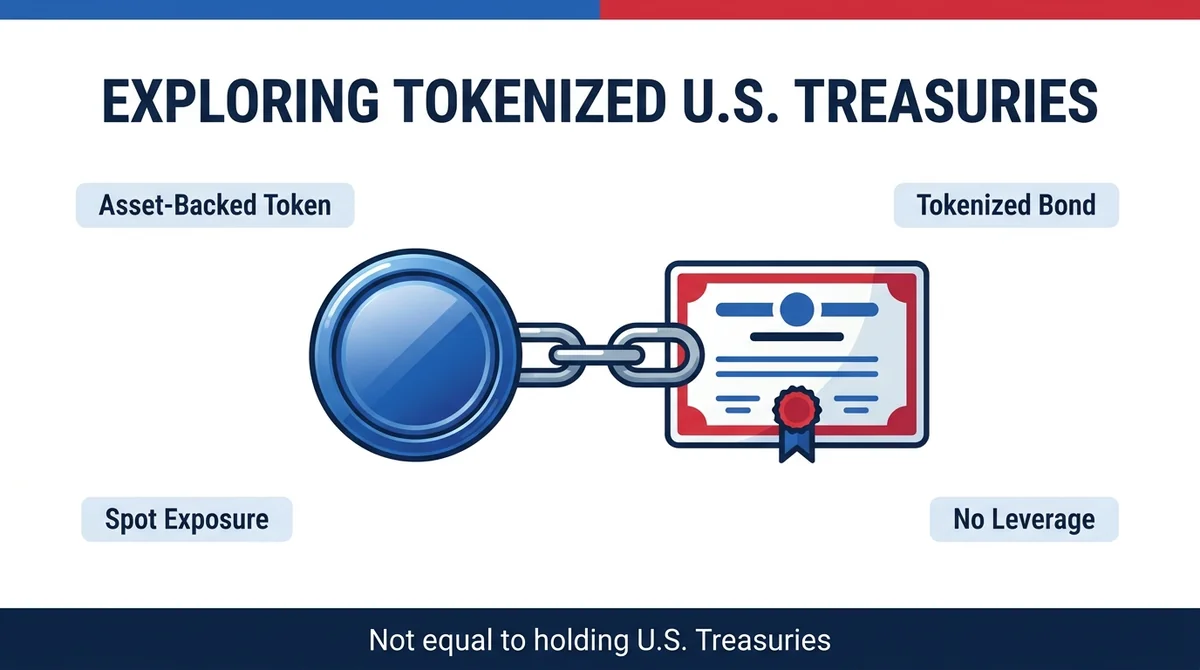
Tokenized US Treasuries are asset-backed tokens in the tokenized bond category. Compare their exposure, leverage, and redemption vs stocks, gold, silver, and crude oil.
Conclusion: Tokenized U.S. Treasuries are asset-backed tokens that bring U.S. Treasury-related exposure on-chain, falling under the broader tokenized bond category. They provide price exposure, are not equivalent to directly holding U.S. Treasuries, and carry no perpetual futures leverage. Whether they suit you depends on whether you want bond-type exposure, equity-type exposure, or commodity-type exposure, and whether you can accept issuer and custody fee dependencies.
#What Are Tokenized U.S. Treasuries and What Asset Class Do They Belong To?
Tokenized U.S. Treasuries (tokenized treasury) sit at the intersection of asset-backed tokens and tokenized bond in classification: the token is linked in some form to U.S. Treasury-related exposure and circulates on-chain as a token.
#What Is the Underlying of Tokenized U.S. Treasuries?
The underlying points to U.S. Treasury-related exposure. Whether this is direct bond holding, indirect holding through a fund/SPV, or mapping via another collateral structure depends on project disclosures. This article did not obtain specific project data on underlying holdings, custodians, or audit reports; the relevant fields are data not publicly available.
#Are They Asset-Backed Tokens or Tokenized Bonds?
Both are true, just from different angles: from an issuance structure perspective, they are asset-backed tokens; from an exposure perspective, they belong to tokenized bond. To judge which category a specific token falls into, look at whether it maps interest rate exposure, share price exposure, or commodity price exposure—not its name.
#Does Holding the Token Equal Holding U.S. Treasuries?
No. Holding the token gives you price exposure, not necessarily a real bond-holding relationship, and not necessarily the legal status and rights of a U.S. Treasury holder. Underlying assets, custody fee arrangements, and redemption mechanisms are all subject to project disclosures; when disclosures are missing, treat it as unknown risk rather than assuming safety.
#How Do Tokenized U.S. Treasuries Differ from Tokenized Bonds, Stocks, Gold, and Crude Oil?
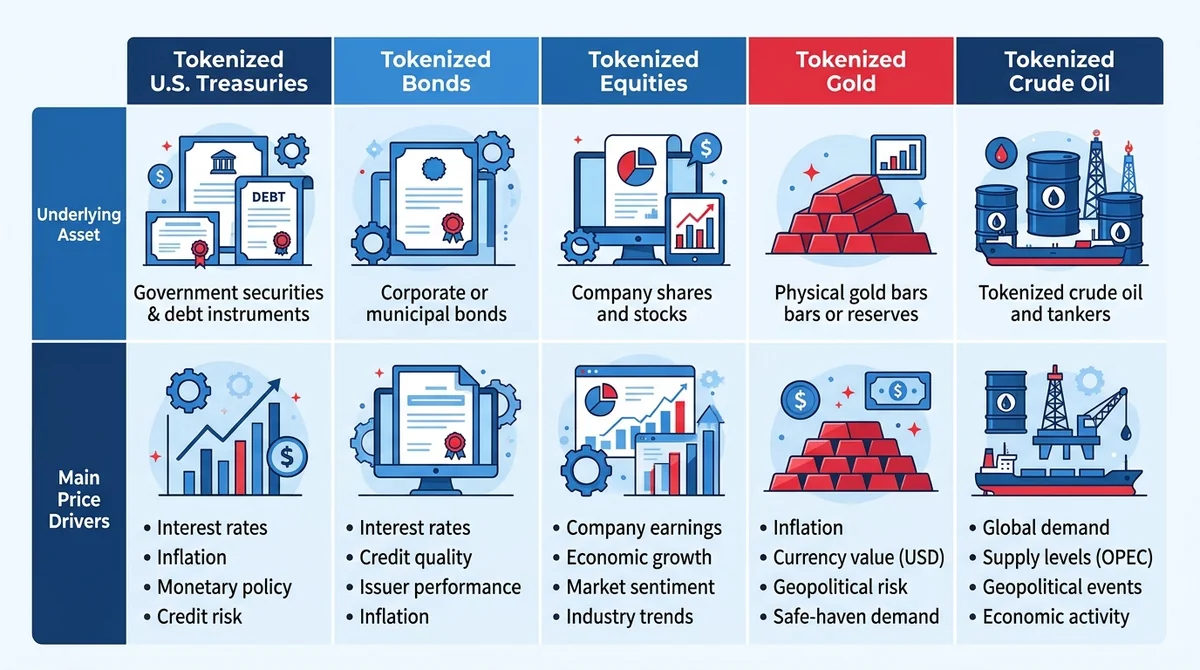
The core differences come down to two things: what the underlying asset is, and whether the exposure type is spot or derivative.
#What Are the Underlying Assets?
- Tokenized U.S. Treasuries: U.S. Treasury-related exposure
- Tokenized bond: bond exposure, with price drivers being interest rates and credit
- Tokenized equities: stock price exposure
- Tokenized commodities (tokenized gold / tokenized silver): precious metals prices
- Tokenized commodities (tokenized crude oil): commodity prices
#How Do the Sources of Price Exposure Differ?
Bond-type tokens are driven by interest rates and credit spreads; equity-type tokens by company earnings and valuation; precious metal tokens by gold and silver prices; crude oil tokens by supply-demand and geopolitical factors. The driving factors of these four asset classes usually have low correlation, which is the practical reason for distinguishing them in multi-asset allocation; but correlations change with the macro environment and are not constant.
#What Is the Difference Between Spot-Type Tokens and Perpetual Contract-Type Tokens?
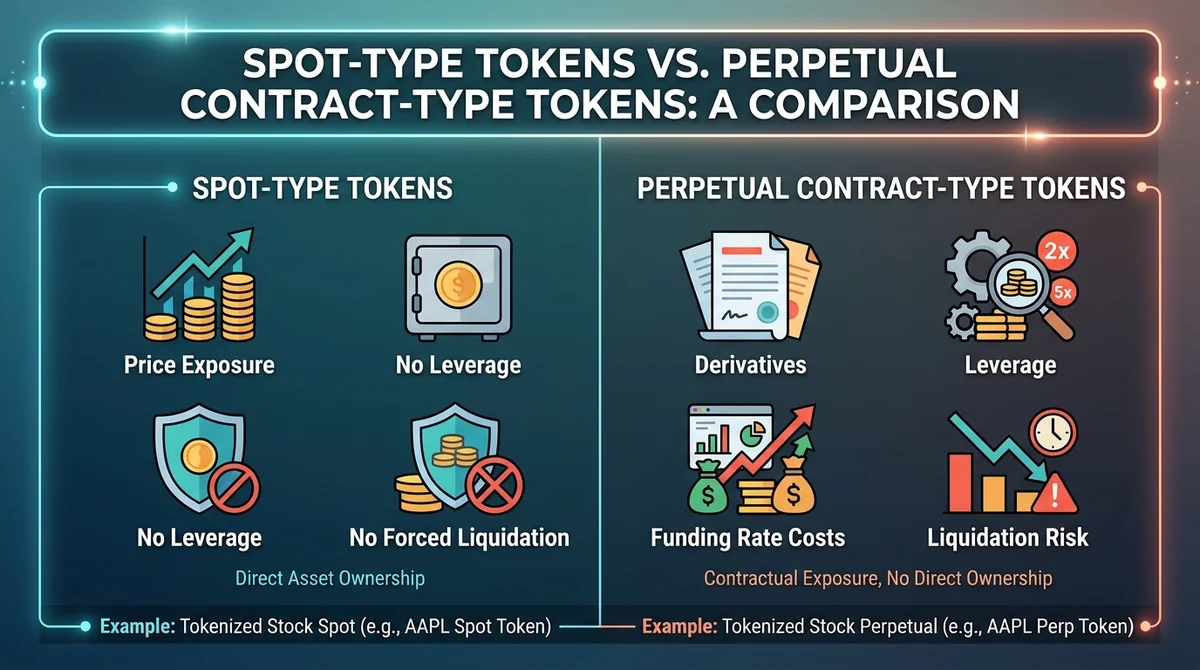
Spot-type tokens are price exposure with no leverage and no forced liquidation mechanism (unless the project stipulates otherwise); perpetual contract-type tokens are derivatives with perpetual futures leverage, funding rate costs, and liquidation risk. Tokenized stock spot and tokenized stock perpetual are typical examples of this divide: the former tracks the share price, the latter is a leveraged bet on the share price.
#How Far Are Tokenized Stocks and Tokenized Stock Perpetuals from Real U.S. Stocks?
#Are Tokenized Stocks Real U.S. Stocks?
No. Tokenized stock spot only provides U.S. stock price exposure, does not constitute shareholder status, does not necessarily carry voting rights, and corporate actions and dividend handling depend on project rules. This difference is most evident in the comparison between direct shareholding and tokenized stocks.
#Why Are Tokenized Stock Perpetuals Derivatives?
Because they do not deliver the underlying asset but bet on price direction via contracts, with added leverage, funding rates, and forced liquidation mechanisms. The risk structure of tokenized stock perpetuals is closer to contract trading than to shareholding.
#What Is the Relationship Between U.S. Stock Prices and Token Prices?
U.S. stock prices are the cause; token prices are the effect. Token prices track the underlying share price, not the other way around. Any interpretation that treats token price fluctuations as a pricing signal for U.S. stocks reverses the causal direction.
#What Kind of Users Are Suited to Follow Assets Like Tokenized U.S. Treasuries?
Suitable users: those who want on-chain bond-type price exposure, do not need leverage, and can accept issuer and custody fee dependencies. Unsuitable users: those who need shareholder rights, need two-way leveraged trading, or cannot verify redemption terms.
#Scenario Routing
- If you want bond-type exposure and do not need leverage → follow tokenized U.S. Treasuries and tokenized bond, focusing on verifying the underlying and redemption terms
- If you want stock price exposure → follow tokenized stock spot, not perpetuals
- If you want precious metals or commodity exposure → follow tokenized commodities, silver, and crude oil, noting their different drivers from bonds
- If you need leverage and two-way trading → only then consider perpetual-type products, and first calculate the funding rate and liquidation line
- If you must have shareholder status or legal bondholder rights → tokenized products do not meet this need; use traditional channels
#Action Checklist
- Confirm which type of exposure you need (interest rate / share price / commodity)
- Review the project's disclosed underlying assets and custody fee arrangements; mark missing items as unknown
- Verify the redemption mechanism, redemption thresholds, and settlement timing
- Distinguish spot-type from perpetual-type, and confirm whether leverage and forced liquidation exist
- Check the liquidity depth of the token in the secondary market
- Confirm local compliance and availability
- Record the data cutoff date to avoid making judgments based on outdated disclosures
#FAQ
Q1: Are tokenized U.S. Treasuries considered bonds or stablecoin-like assets? A: From an exposure perspective, they are a tokenized bond; from an issuance structure perspective, they are asset-backed tokens. The key difference from stablecoins is whether the price floats: bond-type tokens track interest rate exposure, their prices fluctuate, and they are not equivalent to a payment instrument pegged to $1.
Q2: Can I receive coupon payments from holding tokenized U.S. Treasuries? A: It depends on project terms. Whether coupons are passed through, in what form, and whether reinvested are all subject to project disclosures; this article did not obtain specific project data, and the relevant fields are data not publicly available.
Q3: Which is riskier, tokenized stock perpetuals or tokenized stock spot? A: Perpetual-type is riskier. It adds perpetual futures leverage, funding rates, and forced liquidation mechanisms, so losses can be amplified; spot-type only bears price fluctuation risk.
Q4: Why compare bonds, stocks, gold, and crude oil together? A: Because their price drivers differ and correlations are usually low. Distinguishing underlying assets and exposure types is the first step in judging what risk a token actually carries.
Q5: What are the main risks of tokenized assets news? A: Issuer and custody fee dependencies, leverage and liquidation risk of perpetual-type products, and uncertainty around redemption and liquidity terms. All three need to be verified item by item; parts that cannot be verified should not be assumed risk-free.
This content is compiled from public information and qualitative analysis and does not constitute investment or open account advice. It does not cite specific project data on underlying holdings, custodians, or redemption terms; the relevant fields are subject to official project disclosures. Data as of 2026-01-01; actual conditions may change.
FAQ
Are tokenized U.S. Treasuries considered bonds or stablecoin-like assets?
From an exposure perspective, they are a tokenized bond; from an issuance structure perspective, they are asset-backed tokens. The key difference from stablecoins is whether the price floats: bond-type tokens track interest rate exposure, their prices fluctuate, and they are not equivalent to a payment instrument pegged to $1.
Can I receive coupon payments from holding tokenized U.S. Treasuries?
It depends on project terms. Whether coupons are passed through, in what form, and whether reinvested are all subject to project disclosures; this article did not obtain specific project data, and the relevant fields are data not publicly available.
Which is riskier, tokenized stock perpetuals or tokenized stock spot?
Perpetual-type is riskier. It adds perpetual futures leverage, funding rates, and forced liquidation mechanisms, so losses can be amplified; spot-type only bears price fluctuation risk.
Why compare bonds, stocks, gold, and crude oil together?
Because their price drivers differ and correlations are usually low. Distinguishing underlying assets and exposure types is the first step in judging what risk a token actually carries.
What are the main risks of tokenized assets news?
Issuer and custody fee dependencies, leverage and liquidation risk of perpetual-type products, and uncertainty around redemption and liquidity terms. All three need to be verified item by item; parts that cannot be verified should not be assumed risk-free.
Related Terms
Read the review? Ready to try a small position?
The crypto assets and tokenized US stocks/ETFs covered here are available on MSX — spot and perpetuals.
Quick Start Trading →New here? Registration takes three quick steps.