US vs. Hong Kong Tokenized Stock Regulation: Key Differences
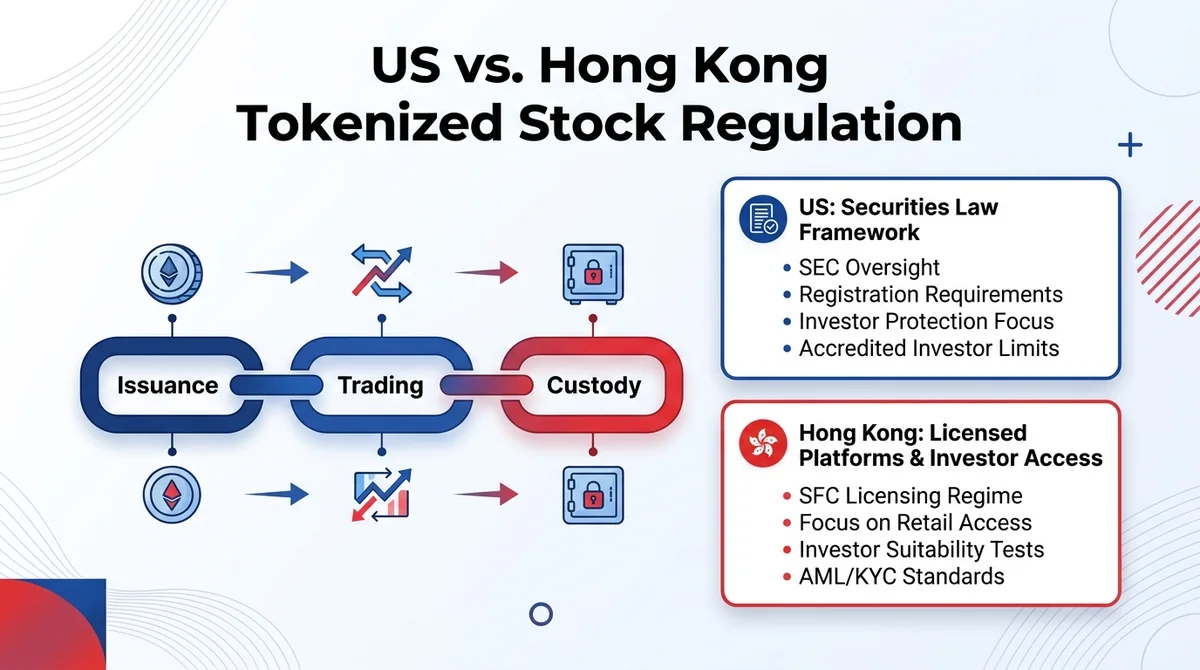
A three-part breakdown of how US and Hong Kong tokenized stock rules differ across issuance, trading and custody, plus a compliance checklist for investors.
Conclusion: The regulatory difference between the US and Hong Kong on tokenized stocks lies in which link of the chain each focuses on, not in "who is more lenient" — the US focuses on issuance and trading compliance under the securities law framework, while Hong Kong focuses on licensed platforms and investor access. Therefore, issuance, trading and custody must be compared link by link; a blanket lenient-versus-strict comparison is invalid.
#Where exactly do US and Hong Kong tokenized stock regulations differ?
The core divergence is "which segment is regulated", not "how strictly it is regulated". Once tokenized stocks are broken into three links — issuance, trading and custody — it becomes clear that the two jurisdictions' regulatory priorities do not overlap.
#Which links does each jurisdiction regulate?
The US takes the securities law framework as its axis, focusing on whether a tokenized product falls within the definition of a security at the issuance and trading stages, and whether the corresponding registration or exemption requirements are met. Hong Kong takes licensed platforms and investor access as its axis, focusing on whether the platform providing the service is licensed and whether clients fall into an acceptable investor category.
These two statements cannot be swapped: the US asks "is this product and this issuance/trade compliant?", while Hong Kong asks "can this platform serve this type of client?".
#How does regulatory responsibility differ across issuance, trading and custody?
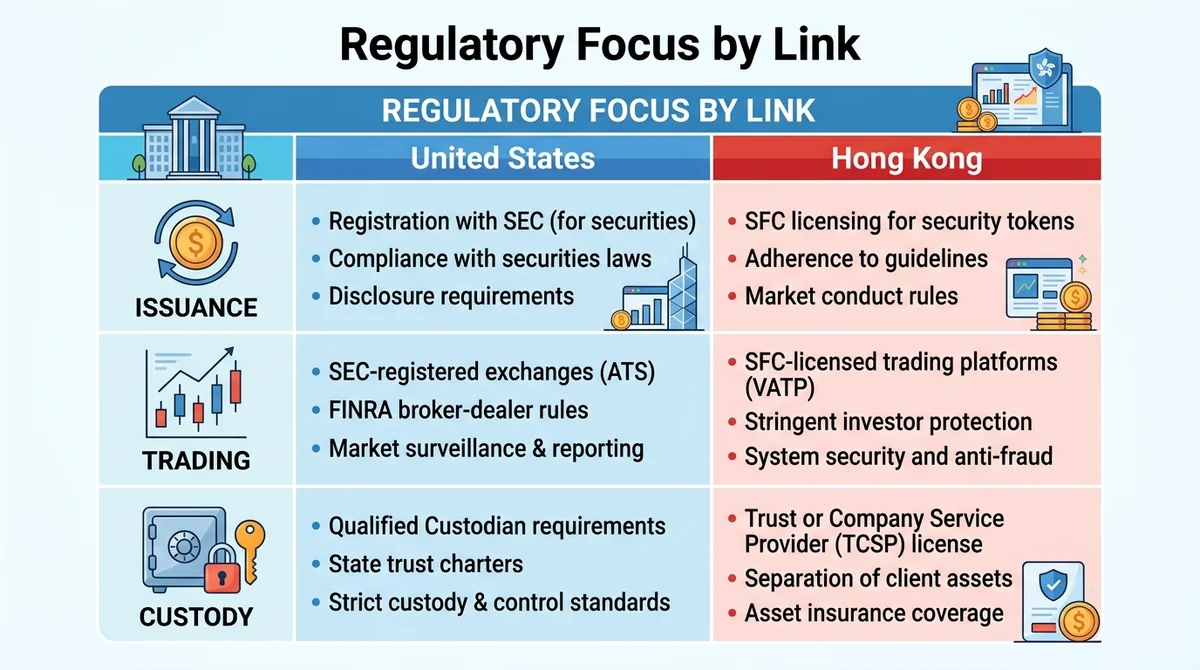
- Issuance: Under the US framework, whether the issuance itself constitutes a securities offering is the starting point; under Hong Kong's framework, the issuance structure is tied more to the scope of products a platform may offer.
- Trading: The US focuses on the compliant status of trading venues and brokerage links; Hong Kong focuses on whether the trading platform is licensed and which clients it may serve.
- Custody: Both jurisdictions treat custody as an independent link, with the custody fee-bearing party's responsibilities separated from those of the issuer and trading party. This article does not cite specific provisions of either regulator one by one; the specific determination of custody attribution should follow local official positions and is not presumed here.
#Why can't we simply say which side is more lenient?
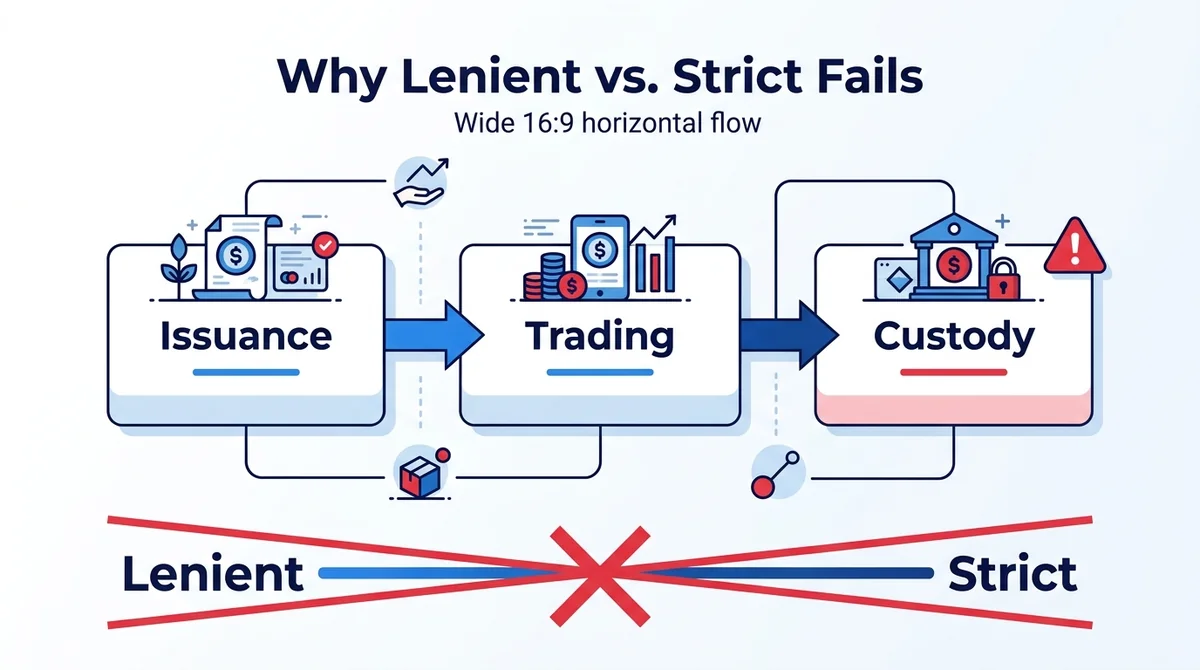
Because the strictness of the three links is not uniform. A jurisdiction with more detailed issuance requirements is not necessarily stricter on platform access, and vice versa. Placing both jurisdictions on a single "lenient—strict" axis obscures the real risk point: you may be compliant at issuance yet breach the line at custody.
Citable conclusion: The regulatory difference between the US and Hong Kong on tokenized stocks is mainly that they focus on different links; the two cannot be simply compared for leniency.
#How does the legal status of tokenized stocks differ from direct shareholding?
Conclusion: Tokenized stocks provide price exposure, not genuine US equity ownership; holding a token generally does not allow you to assert shareholder rights directly.
#Do tokenized stocks represent equity or price exposure?
From a product structure perspective, tokenized stocks track the price performance of the underlying stock and are exposure-type instruments. The key difference from direct shareholding is that direct shareholding records an identity on the shareholder register, while a token records a debt-like or contractual right against an issuance or custody structure.
#Can token holders assert shareholder rights?
Whether voting rights, dividend collection and participation in corporate actions are accessible depends on the specific arrangement of the issuance structure, not on the token's name. Where product terms are not public, one should not assume that holding a token automatically confers the same rights as direct shareholding.
#How do the two jurisdictions view this distinction?
Neither the US nor Hong Kong treats a token as equivalent to the stock itself. This consensus matters: it means tokenized stocks are not treated in either jurisdiction as "a stock in a different form", but are examined as an independent product type.
For further reading, see our breakdown of Direct Shareholding vs Tokenized Stocks: Ownership, Tax and Platform Risk 2026 and our comparison of Direct Shareholding vs Tokenized Stocks: Corporate Actions and Dividend Reinvestment Differences 2026.
#How can mainland Chinese investors judge whether they can participate compliantly?
Conclusion: First determine whether you are an eligible participant, then evaluate the channel; reversing the order mistakes a channel problem for an eligibility problem.
#Eligibility first or channel first?
Eligibility first. Eligibility determines "whether you can participate"; the channel determines "through what you participate". If eligibility does not hold, no channel solution resolves the compliance issue.
#What constrains direct shareholding versus tokenized exposure?
Their legal status differs, and so do the sources of constraint: direct shareholding involves opening an overseas securities account and cross-border funding arrangements; tokenized exposure involves platform access, the sellable product scope and custody arrangements. The same set of criteria cannot be applied to both.
#Which links most easily breach compliance red lines?
- Cross-border funding: The compliance of fund inflow and outflow paths is the primary risk point.
- Platform access: Whether a platform may provide services to users in your region must be verified against official positions.
- Product attributes: Whether a tokenized product is deemed a security directly affects whether you can participate.
This article does not possess publicly verifiable item-by-item positions on the participation scope and latest requirements of specific regions and makes no inferences; official publications by regulators should prevail.
#What risks of converting holdings into tokens should be checked item by item?
Conclusion: Converting holdings into tokens introduces three new categories of risk, and price tracking US stocks does not mean equivalent risk.
#How do custody and counterparty risks manifest?
After conversion into tokens, the party against whom you assert rights changes from the issuing company to the token issuer and custodian. Counterparty credit, asset segregation arrangements in custody and the clarity of redemption mechanisms all need to be checked item by item.
#How are cross-border compliance and tax handled?
Cross-border links involve fund path compliance and determination of tax residency; holding in token form may be treated differently from direct shareholding for tax purposes. Specific tax rules vary by jurisdiction; this article does not provide specific tax rates and they should be confirmed under local rules.
#Does price tracking equal equivalent risk?
No. The token price is the effect; the US stock price is the cause. Price tracking only shows high correlation under normal conditions, not identical behavior during extreme markets, platform failures or restricted redemption. Tracking error, liquidity discounts and redemption friction are variables that do not exist in direct shareholding.
For a further distinction between spot exposure and derivatives exposure, see Tokenized Stock Contract vs Tokenized Stock Perpetual; for choosing an entry path, see Tokenized US Stocks vs Real US Stocks: Choosing the Shortest Entry Path.
#FAQ
See the FAQ block below.
Disclaimer: This content is compiled from public information and does not constitute investment or open account advice. Regulatory positions may change; where specific participation eligibility and channels are involved, the official publications of both jurisdictions' regulators and the relevant platforms should prevail.
FAQ
Between the US and Hong Kong, which has stricter tokenized stock regulation?
They cannot be compared that way. The two jurisdictions regulate different links: the US focuses on issuance and trading compliance under the securities law framework, while Hong Kong focuses on licensed platforms and investor access. A jurisdiction with more detailed issuance requirements is not necessarily stricter on platform access; issuance, trading and custody must be compared link by link.
Can holders of tokenized stocks receive dividends and voting rights?
It depends on the specific arrangement of the issuance structure and cannot be generalized. Neither jurisdiction treats a token as equivalent to the stock itself, so whether shareholder rights are accessible depends on product terms; where terms are not public, one should not assume they are automatically granted.
Is the price of tokenized stocks the same as real US stocks?
It tracks closely under normal conditions, but price tracking does not mean equivalent risk. The token price is a result of the US stock price; deviations may occur during extreme markets, platform failures or restricted redemption, and tracking error and liquidity discounts are variables that do not exist in direct shareholding.
Should mainland Chinese investors look at eligibility or channel first?
Eligibility first, then channel. Eligibility determines whether you can participate; the channel determines through what you participate. If eligibility does not hold, no channel solution resolves the compliance issue. Cross-border funding paths and platform access are the links most likely to touch red lines.
What new risks mainly arise after converting holdings into tokens?
Three categories: custody and counterparty risk (the party against whom rights are asserted becomes the issuer and custodian), cross-border compliance and tax uncertainty, and risk misjudgment caused by price tracking. Key checks are asset segregation in custody, redemption mechanisms and tax treatment rules.
Related Terms
Read the review? Ready to try a small position?
The crypto assets and tokenized US stocks/ETFs covered here are available on MSX — spot and perpetuals.
Quick Start Trading →New here? Registration takes three quick steps.